Recent from talks
Contribute something
Nothing was collected or created yet.
Bonin Islands
View on WikipediaThe Bonin Islands, also known as the Ogasawara Islands (Japanese: 小笠原諸島), is a Japanese archipelago of over 30 subtropical and tropical islands located around 1,000 kilometers (620 mi) SSE of Tokyo and 1,600 kilometers (1,000 mi) northwest of Guam.[1][2] The group as a whole has a total area of 84 square kilometers (32 sq mi) but only two of the islands are permanently inhabited, Chichijima and Hahajima. Together, their population was 2,560 as of 2021. Administratively, Tokyo's Ogasawara Subprefecture also includes the settlements on the Volcano Islands and the Self-Defense Force post on Iwo Jima. The seat of government is Chichijima.
Key Information
Because of the Bonins' isolation, many of their animals and plants have undergone unique evolutionary processes. They have been referred to as the "Galápagos of the Orient" and were named a Natural World Heritage Site in 2011. When first reached during the early modern period, the islands were entirely uninhabited, although subsequent research has found evidence of some prehistoric habitation by Micronesians. Upon their repeated rediscoveries, the islands were largely ignored by the Spanish, Dutch, and isolationist Japanese until finally being claimed by a passing British captain in 1827. American, European, and Hawaiian colonists arrived from the Kingdom of Hawaii in 1830. Subsequently, Meiji Japan successfully colonized and reclaimed the islands in 1875, but Bonin Islanders' community continued up to World War II, when most islanders were forcibly relocated to Honshu. Following Japan's defeat, the US Navy occupied the island, bulldozing existing Japanese homes and restricting resettlement until full control of the Bonins was returned to Japan in 1968. Ethnically, the island is now majority Japanese but remains unusually diverse, which is reflected in the local Creole language known as Bonin English. Improved transportation has made agriculture more profitable and encouraged tourism, but the development required for an airport remains a contentious local issue.
Names
[edit]The name Bonin comes from an 1817 article in the French Journal des Savans by Jean-Pierre Abel-Rémusat in which—among various other misunderstandings of his source material[3]—he misread a description of the islands as uninhabited (無人嶋, "desert island[s]") for their actual name, used the wrong reading of the characters (buninshima for mujintō), and then transcribed the resulting reading incorrectly into French as Bo-nin Sima,[4][5] which eventually lost its original hyphen.
The name Ogasawara (小笠原; Japanese pronunciation: [ogasawaɾa]) literally means "little hat-shaped field(s)" but is used for the islands in honor of Ogasawara Sadayori (小笠原 貞頼), a supposed ancestor of the ronin Ogasawara Sadatō (小笠原 貞任) fictitiously credited with the discovery of the chain. Within Japanese, the Bonins proper are known as the "Ogasawara Islands" or "Group" (小笠原群島, Ogasawara-guntō) while the "Ogasawara Islands" or "Archipelago" (小笠原諸島, Ogasawara-shotō) is a wider term including the other islands of the Ogasawara Municipality (小笠原村, Ogasawara-mura) and its coterminous Ogasawara Subprefecture (小笠原支庁, Ogasawara-shichō)—namely, the Volcano Islands and three remote islands of Nishinoshima, Minamitorishima, and Okinotorishima. These islands are parts of Japan's Nanpō Islands.
The islands were also formerly known to Europeans as the Archbishop Islands (Spanish: Islas del Arzobispo), probably in honor of Pedro Moya de Contreras, archbishop of Mexico and viceroy of New Spain, who sent an expedition to the area in the late 16th century.[6]
History
[edit]Prehistory
[edit]At the end of the 20th century, prehistoric tools and carved stones were discovered on North Iwo Jima and Chichijima, establishing that the islands were previously home to at least some members of an unknown Micronesian people.[7]
Early modern period
[edit]The first recorded visit by Europeans to the islands happened on 2 October 1543, when the Spanish explorer Bernardo de la Torre on the San Juan sighted Haha-jima, which he charted as Forfana.[8] The islands were uninhabited at that time. Japanese discovery of the islands occurred in Kanbun 10 (1670) and was followed by a shogunate expedition in Enpō 3 (1675).[9] The islands were then referred to as Bunin jima (無人島, Buninjima), literally "the uninhabited islands". Shimaya Ichizaemon, the explorer at the order of the shogunate, inventoried several species of trees and birds, but after his expedition, the shogunate abandoned any plans to develop the remote islands.[10]
The first published description of the islands in the West was brought to Europe by Isaac Titsingh in 1796. His small library of Japanese books included Sangoku Tsūran Zusetsu (三国通覧図説, An Illustrated Description of Three Countries) by Hayashi Shihei.[11] This book, which was published in Japan in 1785,[12] briefly described the Ogasawara Islands.[13][14]
These groups were collectively called the Archbishop Islands in Spanish sources of the 18th–19th century, most likely due to an expedition organized by Pedro Moya de Contreras, archbishop of Mexico and viceroy of New Spain, to explore the northern Pacific and the islands of Japan. Its main objective was to find the long sought but legendary islands of Rica de Oro ("Rich in Gold"), Rica de Plata ("Rich in Silver"), and the Islas del Armenio ("Islands of the Armenian"). After several years of planning and frustrated initial attempts, the expedition finally set sail on 12 July 1587, commanded by Pedro de Unamuno. Even if it did revisit the Daitō Islands, already charted by Bernardo de la Torre in 1543, the expedition could not find the wanted islands after searching the positions where they were charted in contemporary references.[6] Japanese maps at the time seem to have been rather inaccurate, to the point that some contemporaries considered them to have been deliberately misleading[15] to discourage colonization attempts by foreign nations. Frederick William Beechey used the Spanish name as late as 1831, believing that the Japanese "Boninsima" were entirely different islands.[16]
19th century
[edit]On 12 September 1824, American Captain James Coffin in the whaler Transit first visited the southern group of islands (Coffin Islands). He revisited the archipelago in 1825, but this time, he arrived at the middle group of islands (Beechey Group).[17]
In September 1825, the British whaling ship Supply landed in the southern Bailey Group of islands. In 1826, another British whaler, William, arrived at Beechey Island.[17] Whaling ships called regularly for water and turtles before continuing their voyages.[18]
In 1827, Captain F. W. Beechey of HMS Blossom reached the island chain and claimed them as a British possession.[19] A copper plate was removed from Blossom's hull and left on a beach as a marker of the claim:
"HBM Ship Blossom Capt F. W. Beechey took possession of this Group of Islands in the Name of and on the behalf of His Britannic Majesty George the IV on the 14th June 1827."[20]
He also named the island of Chichijima "Peel" after then British Home Secretary Sir Robert Peel.[2] Beechey was also surprised to find two men living on the islands. They remained on the islands after the William left the year before in 1826. The men were Wittrein and Petersen.[17]
In 1830, with the help of the British Consul to the Sandwich Islands (Hawaii), Richard Charlton, Richard Millichamp, and Matteo Mazzaro sailed to the islands.[17] The first permanent colony was made up of Nathaniel Savory of Bradford, Massachusetts, America, Richard Millichamp of Devon, England; Matteo Mazzaro of Ragusa/Dubrovnik, Austrian Empire (now in Croatia); Alden B. Chapin and Nathaniel Savory of Boston; Carl Johnsen of Copenhagen; as well as seven unnamed men and 13 women from the Kingdom of Hawaii.[21] They found the climate suitable for farming and the raising of livestock. Rum was made from cane sugar, and bordellos were opened, sometimes staffed by women kidnapped from other island chains. Whalers and other ships that could not find another friendly port in Japan often visited the Bonins for provision and recreation.[22]
Two years later, the Oriental Translation Fund of Great Britain and Ireland published a posthumous, abridged publication of Titsingh's French translation of Sankoku Tsūran Zusetsu.[23]
Further settlers arrived in 1846 aboard the whaling ship Howard. They established themselves initially in South Island. One of them, a woman from the Caroline Islands named Hypa, died in 1897 at the age of about 112, after being baptized on her deathbed.[24]
Commodore Matthew C. Perry of the United States Navy visited the islands in 1853 and bought a property at Port Lloyd from Savory for $50. The US "Colony of Peel Island" (Chichijima) was created, and Savory was appointed governor.
In January 1862 (Bunkyū 1), the Tokugawa shogunate of Japan claimed the islands in a short-lived colonial enterprise. The shogunal steamboat Kanrin Maru was dispatched to the islands with a crew of cartographers, physicians, and prominent bureaucrats. The islands were officially renamed Ogasawara, referring to the legendary Japanese discoverer from the late 16th century. This tentative colonization, however, did not last for long. In the summer of 1863, under foreign pressure, the shogunate ordered the evacuation of the islands.[10]
In 1875, the Japanese Meiji government reclaimed the islands.[25] The Japanese names of each island were resolved, and 38 settlers from Hachijojima were sent the following year. In 1876, the islands were put under the direct control of the Home Ministry. Further, foreign settlements were banned, and the government assisted settlers who wished to relocate from mainland Japan. The islands' forests were also reduced to use the land for sugar cane production. Colonists largely segregated themselves in two different villages, one for the Bonin Islanders and the other for the Japanese.[2] Bonin Islanders were eventually granted Japanese nationality in 1882. Jack London visited the islands in 1893 and published an account of his sojourn.[2]
20th century
[edit]Lionel Cholmondeley compiled a history of the islands over several years, publishing it in 1915.[26]
In 1917, 60–70 Bonin islanders claimed ancestry among the 19th-century English-speaking settlers; however, in 1941, no Bonin people would acknowledge descent from these early colonists.[27] The current residents include some who claim to be related to Nathaniel Savory.[28] In the winter of 1920–1921, Russian Futurist painter David Burliuk lived in the Bonin Islands and painted several landscapes of the islands.[29]

Bonin islanders were relegated to an insignificant status until the early Shōwa period. After Japan attacked the American naval base at Pearl Harbor, English was banned on the Bonins, and Bonin Islanders had to take on Japanese names.[2] As fighting crept closer to Japan during the later stage of World War II, most inhabitants were forcibly evacuated to the mainland. There was a Japanese military base on Chichijima run by a Major Sueo Matoba (的場 末男, Matoba Sueo), who was known for engaging in cannibalism and other heinous acts on prisoners of war.[30] The torpedo bomber of later American President George H. W. Bush crashed in the ocean near Chichijima. He ended up getting rescued by USS Finback and becoming the only one to survive ultimately.[31][32] Eight other airmen downed near the islands were later executed and cannibalized by the Japanese soldiers.[2] After the war, Lieutenant General Tachibana, Major Matoba, and Captain Yoshii were found guilty and hanged.[30][33] The Battle of Iwo Jima in 1945, one of the fiercest battles of World War II, was fought on a garrison island in this region of the Pacific.[34]
Following Japan's surrender, the islands were controlled by the United States Navy for the next 23 years, which the Westerners referred to as "Navy Time". All residents except those descended from the original settlers (Bonin Islanders) and/or related to them by marriage were expelled,[35] while Bonin Islanders (inhabitants of White American or European, Micronesian or Polynesian ancestry) were allowed to return.[36] Vacant properties of exiled Japanese were bulldozed as part of the Navy's management of nuclear weapons on Chichijima. In 1956, the residents petitioned for American annexation of the islands but received no response. In 1968, the United States government returned the Bonins to Japanese control. Bonin Islanders could either become Japanese nationals or receive American citizenship and repatriate to the United States. The majority remained in the islands as Japanese citizens. Initially, 600 Japanese relocated to the islands, growing to about 2,000 by the end of the 20th century.[2]
21st century
[edit]The Bonins were named a natural World Heritage Site on 24 June 2011.[37]
Economy
[edit]Historically, the Bonin Islands consisted of subsistence farming with some exploitation of timber and grazing land for export to the mainland. With improved transportation, it has developed as a tourist destination, particularly for Japanese interested in scuba diving and ecotourism. Foreign tourists are also sometimes drawn by the islands' remoteness and unusually mixed local culture. Refrigeration has also allowed for the greater exportation of fruits and vegetables. Coffee bushes have also recently been introduced successfully.[38]
Some government agencies are also involved with the islands. A 25-metre-diameter (82 ft) radio telescope is located in Chichijima, one of the stations of the very-long-baseline interferometry (VLBI) Exploration of Radio Astrometry (VERA) project. It is operated by the National Astronomical Observatory of Japan.
Geography and administration
[edit]
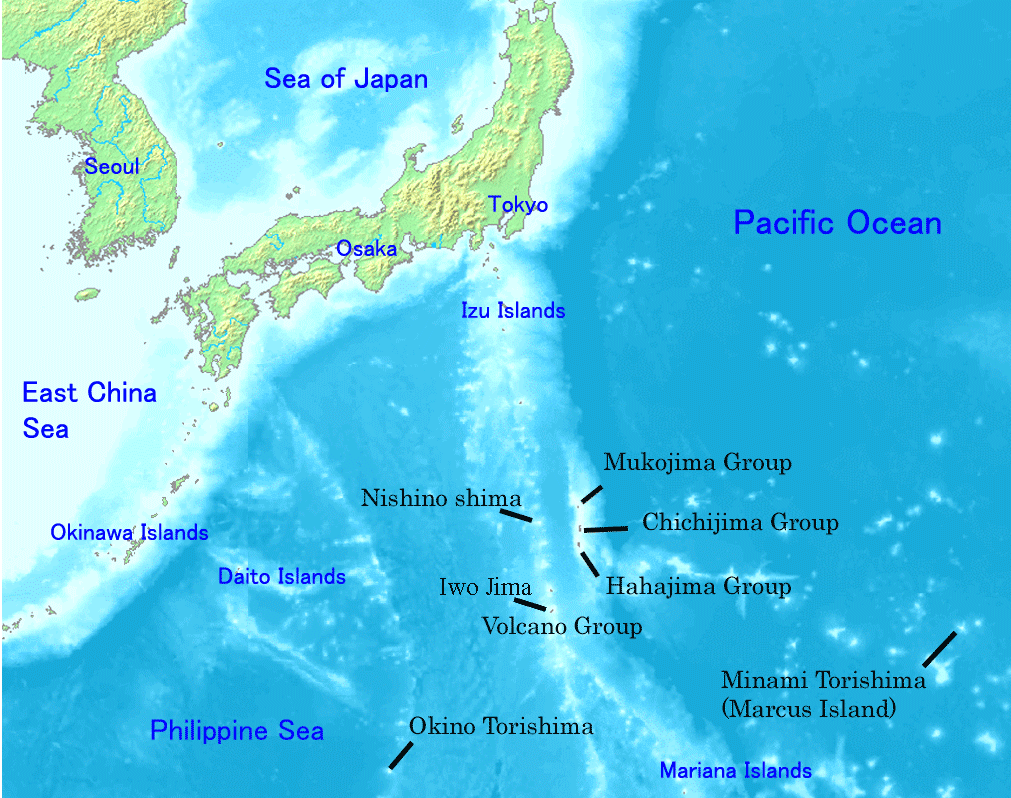
The Bonin Islands consist of three subgroups. Their former names come from a variety of sources, but their Japanese ones generally reflect a family:
- Muko-jima Group (聟島列島 Muko-jima Rettō), formerly the Parry Group
- Muko-jima (聟島, lit. 'Bridegroom Island')
- Yome-jima (嫁島, lit. 'Bride Island'), formerly Kater Island
- Nakōdo-jima or Nakadachi-jima (媒島, lit. 'Matchmaker Island')
- Kita-no-jima (北の島 or 北島, lit. 'Northern Island')
- Mae-jima (前島, lit. 'Front Island'), formerly The Ears
- Chichi-jima Group (父島列島 Chichi-jima Rettō), formerly the Beechey Group
- Chichi-jima (父島, lit. 'Father Island'), formerly the Main Island or Peel Island
- Ani-jima (兄島, lit. 'Elder Brother Island'), formerly Hog Island or Buckland Island
- Otōto-jima (弟島, lit. 'Younger Brother Island'), formerly North Island or Stapleton Island
- Mago-jima (孫島 lit. 'Grandchild Island')
- Higashi-jima (東島 lit. 'East Island')
- Nishi-jima (西島 lit. 'West Island'), formerly Goat Island
- Minami-jima (南島 lit. 'South Island'), formerly Knorr Island
- Haha-jima Group (母島列島 Haha-jima Rettō), formerly the Baily Group or Coffin Islands
- Haha-jima (母島, lit. 'Mother Island'), formerly Hillsborough Island
- Mukō-jima (向島, lit. 'Yonder Island'), formerly Plymouth Island
- Hira-jima or Taira-jima (平島, lit. 'Flat Island')
- Ane-jima (姉島, lit. 'Elder Sister Island'), formerly Perry Island
- Imōto-jima (妹島, lit. 'Younger Sister Island'), formerly Kelly Island
- Mei-jima (姪島, lit. 'Niece Island')
Although not part of the Bonins (小笠原群島, Ogasawara-guntō) geographically,[39] the nearby Volcano Islands, Nishinoshima (Rosario Island), Okinotorishima (Parece Vela), and Minamitorishima (Marcus Island) are organized as part of Ogasawara municipality (小笠原村, Ogasawara-mura).[40] Ogasawara itself is organized as a subprefecture of Tokyo.[41] In Japanese, the geographical expression for the full range of the municipality is the "Ogasawara Archipelago" (小笠原諸島, Ogasawara-shotō), which in turn is sometimes calqued back into English as another meaning for "the Bonin Islands".
Geology
[edit]The Bonin Islands are a part of the Izu–Bonin–Mariana arc of Pacific islands. A fore arc, they lie above the subduction zone where the Pacific Plate slides beneath the Philippine Sea Plate. This began during the Eocene, simultaneously producing the deep Bonin Trench to the east about 50 million years ago and prolonged volcanic activity that created the islands on the west around 48 million years ago. The Bonins are mostly composed of an andesitic volcanic rock called boninite, rich in magnesium oxide, chromium, and silicon dioxide. They may represent the exposed parts of an ophiolite that has not yet been emplaced on oceanic crust. Although the area is currently dormant, most of the islands still have steep shorelines, often with sea cliffs ranging from 50 to 100 meters (160 to 330 ft) high.[42]
The Volcano Islands are much younger and still geologically active. Iwo Jima is a dormant volcano characterized by rapid uplift and several hot springs. The highest point in the entire chain lies on South Iwo Jima, at 916 meters (3,005 ft). In November 2013, a new volcanic island formed offshore from Nishinoshima and eventually merged with it.[43]
The islands are fringed with healthy coral reefs and have many small beaches.[42]
Climate
[edit]The climate of the Bonin Islands ranges from a humid subtropical climate (Köppen climate classification Cfa) to tropical monsoon climate (Köppen climate classification Am).
The climate of Chichijima is on the boundary between the humid subtropical climate (Köppen classification Cfa) and the tropical monsoon climate (Köppen classification Am). Temperatures are warm to hot all year round due to the warm currents from the North Pacific gyre surrounding the island. Rainfall is less heavy than in most parts of mainland Japan since the island is too far south to be influenced by the Aleutian Low and too far from Asia to receive monsoonal rainfall or orographic precipitation on the equatorward side of the Siberian High. The wettest months are May and September, while the driest are January and February.
| Climate data for Chichijima (1991–2020) | |||||||||||||
|---|---|---|---|---|---|---|---|---|---|---|---|---|---|
| Month | Jan | Feb | Mar | Apr | May | Jun | Jul | Aug | Sep | Oct | Nov | Dec | Year |
| Mean daily maximum °C (°F) | 20.7 (69.3) |
20.5 (68.9) |
21.7 (71.1) |
23.4 (74.1) |
25.6 (78.1) |
28.5 (83.3) |
30.4 (86.7) |
30.3 (86.5) |
29.9 (85.8) |
28.6 (83.5) |
25.9 (78.6) |
22.7 (72.9) |
25.7 (78.3) |
| Daily mean °C (°F) | 18.5 (65.3) |
18.1 (64.6) |
19.3 (66.7) |
21.1 (70.0) |
23.4 (74.1) |
26.2 (79.2) |
27.7 (81.9) |
28.0 (82.4) |
27.7 (81.9) |
26.4 (79.5) |
23.8 (74.8) |
20.6 (69.1) |
23.4 (74.1) |
| Mean daily minimum °C (°F) | 15.8 (60.4) |
15.4 (59.7) |
16.8 (62.2) |
18.8 (65.8) |
21.4 (70.5) |
24.4 (75.9) |
25.6 (78.1) |
26.1 (79.0) |
25.7 (78.3) |
24.4 (75.9) |
21.6 (70.9) |
18.2 (64.8) |
21.2 (70.2) |
| Average rainfall mm (inches) | 63.6 (2.50) |
51.6 (2.03) |
75.8 (2.98) |
113.3 (4.46) |
151.9 (5.98) |
111.8 (4.40) |
79.5 (3.13) |
123.3 (4.85) |
144.2 (5.68) |
141.7 (5.58) |
136.1 (5.36) |
103.3 (4.07) |
1,296.1 (51.02) |
| Average rainy days (≥ 0.5 mm) | 11.0 | 8.5 | 9.8 | 10.0 | 11.8 | 8.8 | 8.6 | 11.3 | 13.4 | 13.7 | 12.0 | 11.2 | 130.1 |
| Average relative humidity (%) | 66 | 68 | 72 | 79 | 84 | 86 | 82 | 82 | 82 | 81 | 76 | 70 | 77 |
| Mean monthly sunshine hours | 131.3 | 138.3 | 159.2 | 148.3 | 151.8 | 205.6 | 246.8 | 213.7 | 197.7 | 173.2 | 139.1 | 125.3 | 2,030.3 |
| Source: Japan Meteorological Agency [44] | |||||||||||||
The easternmost island, Minamitorishima or Marcus Island, has a tropical savanna climate (Köppen classification Aw) with warm to hot temperatures throughout the year. The wettest months are July and August, while the driest are February and March.
| Climate data for Minamitorishima or Marcus Island (1991–2020) | |||||||||||||
|---|---|---|---|---|---|---|---|---|---|---|---|---|---|
| Month | Jan | Feb | Mar | Apr | May | Jun | Jul | Aug | Sep | Oct | Nov | Dec | Year |
| Mean daily maximum °C (°F) | 24.6 (76.3) |
24.3 (75.7) |
25.3 (77.5) |
27.1 (80.8) |
29.0 (84.2) |
31.0 (87.8) |
31.3 (88.3) |
31.0 (87.8) |
30.9 (87.6) |
30.2 (86.4) |
28.7 (83.7) |
26.7 (80.1) |
28.3 (82.9) |
| Daily mean °C (°F) | 22.4 (72.3) |
21.8 (71.2) |
22.5 (72.5) |
24.3 (75.7) |
26.1 (79.0) |
28.0 (82.4) |
28.5 (83.3) |
28.4 (83.1) |
28.5 (83.3) |
27.9 (82.2) |
26.5 (79.7) |
24.5 (76.1) |
25.8 (78.4) |
| Mean daily minimum °C (°F) | 20.3 (68.5) |
19.6 (67.3) |
20.4 (68.7) |
22.3 (72.1) |
24.1 (75.4) |
25.8 (78.4) |
26.1 (79.0) |
26.1 (79.0) |
26.4 (79.5) |
25.9 (78.6) |
24.7 (76.5) |
22.6 (72.7) |
23.7 (74.7) |
| Average rainfall mm (inches) | 69.7 (2.74) |
43.4 (1.71) |
56.0 (2.20) |
59.6 (2.35) |
100.6 (3.96) |
44.3 (1.74) |
139.8 (5.50) |
177.1 (6.97) |
94.8 (3.73) |
89.6 (3.53) |
83.0 (3.27) |
90.8 (3.57) |
1,052.8 (41.45) |
| Average rainy days (≥ 0.5 mm) | 10.9 | 8.5 | 8.1 | 7.8 | 9.3 | 7.2 | 14.8 | 16.7 | 14.1 | 12.7 | 10.4 | 11.8 | 132.3 |
| Average relative humidity (%) | 70 | 70 | 74 | 79 | 79 | 77 | 77 | 79 | 79 | 78 | 76 | 74 | 76 |
| Mean monthly sunshine hours | 170.8 | 179.4 | 222.3 | 240.2 | 275.1 | 311.2 | 276.3 | 248.1 | 254.6 | 250.8 | 211.0 | 182.3 | 2,821.7 |
| Source: Japan Meteorological Agency [45] | |||||||||||||
Ecology
[edit]Flora
[edit]
Flora have evolved differently on each of the islands. The Bonin Islands are sometimes referred to as the Galápagos of the Orient.[46][37] They form a distinct subtropical moist broadleaf forest ecoregion, the Ogasawara subtropical moist forests. The ecoregion has a high degree of biodiversity and endemism. The islands are home to about 500 plant species, of which 43% are endemic. The forests are of three main types:[47]
- Type I: Elaeocarpus–Ardisia mesic forest is found in moist lowland areas with deep soils. The forests have a closed canopy with a height of about 15 meters (49 ft), dominated by Ardisia sieboldii. Elaeocarpus photiniaefolius, Pisonia umbellifera, and Planchonella obovata are other important canopy species. These forests were almost completely destroyed by clearing for agriculture before 1945.
- Type II: Distylium–Raphiolepis–Schima dry forest is found in drier lowland and upland sites with shallower soils. It is also a closed-canopy forest, with a 4-to-8-meter (13 to 26 ft) canopy composed mostly of Distylium lepidotum, Rhaphiolepis integerrima, Schima mertensiana, Planchonella obovata, and Syzygium buxifolium. The Type II forests can be further subdivided into:
- Type IIa: Distylium-Schima dry forest occurs in cloudy upland areas with fine-textured soils. These forests contain many rare and endemic species, with Pandanus boninensis and Syzygium buxifolium as the predominant trees.
- Type IIb: Raphiolepis-Livistona dry forest is found in upland areas with few clouds and rocky soils. Rhaphiolepis integerrima is the dominant tree species, along with the fan palm Livistona boninensis, Pandanus boninensis and Ochrosia nakaiana.
- Type III: Distylium-Planchonella scrub forest is found on windy and dry mountain ridges and exposed sea cliffs. These forests have the highest species diversity on the islands. Distylium lepidotum and Planchonella obovata are the dominant species, growing from 0.5 to 1.5 meters (1.6 to 4.9 ft) tall. Other common shrubs are Myrsine okabeana, Symplocos kawakamii, and Pittosporum parvifolium.[47]
These islands are home to the northernmost outliers of the palm genus Clinostigma. Clinostigma savoryanum is endemic and has been planted in Mediterranean climates with success. Other unique species include Metrosideros boninensis, a plant related to similar species growing in Fiji and New Caledonia.
Fauna
[edit]Due to its isolation and recent colonization, the Bonin Islands contain several endemic animal species, most of them recently extinct.
Birds
[edit]The range of the Bonin petrel extends beyond the Bonins themselves to other islands in the North Pacific. There are two restricted-range species of birds on the islands, the Japanese wood pigeon (Columba janthina) and the near-threatened Bonin white-eye (Apalopteron familiare), formerly known as the Bonin honeyeater. The Japanese wood pigeon was extirpated from the Iwo Island groups in the 1980s. The formerly endemic Bonin pigeon (C. versicolor), Bonin thrush (Zoothera terrestris) and Bonin grosbeak (Carpodacus ferreorostris) are now extinct.[48]
Mammals
[edit]A small extinct bat, Sturdee's pipistrelle, is only known in one record and has not been seen since 1915. The Bonin flying fox (Pteropus pselaphon), also called the Bonin fruit bat, is endemic to the islands. It is currently listed as endangered,[49] and a survey published by the Ogasawara Office of Education in 1999 estimated their number at around 100.[50] The Bonin sambar (R. unicolor boninensis),[51] a subspecies of the sambar deer, was supposedly a population introduced to the islands only as late as 1850, but is also known from subfossil remains[verification needed][citation needed]; it went extinct after 1925–26, when Richard Goldschmidt saw the taxidermied pair of the Chichijima museum and was told by locals that merely "half a dozen" animals remained alive[52]
Invertebrates
[edit]
The islands are also renowned for the many species of snails that are found across the islands, especially the Mandarina snails.[53] Most of the native snails are now endangered or extinct because of introduced species and habitat loss.[54] The giant squid (Architeuthis dux) was photographed off the Bonins for the first time in the wild on 30 September 2004. It was filmed alive there in December 2006.[55]
Transportation
[edit]Water transport
[edit]
The main port is Futami on Chichijima. Since 2016, the main line connecting the islands to the mainland is the Ogasawara Shipping Company (小笠原海運株式会社). It operates the Ogasawara Maru (おがさわら丸), an 11,035-ton 150-meter (490 ft) long vessel with 170 private rooms and a total capacity of 894 passengers.[56] With a top speed of 24.7 knots (45.7 km/h; 28.4 mph), it makes the trip from Takeshiba Pier in Tokyo in about 24 hours in good weather.[56] The number of monthly voyages varies, having fallen during the coronavirus pandemic.
Previously, there had been plans for a 14,500-ton "techno superliner" able to reach a maximum speed of 38 knots (70 km/h; 44 mph) and make the same journey in only 17 hours with a capacity of around 740 passengers.[57] The project was canceled in July 2005, however, due to rising fuel prices and cost overruns of ¥2 billion.[58]
Hahajima is reachable via the ferry Hahajima Maru from Chichijima.[59]
Road transport
[edit]Ogasawara Village operates a bus service on Chichijima and elderly passengers may use a "silver pass". There is also a sightseeing taxi service, a rental car company, motorized scooter rental services, a bike rental service, and other amenities. Bringing your automobile onto the island is extremely difficult and costly.
Air transport
[edit]The Bonins have no airport. During severe accidents, illnesses, and other emergencies, a helicopter is dispatched from the Self-Defense Force (SDF) post on Iwo Jima. The ShinMaywa US-1 seaplane from the SDF post at Iwakuni is used during visits by the Tokyo governor and other dignitaries and for any emergency requiring rapid transport back to Honshu.
For several decades, there has been talk of building a full airport.[60][61][62][63] Sites on Chichijima and Anijima have both been rejected. Travel time to the mainland would be cut to around two hours, improving tourism and providing emergency services,[64] and the national, regional, and local governments have all supported the idea in theory. Projects have lagged, however, due to concerns about their economic feasibility and concerns that the proposed sites are homes to numerous valuable, rare, or endangered plant species. Some locals have greatly desired an airport, while a desire to keep the islands' natural beauty untouched has prompted others to work to block one.[65][66] The issue is quite controversial on the islands.[67]
On 26 June 2016, the Japanese Minister of Environment Tamayo Marukawa talked about airport construction on the Bonins after the meeting in Tokyo commemorating the fifth anniversary of their registration as World Natural Heritage.[68] At a 27 July 2017 meeting with Ogasawara Village, the Tokyo Metropolitan Government announced that it was considering opening a regular air route between Tokyo and the Bonins using a proposed 1,200 m (3,900 ft) runway that would be built on Chichijima. This would allow it to land propeller aircraft with up to 50 passengers. The Tokyo government said that construction would depend on future assessments of the impact on the natural environment and economic feasibility. Ogasawara Village supported the runway in preference to expanding either the current helicopter or seaplane access.[69] In fiscal 2019, 490 million yen was included in the Japanese budget for a feasibility study and a survey on Chichijima to determine the best location to construct the runway.[70] In August 2020, the Tokyo Metropolitan Government held a council during which it affirmed its desire to open an airport. Still, it claimed it would not occur until 2030 at the earliest.[64] To address environmental concerns, they further proposed shortening the runway to about 500 meters (1,600 ft) and using tiltrotor aircraft to compensate.[64]
Demography, language, and education
[edit]In 2021, the Bonins had a population of 2560, divided between Chichijima (2120) and Hahajima (440).[71] Virtually all of the Bonin Islands' permanent inhabitants are Japanese citizens. This includes a significant proportion of Bonin Islanders (ancestors from the United States, Europe, and other Pacific islands), who can often be distinguished by their physical features, family names spelled out with katakana, and adherence to Christianity. During and after the US military occupation of 1946–1968, a small minority of islanders opted for US citizenship and/or emigrated from the islands. However, most Bonin islanders now appear to be reassimilating with the ethnic Japanese majority.
Japanese is the common language. Because Bonin Islanders (settlers from the United States, Europe, and other Pacific islands) preceded ethnic Japanese settlers, an English-lexified pidgin which subsequently developed into a creole, known as Bonin English, Ogasawara Creole or Ogasawara Mixed Language, emerged on the islands during the 19th century.[72] This was the result of Japanese being hybridized with island English, resulting in a mixed language that can still be heard.[73]
The Ogasawara Village municipality operates public elementary and junior high schools, while Tokyo Metropolitan Government Board of Education operates Ogasawara High School.[74] In the post–World War II era, Admiral Arthur Radford Elementary School (ラドフォード提督学校) taught elementary students and high school students went to Guam to do their high school education. Ogasawara High opened in 1964.[75]
Fictional references
[edit]The Bonins have been referenced in several works of fiction. Bonin by Robert Standish describes itself as 'a novel', but claims 'this book is an accurate history of the Bonin Islands', based mainly on information from Nathaniel Savory's great-granddaughter, and includes descriptions of maltreatment of Bonin Islanders (the Anglo-Polynesian population) by the later Japanese settlers and authorities and a detailed map of the Chichijima group (on the back end-paper), including over 50 English place-names.[76]
Chapter XVI of Jack London's autobiographical novel John Barleycorn says, "This isolated group, belonging to Japan, had been selected as the rendezvous of the Canadian and American sealing fleets", and describes the drunken visit of a young sailor and his shipmates to the Bonin Islands.[77]
In the television series The Super Dimension Fortress Macross, a fictional island in the chain, South Ataria Island (which would have laid at the southernmost position in the chain, surpassing Minami Iwo Jima), is the landing site of the SDF-1 Macross.[78]
In the 1963 film Matango, a luxury yacht is set adrift and lands on an island. Upon approaching the island, one of the crew members shouts: "I wonder if it's the Bonin Islands?"[79] The English subtitles for the film misspell Bonin "Bonan".[citation needed]
In the 2003 kaiju film Godzilla: Tokyo S.O.S., the twin Mothra larvae hatch from their egg in Himago Island and rush to help their mother who got attacked by Godzilla.
The 2017 anime film The Irregular at Magic High School: The Movie – The Girl Who Summons the Stars takes place on fictional islands in the Bonins.[80]
In the 2023 kaiju film Godzilla Minus One, Koichi Shikishima and his minesweeper crew travel there and are tasked with stalling Godzilla's approach to Japan.
Gallery
[edit]-
Muko-jima
-
Minami-jima, a small island in the Chichi-jima group
See also
[edit]References
[edit]Citations
[edit]- ^ Yoshida, Reiji (2018-07-12). "Ogasawara Islands: Remote witnesses on the front lines of Japanese history". The Japan Times Online. ISSN 0447-5763. Retrieved 2019-09-25.
- ^ a b c d e f g Coppock, Mike (21 January 2021). "American Outpost at Japan's Front Door". American History. Arlington, Virginia: HistoryNet LLC.
- ^ Kublin (1953), p. 35.
- ^ Rémusat (1817), p. 390.
- ^ Kublin (1953), p. 36.
- ^ a b James R. Moriarty III; William R. Roberts (1975). "Between Cipango and Quivira: The legends of Rica de Oro y Rica de Plata and the Islas del Armenio". Southern California Quarterly. 57 (3): 229.
- ^ 小笠原・火山(硫黄)列島の歴史 (in Japanese).
- ^ Welsch (2004).
- ^ Tanaka, Hiroyuki (1993). "Edo Jidai ni okeru Nihonjin no Mujin Tou (Ogasawara Tou) ni tai-suru Ninshiki" ("The Ogasawara Islands in Tokugawa Japan"). Archived 2007-12-25 at the Wayback Machine Kaiji Shi Kenkyuu(Journal of the Maritime History). No. 50, June, 1993.
- ^ a b Rüegg (2017).
- ^ WorldCat, Sangoku Tsūran Zusetsu; alternate romaji Sankoku Tsūran Zusetsu
- ^ Cullen, Louis M. (2003). A History of Japan, 1582–1941: Internal and External Worlds, p. 137., p. 137, at Google Books
- ^ Morris-Suzuki, Tessa. (1998). Re-inventing Japan: Time, Space, Nation, p. 24., p. 24, at Google Books
- ^ Kublin (1953).
- ^ Beechey (1831), pp. 237–240.
- ^ Rein (1884), pp. 533-534.
- ^ a b c d Chapman (2016), p. 27.
- ^ The National Cyclopaedia of Useful Knowledge, Vol.II,, (1847) London, Charles Knight, p.205.
- ^ Beechey (1831).
- ^ Oldman, W. O. (December 1944). "Historical Relic". The Journal of the Polynesian Society. 53 (4): 211. JSTOR 20702990.
- ^ Notes on the Bonin Islands, Michael Quin, Journal of the Royal Geographical Society of London, Vol. 26, (1856), pp. 232–235, Blackwell Publishing on behalf of The Royal Geographical Society (with the Institute of British Geographers)
- ^ Coppock, p. 61
- ^ Klaproth (1832), p. 256.
- ^ King (1898).
- ^ Language and Citizenship in Japan, edited by Nanette Gottlieb, Chapter 10, p. 176.
- ^ Cholmondeley (1915).
- ^ National Geographic, October 1944, pp. 387–388, 404.
- ^ "父島の宿". Retrieved 2007-09-05.
- ^ Société Anonyme (1972). Société Anonyme (the First Museum of Modern Art, 1920–1944): Monographs. Arno Press. p. 87. ISBN 978-0-405-00772-9. Retrieved 2013-05-20.
- ^ a b Welch (2002).
- ^ "Story of George H. W. Bush World War II Experience". CNN. December 20, 2003.
- ^ "George Herbert Walker Bush". Naval History and Heritage Command. United States Department of the Navy. 19 August 2019.
- ^ Case No. 21 Trial Of General Tomoyuki Yamashita[,] United States Military Commission, Manila, (8 October–7 December 1945), and the Supreme Court Of The United States (Judgments Delivered On 4 February 1946). Part VI. Archived from the original on December 8, 2006. Retrieved December 18, 2006.
- ^ Nicol, C. W., ""The far-out Ogasawaras", Archived 2012-07-20 at archive.today Japan Times, 7 August 2011, p. 10.
- ^ J. Bradshaw, "Review of English on the Bonin (Ogasawara) Islands",Language Documentation and Conservation v2, n1 (June 2008), pp. 176–8
- ^ Trumbull, Robert. "Bonin Islanders Seek U.S. Tie But Remain International Pawns; Descendants of Americans Ask Citizenship in Vain—Fight Return of Japanese," New York Times. March 11, 1956.
- ^ a b Japan Times. "Ogasawara Islands Join World Heritage family". Retrieved 26 June 2011.
- ^ Experience the distinctive cuisine of Ogasawara, born from its uncommon island environment
- ^ Freeman (1951), pp. 229–235.
- ^ "Bonin Islands," Encyclopædia Britannica. Retrieved July 06, 2009.
- ^ Nussbaum, Louis-Frédéric. (2005). "Tōkyō" in Japan Encyclopedia, pp. 981–982 at Google Books; in "Kantō" p. 479 at Google Books
- ^ a b coral reefs Archived April 10, 2008, at the Wayback Machine
- ^ "Nishinoshima Continues to Grow". Earth Observatory. NASA. 24 June 2015. Retrieved 20 June 2020.
- ^ "気象庁|過去の気象データ検索". jma.go.jp.
- ^ Yamaoka, Fumiko (May 12, 2007). "Saving an endangered bird in 'Orient's Galápagos'". The Japan Times.
- ^ a b "Ogasawara subtropical moist forests". Encyclopedia of Earth. Accessed 28 July 2020. [1]
- ^ "Bonin Islands" Avibase – Bird Checklists of the World. BirdLife International. Accessed 27 July 2020. [2]
- ^ Vincenot, C. (2017). "Pteropus pselaphon". IUCN Red List of Threatened Species. 2017 e.T18752A22085351. doi:10.2305/IUCN.UK.2017-2.RLTS.T18752A22085351.en.
- ^ "Ogasawara subtropical moist forests". Terrestrial Ecoregions. World Wildlife Fund. Retrieved 2008-01-17.
- ^ Pocock, R.I. (1943). "The Skull-characters of some of the Forms of Sambar (Rusa) occurring to the East of the Bay of Bengal. — Part III. Rusa nigricans and Rusa boninensis". Annals and Magazine of Natural History. 10 (63): 191–196. doi:10.1080/03745481.1943.9728010.
- ^ Goldschmidt, Richard (1927). Neu-Japan: 223. doi:10.1007/978-3-642-99454-8
- ^ Chiba, Satoshi (1999). "Accelerated Evolution of Land Snails Mandarina in the Oceanic Bonin Islands: Evidence from Mitochondrial DNA Sequences". Evolution. 53 (2): 460–471. doi:10.1111/j.1558-5646.1999.tb03781.x. ISSN 1558-5646. PMID 28565404.
- ^ Chiba, Satoshi; Cowie, Robert H. (November 2016). "Evolution and Extinction of Land Snails on Oceanic Islands". Annual Review of Ecology, Evolution, and Systematics. 47 (1): 123–141. doi:10.1146/annurev-ecolsys-112414-054331. ISSN 1543-592X.
- ^ "Japanese Researchers Capture Giant Squid". Fox News. 2006-12-22. Archived from the original on 2007-08-26. Retrieved 2007-09-06.
- ^ a b "おがさわら丸 (Ogasawara Maru)". 2022.
- ^ "Super High-Speed Ship (Techno Super Liner) for Ogasawara Line Naming and Launching Ceremony". Archived from the original on 2007-09-26. Retrieved 2007-08-24.
- ^ "Japan pulls plug on Techno Superliner". Retrieved 2007-08-24.
- ^ "OgasawaraKaiun Co., Ltd".
- ^ Tōkyōto Sōmukyoku Santama Tōsho Taisakushitsu Ogasawara Shinkōka, ed. (1983). Ogasawara Shotō Kōkūro Kaihatsu Chōsa Hōkusho: Ogasawara Shotō no Shinkōjiritsu no tameni [Ogasawara Island Airlines Development Study Report: For the Independence of the Ogasawara Islands] (in Japanese). Tokyo Metropolitan Government.
- ^ Tōkyōto Sōmukyoku, ed. (1985). Ogasawara Shotō Kōkūro Kaihatsu Chōsa Hōkusho: Ogasawara Shotō no Kōkūjuyō Yosoku [Ogasawara Island Airlines Development Study Report: Estimated Air Transportation Demand for Ogasawara Islands] (in Japanese). Tokyo Metropolitan Government.
- ^ Tōkyōto Sōmukyoku, ed. (1987). Ogasawara Shotō Kōkūro Kaihatsu Chōsa (sono 2) Hōkusho: Shūkō Kizai tō Chōsa oyobi Kūkō Kensetsu-an Sakutē Chōsa [Ogasawara Island Airlines Development Study Report: Survey of Air Service Equipment and others with Study on Planning Airport Construction] (in Japanese). Tokyo Metropolitan Government.
- ^ Ogasawara kūkō kensetsu kēkaku tō senmon iinkai (1998). Tōkyōto Sōmukyoku Gyōseibu Chiiki Shinkōka (ed.). Ogasawara kūkō kensetsu kēkaku tō ni kansuru teigen [Recommendations on Ogasawara Airport Construction] (in Japanese). Tokyo Metropolitan Government.
- ^ a b c "小笠原に垂直離着陸可能な「ティルトローター機」案…滑走路500m、環境に配慮". Yomiuri. August 2, 2020. Archived from the original on October 27, 2020.
- ^ Agne, ed. (1987). "Ogasawara kūkō kensetsu no henkō motomeru / Nihon Seitai Gakkai dai 24-kai sōkai" [Petition to Change Ogasawara Airport Construction / 24th General Meeting, Ecological Society of Japan]. Gijutsu to Ningen (in Japanese). 24 (10 (262)): 6–7. ISSN 0285-5186. OCLC 835524887.
- ^ "Tokushū—Ogasawara no shizen to kūkō kensetsu kēkaku" [Special edition—Nature on Ogasawara and airport construction plan]. Chiri (in Japanese). 34 (11): 21–68. November 1989. ISSN 0577-9308. OCLC 551698617.
- ^ McCormack, Gavan (August 1999). "Dilemmas of Development on The Ogasawara Islands". Japan Policy Research Institute. Archived from the original on 2013-01-16. Retrieved 2008-01-17.
- ^ "Minister Marukawa of Environment Ministry seeks progress "Cooperation in Construction" for Ogasawara Airport". Nihon Keizai Shinbun. 2016-06-26. Retrieved 2017-10-12.
- ^ "Ogasawara kōkūro, kūkō kensetsu-an jiku ni kentō—Tōkyōto ga hōshin" [Tokyo Metropolitan Government suggested policy with the Airport Construction Plan on Ogasawara Island] (in Japanese). Asahi Shimbun. 2017-07-27. Archived from the original on 2017-10-13. Retrieved 2017-10-12.
- ^ "「小笠原に空港整備」測量で都が実現性検討へ" ["To Ogasawara Airport maintenance" feasibility study by survey]. 読売新聞オンライン (in Japanese). Yomiuri Shimbun. 2019-01-10. Archived from the original on 2019-07-24. Retrieved 2019-07-24.
- ^ "支庁の案内: 管内概要 (Japanese)". 2021-04-01. Retrieved 2022-06-16.
- ^ Long, Daniel; Peter Trudgill (2004). "The Last Yankee in the Pacific: Eastern New England Phonology in the Bonin Islands". American Speech. 79 (4): 356–367. doi:10.1215/00031283-79-4-356. S2CID 145388563.
- ^ Long, Daniel (2007). English on the Bonin (Ogasawara) Islands. Duke University Press. ISBN 978-0-8223-6671-3.
- ^ "Chichi-jima". ogasawara-h.metro.tokyo.jp. Archived from the original on 2020-02-15. Retrieved 2007-10-30.
- ^ "トップ > 学校案内 > 沿革" (in Japanese). Ogasawara High School. Retrieved 2024-03-21.
- ^ Standish, Robert (pseudonym of Digby George Gerahty). (1943). Bonin: A Novel, London: Peter Davies.
- ^ London, Jack (1913). "John Barleycorn (London)/Chapter XVI". John Barleycorn – via Wikisource.
- ^ Macross Compendium Atlas Listing
- ^ Matango – 00:17
- ^ Morrissy, Kim (June 20, 2017). "The irregular at magic high school The Movie: The Girl Who Summons the Stars - Review". Anime News Network. Archived from the original on May 16, 2022. Retrieved May 16, 2022.
Bibliography
[edit]- Abel-Rémusat, Jean-Pierre (July 1817), "Description d'un Groupe d'Îles Peu Connues et Situé entre le Japon et les Îles Mariannes, Rédigée d'après les Relations des Japonais [Description of a Little Known Group of Islands Situated between Japan and the Mariana Islands, Including the Accounts of the Japanese]", Journal des Savans [Journal of the Learnèd] (in French), Paris: Royal Printing Office, pp. 387–396.
- Beechey, Frederick William (1831), Narrative of a Voyage to the Pacific and Beering's Strait to Co-operate with the Polar Expeditions, Performed in His Majesty's Ship Blossom under the Command of Captain F.W. Beechey, R.N., F.R.S. &c. in the Years 1825, 26, 27, 28, London: H. Colburn & R. Bentley.
- Chapman, David (2016), The Bonin Islanders, 1830 to the Present: Narrating Japanese Nationality, London: Routledge, ISBN 978-2-01-504936-6.
- Cholmondeley, Lionel Berners (1915), The History of the Bonin Islands from the Year 1827 to the Year 1876, London: Constable & Co.
- Freeman, Otis Willard (1951), Geography of the Pacific, New York: John Wiley & Sons, ISBN 978-0-598-43606-1, OCLC 415089
{{citation}}: ISBN / Date incompatibility (help). - King, A.F. (1898), "Hypa, the Centenarian Nurse", The Mission Field, pp. 415–421.
- Hayashi, Shihei (1785), 三國通覽圖說 [Sangoku Tsūran Zusetsu, An Abridged Illustrated Description of the Three Kingdoms] (in Japanese), Edo: autograph manuscript, OCLC 44014900.
- Klaproth, Julius (1832), 三國通覽圖說 San Kokf Tsou Ran To Sets, ou, Aperçu Général des Trois Royaumes [Sangoku Tsūran Zusetsu, or, General Outline of the Three Kingdoms] (in French), Paris: Oriental Translation Fund..., OCLC 2563166.
- Kublin, Hyman (March 1953), "The Discovery of the Bonin Islands: A Reexamination" (PDF), Annals of the Association of American Geographers, vol. 43, Milton Park: Taylor & Francis, pp. 27–46, doi:10.2307/2561081, JSTOR 2561081.
- Rein, J.J. (1884), Japan: Travel and Researches, Psychology Press, ISBN 978-0-7007-1016-4
{{citation}}: ISBN / Date incompatibility (help). - Rüegg, Jonas (2017), "Mapping the Forgotten Colony: The Ogasawara Islands and the Tokugawa Pivot to the Pacific", Cross-Currents, vol. 6, pp. 440–490, archived from the original on 2018-11-24, retrieved 2018-11-24.
- Welch, Jeanie M. (April 2002), "Without a Hangman, Without a Rope: Navy War Crimes Trials after World War II" (PDF), International Journal of Naval History, vol. 1, archived from the original on 2019-11-03, retrieved 2022-12-04
{{citation}}: CS1 maint: bot: original URL status unknown (link). - Welsch, Bernhard (June 2004), "Was Marcus Island Discovered by Bernardo de la Torre in 1543?", Journal of Pacific History, vol. 39, Milton Park: Taylor & Francis, pp. 109–122, JSTOR 25169675.
External links
[edit]- Ogasawara Village (Japanese)
- The Bonin (Ogasawara) Islands Language and Culture Site (no longer maintained, apparently as of 2001)
- Ogasawara Channel (Japanese)
- National Archives of Japan: The faked map of 1752 mentioned in Hiroyuki Tanaka's 1998 article.
- Tokyo Metropolitan Government, Ogasawara-mura: maps/photos
Bonin Islands
View on GrokipediaNomenclature
Etymology and historical names
The Japanese name Ogasawara Islands (小笠原諸島, Ogasawara Guntō) derives from Ogasawara Sadayori, a samurai of Shinano Province whom Japanese tradition credits with discovering the archipelago in 1593; the islands were subsequently granted to him as a fief, associating the name with his clan.[5] [6] This nomenclature was formalized in Japanese records following annexation in 1875, though archaeological evidence indicates no pre-19th-century settlement, casting doubt on early discovery claims.[7] The English designation "Bonin Islands" stems from the Japanese word munin or mujin (無人), signifying "uninhabited" or "no people," a descriptor applied due to the absence of indigenous populations prior to 1830. [8] Japanese explorers from Nagasaki landed in 1675 and termed them Bu Nin (無人), emphasizing their desert status; this evolved into Western usage via transliteration, notably in an 1817 French scholarly work by Jean-Pierre Abel-Rémusat, who rendered it as îles Bonin amid interpretations of mujintō (desert islands).[8] In European historical cartography, the archipelago appeared under Spanish names such as Islas del Arzobispo (Archbishop Islands) from the 16th to 19th centuries, likely drawn from early exploratory charts rather than definitively attributed to Ruy López de Villalobos's 1543 voyage. [6] Individual islands received ad hoc Western labels during 19th-century surveys, including Peel Island for Chichi-jima (父島, "Father Island") by British captain Frederick William Beechey in 1825 and Hog Island for Ani-jima (兄島, "Elder Brother Island").[7] These temporary designations faded with Japanese administration, which standardized names like Haha-jima (母島, "Mother Island") for the principal southern island.[7]Geography
Archipelago composition and physical description
The Bonin Islands, also known as the Ogasawara Islands, consist of more than 30 subtropical and tropical islands clustered into three primary groups: the northern Mukojima Islands, the central Chichijima Islands, and the southern Hahajima Islands, extending approximately 400 kilometers from north to south in the western Pacific Ocean, about 1,000 kilometers south-southeast of Tokyo.[3][9] These groups encompass the core of the archipelago, with additional uninhabited islets and rocks contributing to the total count; the Chichijima group includes the largest and most populated island, Chichijima (also called Peel Island historically), while Hahajima features the second-largest landmass.[10] The Volcano Islands (Kazan Rettō), including Iwo Jima, are sometimes associated but geologically and administratively distinct, lying farther south.[1] The archipelago's total land area measures approximately 80 square kilometers, dominated by volcanic formations resulting in rugged, elevated terrain with minimal flat coastal plains.[1] Elevations vary by group, peaking at 326 meters above sea level in the Chichijima Islands and 462 meters in the Hahajima Islands, where steep basaltic cliffs often plunge directly into the ocean, reaching heights of 50 to 100 meters along much of the coastline.[11] Interior landscapes feature dissected plateaus, narrow valleys, and dense subtropical vegetation, with porous volcanic soils limiting permanent rivers or lakes; freshwater is primarily sourced from rainfall catchment systems.[12] Seismic and eruptive history has shaped irregular coastlines and occasional barren slopes, contrasting with forested highlands that cover over half the land surface.[13]Administrative status within Japan
The Bonin Islands, referred to as the Ogasawara Islands in Japanese administration, constitute Ogasawara Village (小笠原村), a village-level municipality within Tokyo Metropolis. This status was formalized upon the islands' reversion to Japanese control on June 26, 1968, ending U.S. postwar occupation and integrating them into the Tokyo Metropolitan Government as an exclave roughly 1,000 km south of the Japanese mainland.[14][2] Ogasawara Village serves as the primary local government body, overseeing inhabited areas such as Chichijima (the administrative center) and Hahajima, along with uninhabited islets in the Bonin chain; it also extends to the Volcano Islands (e.g., Iwo Jima) and other remote features like the Daitō Islands. The village maintains its office in Chichijima's Nishimachi district and handles municipal functions including education, health services, and community development, with a population of approximately 2,400 residents concentrated on the main settled islands as of recent estimates.[2][15] Overseeing village-level operations is the Ogasawara Subprefecture (小笠原支庁), a specialized branch agency of the Tokyo Metropolitan Government established to manage regional affairs in this isolated territory. The subprefecture coordinates metropolitan policies on infrastructure, agriculture, disaster response, and environmental protection, operating from offices on Chichijima and Hahajima; it functions as a comprehensive administrative hub under Tokyo's ordinance-based framework, addressing the logistical challenges of remoteness such as reliance on sea and air links from the mainland.[15][16]Geology
Tectonic origins and island formation
The Bonin Islands lie within the forearc of the Izu-Bonin-Mariana (IBM) convergent margin, a tectonic system driven by the oblique westward subduction of the Pacific Plate beneath the overriding Philippine Sea Plate at rates of 4-9 cm/year. This subduction zone, extending over 2,800 km from near Tokyo southward, generates partial melting in the mantle wedge, producing magmas that ascend to form the volcanic arc. The Bonin segment represents an uplifted forearc high, exposing ancient arc basement rocks that record the system's initiation without significant sedimentary cover or accretionary prism influence, allowing direct insight into subduction-related magmatism.[17][18] Subduction in the IBM system began in the early Eocene, around 52-50 Ma, following supra-subduction zone spreading that created the forearc oceanic crust via seafloor spreading in a nascent arc setting. Initial arc volcanism erupted shortly after, with boninitic lavas—low-silica, high-magnesium-andesites indicative of hydrous, shallow mantle melting—forming between 48 and 34 Ma across the Bonin forearc ridge. These boninites, erupted in a forearc environment prior to stable back-arc basin formation, mark the transition from spreading to steady-state subduction, with the Ogasawara Trough emerging as the first back-arc basin by late Eocene time. The Bonin Islands' exposed stratigraphy, including pillow basalts and tuffaceous deposits on Chichijima and Hahajima, preserves this early phase, with radiometric ages confirming eruptions as old as 48 Ma.[19][20][21] Island edifice construction accelerated in the Oligocene to Miocene, with calc-alkaline andesites and basalts building stratovolcanoes and associated submarine ridges, though the core islands retain Eocene-Oligocene foundations uplifted by tectonic forces. The Muko-jima group features older, dissected volcanics, while Chichi-jima and Haha-jima exhibit more recent Pliocene-Quaternary activity overlaying the ancient basement, resulting in a rugged topography of steep ridges and calderas. No significant post-formation tectonic collision has altered the arc's intra-oceanic character, preserving the subduction-driven assembly without continental influence.[21][22][23]Volcanic activity and seismic risks
The Bonin Islands form part of the Izu-Bonin-Mariana volcanic arc, resulting from the subduction of the Pacific Plate beneath the Philippine Sea Plate, which drives magma generation and island formation primarily through basaltic and boninitic volcanism.[24] The archipelago's islands, including Chichijima and Hahajima, consist largely of volcanic rocks from Miocene to Pliocene eruptions, with ongoing uplift at rates up to 1 meter per year attributed to residual volcanic processes and tectonic forces.[13] While the core Bonin group features dormant stratovolcanoes, active volcanism persists in the associated Volcano Islands subgroup, such as Nishinoshima, where submarine eruptions from November 2023 onward extruded new lava flows, forming an islet roughly 100 meters in diameter by early reports.[25] Submarine volcanoes in the region, including Fukutoku-Oka-no-Ba, exhibit recurrent activity characterized by discolored seawater, pumice rafts, and episodic island-building events; for instance, temporary islands emerged there in 1904–1905 and 1914 before eroding.[26] Ioto (Iwo Jima) records phreatic explosions and fumarolic emissions, with documented eruptions in 1889, 2001 (pumice falls), and ongoing hydrothermal activity producing discolored waters as of recent monitoring.[27] These events are monitored via seafloor observatories detecting pressure changes and acoustic signals, revealing that eruptions often initiate at depths exceeding 1,000 meters, with surface manifestations limited to pumice dispersal affecting regional shipping.[28] Seismicity in the Bonin Islands region stems from the same subduction dynamics, positioning it within a high-hazard zone of the Pacific Ring of Fire, where intermediate-depth and deep-focus earthquakes predominate due to slab dehydration and phase transitions in the mantle.[29] The 2015 Mw 7.9 event, nucleating at 680 km depth—the deepest instrumentally recorded major earthquake—ruptured a planar fault surface spanning 40 km, followed by aftershocks extending to approximately 750 km, highlighting unusual lower-mantle seismicity initiation.[30] Shallow crustal quakes remain frequent, such as the M 5.3 event on April 24, 2024, at 10 km depth, and the M 4.8 quake on January 12, 2025, though these typically induce minimal shaking on the sparsely populated islands due to resistant building codes and low structural vulnerability.[31][32] Risks include potential tsunamis from shallow megathrust events, though deep quakes (>300 km) generate negligible surface waves or waves; historical data show no major tsunami impacts on the islands from regional seismicity, with preparedness emphasizing evacuation drills and seismic retrofitting.[31] Combined volcanic-seismic interactions, such as eruption-triggered seismicity, amplify hazards, necessitating continuous geophysical surveillance to forecast ash falls or ground deformation that could disrupt the limited infrastructure and endemic ecosystems.[28]Climate and Environment
Meteorological patterns
The Ogasawara Islands exhibit a subtropical oceanic climate characterized by mild temperatures year-round, high humidity, and abundant precipitation without a pronounced dry season. Annual mean temperatures average 22.9°C, with monthly maxima reaching 27.6°C in August and minima around 19.6°C in February, reflecting a narrow diurnal and annual range influenced by surrounding Pacific waters.[33][34] Precipitation totals approximately 1,317–1,380 mm annually, distributed relatively evenly but peaking in May and November due to convergence of trade winds and migratory fronts, while June and September see secondary maxima from intermittent convective activity.[35][34] Unlike mainland Japan, the islands lack a defined rainy season (tsuyu), as the subtropical front typically stalls northward, though episodic heavy rains occur from passing low-pressure systems. Driest periods align with January and April, when northeasterly trades dominate.[36] Summers (June–August) feature hot, muggy conditions under the influence of the Ogasawara High—a semi-permanent anticyclone extension of the North Pacific High—promoting stable, sunny weather interspersed with thunderstorms. Winters (December–February) remain mild with average air temperatures of 20-22°C and occasional cool spells from Siberian air outbreaks moderated by the ocean, yielding average lows above 19°C; the subtropical climate enables swimming with sea surface temperatures averaging 23-25°C in December, comparable to milder mainland summer conditions. Autumn (September–November) transitions with increasing tropical cyclone activity.[37][36][38][39] Tropical cyclones (typhoons) significantly shape seasonal patterns, particularly from July to October, when their frequency, intensity, and tracks—often steering northwestward—enhance precipitation and gusty winds exceeding 30 m/s on affected islands. These events contribute 20–30% of annual rainfall in peak months, with historical data indicating 3–5 passages per season, though interannual variability ties to El Niño-Southern Oscillation phases. Southeasterly trade winds prevail otherwise, averaging 5–10 m/s, fostering consistent humidity levels above 75%.[40][41]Natural hazards
The Ogasawara Islands experience frequent typhoons, or tropical cyclones, which pose the primary meteorological hazard due to their subtropical location in the western Pacific. These storms typically influence seasonal precipitation from summer through autumn, with patterns dictated by cyclone intensity, frequency, and trajectories; multiple typhoons affect Japan annually, including the remote Ogasawara chain.[40][42] Large-scale events occur roughly every several decades, delivering intense winds and rainfall that disrupt ecosystems and infrastructure, as seen with Typhoon Bualoi on October 24, 2019, which recorded a minimum central pressure of 963.5 hPa and maximum instantaneous winds exceeding typical thresholds.[43][44] Associated heavy precipitation elevates risks of flooding and landslides, exacerbated by the islands' steep volcanic topography and limited drainage. Vulnerable coastal and mountainous zones near settlements face heightened threats from rain-induced slope failures, potentially damaging roads, ports, and habitats.[45][46] Isolation from mainland Japan amplifies response challenges during such events.[46] Tsunamis represent an additional peril, often triggered by regional earthquakes, with advisories for waves up to 1 meter above tide levels impacting Ogasawara coasts; historical records document observability from Izu-Bonin-Mariana sources.[47][48] Storms and eruptions also contribute to secondary fires, though mitigation relies on early warnings from the Japan Meteorological Agency.[49]History
Prehistoric evidence and early human contact
Archaeological investigations have identified artifacts indicative of prehistoric human activity on several Bonin Islands, though these surface finds lack stratigraphic context and associated dates, precluding confirmation of permanent habitation. On Kita-Iwojima, three polished basalt stone adzes, ranging from 14.0 to 19.0 cm in length and classified as gouge-type tools, were recovered in the late 1920s and presented to the Tokyo National Museum; their form suggests manufacture during Japan's Final Jōmon (circa 1500–300 BCE) or Yayoi (circa 300 BCE–300 CE) periods by seafarers capable of open-ocean navigation.[50] Additional artifacts from Chichijima include a tuff sandstone gouge, coral or pebble tools, an agate scraper, and obsidian flakes and cores, while Hahajima yielded a bone lure hook (7 cm long, possibly from deer or cow) and cowry shell pendants (6.5–8.2 cm), interpreted as potential fishing or ornamental items from transient visitors.[50] These discoveries point to episodic contacts rather than sustained occupation, as no village sites, burials, or extensive midden deposits have been documented, consistent with the islands' isolation—over 1,000 km from the Japanese mainland and nearest landmasses. Stone adzes from the Bonins exhibit typological similarities to those in the Mariana Islands, supporting hypotheses of prehistoric maritime links, possibly involving Chamorro ancestors or other Austronesian navigators from Micronesia who reached the archipelago for resource exploitation or exploration prior to European contact.[51][50] Shell artifacts and adzes also align with broader patterns in the Ryukyu and northern Austronesian migration zones, implying drift voyages or deliberate expeditions across the Philippine Sea during the late Holocene.[52] The earliest recorded sightings of the islands, predating settlement, occurred in 1543 when Spanish explorer Bernardo de la Torre noted them during a voyage from Mexico to the Philippines, followed by unsubstantiated Japanese claims of discovery in 1593 by Ogasawara Sadayori; however, no landings or prolonged stays were reported until the 19th century. These historic encounters yielded no evidence of prior awareness of the prehistoric artifacts, underscoring the limited and intermittent nature of early human interactions with the uninhabited archipelago.[53]European rediscovery and initial settlement (early 19th century)
The Bonin Islands, uninhabited at the time despite sporadic earlier visits by whalers, were formally rediscovered by Europeans during Captain Frederick William Beechey's expedition on HMS Blossom. On June 9, 1827, Beechey anchored at what he named Port Lloyd (now Futami Bay on Chichi-jima) and conducted surveys of the main islands, renaming Chichi-jima as Peel Island after the British Home Secretary.[7] He claimed the archipelago for Britain, affixing a copper plaque to a tree on Peel Island to assert sovereignty, motivated by strategic interests in the Pacific whaling grounds and potential coaling stations.[54] Beechey's account described the islands' volcanic terrain, fertile valleys suitable for agriculture, and abundant timber, but noted no permanent human presence, only evidence of transient whalers like the English vessel Supply in 1825.[7] Initial settlement commenced on June 26, 1830, when a group of 25-30 colonists departed from Honolulu in the Kingdom of Hawaii aboard the schooner Hinata, arriving at Peel Island under loose British auspices via Consul Richard Charlton.[7] The core Western settlers numbered five: Nathaniel Savory (an American beachcomber born in 1794), Matteo Mazarro (a Genoese adventurer initially designated leader), John Millinchamp (English), Aldin Chapin (American), and Charles Johnson (Dane); they were accompanied by approximately 20 Hawaiian and other Pacific Islander laborers recruited for manual work.[7] [55] The settlers aimed to establish a provisioning station for Pacific whalers, cultivating crops like sugarcane, potatoes, and vegetables on the islands' arable slopes, while harvesting timber and raising livestock; Savory, who assumed de facto leadership after disputes, focused on self-sufficiency amid rudimentary conditions without external governance.[7] By 1831, reinforcements arrived, including women and additional men via British whalers like the Partridge and Kent, increasing the population to around 40, though high mortality from disease and internal conflicts—such as rivalries between Savory and Mazarro—marked early years.[7] The community operated autonomously, trading provisions with passing ships for tools and cloth, but lacked formal title or protection, relying on the 1827 British claim which Britain did not enforce due to limited Pacific commitments.[7] This motley group of Anglo-American, European, and Polynesian descent laid the foundation for a multicultural society, with intermarriages producing mixed-heritage descendants who later formed the core of the islands' pre-Japanese population.[7]Colonial claims and Japanese incorporation (mid-19th century)
The Bonin Islands, known in Japanese as Ogasawara-shotō, drew competing colonial interests in the mid-19th century amid expanding Pacific whaling, trade, and naval ambitions. Britain had asserted sovereignty in 1827 after exploratory visits by Royal Navy captains, including Richard Hurd and George Anson Byron, but maintained no permanent presence or administration, treating the claim as nominal amid broader imperial surveys.[56] The islands' primary inhabitants were a small, multicultural settler community established since 1830, primarily under American leadership such as Nathaniel Savory, comprising roughly 100 individuals by the 1850s from the United States, Hawaii, and other Pacific regions; these settlers raised the U.S. flag sporadically but operated without formal national endorsement or legal title.[7] The United States showed strategic interest during Commodore Matthew C. Perry's expeditions to Japan in 1853–1854, with Perry personally surveying the islands and recommending their acquisition as an uninhabited coaling station to support steamships en route to Asia; however, the U.S. government declined formal annexation, citing insufficient resources and Perry's unauthorized advocacy.[57] This hesitation reflected broader American priorities focused on continental expansion rather than distant Pacific outposts, leaving the islands effectively stateless despite settler presence. Japan's Tokugawa shogunate, alarmed by Western encroachments near its territory, initiated reconnaissance in 1860 after reports of foreign settlements surfaced through Dutch intermediaries. In 1862, the shogunate formally proclaimed the Ogasawara Islands as Japanese possessions, dispatching the naval vessel Kanto-maru to install a magistrate on Chichijima and assert administrative oversight, though implementation faltered amid internal political instability leading to the Boshin War.[58] [50] This initial claim invoked vague historical precedents from 17th-century Japanese voyages but prioritized practical exclusion of rivals over continuous prior occupancy, which had been absent for over two centuries. Following the Meiji Restoration in 1868, the imperial government renewed efforts to secure the islands against potential British or American bases. In 1875, Japan organized subsidized colonization, sending officials and settlers to Chichijima, and negotiated diplomatic recognition from Britain and the United States, who relinquished prior pretensions in exchange for trade concessions. Formal incorporation occurred on December 26, 1876, when the islands were designated Nanpō-shotō under Tokyo Prefecture, marking Japan's first overseas colonial venture and integrating the existing settler population under Japanese law.[14] [59] By 1880, foreign nationals were compelled to naturalize or depart, with most Americans assimilating amid incentives for loyalty to the emperor.[59] This incorporation stabilized Japanese control but sparked tensions with settlers over land rights, as the Meiji administration redistributed properties without full compensation for pre-existing claims.[60]Pre-WWII development and imperial era
Following the Meiji government's annexation of the Bonin Islands in 1876, with international recognition secured, the resident foreign population—primarily descendants of early 19th-century Western and Pacific Islander settlers—was naturalized as Japanese subjects by 1882.[14] This facilitated increased migration from the Japanese mainland and nearby Izu Islands, driving rapid demographic expansion as Japanese settlers established permanent communities on Chichijima and Hahajima.[14] By the early 20th century, the islands' population had grown to support diversified economic activities, reaching a pre-war peak of approximately 7,000 residents across the main islands by the late 1930s.[4] The economy during the Meiji and Taishō periods relied heavily on subtropical agriculture, including fruit orchards, winter vegetable cultivation, and sugarcane farming, the latter becoming a cornerstone with sugar refining operations that fueled a boom in the early 1900s.[14] A sharp decline in global sugar prices during the 1920s necessitated economic shifts toward summer vegetable exports, a burgeoning fishery targeting bonito, tuna, and whales, and a brief but lucrative coral harvesting surge around 1926 that generated sudden wealth for some islanders.[14] [61] These activities leveraged the islands' mild climate and isolation, though they also introduced non-native species and strains on local resources.[62] Civil infrastructure expanded in tandem with population and economic growth, including the development of roads, ports, and basic utilities to facilitate trade and daily life; for instance, ports on Chichijima handled exports while rudimentary airstrips emerged later.[62] The early Shōwa era marked intensified imperial militarization amid rising tensions with the United States, beginning with the Japanese Army's establishment of a fortification headquarters on Chichijima in the 1920s and the formal Chichijima Fort Command Post in 1932.[14] [62] Military infrastructure proliferated thereafter, with a naval airfield completed on Iwo Jima in 1932, the Susaki airstrip on Chichijima finished in 1937, and a Japanese Navy air squadron base constructed on Chichijima by 1939, transforming the islands into strategic outposts.[14] [62] This buildup prioritized defense over civilian needs, foreshadowing the islands' role in the Pacific War.[14]World War II battles and occupation
The Bonin Islands, particularly Chichi-jima, served as key Japanese naval and air facilities during World War II, hosting a seaplane base, airfield, radio station, and fleet anchorage that supported reconnaissance and communication for the Imperial Japanese Navy.[63] These installations were fortified with anti-aircraft batteries and garrisons, though less extensively than nearby Iwo Jima in the Volcano Islands group.[64] United States forces initiated attacks on the Bonins in mid-1944 as part of preparations for the Iwo Jima campaign, conducting naval bombardments on June 24 and July 4 by carrier task forces targeting defenses across the Volcano and Bonin chains.[65] Subsequent carrier-based air raids intensified, including strikes by Task Force 58 on August 15, 1944, against Chichi-jima and other sites, aimed at neutralizing radar and command facilities.[66] By September 1944, frequent bombing runs, such as those involving Grumman TBF Avengers from USS San Jacinto, led to several American pilots being shot down over Chichi-jima, resulting in captures and executions by Japanese forces amid the aerial campaign.[67] No amphibious landings occurred on the Bonin Islands proper, as U.S. strategy bypassed them after softening defenses through sustained naval gunfire and air assaults, leaving garrisons isolated.[63] Following Japan's surrender on August 15, 1945, Bonin Islands commander Rear Admiral Shigematsu Tachibana formally capitulated on September 3 aboard the destroyer USS Dunlap, marking the end of hostilities in the chain.[68] U.S. Navy forces immediately occupied the islands, securing military installations and restricting civilian access while establishing naval bases; Japanese structures were largely demolished to repurpose the sites.[69] This initial occupation phase focused on demilitarization and intelligence gathering, with over 20,000 Japanese troops surrendering across the Bonins and Volcanoes, though isolated holdouts persisted briefly.[64]U.S. administration and repatriation (1945-1968)
Following Japan's surrender in World War II, United States Marine forces occupied Chichi Jima on December 13, 1945, establishing formal control over the Bonin Islands as part of broader Pacific administration.[64] The U.S. Navy assumed jurisdiction shortly thereafter, governing the islands initially as an occupying power and, from April 28, 1952, under Article 3 of the Treaty of Peace with Japan, which granted administrative rights for security purposes.[70] [64] Japanese civilians, numbering approximately 6,700 to 7,711, had been evacuated from the islands by Japanese authorities starting February 1944, prior to full U.S. arrival, with the process completing by July 1, 1945.[64] An additional 21,014 Japanese military personnel (13,355 army and 7,659 navy) were repatriated to mainland Japan by summer 1946 under U.S. policy outlined in SWNCC 240/1 (November 7, 1945), which prioritized security by designating the islands a military reservation and barring return of Japanese civilians.[64] Exceptions were made for 126 to 192 descendants of early Western (primarily American and British) settlers, who were permitted to resettle on Chichi Jima beginning October 17, 1946, forming a small civilian population of about 130 by 1947; these individuals, governed via the Bonin Islands Council established October 19, 1946, received Navy employment, subsidies (including a $75,000 annual payroll for 57 workers), English-language education, and services but held no private land titles.[64] [70] During the administration, the islands served primarily military functions, including air bases on Iwo Jima (supporting B-29 operations from March 4, 1945, and Korean War logistics), naval facilities on Chichi Jima (established March 8, 1952), submarine bases, communication stations, and temporary nuclear weapons storage from 1956 to 1965.[64] Japanese requests for civilian repatriation—initially for all former residents, later scaled to groups like 2,000 to Haha Jima (1952) or 2,639 (1957)—were rejected on security grounds, prompting formation of the League of Bonin Evacuees in July 1946 and delegations to U.S. officials.[64] In 1956, the resident Western-descended population petitioned for U.S. annexation, receiving no response.[59] To address property claims of the excluded Japanese (affecting 1,370 households and 3,260 acres), the U.S. enacted Public Law 86-486 on June 1, 1960, authorizing $6 million in compensation (transferred June 1961), covering land at approximately $1,060 per acre with interest but excluding fishing rights; Japan supplemented this with prior aid totaling over 117 million yen.[64] [70] Reversion negotiations accelerated in the 1960s amid Cold War alliance dynamics, culminating in the November 15, 1967, joint communiqué between President Lyndon B. Johnson and Prime Minister Eisaku Sato agreeing to return the Bonins (along with Volcano Islands, including Iwo Jima), formalized in the Ogasawara Reversion Agreement signed April 5, 1968.[64] [70] Control transferred to Japan on June 26, 1968, with the U.S. retaining access to select facilities like LORAN navigation stations under the 1960 U.S.-Japan Security Treaty; Japan assumed public services, waived further claims, and began limited repatriation (234 returnees by June 1968, though fewer than 1,333 of over 4,000 applicants by 1970).[64] [70] At reversion, civilian population stood at 343, primarily the Western-descended group, who faced options to retain Japanese citizenship or emigrate to the U.S., with few (e.g., three Savory family members) choosing the latter.[64] [59]Post-return developments (1968-present)
![Port of Futami, Chichijima, Ogasawara][float-right] The Ogasawara Islands were returned to Japanese administration on June 26, 1968, following the signing of the reversion agreement on April 5 of that year, marking the end of U.S. military control established after World War II.[55] Upon reversion, the Ogasawara Village was established, and administrative bodies such as the Ogasawara General Office were created to govern the islands under Tokyo Metropolis.[55] Original inhabitants, primarily of Japanese descent who had been evacuated during the war, were permitted to return after 23 years in exile, though many found their homes destroyed and infrastructure in ruins.[4] Repopulation proceeded gradually, supported by reconstruction efforts, with the population reaching approximately 2,033 by recent counts, concentrated mainly on Chichijima (1,472 residents) and Hahajima (416 residents).[2] In December 1969, Japan enacted the Act on Special Measures for the Reconstruction of the Ogasawara Islands, which facilitated public investments in rebuilding.[55] The Cabinet approved the Ogasawara Islands Reconstruction Plan in July 1970, focusing on infrastructure such as ports, roads, and utilities to support habitation and limited economic activity.[55] By 1972, the islands were designated a national park, emphasizing environmental protection alongside development.[55] Further revisions in 1974 and 1979 extended measures to promote comprehensive promotion, including town planning on Chichijima and Hahajima, while the first village mayor election occurred in April 1979.[55] Economic activities shifted from traditional fishing—targeting bonito, tuna, and historically whales—to sustainable practices like whale observation, reflecting a broader pivot toward conservation.[4] The islands' ecological significance led to their inscription as a UNESCO World Natural Heritage site on June 29, 2011, recognizing ongoing evolutionary processes and high endemism in flora and fauna.[55][1] This designation has bolstered ecotourism as the primary economic driver, with strict regulations limiting visitor numbers and development to preserve biodiversity, though access remains challenging without an airport—plans for which were included in Japan's sixth Five-Year Airport Development Plan in 1991 but have not materialized due to environmental concerns.[55][1] Infrastructure advancements include the completion of an underwater optical cable in 2011, improving communications.[55] Socially, the community maintains a distinctive multicultural heritage from pre-war settlers, but under Japanese governance, emphasis has been on integration, education, and small-scale services amid modest population growth.[14] Iwo-to (Iwo Jima) remains largely uninhabited except for Japan Self-Defense Forces personnel due to ongoing volcanic activity.[4]Ecology and Biodiversity
Endemic flora
The Bonin Islands, also known as the Ogasawara Islands, host a vascular flora characterized by exceptionally high endemism, resulting from their volcanic origins, geographic isolation in the northwestern Pacific, and limited colonization events primarily via long-distance dispersal from Southeast Asia and mainland Japan.[71][1] Over 440 native vascular plant species have been documented, with endemic taxa comprising a significant portion, including up to 70% of woody plants.[1] Earlier surveys identified more than 260 indigenous vascular taxa, of which approximately 112 (43%) were endemic, though recent assessments recognize at least 125 endemic species.[71][72] Endemism patterns include schizoendemics (lacking chromosome differences from continental relatives) and aneuendemics (showing differentiation via aneuploidy), with rarer polyploid-derived forms; adaptive radiation is evident in bird-dispersed lineages adapted to the islands' mesic forests and limited habitats.[71] Genera exhibiting notable speciation include Callicarpa (Lamiaceae), Pittosporum (Pittosporaceae), and Crepidiastrum (Asteraceae), where multiple endemic species have diversified within the archipelago.[71] Prominent endemic species encompass Pittosporum boninense and Callicarpa glabra, trees and shrubs forming key components of native forests; Crepidiastrum ameristophyllum, a herbaceous composite; Lobelia boninensis, a vulnerable cliff-dwelling herb reaching 2–3 meters in height, distributed across Mukojima, Chichijima, and Hahajima groups; and Ochrosia nakaiana, a common forest apocynaceous tree.[71][72] Additional examples include Vaccinium boninense, a winter-blooming ericaceous shrub with pendulous white flowers.[71] Approximately 68% of these endemics face extinction risks, underscoring the flora's precarious evolutionary legacy.[72]Native fauna and extinctions
The Bonin Islands, due to their volcanic origins and prolonged isolation, support a fauna marked by exceptional endemism across multiple taxa, though populations have been severely impacted by human activities. Terrestrial birds include four historically endemic species, with the Bonin honeyeater (Apalopteron familiare), a small passerine confined to forested habitats on Chichijima and Hahajima, as the sole survivor; the other three species became extinct primarily from habitat loss and predation by introduced mammals.[73] The Bonin flying fox (Pteropus pselaphon), the islands' only native terrestrial mammal, is a critically endangered fruit bat essential for pollination and seed dispersal, with populations reduced to fewer than 1,000 individuals as of recent assessments due to habitat degradation and hunting.[1] Marine fauna features endemic reef fish such as Scarus obishime and Genicanthus takeuchii, adapted to subtropical waters surrounding the archipelago.[74] Invertebrates dominate the endemic diversity, with over 1,380 native insect species recorded, 379 of which are unique to the islands, including the ground beetle Cicindela bonina.[75] Land snails, particularly the genus Mandarina, exemplify this pattern, comprising more than 100 native species with over 90% endemism; these arboreal and semi-arboreal pulmonates evolved distinct ecotypes but face acute threats from predation.[1] Endemic bees, vital for pollination, persist in diminished numbers, with all but the largest species (Mesotrichia spp.) nearing extinction on major islands due to competition and habitat alteration.[76] Extinctions have disproportionately affected endemic fauna since human colonization introduced predators like black rats (Rattus rattus), feral cats, and goats, alongside invasive invertebrates such as predatory flatworms and the rosé wolf snail (Euglandina rosea). Three endemic bird species vanished by the mid-20th century, attributed to rat predation on nests and goat-induced deforestation.[77] Among snails, at least five Mandarina species are extinct, including M. luhuana from Minamijima, where rat predation on eggs and juveniles caused rapid local extirpations post-1800s settlement; remaining populations on Chichijima have declined over 90% since the 1990s.[78] [79] Diurnal insects, including several endemic beetles and cicadas, have gone locally extinct on Chichijima from invasive green anole lizards and habitat changes.[80] These losses underscore the causal role of non-native species in disrupting predator-prey dynamics and vegetation structure, with empirical surveys showing correlations between invader distributions and native declines.[81] Conservation efforts, including rat eradications on smaller islets, have stabilized some populations, but ongoing invasions threaten further extinctions without rigorous biosecurity.[82]Invasive species impacts and management
Invasive alien species have profoundly disrupted the endemic biodiversity of the Bonin Islands, primarily through predation, herbivory, competition, and habitat alteration, leading to population declines and local extinctions among native flora and fauna. Black rats (Rattus rattus), introduced via shipping, prey on seabird eggs, chicks, and invertebrates, contributing to the extinction of at least six endemic bird species and threatening others like the Bonin honeyeater (Gymnomyza viridis). Feral goats (Capra hircus) caused widespread vegetation destruction through grazing and trampling, accelerating soil erosion and facilitating the invasion of weedy plants on islands such as those in the Muko-jima group. Alien trees like Bischofia javanica outcompete native species, forming dense monocultures that suppress forest regeneration and alter soil chemistry. These impacts are exacerbated by the islands' isolation and depauperate native predator guilds, making endemics particularly vulnerable; for instance, post-goat eradication on some islands, rat populations surged, intensifying predation pressure on remaining natives.[83][80][84] Management efforts, intensified since the Ogasawara Islands' designation as a UNESCO World Heritage site in 2011, focus on eradication, prevention, and restoration, coordinated by Japan's Ministry of the Environment and local authorities. Feral goats were successfully eradicated from the Muko-jima group by the early 2000s, allowing native vegetation recovery, though full ecosystem restoration requires decades. The invasive tree Bischofia javanica has been targeted since 2002 using glyphosate applications; by 2010, it was nearly eliminated from Ototojima through systematic removal of over 10,000 individuals, with follow-up monitoring preventing regrowth. Black rat control involves baiting and trapping on smaller islands, with complete eradications achieved on islets like Higashijima, but challenges persist on larger ones like Chichi-jima due to reinvasion risks from maritime traffic. The Ogasawara Ecosystem Conservation Action Plan (2013) mandates biosecurity measures, including quarantine for vessels and cargo, aiming to eradicate major invasives like Leucaena leucocephala and alien bamboos by fiscal year 2012 targets, though ongoing projects address residuals. Post-eradication monitoring shows native plant cover increasing by up to 50% on treated sites within five years, but secondary invasions and logistical constraints in remote areas hinder progress.[82][85][86][87]Human Population and Society
Demographic composition and migration history
The Bonin Islands remained uninhabited until 1830, when the first permanent settlers arrived from Honolulu, Hawaii, forming a multi-ethnic group of approximately 15 individuals including Europeans, Americans, and Polynesians such as Hawaiians and Tahitians.[7] This founding cohort was led by figures like Matteo Mazarro, an Italian-born sailor, and Nathaniel Savory, an American beachcomber, who established small farming communities on Chichi-jima, focusing on subsistence agriculture with crops like sugarcane and sweet potatoes.[88] Subsequent migrations in the 1830s and 1840s added more adventurers from Europe, North America, and the Pacific, resulting in a diverse population speaking multiple languages and engaging in intermarriages that gave rise to a creolized culture.[14] Japanese settlement began in earnest after the Meiji government's formal incorporation of the islands in 1875, with organized colonization efforts bringing families from mainland Japan starting in the 1880s, particularly to Chichi-jima.[60] By the early 20th century, Japanese migrants outnumbered the original Western-Pacific descendants, known locally as Ōbeikei, shifting the demographic balance toward ethnic Japanese while the Ōbeikei maintained distinct communities with retained English creole usage.[14] Pre-World War II population peaked at around 7,000, predominantly Japanese laborers in fisheries and agriculture, though the Ōbeikei formed a notable minority preserving mixed ancestries from American, British, Hawaiian, and other origins.[60] During World War II, the entire population of approximately 6,000-7,000 was evacuated to mainland Japan in 1944 ahead of U.S. forces' arrival, disrupting communities and leading to temporary resettlement.[14] Under U.S. administration from 1945 to 1968, a small number of pre-war Bonin Islanders, including Ōbeikei families loyal to Japan, were permitted to return, while military personnel dominated; upon reversion to Japan in 1968, Japanese repatriates from the mainland repopulated the islands, further homogenizing the demographics.[14] This period saw the Ōbeikei population diminish through assimilation and out-migration, though some families retained cultural elements like Bonin English. As of 2020, Ogasawara Village, encompassing the inhabited Bonin Islands, had a total population of 2,929 residents, concentrated on Chichi-jima (over 2,000) and Haha-jima (around 400), with virtually all holding Japanese citizenship.[89] Ethnically, the composition is overwhelmingly Japanese, reflecting post-1968 migration patterns driven by economic opportunities in tourism and conservation, yet a small proportion descends from the 19th-century multi-ethnic settlers, forming a Euronesian subgroup with traceable Western and Pacific heritage.[14] Migration since reversion has been limited due to the islands' remoteness, with inflows primarily of Japanese workers and families attracted by the unique environment, while outflows occur for education and employment on the mainland.[60]Cultural identity and language retention
The Bonin Islanders, known locally as Ōbeikei tōmin, possess a hybrid cultural identity rooted in the 1830 settlement by approximately 15-20 individuals of diverse origins, including Europeans, Americans, Hawaiians, and Micronesians, who established communities centered on whaling and subsistence farming.[14] This foundational population intermarried extensively, producing a Euronesian ethnic group that blended Western seafaring traditions, Christian practices, and Polynesian customs with subsequent Japanese influences following formal annexation in 1875.[60] Post-World War II U.S. administration from 1945 to 1968 reinforced English-language education and American cultural ties among remaining descendants, fostering a sense of dual heritage; however, reversion to Japan in 1968 prompted accelerated assimilation, with many families adopting Japanese nationality while preserving oral histories of pre-annexation autonomy.[90] Today, amid a population of about 2,400 residents predominantly of Japanese descent, the original settler lineages—estimated at 5-10% of Chichijima's inhabitants—maintain identity through family genealogies, Western-style surnames (e.g., Jones, Washington), and communal events evoking 19th-century pioneer life, though full cultural autonomy has eroded due to geographic isolation and national integration policies.[91] Language retention reflects this creolized history, with Bonin English emerging as a substrate-influenced variety spoken by early mixed communities, featuring English-based syntax and vocabulary augmented by Japanese loanwords and Polynesian elements from settlers like Hawaiian and Tahitian speakers.[92] Documented in linguistic surveys as late as the 2000s, Bonin English retains archaic British and American features traceable to 1830s whalers, such as simplified verb forms and nautical lexicon, but its use has declined sharply since 1968, confined primarily to elderly bilingual speakers in informal settings on Chichijima and Hahajima.[93] Japanese standardization in schools and media has supplanted it, resulting in an Ogasawara mixed language among younger generations—predominantly Tokyo-dialect Japanese with embedded English phrases—though revitalization efforts, including recordings by linguists like Daniel Long, document approximately 100 fluent heritage speakers as of 2007.[94] This linguistic shift parallels broader identity assimilation, where English proficiency symbolizes ancestral ties but yields to Japanese monolingualism for socioeconomic integration, with no formal institutional support for creole preservation amid Japan's emphasis on linguistic uniformity.[95]Education and social services
The public education system in the Ogasawara Islands adheres to Japan's national compulsory education standards, with schooling provided up to junior high level by the Ogasawara Village administration. On Chichijima, the main inhabited island, Ogasawara Elementary School serves primary students, advancing to Ogasawara Junior High School for lower secondary education.[96][97] On Hahajima, a combined Ogasawara Municipal Hahajima Elementary School and Junior High School accommodates the smaller student population, emphasizing local environmental education integrated with the islands' UNESCO World Heritage status.[98][99] Upper secondary education is available solely through Tokyo Metropolitan Ogasawara High School on Chichijima, established to reduce the need for students to travel abroad, as was previously required with attendance in Guam under earlier administrative periods.[100] The school's establishment addressed logistical challenges of remoteness, enabling local access to high school curricula aligned with metropolitan standards. Enrollment remains low due to the islands' population of approximately 2,400 residents, fostering small class sizes that incorporate island-specific topics like biodiversity conservation.[60] Healthcare services are managed at the village level, with primary care delivered through the Ogasawara Village Clinic on Chichijima, which includes laboratory capabilities for basic diagnostics and blood management protocols adapted for isolation.[101] A smaller Ogasawara Municipal Hahajima Clinic provides essential services on Hahajima, handling routine consultations but relying on inter-island transfers for advanced needs.[102] Serious medical emergencies necessitate air or sea evacuation to Tokyo's facilities, given the absence of full hospitals on the islands; this system supports the sparse population but highlights vulnerabilities in emergency response times, often exceeding 24 hours.[101] Social welfare provisions follow Japan's national framework, administered locally through the village office for elderly care, child welfare, and community support, though scaled to the small demographic with limited specialized staff. Programs emphasize self-reliance and integration with conservation efforts, such as community health initiatives tied to environmental monitoring, reflecting the islands' remote, self-contained society. No dedicated welfare institutions exist beyond basic village operations, with residents accessing mainland subsidies for disabilities or poverty alleviation.[60]Economy
Resource extraction and agriculture
Agriculture in the Bonin Islands, also known as the Ogasawara Islands, has historically been small-scale and oriented toward subsistence and limited export, constrained by the islands' remote location, volcanic soils, and limited arable land. Early settlement in the 19th century involved basic farming supplemented by timber harvesting and grazing for livestock export to mainland Japan, though these activities remained modest due to transportation challenges via sailing ships.[103] By the early 20th century, sugarcane cultivation emerged as a primary crop, with refining operations supporting economic growth until around 1910, after which fields transitioned to vegetables, fruits, and foliage plants for Tokyo markets.[14][43] Resource extraction beyond agriculture has been negligible, with no significant mining operations recorded; coral harvesting, once a minor activity, declined sharply by the mid-20th century, and forestry was underdeveloped compared to nearby Izu Islands due to sparse timber resources and ecological limitations.[49] Guano deposits, while present on some Pacific islets, did not support large-scale extraction in the Bonins, unlike Peruvian sites, and Japanese guano ventures focused elsewhere in the region.[104] Pre-World War II agricultural output included crops such as pumpkins, tomatoes, cucumbers, celery, and medicinal plants, concentrated on larger islands like Chichijima, but wartime evacuations in 1944 halted most production.[105] Post-1968 repatriation and subsequent UNESCO World Heritage designation in 2011 have further restricted expansion, prioritizing biodiversity conservation over intensive land use; agriculture now focuses on local self-sufficiency in fruits, vegetables, and limited livestock, with new plant introductions requiring environmental approval to prevent invasive species risks.[106] The Tokyo Metropolitan Ogasawara Subtropical Agricultural Research Center conducts ongoing studies in fruit cultivation and pest management to sustain yields on approximately 100 hectares of cultivable land across the archipelago, though high shipping costs to Tokyo limit commercial viability.[107] Overall, these sectors contribute marginally to the local economy, overshadowed by tourism and fisheries, with farming supporting roughly 20-30 households amid a total population under 2,500.[106]Tourism and fisheries
![Ogasawara Maru ferry for access to the islands][float-right]Tourism constitutes the principal economic activity in the Ogasawara Islands, drawing approximately 25,000 visitors annually, of whom around 16,000 engage with the marine and terrestrial ecosystems through activities such as hiking, snorkeling, and whale watching.[106] Access is restricted to the weekly Ogasawara Maru ferry from Tokyo's Takeshiba Pier, requiring a 25.5-hour voyage, which limits visitor volumes and supports sustainability efforts.[106] Ecotourism has been emphasized since the islands' designation as a UNESCO World Natural Heritage site in 2011, with initiatives like the Ogasawara Ecotourism Association promoting guided tours, trail restrictions, and educational programs to minimize environmental impact.[1] Whale watching tours, initiated in 1988, exemplify regulated marine observation, adhering to distance protocols to protect cetacean populations.[106] To address overtourism pressures, certain sensitive sites impose daily visitor caps, such as 100 persons, balancing economic benefits with conservation imperatives.[108] Fisheries remain a secondary but traditional sector, centered on small-scale inshore operations targeting swordfish as the primary species, supplemented by catches of yellow jack, red sea bream, and yellowtail for local consumption and limited export via ferry.[106][9] Historical production included bonito, tuna, and whaling activities prominent in the 1920s–1930s, though yields have since declined amid stricter marine protections and the islands' remote logistics.[106] In 2002, total fishery output reached 503 million yen, reflecting a modest scale relative to tourism revenues, with operations integrated into broader ecotourism frameworks via fisheries cooperatives that advocate sustainable practices.[109] Regulations under national park designations constrain expansion, prioritizing biodiversity preservation over commercial intensification, as the surrounding waters harbor diverse fish and cetacean species vulnerable to overexploitation.[1]
Conservation economics and sustainability debates
The Ogasawara Islands' designation as a UNESCO World Heritage site in 2011 has intensified efforts to balance economic utilization through ecotourism with stringent conservation measures, given the archipelago's status as a biodiversity hotspot with over 190 endemic species vulnerable to human impacts.[1] Annual visitor numbers, capped at around 70,000 to 80,000 since the 2010s to mitigate environmental strain, generate substantial revenue primarily from whale-watching tours initiated in 1988, which contribute to local GDP while funding habitat restoration through operator fees and taxes.[109] However, these activities necessitate ongoing investments in monitoring, as unregulated tourism could exacerbate soil erosion and invasive species spread on fragile volcanic terrain.[110] Invasive alien species control represents a major economic burden, with eradication programs for goats, cats, rats, and black rats on islands like Anijima and Minamijima costing millions in labor, trapping, and monitoring since the 1990s, though exact figures for Ogasawara remain aggregated within Japan's broader invasive management expenditures exceeding 728 million USD (2017 values) from 1970 to 2017.[80] These interventions, including aerial baiting and fence construction, have restored native vegetation on treated islands, yielding long-term ecological benefits estimated to prevent billions in global island biodiversity losses, but local debates highlight opportunity costs, such as restricted land use that limits agricultural expansion.[111] Peer-reviewed assessments emphasize that incomplete eradications risk reinvasion via boat traffic, underscoring the need for sustained funding from national budgets rather than tourism alone.[112] Sustainability debates center on ecotourism's dual role as both economic driver and potential threat, with proponents arguing that regulated activities like guided hikes enhance public support for conservation, as evidenced by community-led initiatives under the Ogasawara Management Plan that integrate revenue from permits into habitat maintenance.[106] Critics, including environmental researchers, contend that even low-impact tourism introduces propagules of alien plants via footwear and vehicles, prompting calls for stricter quarantines and visitor quotas on sensitive sites like Minami-jima, where coral reef degradation from anchoring has been documented.[110] Empirical data from similar oceanic islands indicate that without adaptive management, tourism growth could outpace carrying capacity, leading to net economic losses from ecosystem service declines such as pollination and water purification provided by endemics.[113] Japanese government policies prioritize preservation over development, rejecting large-scale infrastructure to avoid precedents set by over-touristed sites elsewhere, though this constrains per capita income for the resident population of approximately 2,500.[114]Transportation and Infrastructure
Maritime transport and ports
The Bonin Islands, lacking airports on their main inhabited isles of Chichijima and Hahajima, rely exclusively on maritime transport for access from the Japanese mainland. The Ogasawara Maru ferry, operated by Ogasawara Kaiun Co., Ltd., provides the sole regular passenger and cargo service, departing weekly from Tokyo's Takeshiba Pier and reaching Futami Port on Chichijima after a voyage of approximately 24 hours, weather permitting.[115][116] Schedules typically feature one round trip per week year-round, with additional departures—such as twice weekly in August—to accommodate peak tourism demand.[117][118] Futami Port, situated on the western coast of Chichijima, functions as the primary harbor and port of entry for the archipelago, handling all inter-island and mainland vessel traffic.[119] This facility supports docking for the Ogasawara Maru, which has a capacity for passengers, vehicles, and freight, though the islands' limited road infrastructure restricts automobile transport.[115] Smaller operations, including recreational yacht clearances, occur here under Japanese customs protocols, but port amenities remain basic, focused on ferry operations rather than extensive commercial shipping.[120] Inter-island connectivity depends on the Hahajima Maru, a smaller ferry service linking Futami Port to ports on Hahajima, with sailings several times weekly to facilitate resident and tourist movement between the two largest islands.[115] No dedicated car ferries operate due to the archipelago's remote 1,000-kilometer distance from Tokyo, minimal road networks, and emphasis on environmental preservation over vehicular dependency.[121]Air access and airstrips
The Bonin Islands, administered as part of Ogasawara Village in Tokyo Metropolis, lack commercial airports and scheduled civilian air services, rendering air access unavailable to the general public. Transportation to the main inhabited islands of Chichijima and Hahajima relies exclusively on ferry services from Tokyo's Takeshiba Pier, with voyages lasting approximately 24 hours weekly.[122][123] This isolation stems from the archipelago's remote position over 1,000 kilometers south of mainland Japan and its designation as a UNESCO World Natural Heritage site since 2011, which imposes strict environmental protections limiting infrastructure development.[124] Limited airstrips and heliports support military operations and occasional emergency or official visits. The Japan Maritime Self-Defense Force maintains facilities at Chichijima, including a heliport and provisions for seaplane landings, such as those for amphibious aircraft like the Shin Meiwa US-2. Susaki Airstrip on Chichijima, the islands' sole historical land-based runway, saw limited Japanese use during World War II for fighter operations starting in August 1944, but post-war development has not expanded it for civilian aviation. Hahajima features a basic heliport for inter-island or emergency helicopter transfers, though no fixed-wing operations occur there.[125][126] Proposals for a civilian airport have surfaced periodically to mitigate reliance on sea transport, which is vulnerable to weather disruptions and logistical constraints affecting the islands' 2,400 residents and tourism economy. In 2018, Tokyo Governor Yuriko Koike assessed construction feasibility via helicopter visit to Chichijima, citing potential benefits for disaster response and economic growth, yet environmental concerns over ecosystem disruption in this biodiversity hotspot have stalled progress. Media analyses highlight divided public opinion, with advocates emphasizing reduced shipping dependencies and opponents prioritizing conservation of endemic species.[127][124] No construction has commenced as of 2024, preserving the status quo of sea-only civilian access.[128]Road networks and utilities
The Bonin Islands, comprising primarily Chichijima and Hahajima as inhabited areas, feature limited road networks constrained by the islands' small land areas, volcanic terrain, and emphasis on environmental conservation as a UNESCO World Heritage site. Chichijima maintains one prefectural road spanning approximately 21.9 kilometers, while Hahajima has a single prefectural road of about 13.5 kilometers, supplemented by 16 municipal roads totaling around 3.5 kilometers across both islands; nearly all these roads are paved to facilitate local access.[62][129] Vehicle ownership and usage remain sparse due to logistical challenges in importing cars—no car ferries operate from mainland Japan—and the prevalence of narrow, winding paths suited to bicycles, motorbikes, or small rentals rather than heavy traffic.[121] Public transport on Chichijima includes village buses and sightseeing routes operated several times daily, connecting key sites like ports and observatories, alongside taxi services for on-demand travel.[130][131] Hahajima lacks formal public buses, relying instead on rented bicycles or cars for navigation, with walking viable given low vehicle density and safe roadside conditions.[132][133] Road development prioritizes minimal ecological disruption, avoiding expansive paving that could harm endemic species or hydrology, though past widening efforts have occasionally led to localized environmental stress such as fern desiccation.[134] Utilities provision reflects the islands' isolation, with self-reliance emphasized amid vulnerability to typhoons and resource scarcity. Fresh water supply depends predominantly on rainwater collection, supplemented by limited streams and lakes, as natural groundwater sources are scarce; infrastructure constraints on Chichijima and Hahajima limit capacity, straining under population pressures.[49][134] Electricity generation has historically relied on diesel-fueled internal combustion power plants, such as Hahajima's facility handling peak demands, but recent initiatives integrate renewables like solar panels and storage batteries to achieve 100% clean energy supply, reducing diesel dependence and emissions.[135][136] Sewerage systems remain underdeveloped, with ongoing improvements tied to broader public welfare enhancements including piped water distribution.[134][105]Geopolitical and Strategic Role
Military significance in Pacific strategy
The Bonin Islands, particularly Iwo Jima and Chichi-jima, served as critical forward positions for Japanese forces during World War II, hosting radar installations, communication centers, and airfields that supported naval and air operations in the central Pacific. Japanese military buildup intensified after 1941, with Chichi-jima functioning as a command hub for the Bonin Islands Defense Force, while Iwo Jima's airstrips were expanded to accommodate fighters and bombers defending against Allied advances. The United States launched extensive carrier-based air strikes on the islands starting in June 1944 to neutralize these threats and pave the way for amphibious assaults, culminating in the Battle of Iwo Jima from February 19 to March 26, 1945, where U.S. forces captured the island at high cost to establish emergency landing fields for B-29 Superfortress bombers conducting strategic raids on Japan.[57][69] Following Japan's surrender on September 2, 1945, U.S. forces formally accepted the islands' capitulation aboard the USS Dunlap off Chichi-jima on September 3, initiating a prolonged occupation that lasted until June 26, 1968. Despite the 1951 San Francisco Peace Treaty restoring sovereignty over most Japanese territories, the United States retained administrative control of the Bonins—excluding Iwo Jima initially—due to their assessed strategic value in projecting naval and air power across the Pacific amid Cold War tensions with the Soviet Union and communist China. U.S. military planners viewed the islands as integral to maintaining sea lines of communication and as potential bases for surveillance and logistics in a forward defense posture, overriding Japanese reversion claims until geopolitical shifts, including the Vietnam War's demands, prompted their return under a 1968 agreement.[137][138][64] In contemporary Pacific strategy, the Bonin Islands enhance Japan's defensive perimeter within the U.S.-Japan alliance, contributing to the "island chain" concept originally formulated in the 1950s to contain adversarial powers through geographic barriers and denial capabilities. Their position southeast of Tokyo, spanning exclusive economic zones rich in potential resources, supports maritime domain awareness and rapid response against threats from Chinese naval expansion beyond the first island chain, as evidenced by Japan's fortification of southern islands including the Ogasawara group for anti-access/area-denial operations. While lacking permanent large-scale bases today—owing to environmental protections and remoteness—the islands host periodic Japan Ground Self-Defense Force exercises on Iwo Jima and serve as vantage points for monitoring sea lanes vital to global trade, underscoring their role in deterring coercion in the western Pacific amid rising tensions over Taiwan and the South China Sea.[139][140][141]Sovereignty assertions and international relations
The Bonin Islands, known as Ogasawara Islands in Japanese, were uninhabited prior to European discovery in the 16th century, leading to competing sovereignty assertions among Western powers and Japan during the 19th century. Initial Western settlements began in the 1830s, primarily by American and British whalers and adventurers, prompting informal claims by the United States and Britain amid broader Pacific imperial rivalries.[57][60] These assertions culminated in a three-way dispute resolved through diplomatic engagements, including U.S. Commodore Matthew Perry's 1853 expedition, which tacitly acknowledged emerging Japanese interests without formal cession.[57] Japan asserted sovereignty under the Tokugawa shogunate in 1862, dispatching expeditions to formalize control and integrate the islands into its domain, followed by Meiji-era policies that naturalized foreign settlers as Japanese subjects starting in 1877 to consolidate administrative authority.[58][142] This incorporation faced no sustained international challenge until World War II, when Japanese military fortifications prompted U.S. occupation following Japan's 1945 surrender; the United States administered the islands under naval jurisdiction from 1945 to 1952, then as part of a strategic trusteeship excluding civilian repatriation for security reasons.[57][69][143] The islands' reversion to Japan on June 26, 1968, via a bilateral executive agreement relinquishing U.S. claims, marked a pivotal enhancement of U.S.-Japan alliance relations amid Cold War dynamics, with the United States retaining navigational and communication facilities to support mutual defense.[70][63][144] No other nations have advanced formal territorial claims since, distinguishing the Bonins from Japan's other insular disputes; the arrangement underscores stable bilateral cooperation without ongoing sovereignty contestation.[145]Controversies over settler heritage and governance
The Bonin Islands were settled in the 1830s by approximately 15 Western adventurers, primarily from the United States and Britain, along with Hawaiian companions, on previously uninhabited land, establishing self-governing communities that developed a distinct creole culture including Bonin English.[60] Japan asserted sovereignty in 1862 and formalized control by 1876, requiring original settlers to naturalize as Japanese subjects, with Robert Myers and four others becoming the first foreigners naturalized in Japan in 1877; this process involved adopting Japanese names and integrating into imperial administration, though descendants retained some cultural distinctions as ōbeikei (Western-style residents).[142][91] Post-World War II, following civilian evacuations in 1944, U.S. occupation authorities in 1946 permitted the return of about 129 descendants of Western settlers to Chichijima while barring approximately 2,300 ethnic Japanese islanders, a policy attributed to strategic interests in maintaining an anglophone-friendly population amid military basing plans, which has been criticized as ancestry-based discrimination.[14][146] This selective repatriation exacerbated divisions, as returning Western descendants faced land tenure insecurities under U.S. civil administration favoring their group.[60] Upon reversion to Japanese sovereignty in 1968 under the U.S.-Japan Treaty of Mutual Cooperation and Security, ethnic Japanese islanders previously denied return gained access, leading to property disputes and displacements among Western descendants, who were required to affirm full Japanese citizenship without dual nationality options.[60] Japanese governance policies emphasized assimilation, contributing to the decline of Bonin English and traditional practices through education in standard Japanese and intermarriage, with original settler descendants reducing to a minority amid influxes of mainland Japanese.[91] Critics, including academic analyses, argue this marginalization stems from classifying Bonin Islanders as kikajin (naturalized subjects) rather than indigenous, denying them cultural preservation funding available to groups like the Ainu.[60] Contemporary debates center on heritage recognition, with roughly 400 of the islands' 2,500 residents identifying as kyūtōmin (old islanders) in 2018, though fewer than 10% trace unmixed Western ancestry; high outmigration rates, such as 14% relocation in 2014, further erode distinct identity.[60] Local officials, like Chichijima's vice mayor in 2012, have opposed preservation initiatives, citing non-indigenous status based on the islands' uninhabited state prior to 1830s settlement, a position contested by descendants advocating for acknowledgment of their pre-Japanese tenure without indigenous privileges.[60] Descendants often maintain private English usage and dual cultural affinities, but face societal queries on racial identity within homogeneous Japan, highlighting tensions between assimilation imperatives and historical settler legacies.[91][147]References
- https://commons.wikimedia.org/wiki/Category:Elementary_schools_in_Ogasawara%2C_Tokyo
- https://www.wikidata.org/wiki/Q7079828


