


Community hub
Recent from talks
Contribute something
Nothing was collected or created yet.
Nokia 1110
View on Wikipedia
 | |
| Manufacturer | Nokia |
|---|---|
| Availability by region | June 2005[1] |
| Predecessor | Nokia 1100 (1110) Nokia 1101 (1110i) |
| Successor | Nokia 1200 |
| Related | Nokia 1112 Nokia 1600 |
| Compatible networks | 2G Network GSM 900 / 1800 US version - GSM 850 / 1900 |
| Form factor | Candybar |
| Dimensions | 104×44×17 mm (4.09×1.73×0.67 in) |
| Weight | 80 g (3 oz) |
| Operating system | Series 30 |
| Battery | Nokia BL-5CA Li-Ion 700 mAh |
| Connectivity | Cellular network GSM |
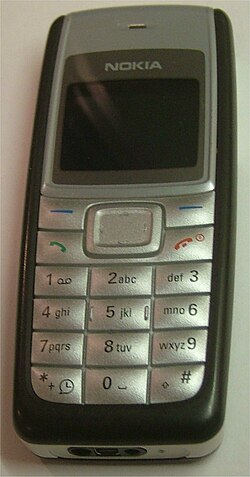
The Nokia 1110 and Nokia 1110i/1112 are low-end GSM mobile phones which were made by Nokia. The 1110 was released in 2005; the 1110i/1112 was released in 2006. Both were aimed at first-time mobile phone users. In Nokia's view, the 1110i had the advantage of ease-of-use, reliability and a low price.[2][3] These phones are very similar to the Nokia 1100. Between January and May 2007, the 1110 was marketed by Nokia as their standard low-end monochrome model before being superseded by the Nokia 1200.[4] One of its key markets was that of developing countries.[4]
The Nokia 1110 is the second-highest-sold mobile device of all time, selling about 250 million units.[5]
Features
[edit]The Nokia 1110 has an inverted black and white display with amber green backlight, while the 1110i/1112 has a regular or non-inverted black and white display with green and white backlight.
It has five hours of battery talktime and allows Call Barring. It has a speaking alarm and clock, analog clock display, and call management timers and counters.
It comes with three built-in games:
From 2005 (for 1110): Pocket Carrom, Dice Games and Cricket Cup.
From 2006 (for 1110/1110i/1112): Pocket Carrom, Dice Games and Snake Xenzia.
From 2007 (for 1112): Rapid Roll, Dice Games and Snake Xenzia.
It supports picture messaging to send a picture greeting. It also included a Ringtone Composer, like the Nokia 1600.
See also
[edit]References
[edit]
- ^ "Nokia 1110 - Full phone specifications".
- ^ "Nokia Press Release (19 June 2006)".
- ^ Nokia launches two new handsets as part of its strategy for growth markets, forbes.com, 2 June 2005. Accessed on line 4 December 2007.
- ^ a b Bremner, Brian (30 January 2007). "India Blows by China in Mobile Phone Market Growth". BusinessWeek. Archived from the original on 2 February 2007. Retrieved 3 July 2007.
All this explains why global handset makers such as Nokia, Motorola and Samsung are shifting product development efforts and marketing strategies to emerging markets [..] Nokia, which has invested heavily in emerging markets, late last year slashed the price of its basic monochrome model —the Nokia 1110 [and] has three phones in the sub-$50 range.
- ^ "20 bestselling mobile phones of all time". The Telegraph. 26 January 2016.
External links
[edit]Nokia-branded mobile devices | |||
|---|---|---|---|
| 1000 series | |||
| 2000 series | |||
| 3000 series | |||
| 5000 series | |||
| 6000 series |
| ||
| 7000 series | |||
| 8000 series | |||
| 9000 series (Communicator) | |||
| 3-digit series (feature phone) | |||
| Asha series |
| ||
| Cseries | |||
| Eseries | |||
| Nseries |
| ||
| Xseries | |||
| 3-digit series (Symbian phone) | |||
| Lumia |
| ||
| Internet tablet | |||
| N-Gage | |||
| X family | |||
| Android smartphones2 | |||
| Originals2 | |||
| C series2 | |||
| G series2 | |||
| T series2 | |||
| X series2 | |||
| Other | |||

Nokia 1110
View on GrokipediaDevelopment and release
Development background
The Nokia 1110 was developed as a direct successor to the highly successful Nokia 1100 and 1101 models, building on their proven formula to serve first-time mobile users in developing countries by prioritizing simplicity and affordability.[10] The Nokia 1100 series had achieved remarkable market penetration, with sales exceeding 200 million units by 2007, which underscored the demand for basic, reliable devices in emerging economies and directly influenced Nokia's strategy to iterate on this low-end segment.[10] Key development goals for the 1110 centered on enhancing ease of use, reliability, low cost, and durability to meet the essential communication needs of users in resource-constrained environments.[11] Nokia engineers focused on minimizing complexity, ensuring the phone could withstand harsh conditions common in target regions while keeping production costs down through streamlined components.[12] The primary target markets were emerging economies, where access to advanced features was limited, and Nokia designed the 1110 with a monochrome display and minimal functionality to further reduce manufacturing expenses and appeal to budget-conscious consumers seeking straightforward voice and SMS capabilities.[12] This approach aligned with Nokia's broader emphasis on "new growth markets," positioning the device as an accessible entry point to mobile connectivity for underserved populations.[13]Launch and availability
The Nokia 1110 was officially announced on June 2, 2005, during a press conference in Nairobi, Kenya, and became commercially available starting in the third quarter of 2005.[14] It was positioned as an entry-level GSM phone targeted at first-time users in emerging markets, with an initial estimated retail price of around 65 euros (approximately $78) before subsidies or taxes.[14] By later in its lifecycle, it was commonly available for under $50 in many markets, reinforcing its role as Nokia's standard low-end monochrome model until its replacement by the Nokia 1200 in May 2007.[1][15] Variants followed in 2006, including the Nokia 1110i announced in June and the Nokia 1112 announced in March, both serving as upgraded regional models with enhancements over the original.[9][16] The 1110i featured a regular black-and-white display with green-white backlight—contrasting the original's inverted display—and added capabilities like picture messaging for sending simple image greetings, alongside a speaking alarm and clock.[9] The 1112, positioned as a similar regional variant, incorporated comparable upgrades such as picture messaging and a non-inverted black-and-white display, tailored for specific locales with minor adaptations in language support and band compatibility.[17] Availability emphasized developing regions, with the standard model supporting GSM 900/1800 bands for Europe, Asia, and Africa, while a US version used GSM 850/1900 bands for the Americas.[1][4] Distribution focused on growth markets like Africa, where subscriber numbers were projected to double from 100 million to 200 million between 2005 and 2009, though penetration remained limited in high-income markets due to its basic feature set.[14]Design and specifications
Physical design
The Nokia 1110 adopts a slim candybar form factor, with dimensions of 104 × 44 × 17 mm and a weight of 80 g, contributing to its high portability and ease of handling.[1] This compact design was tailored for users in developing markets seeking a reliable, pocket-friendly device.[18] The phone's build utilizes durable plastic construction, which supports interchangeable covers for personalization and straightforward repairs. These covers enhance the device's aesthetic versatility while maintaining structural integrity suitable for everyday use. Its keypad features a standard numeric layout with dedicated soft keys for navigation and functions, promoting one-handed operation. The display is an inverted black-and-white monochrome graphic type, with a resolution of 96 × 68 pixels and an amber backlight for visibility in low-light conditions on the base model; the 1110i variant features a non-inverted display with green backlight.[1][19][18] Ergonomically, the Nokia 1110 emphasizes simplicity and resilience, with an overall rugged design optimized for challenging environments in emerging economies.[20] This focus on durability and intuitive handling made it ideal for users requiring a robust, no-frills handset.[21]Technical specifications
The Nokia 1110 supports dual-band GSM networks, operating on 900/1800 MHz frequencies for the global version and 850/1900 MHz for the US variant, enabling basic voice calls and SMS messaging without data services like GPRS.[1][4] It is powered by a removable BL-5C Li-Ion battery with a capacity of 900 mAh, offering up to 5 hours of talk time and 380 hours of standby time depending on usage and network conditions.[1][4][22] The device features 4 MB of internal storage for contacts, messages, and basic functions, with no support for expandable memory via card slots.[1][4] Audio capabilities include a built-in loudspeaker for hands-free speakerphone use and support for 20-chord polyphonic ringtones, while connectivity is limited to a basic charger port with no Bluetooth, USB data transfer, or wireless features.[1][4][22] The phone runs on Nokia's Series 30 platform, optimized for simple operations like calling, texting, and profile management.[1]Features and software
User interface and software
The Nokia 1110 operated on the Nokia Series 30 platform, a lightweight software environment tailored for entry-level mobile devices emphasizing simplicity and reliability over advanced multimedia capabilities.[23] This platform provided a streamlined operating system focused on core telephony functions, with a menu-driven interface that prioritized ease of access for users in emerging markets. The software was optimized for low resource consumption, ensuring stable performance on the device's limited hardware without support for complex applications or internet connectivity.[22] The user interface centered around a monochrome LCD display featuring text-based menus and icons, allowing for straightforward navigation via dedicated keys. Input was handled through a numeric keypad supporting traditional multi-tap entry or T9 predictive text for composing SMS messages, which suggested words based on key presses (e.g., pressing 6-6-5-4-2 to input "Nokia") and was available in multiple supported languages.[22] Two soft keys below the display dynamically assigned functions—such as "Menu," "Options," or "Back"—based on the current screen context, while a central scroll key facilitated menu traversal. In standby mode, the display showed essential indicators like signal strength, battery level, and soft key labels, with shortcuts for quick access: scrolling up for call register, down for contacts, left for messages, and right for a demo mode overview.[22] Basic operations were designed for intuitive handling, including call management where users could dial numbers directly, redial recent calls with a single key press, or access speed dials from the contacts menu. The phonebook supported storage of up to 200 names and numbers, searchable alphabetically or by scrolling, with options to add, edit, or delete entries via the main menu.[22] Settings menus allowed customization of profiles for ringtones and vibrations, display options like backlight timeout, and phone language selection from a predefined list, all navigated through a hierarchical structure accessible by the menu key and exited via back or end keys. Network-dependent features, such as call diverting, required activation through the service provider.[22] The interface's limitations reflected its focus on basic usability, lacking color graphics, animations, or graphical icons beyond simple text, which kept the experience minimalistic and battery-efficient. This design catered to non-technical users by avoiding overwhelming options, though shared memory across functions like messages and contacts could limit storage if heavily used, and T9 functionality was restricted to specific languages without support for extensive accented characters.[22]Key features
The Nokia 1110 provided essential communication tools tailored for basic mobile use, including support for SMS messaging that allowed users to send and receive text messages, with the capability to handle multi-part messages for longer content. The 1110i variant extended this with picture messaging, enabling the inclusion of simple graphics in SMS for more expressive communication. Additionally, the phone supported call barring to restrict incoming or outgoing calls as a security measure, and call timers that tracked the duration of calls for monitoring usage.[22][9][22] Productivity aids on the Nokia 1110 focused on everyday time management, featuring a speaking alarm and clock that could audibly announce the time or alarm alerts when activated. Users could also display an analog clock on the idle screen via the power saver mode, providing a classic visual time reference without draining the battery excessively.[22] For entertainment, the device included three pre-installed games—Snake Xenzia, a variation of the classic Snake where players navigated a growing line to collect food; Pocket Carrom, a digital take on the tabletop game; and additional options like dice-based challenges—offering simple diversions during downtime. The Ringtone Composer tool allowed users to create custom polyphonic ringtones by inputting musical notes via the keypad, supporting up to 20 voices for personalization.[1] Additional utilities encompassed basic enhancements like the screen backlight, which could function as a rudimentary flashlight in low-light conditions by illuminating the display. Select variants, such as certain regional 1110i models, incorporated an FM radio for tuning into broadcasts, though this was not standard across all units.[1]Reception and legacy
Commercial performance
The Nokia 1110 achieved remarkable commercial success, with approximately 250 million units sold worldwide, establishing it as one of the best-selling mobile phones in history alongside the Nokia 1100.[6][24] This volume significantly bolstered Nokia's revenue in the low-end segment, where the phone's initial retail price of around $65 (65 EUR) made it accessible to budget-conscious consumers.[25][21] The device dominated market share in emerging economies, particularly through its appeal in regions with high demand for affordable, reliable handsets.[26] Key factors contributing to this success included its low cost, robust build capable of withstanding harsh conditions, and extended battery life, which fostered strong adoption via grassroots recommendations in developing regions.[7] Sales were concentrated in Asia, Africa, and Latin America, where the phone's simplicity met the needs of first-time users and rural markets, while penetration remained limited in developed countries favoring feature-rich devices.[26] Following peak sales in the mid-2000s, the Nokia 1110 was succeeded by the Nokia 1200 as Nokia's entry-level model in 2007.[23]Cultural impact and legacy
The Nokia 1110 earned iconic status through its renowned reliability and simplicity, qualities that cemented its reputation as a durable "brick" phone capable of enduring drops, dust, and daily wear without failing.[27] Users and reviewers frequently highlighted its robust construction and extended battery life, fostering anecdotes of the device surviving extreme conditions, which bolstered Nokia's perception as an accessible budget brand focused on essential functionality.[28] In cultural narratives and media portrayals, the Nokia 1110 emerged as a symbol of early mobile adoption, particularly in emerging and export markets where budget-friendly devices were vital for basic communication.[7] It represented the democratizing power of feature phones, enabling widespread connectivity in regions with limited infrastructure and underscoring a preference for uncomplicated technology even as smartphones proliferated.[27] The phone's minimalist candybar design influenced standards for low-end mobile devices, establishing a template for compact, ergonomic forms that prioritized usability and affordability over advanced features.[29] This approach contributed to Nokia's broader legacy in shaping entry-level phone aesthetics, as seen in the company's shift toward customizable, youth-oriented handsets that blended durability with everyday appeal.[30] In contemporary contexts, the Nokia 1110 sustains relevance through nostalgia-driven collector interest and its inclusion in historical overviews of influential mobiles, often praised for bridging the digital divide by delivering reliable access in underserved areas.[27] Its legacy evokes a simpler era of mobile use, contrasting with today's app-centric devices and inspiring retrospectives on sustainable, long-lasting technology.[28]References
- https://lpcwiki.miraheze.org/wiki/Nokia_1110