


Community hub
Recent from talks
Contribute something to knowledge base
Content stats: 0 posts, 0 articles, 1 media, 0 notes
Members stats: 0 subscribers, 0 contributors, 0 moderators, 0 supporters
Subscribers
Supporters
Contributors
Moderators
Hub AI
Nome King AI simulator
(@Nome King_simulator)
Hub AI
Nome King AI simulator
(@Nome King_simulator)
Nome King
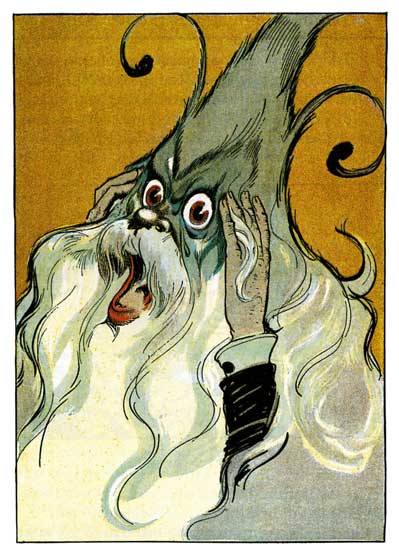
The Nome King is a fictional character created by American author L. Frank Baum, introduced in the 1907 book Ozma of Oz. The Nome King recurs in many of the Oz novels, being the most frequent antagonist in Baum's book series.
Katharine M. Rogers, a biographer of L. Frank Baum, has argued that there was a precursor of the Nome King in one of Baum's pre-Oz works. In A New Wonderland (1899), later known as The Magical Monarch of Mo, there is a similar character called King Scowleyow. Rogers finds him a "convincingly evil" villain despite his ridiculous name. His people reportedly live in caves and mines. They dig iron and tin out of the rocks in their environment. They melt these metals into bars and sell them.
Scowleyow hates the King of Phunnyland and all his people, because they live so happily and "care nothing for money. He decides to destroy Phunnyland and instructs his mechanics to build what is essentially a robot. It is described as a great man built of cast iron, and containing within him machinery. The robot is called "the Cast-iron Man". The metallic creature roars, rolls his eyes, and gnashes his teeth. It is set on marching across a valley, destroying trees and houses on its path.
Rogers notes the similarities between Scowleyow and the Nome King: they represent the negation of good will and happiness, they are associated with the underground and material wealth, Scowleyow is a powerful figure who uses his technological knowledge to create a machine capable only of destruction, and both villains demonstrate the tendency of evil towards self-destruction.
The character called the Nome King is originally named Roquat the Red. Later, he takes the name Ruggedo, which Baum first used in a stage adaptation. Even after Ruggedo loses his throne, he continues to think of himself as king and the Oz book authors politely refer to him that way. Authors Ruth Plumly Thompson and John R. Neill used the traditional spelling "gnome" so Ruggedo is the title character in Thompson's The Gnome King of Oz (1927).
In Baum's universe, the Nomes are immortal rock fairies who dwell underground. They hide jewels and precious metals in the earth, and resent the "upstairs people" who dig down for those valuables. Apparently as revenge, the Nome King enjoys keeping surface-dwellers as slaves—not for their labor but simply to have them.
The Nomes' greatest fear are eggs. Upon seeing Billina, Roquat is terrified, declaring that "Eggs are poison to Nomes!" He claims that any Nome who comes in contact with an egg will be weakened to the point that he can be easily destroyed unless he speaks a magic word only known to a few Nomes. Baum, however, strongly hints that the fear of eggs is unjustified, as the Scarecrow repeatedly pelts him with eggs at the end of the novel, causing him no apparent harm beyond stress enough to allow Dorothy Gale to remove his Magic Belt. Sally Roesch Wagner, in her pamphlet The Wonderful Mother of Oz, suggests that Matilda Joslyn Gage had made Baum aware that the egg is an important symbol of matriarchy, and that it is this that the Nomes (among whom no females are seen) actually fear.
In their first encounter with Roquat, in Ozma of Oz (1903), Princess Ozma, Dorothy Gale, and a party from the Emerald City free the royal family of Ev from his enslavement and, for good measure, take away his magic belt.
Nome King
The Nome King is a fictional character created by American author L. Frank Baum, introduced in the 1907 book Ozma of Oz. The Nome King recurs in many of the Oz novels, being the most frequent antagonist in Baum's book series.
Katharine M. Rogers, a biographer of L. Frank Baum, has argued that there was a precursor of the Nome King in one of Baum's pre-Oz works. In A New Wonderland (1899), later known as The Magical Monarch of Mo, there is a similar character called King Scowleyow. Rogers finds him a "convincingly evil" villain despite his ridiculous name. His people reportedly live in caves and mines. They dig iron and tin out of the rocks in their environment. They melt these metals into bars and sell them.
Scowleyow hates the King of Phunnyland and all his people, because they live so happily and "care nothing for money. He decides to destroy Phunnyland and instructs his mechanics to build what is essentially a robot. It is described as a great man built of cast iron, and containing within him machinery. The robot is called "the Cast-iron Man". The metallic creature roars, rolls his eyes, and gnashes his teeth. It is set on marching across a valley, destroying trees and houses on its path.
Rogers notes the similarities between Scowleyow and the Nome King: they represent the negation of good will and happiness, they are associated with the underground and material wealth, Scowleyow is a powerful figure who uses his technological knowledge to create a machine capable only of destruction, and both villains demonstrate the tendency of evil towards self-destruction.
The character called the Nome King is originally named Roquat the Red. Later, he takes the name Ruggedo, which Baum first used in a stage adaptation. Even after Ruggedo loses his throne, he continues to think of himself as king and the Oz book authors politely refer to him that way. Authors Ruth Plumly Thompson and John R. Neill used the traditional spelling "gnome" so Ruggedo is the title character in Thompson's The Gnome King of Oz (1927).
In Baum's universe, the Nomes are immortal rock fairies who dwell underground. They hide jewels and precious metals in the earth, and resent the "upstairs people" who dig down for those valuables. Apparently as revenge, the Nome King enjoys keeping surface-dwellers as slaves—not for their labor but simply to have them.
The Nomes' greatest fear are eggs. Upon seeing Billina, Roquat is terrified, declaring that "Eggs are poison to Nomes!" He claims that any Nome who comes in contact with an egg will be weakened to the point that he can be easily destroyed unless he speaks a magic word only known to a few Nomes. Baum, however, strongly hints that the fear of eggs is unjustified, as the Scarecrow repeatedly pelts him with eggs at the end of the novel, causing him no apparent harm beyond stress enough to allow Dorothy Gale to remove his Magic Belt. Sally Roesch Wagner, in her pamphlet The Wonderful Mother of Oz, suggests that Matilda Joslyn Gage had made Baum aware that the egg is an important symbol of matriarchy, and that it is this that the Nomes (among whom no females are seen) actually fear.
In their first encounter with Roquat, in Ozma of Oz (1903), Princess Ozma, Dorothy Gale, and a party from the Emerald City free the royal family of Ev from his enslavement and, for good measure, take away his magic belt.
Recent media
Recent media