Hubbry Logo
Emerald CityEmerald CityMain
Open search
Emerald City
Community hub
Emerald City
logo
8 pages, 0 posts
0 subscribers
Be the first to start a discussion here.
Emerald City
Emerald City
from Wikipedia
Emerald City
The Oz series location
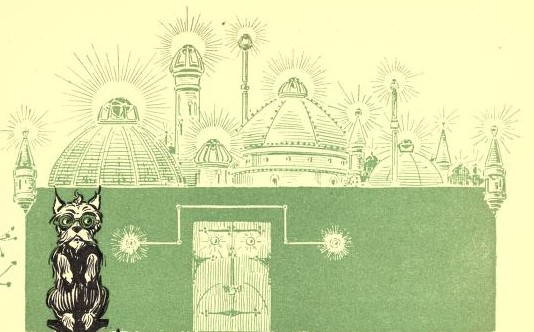
Illustration by W. W. Denslow
First appearanceThe Wonderful Wizard of Oz
Created byL. Frank Baum
GenreChildren's fantasy
In-universe information
TypeCapital city
Ruled byPrincess Ozma
LocationsOzma's palace
CharactersWizard of Oz, Dorothy Gale (eventually), Soldier with the Green Whiskers, Jellia Jamb
Population57,318 (1910 census)

The Emerald City (sometimes called the City of Emeralds) is the capital city of the fictional Land of Oz in L. Frank Baum's Oz books, first described in The Wonderful Wizard of Oz (1900).

Fictional description

[edit]

Located in the center of the Land of Oz, the Emerald City is the end of the famous yellow brick road, which begins in Munchkin Country. In the center of the Emerald City is the Royal Palace of Oz. The Oz books generally describe the city as being built of green glass, emeralds, and other jewels.

In the earlier books, it was described as completely green. However, in later works, green was merely the predominant color while buildings were also decorated with gold, and people added other colors to their costumes.[1]

In The Wonderful Wizard of Oz (1900)

[edit]

In the first book, The Wonderful Wizard of Oz (1900), the walls are green, but the city itself is not. However, when they enter, everyone in the Emerald City is made to wear green-tinted spectacles. This is explained as an effort to protect their eyes from the "brightness and glory" of the city, but in effect makes everything appear green when it is, in fact, "no more green than any other city". This is yet another "humbug" created by the Wizard.[2]

One scene of the Emerald City is of particular note in the development of Oz: Dorothy sees rows of shops that sell green articles of every variety and a vendor who sells green lemonade that children buy with green pennies. This contrasts with the later description of Oz, in which money does not feature. Interpreters have argued that the Wizard may have introduced money into the city, but this is not in the text itself.[3]

In this book, the Wizard also describes the city as having been built for the Wizard within a few years after he arrived.[4] It was he who decreed that everyone in the Emerald City must wear green eyeglasses, since the first thing he noticed about Oz after he landed in his hot air balloon was how green and pleasant the land was.

In The Marvelous Land of Oz (1904)

[edit]

In The Marvelous Land of Oz (1904), the characters are required to wear the glasses at first, but, contrast to the preceding Wonderful Wizard of Oz (1900), halfway through the book, no more eyeglasses appear and no more mention is made of the brilliance, but the city is still described as green.[5] This is continued throughout the series.

Although at one point the character Tip describes the city as being built by the Wizard, the Scarecrow later explains that the Wizard had usurped the crown of Pastoria, the former king of the city, and from the Wizard the crown had passed to him. The book quickly concerns itself with finding the rightful heir to the crown of the city.[6] Princess Ozma remained the king's heir, though both she and the original king were transformed to the ruler of all Oz.[7]

Later works

[edit]

The story reverted to the Wizard's having built the city in Dorothy and the Wizard in Oz (1908), with the four witches having usurped the king's power before the Wizard's arrival.[8]

The only allusions to the original conception of Emerald City among the Oz sequels appeared in The Road to Oz (1909), where the Little Guardian of the Gates wears green spectacles—though he is the only character to do so.[1]

The Emerald City of Oz (1910)

The Emerald City of Oz (1910), the sixth book in the Oz series, describes the city as having exactly 9,654 buildings and 57,318 citizens.[9]

Inspiration

[edit]

Baum may have been partly inspired in his creation of the Emerald City by the World Columbian Exposition of 1893, nicknamed the "White City,"[10] which he visited frequently, having moved to Chicago in anticipation of the event. W. W. Denslow, who illustrated the original Oz book, also incorporated elements that may have been inspired by the White City.[11] Denslow was familiar with the exposition as he had been hired to sketch and document it for the Chicago Times. Likewise, the quick building of the real-life White City, in less than a year, may have contributed to the quick construction of the Emerald City in the first book.[4]

Others believe Baum may have based his description of the city on the Hotel del Coronado, where he supposedly did much of his writing.[12]

Interpretations

[edit]

Capitalist America

[edit]

Scholars who interpret The Wonderful Wizard of Oz as a political allegory see the Emerald City as a metaphor for Washington, D.C., and unsecured "greenback" paper money. In this reading of the book, the city's illusory splendor and value are compared with the value of fiat money, which also has value only because of a shared illusion or convention. Here, Dorothy gains entry to the Emerald City (Washington, D.C.) wearing the witch's silver slippers (the silver standard) and taking the Yellow Brick Road (the gold standard). There, she met the Wizard (President William McKinley), whose power was eventually revealed to be an illusion.[13]

Post-Industrial America

[edit]

There are also scholars who interpret the Emerald City as a benevolent vision of America with its new priorities and values that emerged with the onset of the industrial order.[14] Some claim, for instance, that it is 1890s Chicago, which rose on a plain, subsuming unto itself much of the Midwestern creative aspiration so that it becomes the Garden of the West that has long struggled in its prairies.[15] This interpretation focused on the affirmative descriptions of the city, which reveal the benefits and rewards of the new culture, particularly urban abundance and the economy of consumption.[14]

Other

[edit]

More recently it has been speculated that the name “Emerald City” may be referring to the city of Seattle, Washington. This is incorrect as the American city gained its “Emerald City” nickname in 1982,[16] over 80 years after the publication of Baum's first book.

Known locations

[edit]
  • Notta Bit More's Tent – A tent outside the Royal Palace of Oz where Notta Bit More resides.
  • Prison – This is the only prison in the Land of Oz, and it is run by Tollydiggle. The prison is rarely occupied due to lack of crime. Accordingly, Ojo is the only notable prisoner here.
  • Royal Palace of Oz – The Royal Palace of Oz is at the center of the Emerald City. This is where the rulers of the Land of Oz reside. It contains a throne room, the royal gardens, and the royal suites for the guests to the Royal Palace.

Adaptations and allusions

[edit]

In city branding

[edit]

United States of America

[edit]

The City of Seattle has used "The Emerald City" as its official nickname since 1982.[17] There is also a drink known as "Emerald City" that is associated with the city of Seattle.[18]

Eugene, Oregon is also referred to as the Emerald City, and the region has been known as the "Emerald Empire" as early as 1928.[19]

Greenville, North Carolina is called the Emerald City by locals and tourists alike. The city has an art loop in the uptown district that is called the emerald loop,[20] and on New Years Eve, the city drops an Emerald in the Town Common Park.[21]

Peter Kaplan, a media icon and the former editor of the New York Observer, a newspaper that chronicled the city's political, financial and cultural elites, frequently referred to New York as the "Emerald City."[22][23]

Sydney, Australia

[edit]

In 1987, David Williamson—whose brother-in-law scripted the musical film Oz (1976)—wrote the play Emerald City in which the character Elaine Ross describes Sydney metaphorically as "the Emerald City of Oz." Sydney is where people go expecting their dreams to be fulfilled only to end up with superficial substitutes and broken dreams.[24]

In 2006, the annual Sydney New Year's Eve was entitled "A Diamond Night in Emerald City", where the "Diamond Night" alluded to the 75th anniversary of the opening of the Sydney Harbour Bridge.[25] Subsequently, "Emerald City" has occasionally been used as an unofficial nickname for the City of Sydney.[26]

The head office of the Sydney-based merchant banking and private equity firm Emerald Partners is located on top of the Museum of Contemporary Art Australia building on the Sydney Harbour foreshore, at Circular Quay. The firm was named after Baum's book and the David Williamson play.[citation needed]

Fittingly, the word "Oz" can refer to "Australia" in colloquial Australian speech.[27]

A long-running gossip column in the Sydney Morning Herald, the city's flagship newspaper, is named "Emerald City."[28]

Asia

[edit]

Muntinlupa is nicknamed as the "Emerald City of the Philippines" by the Department of Tourism.

In cinema & live production

[edit]
The Emerald City at Universal Studios Japan
  • The city appears in the film The Wizard of Oz (1939), directed by Victor Fleming.
  • The 1976 Australian musical Oz is a reimagining of Baum's original story, set in 1970s Australia.
  • The 1978 musical The Wiz, the plaza and main buildings of the World Trade Center serve as the setting for the Emerald City.[29]
  • The city appears in Return to Oz, having been destroyed by the Nome King with all of its inhabitants turned to stone. When Dorothy enters, she finds the city inhabited by Wheelers and ruled over by Mombi. Upon retrieving the ruby slippers from the Nome King, Dorothy uses their power to restore the Emerald City to its former glory.
  • The 1987 Australian play Emerald City satirizes the entertainment industry and uses the Emerald City as a metaphor for Sydney, Australia.[24]
  • The 2003 stage musical Wicked, written by Stephen Schwartz and Winnie Holzman, depicts the city in the song 'One Short Day', with Glinda and Elphaba visiting the sights of the city on their way to meet the Wizard. Glinda is seen wearing the green spectacles, as per tradition of the city in The Wonderful Wizard of Oz.
  • The city appears in the 'One Short Day' sequence of the film Wicked (2024), based on the musical of the same name directed by Jon M. Chu. The sequence includes a musical within the scene named Wiz-O-Mania, advertised as the "absolutely factual story of the wonderful Wizard of Oz".

In television

[edit]
  • The city appears in the Wizard of Oz TV series. After the Wicked Witch of the West is resurrected by her loyal Flying Monkeys, she casts a spell on the Emerald City that tarnishes it.
  • The HBO prison series Oz takes place mostly in the experimental unit Emerald City (colloquially EM City) of the fictional Oswald State Penitentiary, somewhere in New York.
  • The city can be seen on the hit ABC TV show Once Upon A Time.
  • Emerald City is alluded to through "Central City," one of the chief settings in the Sci Fi television miniseries Tin Man (2007). The show is a re-imagining of Baum's world that alludes to many of the locales of Oz. Central City is a completely computer-generated set, one of the largest for a television series of its time, according to the production designer, Michael Joy.[30] Its scenic design features heavy elements of steampunk and pays visual homage to Blade Runner (1982), according to co-creator Craig van Sickle.[31] Likewise, the "Outer Zone" (O.Z.) is described as a bleak rendition of the beautiful world of Oz.[32]
  • The 2017 NBC TV series Emerald City.
  • The Emerald City appears in Dorothy and the Wizard of Oz

In literature

[edit]

In Gregory Maguire's revisionist Oz novels, Wicked: The Life and Times of the Wicked Witch of the West (1995) and Son of a Witch (2005), the Emerald City is a much darker place than in Baum's novels. It does have splendid palaces and gardens, but sections are also beset by crime and poverty. Son of a Witch introduces Southstairs, an extensive political prison located in the caves below the Emerald City. The green glasses worn by the citizens are often used as a way to stop them from seeing what is going on around them.

In video games

[edit]

The video game Emerald City Confidential (2009) portrays the Emerald City as a film noir place with private detectives, widespread corruption, mob bosses, smugglers, and crooked lawyers. Set 40 years after the events of The Wizard of Oz, its described as "Oz, seen through the eyes of Raymond Chandler".[33]

Other allusions

[edit]

The Green Zone in Baghdad is sometimes ironically and cynically referred to as the Emerald City.[34]

References

[edit]
Revisions and contributorsEdit on WikipediaRead on Wikipedia
from Grokipedia
The Emerald City is the capital of the fictional , introduced by American author in his 1900 children's novel . Situated at the exact center of Oz, the city is portrayed as a grand metropolis constructed entirely of green marble buildings studded with emeralds, with streets paved in the same material and lined with sparkling gems. To protect inhabitants from its dazzling brilliance, all residents and visitors are compelled to wear green-tinted spectacles fastened with gold chains and locked by the Guardian of the Gates, creating the pervasive illusion of an emerald-colored environment. Initially governed by the enigmatic Wizard of Oz, who maintains seclusion in his emerald-encrusted palace, the city becomes the seat of Princess Ozma's rule after the Wizard's departure and the Scarecrow's interim leadership in the original narrative. Baum's subsequent Oz books, such as The Marvelous Land of Oz (1904) and The Emerald City of Oz (1910), expand the city's role as the political and cultural hub of the realm, featuring elaborate descriptions of its palaces, gardens, and magical defenses against external threats. The Emerald City's iconic green motif and utopian splendor have cemented its status as a enduring symbol of wonder in children's literature, influencing numerous adaptations including the 1939 MGM film The Wizard of Oz. While unrelated to the 1982 nickname for Seattle—derived from the city's evergreen foliage—the fictional locale predates and overshadows such real-world appropriations in cultural significance.

Literary Origins

Creation and Initial Description in The Wonderful Wizard of Oz (1900)

The Emerald City was conceived by as the glittering capital of the fictional in his 1900 children's novel , serving as the seat of power for the enigmatic Wizard who draws and her companions to seek his aid. Baum, aiming to craft an American fairy tale free of the moralistic tone of traditional , invented the city as a symbol of illusory splendor within Oz's magical yet deceptive realm, where the protagonists' quest culminates. Published on May 17, 1900, by the George M. Hill Company in , the book marked the Emerald City's debut in literature, with Baum initially contemplating The Emerald City as the title before rejecting it to preserve narrative surprise. The city's initial portrayal occurs as Dorothy, the Scarecrow, the Tin Woodman, and the Cowardly Lion approach via the yellow brick road in Chapter X, "The Guardian of the Gates," sighting its enclosing wall: a massive barrier "very high and very thick," rendered in bright green and embedded with "countless glittering emeralds" along its top and surface. At the road's end, a grand gate prompts entry via the Guardian, a short green-uniformed figure who mandates locked green-tinted spectacles for all visitors to shield their eyes from the presumed glare of the city's treasures—a requirement later revealed as a compulsion fostering the illusion of emerald ubiquity. Upon entering in Chapter XI, "The Wonderful Emerald City of Oz," the travelers behold streets paved in green marble, edged with emerald-set joints forming a pattern, flanked by houses of green marble "studded everywhere with sparkling emeralds" and featuring green windows that tint the entire vista emerald-hued. Inhabitants, clad in green garments with faintly greenish tones, appear prosperous and content, underscoring the city's facade of ; Baum describes the scene as dazzling even through the spectacles, with filtering greenly overhead. This establishes the Emerald City not merely as a destination but as a pivotal element in the narrative's exploration of perception versus reality, where enforced enforces a of wealth.

Developments in Baum's Subsequent Oz Books

In The Marvelous Land of Oz, published July 5, 1904, the Emerald City experiences political upheaval when General Jinjur and her Army of Rebellious Girls march on the capital, overthrowing as king and seizing . The invaders loot the royal treasures, fashioning emerald jewelry from the furnishings, and abolish the mandatory green-tinted spectacles, confirming the city's structures are verifiably composed of genuine emeralds rather than illusory enhancements. Restoration follows through alliances with the Scarecrow's improvised forces and Glinda's magic, establishing Ozma as the permanent, fairy-descended sovereign and affirming the city's status as Oz's political core. Books like (1907) and (1909) portray the Emerald City under Ozma's steady governance as a vibrant, welcoming center for visitors and festivities, with no structural changes but enhanced depictions of its grandeur and the ruler's progressive policies, such as prohibiting killing within Oz. The Emerald City of Oz (1910) introduces existential peril as Roquat 54321/4 tunnels beneath the barriers to conquer the city, transforming captives into decorative ornaments via magic belts until defeated by eggs—lethal to Nomes—and other countermeasures. In aftermath, and the Wizard encircle Oz with an impenetrable, invisible dome, severing external access to preserve peace, a narrative device Baum designed to conclude the series amid his growing disinterest in Oz tales. Subsequent volumes, including The Patchwork Girl of Oz (1913) through Glinda of Oz (1920), maintain the isolated, fortified Emerald City as Ozma's unchallenged seat, site of inventions like the Frogman's contrivances and defenses against sporadic threats, underscoring its evolution into an impregnable emblem of Oz's self-contained harmony.

Expansions by Later Authors

Ruth Plumly Thompson assumed the role of Royal Historian of Oz following L. Frank Baum's death on May 6, 1919, and authored 19 sequels published by Reilly & Lee from 1921 to 1939, with many narratives originating in or revolving around the Emerald City as the empire's administrative and social core. These works expanded the city's lore by integrating new permanent residents and institutions, such as the royal elephant Kabumpo in Kabumpo in Oz (1922), who resides in Ozma's palace stables, and various whimsical courtiers like the Runaway Spoon and the Silver Hen, thereby diversifying the palace's entourage beyond Baum's core characters like the Scarecrow and Tin Woodman. Thompson's depictions reinforced the city's green-hued opulence while introducing annual customs, such as elaborate birthday celebrations for Ozma and her court, which feature parades and magical displays centered in the city's streets and squares. John R. Neill, Baum's longtime illustrator, transitioned to authorship for three Oz books published between 1940 and 1942, beginning with The Wonder City of Oz (1940), where he reimagined the Emerald City with 20th-century urban elements including skyscrapers, gas stations, and animated infrastructure like talking houses and singing shoes. This modernization marked a departure from Baum's , fairy-tale , portraying the city as a bustling with mechanical conveniences, such as scalawagons—self-propelled vehicles—in The Scalawagons of Oz (1941), which originate from Emerald City factories and facilitate rapid travel within its environs. Neill's additions emphasized technological whimsy, with clocks that run backward and objects endowed with personality, expanding the city's fantastical yet increasingly industrialized character. Subsequent canonical authors under Reilly & Lee, including Jack Snow in The Magical Mimics in Oz (1946) and The Shaggy Man of Oz (1948), further utilized the Emerald City as a staging ground for invasions and enchantments, such as the mimics' infiltration mimicking residents to seize control, which tested the city's defenses and highlighted its vulnerability despite magical protections. These expansions collectively broadened the Emerald City's narrative function from Baum's isolated gem to a dynamic, evolving hub susceptible to external threats and internal innovations, while preserving its status as Oz's unbreachable heart.

Fictional Characteristics

Physical Appearance and Architecture

The Emerald City is surrounded by a high, thick wall made of bright green marble, visible from afar as a gleaming barrier encircling the . This wall includes gates, such as the one at the end of the , adorned with large emeralds that glitter in the sunlight and contribute to the city's dazzling appearance. Upon entering, visitors pass through arched gateways into interiors where walls glisten with embedded emeralds. The city's streets are paved with slabs of green marble, their joints inlaid with rows of emeralds, while buildings are constructed from green marble blocks studded throughout with sparkling emeralds, creating an impression of immense wealth and uniformity in hue. Windows feature panes of green glass, tinting the and with green, enhanced by the mandatory green spectacles worn by all entrants to shield against the purported of the gems. The Royal dominates the center, a grand edifice with a prominent dome amid towers and spires, containing expansive rooms with green marble furnishings, emerald-set carpets, and a throne room whose walls, ceiling, and floor are covered in closely packed emeralds, centered around a brilliant source. In (1910), Baum elaborates on the scale, stating the city comprises 9,654 buildings housing 57,318 inhabitants, with exteriors presenting emeralds prominently, though the green spectacles enforce the perception of verdant splendor. Additional features include green marble bridges over internal channels, ornate fountains in spraying perfumed water, and surrounding gardens with statues, all upholding the architectural theme of gem-encrusted opulence without deviation from the green motif.

The Green Spectacles and Perception of Wealth

In , visitors to the Emerald City, including Dorothy and her companions, are compelled by the Guardian of the Gates to don green-tinted spectacles, which are locked onto their heads with a and key to ostensibly their eyes from the city's overwhelming "brightness and glory." These spectacles tint the entire urban landscape in shades of green, rendering buildings, streets, and decorations as if encrusted with emeralds, thereby projecting an image of extraordinary opulence and material splendor. The mandate applies universally to entrants, fostering a collective visual experience that amplifies the city's apparent wealth, with descriptions emphasizing emerald-studded gates, green marble edifices, and verdant hues permeating every vista. The Wizard of Oz later confesses to Dorothy that the spectacles serve no protective function but instead fabricate the city's famed emerald character: "I put green spectacles on all the people... so that everything they saw was green," revealing that the structures are ordinary materials—not inherently emerald—painted or otherwise unaltered, with the tinted lenses imposing the illusion of precious gemstone abundance. This artifice underscores a deliberate manipulation of perception, where the enforced eyewear convinces inhabitants and visitors alike of a prosperity rooted in illusory riches, as the Wizard admits the city holds "no more [emeralds] than in any other city." Literary analyses interpret this as emblematic of deceitful authority sustaining a facade of grandeur, where perceived wealth hinges on controlled sensory input rather than substantive assets. The removal of the spectacle requirement occurs in Baum's sequel The Marvelous Land of Oz (1904), enacted by upon reclaiming the throne, allowing residents to view the city unfiltered and confirming its inherent beauty without the green distortion, though green elements persist in architecture and attire as a cultural vestige. This shift highlights how the original mandate inflated the Emerald City's reputation for wealth, equating visual deception with economic allure; without the glasses, the emphasis moves from simulated jewel-like excess to functional splendor, diminishing the connotation of vast, emerald-derived fortune. In the Oz series' evolving economy—initially featuring and later idealized as barter-based without —the spectacles' role in early depictions critiques how enforced illusions can fabricate perceptions of affluence, independent of actual resources.

Governance, Society, and Economy

The Emerald City serves as the imperial capital of the Land of Oz, centrally located and housing 57,318 inhabitants across 9,654 buildings. Under the rule of Princess Ozma, the city and surrounding territories form an absolute monarchy characterized by benevolent governance, where Ozma, a fairy princess, ensures the welfare and peace of her subjects through magical artifacts such as the Magic Picture for surveillance and the Magic Belt for transportation and defense. She resolves disputes non-violently, often by counsel or enchantment, and maintains isolation from external threats, as evidenced by her decision to render Oz invisible to outsiders following an invasion attempt. Glinda the Good, a sorceress, supports Ozma by enforcing laws and creating protected communities, reinforcing a hierarchical yet harmonious structure free of opposition or coercion. Society in the Emerald City reflects a diverse, contented populace comprising fairy folk, talking animals like the , and enchanted beings such as the and , all integrated into daily life within the royal and surrounding gardens. Inhabitants enjoy perpetual youth, with no disease or death except by accident, fostering a culture of merriment and cooperation; work alternates equally with play, and luxuries like fine clothing and ornaments are distributed freely among neighbors. The city's guardians, including the Soldier with the Green Whiskers and the Keeper of the Jewels, uphold order symbolically rather than through force, while diverse regional communities—such as the paper-crafted Cuttenclips or the structured rabbit society of Bunnybury—contribute to Oz's broader social fabric under Ozma's oversight. The economy of the Emerald City and Oz eschews monetary exchange entirely, with all property owned collectively by Ozma and allocated based on need, eliminating and want. Resources, including food from communal farms, tailored goods, and abundant emeralds used ornamentally rather than as , are produced through voluntary labor and replenished via or shared storehouses; for instance, jewelers craft adornments freely, and agricultural yields are divided equally. This sustains prosperity without overseers or , as each resident contributes to communal goods—tilling fields or maintaining structures like the Tin Woodman's —motivated by mutual benefit rather than compulsion, ensuring that "each one was proud to do all he could for his friends and neighbors."

Real-World Inspirations

Influences from American Cities and Landscapes

The 1893 in , often called the "White City" for its gleaming neoclassical pavilions constructed from white staff—a temporary material—served as a primary visual model for the Emerald City's and illusory splendor. L. Frank Baum, who had relocated to the area in 1891 and served as editor of the trade journal Show Windows nearby, attended the fair and documented its attractions, including its monumental domes, lagoons, and electrified displays that created a sense of otherworldly magnificence amid the city's industrial backdrop. This event, spanning 633 acres and drawing over 27 million visitors from May to October 1893, exemplified American ambitions for progress through grand , with structures like the Court of Honor evoking the Emerald City's gates, walls, and palatial forms as described in Baum's 1900 novel. Baum adapted the White City's temporary, facade-driven aesthetic—where underlying wood frames were masked by white coatings—into the Emerald City's reliance on green-tinted spectacles, which compel inhabitants to perceive ordinary buildings as emerald-encrusted jewels, underscoring themes of deceptive prosperity akin to the fair's ephemeral glamour before its structures deteriorated post-event. itself, as a booming metropolis of over 1.1 million residents by 1890 undergoing rapid construction and Beaux-Arts influences, informed the Emerald City's portrayal as a centralized hub of and commerce, contrasting the rural prairies Dorothy traverses, much like 's role as a gateway from Midwestern farmlands. Baum's firsthand exposure to the city's , including elevated railways and expansive parks like Jackson Park (site of the exposition), contributed to the fictional capital's organized layout and accessibility via the , evoking improved turnpikes and emerging highways in late-19th-century America. While urban inspirations dominate, Baum's earlier experiences in the flat, expansive landscapes of upstate New York and the South Dakota prairies—where he homesteaded from 1888 to 1891—subtly shaped the Emerald City's surrounding environs, portraying Oz as a contained oasis amid vast, featureless plains that parallel the isolation of rural Midwest expanses before urbanization. These regional vistas, characterized by endless horizons and cyclone-prone weather (as in Baum's Aberdeen, South Dakota, tornado of 1893), informed the transitional journey to the city, emphasizing a shift from natural desolation to engineered utopia without direct replication of specific topographical features.

Baum's Personal Experiences and Era Context

Lyman Frank Baum relocated to in 1891 after business failures in , where he had edited The Saturday Pioneer and operated a that collapsed during the Panic of 1890. In , Baum supported his family through salesmanship for a china firm, instruction in , and eventually as editor of Show Windows, a journal promoting innovative display techniques amid the city's commercial boom. These experiences immersed him in Chicago's dynamic retail and visual culture, fostering an appreciation for spectacle and artifice that later informed the Emerald City's reliance on perceptual enhancements like the green-tinted spectacles to amplify its allure. The 1893 World's Columbian Exposition in profoundly shaped Baum's conception of the Emerald City, as he and his wife Maud attended multiple times, captivated by the "White City"—a temporary enclave of over 200 neoclassical buildings coated in staff (a plaster-like material) and illuminated by 120,000 incandescent lights, evoking a sense of boundless progress and harmony. Baum contributed to fair-related publications, including descriptions of its decorative displays, and later transmuted the White City's ephemeral grandeur into Oz's enduring capital, substituting white for green to symbolize an idealized, unchanging prosperity amid the fair's post-exposition decay by fire in 1894. His theater background, including failed and production ventures in the 1880s, further influenced the city's theatrical elements, such as its deceptive opulence masking simpler realities. The broader era context of the Gilded Age's closing years, marked by industrial expansion, urban migration, and economic volatility—including the 1893 Panic that bankrupted thousands—provided a backdrop for Baum's utopian counterpoint in the Emerald City. World's Fairs like Chicago's exemplified American optimism, showcasing inventions such as the and moving sidewalks while masking social strains from labor unrest and inequality. Baum, writing in 1899–1900 amid his own intermittent financial pressures despite moderate success with earlier children's books, depicted the Emerald City as a realm where governance and economy operated without visible toil, reflecting era aspirations for technological ease and centralized order against the backdrop of decentralized rural hardships he knew from Kansas-inspired settings.

Symbolic and Interpretive Analyses

Economic and Monetary Symbolism

In L. Frank Baum's (1900), the Emerald City's gleaming green appearance depends entirely on mandatory green-tinted spectacles affixed to all entrants, which tint ordinary white marble structures to simulate emerald opulence; upon removal, the city's true pallid reality emerges, underscoring perception's role in fabricating value. This device has been analyzed as symbolizing the constructed illusion of monetary worth, where enforced parallel how currencies derive value not from inherent but from and institutional mandate. Interpretations linking the city to 1890s U.S. monetary controversies, particularly the debate over gold-backed versus fiat or bimetallic standards, portray the green tint as evoking "greenback" paper dollars issued during the Civil War, which lacked specie backing and relied on decree for acceptance. Henry Littlefield's 1964 essay first systematized this view within a broader Populist , equating the locked spectacles to policies compelling public faith in unbacked , with the Emerald City embodying 's distant, illusory promise of prosperity amid agrarian distress from deflationary standards. Hugh Rockoff's 1990 elaboration ties it to the 1873 demonetization of silver, arguing the city's enforced verdancy critiques how monetary sustains apparent wealth through perceptual controls rather than substantive reserves, mirroring Populists' calls for silver coinage to inflate and ease debt burdens. These readings align with the era's context—Baum resided in debtor-prone during the farm crises and 1896 election—yet remain conjectural, as no direct evidence confirms authorial intent beyond fairy-tale whimsy; Baum described his work as unpolitical , and later Oz books dilute any consistent by introducing non-monetary elements like magic. Critics of the theory, including some economists, contend it overfits symbols to hindsight, noting green's pre-existing association with envy or (via Baum's theosophical interests) rather than currency alone, though the perceptual motif persists as a caution against mistaking nominal for real economic value.

Political Allegories and Debates

One prominent interpretation posits (1900) as an allegory for the late-19th-century Populist movement and debates over , with the Emerald City symbolizing , or Eastern financial centers as illusory bastions of power and prosperity. In this reading, first articulated by historian Henry Littlefield in a 1964 scholarly article, the city's mandatory green spectacles represent enforced deception, akin to how political and banking elites allegedly masked economic hardships under the gold standard, compelling citizens to perceive false wealth while the Wizard—a fraudulent leader—hides behind a curtain of authority. The yellow brick road leading to the Emerald City evokes the "gold brick" path to currency stability, which Populists viewed as a sham restricting silver coinage and agrarian interests, contrasting with Dorothy's silver slippers as a symbol of bimetallism's liberating potential. Scholars like Hugh Rockoff have extended this to view the Emerald City's green hue as alluding to greenback , critiquing post-Civil War monetary contraction and the 1896 election's gold-vs.-silver divide, where the city's guarded opulence mirrors corruption and elite control over . Proponents argue Baum embedded these symbols amid contemporary events, such as the 1893 Panic and William Jennings Bryan's "Cross of Gold" speech, portraying the Emerald City as a of centralized power that promises solutions but delivers humbuggery, much like ineffective presidential interventions. However, debates persist over the allegory's validity, with critics like David B. Parker contending in a that it constitutes a retrospective imposition rather than Baum's intent, as the —a Republican newspaper editor—openly supported gold-standard advocate William in the 1896 and elections against Populist silverite Bryan, undermining claims of pro-agrarian sympathy. Baum explicitly described the book as a non-allegorical for children, and its publication elicited no contemporary political readings, while subsequent Oz novels introduce elements like communal economies and colored monies inconsistent with strict Populist mapping. Littlefield himself later clarified his essay as a pedagogical device to illustrate via Oz's imagery, not evidence of Baum's design, fueling arguments that symbolic parallels arise from broad archetypes rather than deliberate encoding. Further contention arises from Baum's Dakota experiences, where he criticized in editorials as demagoguery, suggesting any Emerald City critique targets wizardly pretense universally rather than specific monetary orthodoxy; yet some maintain the city's —guarded gates and spectacle-enforced uniformity—causally reflects era anxieties over federal overreach, even if Baum prioritized narrative whimsy over partisanship. These interpretations, while influential in pedagogy, remain contested, with empirical review of Baum's writings and era context favoring authorial disavowal over ideological projection.

Critiques of Overly Ideological Readings

Critics of ideological interpretations of contend that readings imposing political allegories, such as portraying the as a symbol of deceptive governmental prosperity or the gold standard's illusion, distort Baum's original intent and historical context. Henry Littlefield's essay popularized the view that the city's mandatory green spectacles represented enforced perception of wealth under , aligning with populist critiques of Eastern elites. However, this framework emerged 64 years after the book's publication, with no contemporaneous evidence from Baum or reviews supporting such symbolism. Baum's personal politics directly contradict a pro-populist reading of the Emerald City as elite deception. As editor of the Saturday Pioneer in the 1890s, he endorsed Republican and the gold standard in a 1896 poem, while denouncing free-silver advocates and populist figures like as demagogues. His 1902 stage adaptation of the story included parodies of populist rhetoric, further indicating opposition rather than endorsement. In the book's introduction, Baum explicitly stated it was "solely to please the children of today," emphasizing fairy-tale over didactic . Littlefield later clarified that his analysis served as a pedagogical device for teaching , not an assertion of Baum's deliberate encoding, acknowledging no biographical basis for viewing the author as a populist sympathizer. Inconsistencies undermine the interpretation: the Emerald City's governance evolves into a stable in subsequent Oz books like (1910), without sustained monetary or anti-elite critique, and symbolic mappings—such as the Cowardly Lion as Bryan—lack textual or character parallels beyond retrospective force-fitting. Such overly ideological overlays, often amplified in academic circles sympathetic to anti-capitalist narratives, prioritize pattern-seeking over primary evidence, including Baum's Republican affiliations and absence of political manifestos in his 14 Oz novels. Later adaptations and analyses risk similar by retrofitting modern concerns like inequality onto the , ignoring the narrative's core emphasis on individual agency and inherent virtues, as evidenced by the protagonists' self-discovered qualities upon removing the spectacles' . This approach aligns with causal realism by grounding meaning in authorial context rather than imposed ideologies.

Cultural Adaptations

Film and Theatrical Productions

The first major theatrical adaptation incorporating the Emerald City was Baum's own 1902 musical extravaganza , co-written with composer Paul Tietjens and librettist A. Baldwin Sloane, which premiered at Chicago's Grand Opera House on June 16, 1902, before transferring to Broadway's Majestic Theatre on January 21, 1903, for 293 performances. This production emphasized spectacle, including elaborate sets for the Emerald City as the Wizard's domain, though it deviated from the novel by incorporating elements like a cyclone subplot and cyclone effects using real wind machines. Later stage revivals, such as the Royal Shakespeare Company's 1987 musical directed by Adrian Noble, restored closer fidelity to Baum's text while featuring the Emerald City as a central, opulent locale in international tours and adaptations. In film, the Emerald City's most enduring depiction occurs in Metro-Goldwyn-Mayer's 1939 production The Wizard of Oz, directed primarily by Victor Fleming, where it materializes in full Technicolor as a gleaming, emerald-hued metropolis guarded by massive gates, entered via the Yellow Brick Road amid the ensemble number "The Merry Old Land of Oz" performed by 46 principal dancers and chorus members. The sequence, filmed on MGM's backlots with matte paintings and miniatures for the city's scale, contrasted sharply with the sepia-toned Kansas sequences and drew on 1,760 meters of green-dyed fabric for costumes to enhance the illusory "emerald" effect achieved without actual green glasses as in the book. Subsequent films reinterpreted the setting variably: Sidney Lumet's 1978 musical , starring as Dorothy and as the , transposed the Emerald City to a surreal analog, with its amusement-park-inspired architecture symbolizing urban disillusionment in a $24 million production that grossed $21 million domestically. Walter Murch's 1985 Disney film presented a darker, post-invasion ruin of the city, rebuilt by forces, using practical effects and Fairylands for a $28 million budget amid critical polarization for its tonal shift from the 1939 version. Sam Raimi's 2013 prequel , directed with as the Wizard, depicted the city's origins as a wondrous hub under the Wizard's arrival, employing extensive CGI for its skyline and in a $215 million production that emphasized aerial views and magical transformations. The Broadway musical Wicked, which premiered on October 30, 2003, at the with music by and book by , prominently features the Emerald City in the Act I finale "One Short Day," portraying and Glinda's triumphant entry amid parades and the Wizard's balloon, staged with rotating sets and pyrotechnics to evoke grandeur and foreshadow political intrigue. This sequence, drawing from Gregory Maguire's 1995 novel, has been performed over 7,000 times by 2025, influencing global tours. Jon M. Chu's 2024 two-part film adaptation retained the scene, filmed on expanded sets with and , incorporating cameos from original Broadway stars and for authenticity.

Television, Literature, and Video Games

The television series Emerald City (2016–2017) reimagines the as a gritty, adult-oriented fantasy realm fraught with political machinations, , and prophecy. Premiering on , 2017, the show follows a modern , portrayed by , who is transported from to Oz at age 20, allying with figures like the Wizard and confronting rival witches amid a brewing war for control of the Emerald City. Developed by and , it aired for one 10-episode season before cancellation, earning a 38% approval rating on based on 42 reviews citing its stylistic ambition but uneven pacing and deviations from source material. In literature, the Emerald City serves as the central hub in L. Frank Baum's Oz series, most prominently in (1910), the sixth canonical novel, where Dorothy escorts and Uncle Henry on a tour of Oz's domains while Ozma mobilizes defenses against an invasion by the and his subterranean forces. Illustrated by with 16 color plates and numerous black-and-white drawings, the book emphasizes themes of communal protection and magical ingenuity, concluding Baum's initial plan to end the series. Subsequent Oz authors, including in works like The Hungry Tiger of Oz (1926), expanded the city's role as a seat of governance and adventure origin point across over 40 official sequels. Modern retellings, such as Gregory Maguire's Wicked: The Life and Times of the (1995), depict the Emerald City as a hub of emerging under the Wizard, drawing on Baum's framework to explore events involving Elphaba's rise. Video games featuring the Emerald City include Emerald City Confidential (2009), a noir-style point-and-click adventure developed by and published by , in which players control Petra Pebble, a unraveling corruption and intrigue in a hard-boiled, post-Baum Oz underworld of speakeasies, magical artifacts, and figures like the reimagined as informants. Released on February 17, 2009, for PC, it incorporates puzzle-solving and dialogue trees inspired by , earning praise for atmospheric writing amid mixed reception for inventory mechanics. Other titles, such as the mobile puzzle game The Wizard of Oz: Magic Match 3 (2017) by , incorporate Emerald City levels where players match gems to progress through Oz narratives, amassing over 300,000 downloads by emphasizing trivia and iconic scenes.

Recent Developments (2000–Present)

In 2013, Disney released Oz the Great and Powerful, a prequel film directed by Sam Raimi that explores the origins of the Wizard and the establishment of the Emerald City as a gleaming metropolis under threat from witches. Starring James Franco as Oscar Diggs, the film portrays the city as a vibrant hub of opulence and intrigue, drawing on Baum's lore while introducing new elements like flying baboons and porcelain figurines. It earned $493.3 million at the global box office despite mixed critical reception for its visual effects and narrative deviations from canon. NBC's Emerald City premiered on January 6, 2017, as a gritty, adult-oriented reimagining of the Oz mythos, centering on a 20-year-old (Adria Arjona) navigating political intrigue, , and in a war-torn Emerald City ruled by the Wizard (Vincent D'Onofrio). The 10-episode series emphasized themes of power struggles and moral ambiguity, with the city depicted as a dystopian stronghold amid prophecies of beasts and witches. It received a 38% approval rating on but was canceled after one season on May 5, 2017, due to insufficient viewership. The 2024 film adaptation of the musical Wicked, directed by Jon M. Chu, prominently features the Emerald City in sequences like "One Short Day," where Elphaba (Cynthia Erivo) and Glinda (Ariana Grande) arrive to meet the Wizard amid festive pomp and underlying tyranny. Released on November 22, 2024, as the first part of a two-film saga, it grossed over $600 million worldwide in its opening weeks, revitalizing interest in Oz's capital as a symbol of deceptive grandeur inspired by Chicago's 1893 World's Fair architecture. The production's elaborate sets underscored the city's role in the story's exploration of propaganda and outsider alienation.

Real-World Allusions

Nicknamed Geographic Locations

Seattle, Washington, is the preeminent real-world location nicknamed the Emerald City, a moniker reflecting its year-round verdant scenery from evergreen forests, parks, and greenbelts that thrive despite frequent rainfall and mild winters. The term emerged informally in the early 20th century but was formalized in 1982 through a city-sponsored contest to select an official nickname, emphasizing the region's natural lushness over prior labels like the "Queen City." Eugene, Oregon, also bears the nickname Emerald City, highlighting its encircling forests, river valleys, and commitment to environmental sustainability, which contribute to a distinctly urban aesthetic. The designation dates back at least to the mid-20th century and aligns with the city's identity as a hub for and progressive . Dublin, Georgia, promotes itself as the Emerald City, tying the name to its verdant rural surroundings in Laurens County and a historical emphasis on preserving "green and growing" landscapes amid Southern agricultural heritage. Local branding, including businesses and historical narratives, reinforces this identity since at least the early . Sydney, Australia, employs the Emerald City nickname sporadically, largely inspired by David Williamson's 1987 play Emerald City, which metaphorically links the harbor city's vibrant, opportunity-laden allure to the fictional Oz capital. Though not its primary moniker—the "Harbour City" prevails—the term evokes Sydney's coastal greenery and cultural dynamism.

Branding and Commercial Uses

The term "Emerald City" has been incorporated into various commercial brands for consumer goods, leveraging its connotations of vibrancy and fantasy without direct ties to specific geographic nicknames. For instance, Emerald City Tallow & Co., founded by and Justin, markets -based skincare products formulated with natural ingredients for all ages, emphasizing toxin-free and eco-friendly attributes. Similarly, Emerald City Smoothie has operated as a brand offering nutritional beverages, supplements, and snacks from brands like BSN and Optimum , with efforts to expand nationwide beginning around 2008. In the cannabis sector, Emerald City NY LLC, established in 2018 and based in New York's , specializes in manufacturing and packaging CBD, THC topicals, edibles, and pet products for U.S. clients, utilizing advanced formulation processes. These applications reflect opportunistic use of the name for in wellness and markets, though trademark registrations for "Emerald City" in unrelated categories, such as a 2017 cancellation of "The Emerald City" for services due to improper intent-to-use assignment, highlight legal challenges in securing exclusive rights. Recent filings underscore ongoing commercial interest; on October 15, 2025, Universal City Studios LLC applied for "Emerald City" trademarks with the USPTO for wines, alcoholic beverages excluding , and products, indicating potential expansion into themed merchandise. Such uses often navigate existing Oz-related held by entities like Warner Bros., but independent brands persist in non-entertainment goods where no direct conflict arises.

References

Add your contribution
Related Hubs
User Avatar
No comments yet.