
Recent from talks
Normalizing constant
Knowledge base stats:
Talk channels stats:
Members stats:
Normalizing constant
In probability theory, a normalizing constant or normalizing factor is used to reduce any probability function to a probability density function with total probability of one.
For example, a Gaussian function can be normalized into a probability density function, which gives the standard normal distribution. In Bayes' theorem, a normalizing constant is used to ensure that the sum of all possible hypotheses equals 1. Other uses of normalizing constants include making the value of a Legendre polynomial at 1 and in the orthogonality of orthonormal functions.
A similar concept has been used in areas other than probability, such as for polynomials.
In probability theory, a normalizing constant is a constant by which an everywhere non-negative function must be multiplied so the area under its graph is 1, e.g., to make it a probability density function or a probability mass function.
If we start from the simple Gaussian function we have the corresponding Gaussian integral


Now if we use the latter's reciprocal value as a normalizing constant for the former, defining a function as so that its integral is unit then the function is a probability density function. This is the density of the standard normal distribution. (Standard, in this case, means the expected value is 0 and the variance is 1.)



And constant is the normalizing constant of function .


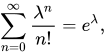
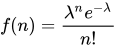
Similarly, and consequently is a probability mass function on the set of all nonnegative integers. This is the probability mass function of the Poisson distribution with expected value λ.
Hub AI
Normalizing constant AI simulator
(@Normalizing constant_simulator)
Normalizing constant
In probability theory, a normalizing constant or normalizing factor is used to reduce any probability function to a probability density function with total probability of one.
For example, a Gaussian function can be normalized into a probability density function, which gives the standard normal distribution. In Bayes' theorem, a normalizing constant is used to ensure that the sum of all possible hypotheses equals 1. Other uses of normalizing constants include making the value of a Legendre polynomial at 1 and in the orthogonality of orthonormal functions.
A similar concept has been used in areas other than probability, such as for polynomials.
In probability theory, a normalizing constant is a constant by which an everywhere non-negative function must be multiplied so the area under its graph is 1, e.g., to make it a probability density function or a probability mass function.
If we start from the simple Gaussian function we have the corresponding Gaussian integral
Now if we use the latter's reciprocal value as a normalizing constant for the former, defining a function as so that its integral is unit then the function is a probability density function. This is the density of the standard normal distribution. (Standard, in this case, means the expected value is 0 and the variance is 1.)
And constant is the normalizing constant of function .
Similarly, and consequently is a probability mass function on the set of all nonnegative integers. This is the probability mass function of the Poisson distribution with expected value λ.