

Recent from talks
Gaussian integral
Knowledge base stats:
Talk channels stats:
Members stats:
Gaussian integral
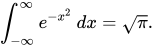
The Gaussian integral, also known as the Euler–Poisson integral, is the integral of the Gaussian function over the entire real line. Named after the German mathematician Carl Friedrich Gauss, the integral is

Abraham de Moivre originally discovered this type of integral in 1733, while Gauss published the precise integral in 1809, attributing its discovery to Laplace. The integral has a wide range of applications. For example, with a slight change of variables it is used to compute the normalizing constant of the normal distribution. The same integral with finite limits is closely related to both the error function and the cumulative distribution function of the normal distribution. In physics this type of integral appears frequently, for example, in quantum mechanics, to find the probability density of the ground state of the harmonic oscillator. This integral is also used in the path integral formulation, to find the propagator of the harmonic oscillator, and in statistical mechanics, to find its partition function.
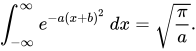
Although no elementary function exists for the error function, as can be proven by the Risch algorithm, the Gaussian integral can be solved analytically through the methods of multivariable calculus. That is, there is no elementary indefinite integral for but the definite integral can be evaluated. The definite integral of an arbitrary Gaussian function is


A standard way to compute the Gaussian integral, the idea of which goes back to Poisson, is to make use of the property that:

Consider the function on the plane , and compute its integral two ways:


Comparing these two computations yields the integral, though one should take care about the improper integrals involved.
where the factor of r is the Jacobian determinant which appears because of the transform to polar coordinates (r dr dθ is the standard measure on the plane, expressed in polar coordinates Wikibooks:Calculus/Polar Integration#Generalization), and the substitution involves taking s = −r2, so ds = −2r dr.
![{\displaystyle {\begin{aligned}\iint _{\mathbb {R} ^{2}}e^{-\left(x^{2}+y^{2}\right)}dx\,dy&=\int _{0}^{2\pi }\int _{0}^{\infty }e^{-r^{2}}r\,dr\,d\theta \\[6pt]&=2\pi \int _{0}^{\infty }re^{-r^{2}}\,dr\\[6pt]&=2\pi \int _{-\infty }^{0}{\tfrac {1}{2}}e^{s}\,ds&&s=-r^{2}\\[6pt]&=\pi \int _{-\infty }^{0}e^{s}\,ds\\[6pt]&=\pi \,\left[e^{s}\right]_{-\infty }^{0}\\[6pt]&=\pi \,\left(e^{0}-e^{-\infty }\right)\\[6pt]&=\pi \,\left(1-0\right)\\[6pt]&=\pi ,\end{aligned}}}](https://wikimedia.org/api/rest_v1/media/math/render/svg/5c7ee7fe39e38192c65bcc75728304264aa581e1)
Hub AI
Gaussian integral AI simulator
(@Gaussian integral_simulator)
Gaussian integral
The Gaussian integral, also known as the Euler–Poisson integral, is the integral of the Gaussian function over the entire real line. Named after the German mathematician Carl Friedrich Gauss, the integral is
Abraham de Moivre originally discovered this type of integral in 1733, while Gauss published the precise integral in 1809, attributing its discovery to Laplace. The integral has a wide range of applications. For example, with a slight change of variables it is used to compute the normalizing constant of the normal distribution. The same integral with finite limits is closely related to both the error function and the cumulative distribution function of the normal distribution. In physics this type of integral appears frequently, for example, in quantum mechanics, to find the probability density of the ground state of the harmonic oscillator. This integral is also used in the path integral formulation, to find the propagator of the harmonic oscillator, and in statistical mechanics, to find its partition function.
Although no elementary function exists for the error function, as can be proven by the Risch algorithm, the Gaussian integral can be solved analytically through the methods of multivariable calculus. That is, there is no elementary indefinite integral for but the definite integral can be evaluated. The definite integral of an arbitrary Gaussian function is
A standard way to compute the Gaussian integral, the idea of which goes back to Poisson, is to make use of the property that:
Consider the function on the plane , and compute its integral two ways:
Comparing these two computations yields the integral, though one should take care about the improper integrals involved.
where the factor of r is the Jacobian determinant which appears because of the transform to polar coordinates (r dr dθ is the standard measure on the plane, expressed in polar coordinates Wikibooks:Calculus/Polar Integration#Generalization), and the substitution involves taking s = −r2, so ds = −2r dr.
Recent media