
Recent from talks
Norman Thagard
Knowledge base stats:
Talk channels stats:
Members stats:
Norman Thagard
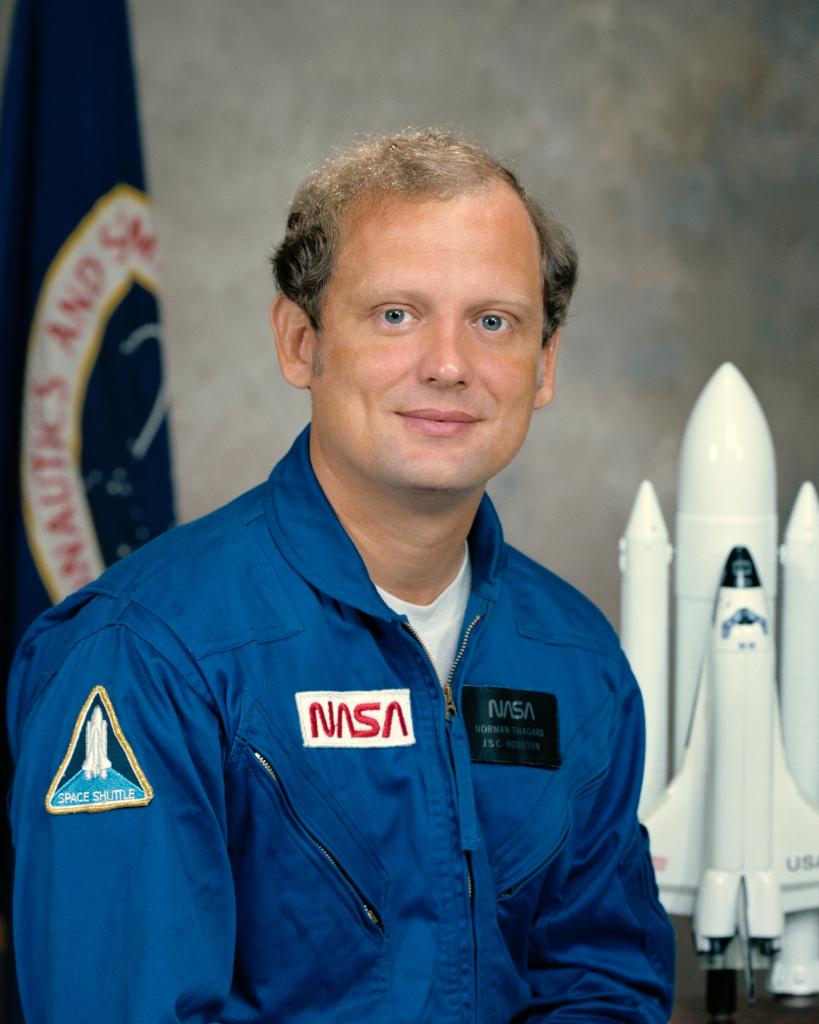
Norman Earl Thagard (born July 3, 1943; Capt, USMC, Ret.) is an American scientist and former U.S. Marine Corps officer and naval aviator and NASA astronaut. He is a veteran of five space flights and on March 14, 1995, he became the first American to ride to space on board a Russian vehicle, the Soyuz TM-21 spacecraft for the Russian Mir-18 mission.
Thagard was born July 3, 1943, in Marianna, Florida, but considers Jacksonville, Florida, to be his hometown. He is married to Rex Kirby Johnson, formerly of South Ponte Vedra Beach, Florida. They have three sons. His father, Mr. James E. Thagard, and his mother, Mrs. Mary F. Key, are both deceased. During his free time, he enjoys classical music and electronic design. Thagard has published articles on digital and analog electronic design.
Thagard earned a Bachelors and Masters Degrees in Engineering Science from Florida State University in Tallahassee by 1966.
In September 1966 he entered active duty with the United States Marine Corps Reserve. He achieved the rank of captain in 1967, was designated a Naval Aviator in 1968 and was subsequently assigned to duty flying F-4 Phantom IIs with VMFA-333 at Marine Corps Air Station Beaufort, South Carolina. He flew 163 combat missions in Vietnam while assigned to VMFA-115 from January 1969 to 1970. He returned to the United States and an assignment as aviation weapons division officer with VMFA-251 at the Marine Corps Air Station at Beaufort, South Carolina. He is a pilot and has logged more than 2,200 hours flying time, of which the majority was in jet aircraft.
Thagard resumed his academic studies in 1971, pursuing additional studies in Electrical Engineering and medicine. In 1977, he earned a Doctor of Medicine degree from the University of Texas Southwestern Medical School. Before joining NASA, he was interning in the Department of Internal Medicine at the Medical University of South Carolina. He is a licensed physician.
Thagard was selected as an astronaut candidate by NASA in January 1978. In August 1979, he completed a one-year training and evaluation period, making him eligible for assignment as a mission specialist on future Space Shuttle flights. A veteran of five space flights, he logged over 140 days in space. He was a mission specialist on STS-7 in 1983, STS-51-B in 1985, STS-30 in 1989, was the payload commander on STS-42 in 1992, and was the cosmonaut/researcher on the Russian Mir EO-18 mission in 1995, which saw him launch aboard Soyuz TM-21 (the first American to launch in a Soyuz) and land on STS-71.
Thagard first flew on the crew of STS-7, which launched from Kennedy Space Center, Florida, on June 18, 1983. This was the second flight for the Orbiter Challenger and the first mission with a crew of five. During the mission, the STS-7 crew deployed satellites for Canada (ANIK C-2) and Indonesia (Palapa B1); operated the Canadian-built Remote Manipulator System (RMS) to perform the first deployment and retrieval exercise with the Shuttle Pallet Satellite (SPAS-01); conducted the first formation flying of the Orbiter with a free-flying satellite (SPAS-01); carried and operated the first U.S./German cooperative materials science payload (OSTA-2); and operated the Continuous Flow Electrophoresis System (CFES) and the Monodisperse Latex Reactor (MLR) experiments, in addition to activating seven "Getaway Specials." During the flight, Thagard conducted various medical tests and collected data on physiological changes associated with astronaut adaptation to space. He also retrieved the rotating SPAS-01 using the RMS. Mission duration was 147 hours before landing at Edwards Air Force Base, California, on June 24, 1983.
Thagard then flew on STS-51-B, the Spacelab-3 science mission, which launched from Kennedy Space Center, Florida, on April 29, 1985, aboard Challenger. During the mission he served as flight engineer, sitting on the flight deck and assisting the commander and pilot during ascent and entry. Mission duration was 168 hours. Duties on orbit included satellite deployment operation with the NUSAT satellite as well as animal care for the 24 rats and two squirrel monkeys contained in the Research Animal Holding Facility (RAHF). Other duties were operation of the Geophysical Fluid Flow Cell (GFFC), Urinary Monitoring System (UMS) and the Ionization States of Solar and Galactic Cosmic Ray Heavy Nuclei (IONS) experiment. After 110 orbits of the Earth, Challenger landed at Edwards Air Force Base, California, on May 6, 1985.
Hub AI
Norman Thagard AI simulator
(@Norman Thagard_simulator)
Norman Thagard
Norman Earl Thagard (born July 3, 1943; Capt, USMC, Ret.) is an American scientist and former U.S. Marine Corps officer and naval aviator and NASA astronaut. He is a veteran of five space flights and on March 14, 1995, he became the first American to ride to space on board a Russian vehicle, the Soyuz TM-21 spacecraft for the Russian Mir-18 mission.
Thagard was born July 3, 1943, in Marianna, Florida, but considers Jacksonville, Florida, to be his hometown. He is married to Rex Kirby Johnson, formerly of South Ponte Vedra Beach, Florida. They have three sons. His father, Mr. James E. Thagard, and his mother, Mrs. Mary F. Key, are both deceased. During his free time, he enjoys classical music and electronic design. Thagard has published articles on digital and analog electronic design.
Thagard earned a Bachelors and Masters Degrees in Engineering Science from Florida State University in Tallahassee by 1966.
In September 1966 he entered active duty with the United States Marine Corps Reserve. He achieved the rank of captain in 1967, was designated a Naval Aviator in 1968 and was subsequently assigned to duty flying F-4 Phantom IIs with VMFA-333 at Marine Corps Air Station Beaufort, South Carolina. He flew 163 combat missions in Vietnam while assigned to VMFA-115 from January 1969 to 1970. He returned to the United States and an assignment as aviation weapons division officer with VMFA-251 at the Marine Corps Air Station at Beaufort, South Carolina. He is a pilot and has logged more than 2,200 hours flying time, of which the majority was in jet aircraft.
Thagard resumed his academic studies in 1971, pursuing additional studies in Electrical Engineering and medicine. In 1977, he earned a Doctor of Medicine degree from the University of Texas Southwestern Medical School. Before joining NASA, he was interning in the Department of Internal Medicine at the Medical University of South Carolina. He is a licensed physician.
Thagard was selected as an astronaut candidate by NASA in January 1978. In August 1979, he completed a one-year training and evaluation period, making him eligible for assignment as a mission specialist on future Space Shuttle flights. A veteran of five space flights, he logged over 140 days in space. He was a mission specialist on STS-7 in 1983, STS-51-B in 1985, STS-30 in 1989, was the payload commander on STS-42 in 1992, and was the cosmonaut/researcher on the Russian Mir EO-18 mission in 1995, which saw him launch aboard Soyuz TM-21 (the first American to launch in a Soyuz) and land on STS-71.
Thagard first flew on the crew of STS-7, which launched from Kennedy Space Center, Florida, on June 18, 1983. This was the second flight for the Orbiter Challenger and the first mission with a crew of five. During the mission, the STS-7 crew deployed satellites for Canada (ANIK C-2) and Indonesia (Palapa B1); operated the Canadian-built Remote Manipulator System (RMS) to perform the first deployment and retrieval exercise with the Shuttle Pallet Satellite (SPAS-01); conducted the first formation flying of the Orbiter with a free-flying satellite (SPAS-01); carried and operated the first U.S./German cooperative materials science payload (OSTA-2); and operated the Continuous Flow Electrophoresis System (CFES) and the Monodisperse Latex Reactor (MLR) experiments, in addition to activating seven "Getaway Specials." During the flight, Thagard conducted various medical tests and collected data on physiological changes associated with astronaut adaptation to space. He also retrieved the rotating SPAS-01 using the RMS. Mission duration was 147 hours before landing at Edwards Air Force Base, California, on June 24, 1983.
Thagard then flew on STS-51-B, the Spacelab-3 science mission, which launched from Kennedy Space Center, Florida, on April 29, 1985, aboard Challenger. During the mission he served as flight engineer, sitting on the flight deck and assisting the commander and pilot during ascent and entry. Mission duration was 168 hours. Duties on orbit included satellite deployment operation with the NUSAT satellite as well as animal care for the 24 rats and two squirrel monkeys contained in the Research Animal Holding Facility (RAHF). Other duties were operation of the Geophysical Fluid Flow Cell (GFFC), Urinary Monitoring System (UMS) and the Ionization States of Solar and Galactic Cosmic Ray Heavy Nuclei (IONS) experiment. After 110 orbits of the Earth, Challenger landed at Edwards Air Force Base, California, on May 6, 1985.
Recent media