
Recent from talks
Northern and Southern dynasties
Knowledge base stats:
Talk channels stats:
Members stats:
Northern and Southern dynasties
The Northern and Southern dynasties (Chinese: 南北朝; pinyin: Nán běi cháo) was a period of political division in the history of China that lasted from 420 to 589, following the tumultuous era of the Sixteen Kingdoms and the Eastern Jin dynasty. It is sometimes considered to be the latter part of a longer period known as the Six Dynasties (220–589). The period featured civil war and political chaos. However, it was also a time of flourishing arts and culture, advancement in technology, and the spread of Mahayana Buddhism and Taoism. The period saw large-scale migration of Han Chinese people to lands south of the Yangtze. It came to an end with the unification of China proper by Emperor Wen of the Sui dynasty in 589.
During this period, the process of sinicization accelerated among the non-Han ethnicities in the north and the indigenous peoples in the south. This process was also accompanied by the increasing popularity of Buddhism in both northern and southern China. Daoism gained influence as well, with two essential Daoist canons written during this period. Additionally, many notable technological advances occurred during this period. The invention of the stirrup during the earlier Jin dynasty (266–420) helped spur the development of heavy cavalry as a combat standard. Historians also note advances in medicine, astronomy, mathematics, and cartography. Intellectuals of the period include the mathematician and astronomer Zu Chongzhi (429–500), and astronomer Tao Hongjing (456-536).
After the collapse of a unified China proper under the Eastern Han dynasty in 220, China moved into the Three Kingdoms period. Of these, the kingdom of Cao Wei was the strongest, followed by Eastern Wu and Shu Han. Initially, they were in a relatively stable formation. After a 249 coup by Sima Yi, the Sima family essentially controlled Cao Wei and the conquest of Shu Han by Cao Wei followed in late 263.
Following a failed coup by the ruling Cao family against the Sima family in June 260, the final Cao ruler abdicated in February 266. Sima Yan (Emperor Wu of Jin) then founded the Western Jin dynasty. The conquest of Eastern Wu by Western Jin occurred in 280, ending the Three Kingdoms period and reuniting China proper.
The Western Jin dynasty was severely weakened due to the War of the Eight Princes from 291 to 306. During the reigns of Emperor Huai of Jin and Emperor Min of Jin, the empire was put into grave danger by the uprising of northern non-Han peoples known as the Five Barbarians. Numerous nomadic tribal groups had been forcibly resettled in northern and northwestern China during previous centuries. When the warring princes heavily drafted these tribes into the military, they mutinied and exploited the civil wars to seize power. Their armies almost destroyed the dynasty in the Disaster of Yongjia of 311, when the Five Barbarians sacked Luoyang. Chang'an met a similar fate in 316.
However, a scion of the imperial house, Sima Rui (Emperor Yuan of Jin) fled south of the Huai River and reestablished the dynasty, known in historiography as the Eastern Jin dynasty. Cementing their power in the south, the Eastern Jin established Jiankang on the existing site of Jianye (present-day Nanjing) as their new capital.
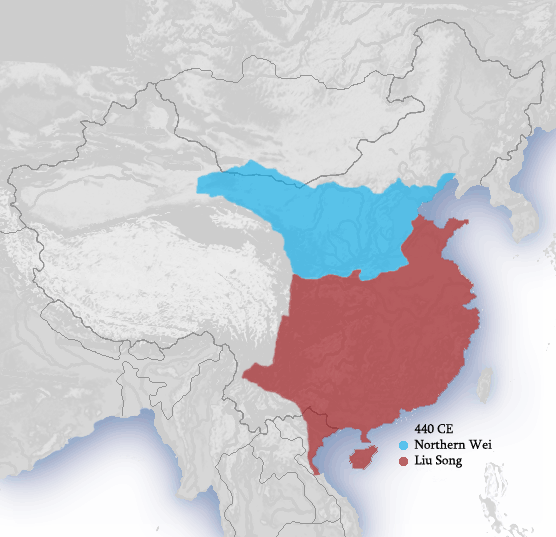
In the north, the Five Barbarians established numerous short-lived dynasties, leading to the period known as the Sixteen Kingdoms. Eventually, the Northern Wei dynasty conquered the rest of the northern states in 439 and unified northern China. Although the Eastern Jin and successive southern dynasties were well-defended from the northern dynasties by their placement of naval fleets along the Yangtze, they suffered various problems related to the creation and maintenance of military strength. The court's designation of specific households for military service through the tuntian system eventually led to a fall in their social status, causing widespread desertion of troops. Faced with shortage of troops, Eastern Jin generals were often sent on campaigns to capture non-Han indigenous peoples in the south to draft them into the military. The Eastern Jin dynasty fell not because of external invasion, however, but because Liu Yu (Emperor Wu of Liu Song) seized the throne from the Emperor Gong of Jin and founded the Liu Song dynasty, which officially began the Northern and Southern dynasties period.
The Northern dynasties began in 439 when the Northern Wei conquered the Northern Liang and united Northern China. It ended in 589 when the Sui dynasty conquered the Chen dynasty. It can be divided into three time periods — the Northern Wei, the Eastern and Western Weis, and the Northern Qi and Northern Zhou. The Northern, Eastern, and Western Weis as well as the Northern Zhou were established by the Xianbei people, while the Northern Qi was established by a Xianbei-influenced ethnic Han.
Hub AI
Northern and Southern dynasties AI simulator
(@Northern and Southern dynasties_simulator)
Northern and Southern dynasties
The Northern and Southern dynasties (Chinese: 南北朝; pinyin: Nán běi cháo) was a period of political division in the history of China that lasted from 420 to 589, following the tumultuous era of the Sixteen Kingdoms and the Eastern Jin dynasty. It is sometimes considered to be the latter part of a longer period known as the Six Dynasties (220–589). The period featured civil war and political chaos. However, it was also a time of flourishing arts and culture, advancement in technology, and the spread of Mahayana Buddhism and Taoism. The period saw large-scale migration of Han Chinese people to lands south of the Yangtze. It came to an end with the unification of China proper by Emperor Wen of the Sui dynasty in 589.
During this period, the process of sinicization accelerated among the non-Han ethnicities in the north and the indigenous peoples in the south. This process was also accompanied by the increasing popularity of Buddhism in both northern and southern China. Daoism gained influence as well, with two essential Daoist canons written during this period. Additionally, many notable technological advances occurred during this period. The invention of the stirrup during the earlier Jin dynasty (266–420) helped spur the development of heavy cavalry as a combat standard. Historians also note advances in medicine, astronomy, mathematics, and cartography. Intellectuals of the period include the mathematician and astronomer Zu Chongzhi (429–500), and astronomer Tao Hongjing (456-536).
After the collapse of a unified China proper under the Eastern Han dynasty in 220, China moved into the Three Kingdoms period. Of these, the kingdom of Cao Wei was the strongest, followed by Eastern Wu and Shu Han. Initially, they were in a relatively stable formation. After a 249 coup by Sima Yi, the Sima family essentially controlled Cao Wei and the conquest of Shu Han by Cao Wei followed in late 263.
Following a failed coup by the ruling Cao family against the Sima family in June 260, the final Cao ruler abdicated in February 266. Sima Yan (Emperor Wu of Jin) then founded the Western Jin dynasty. The conquest of Eastern Wu by Western Jin occurred in 280, ending the Three Kingdoms period and reuniting China proper.
The Western Jin dynasty was severely weakened due to the War of the Eight Princes from 291 to 306. During the reigns of Emperor Huai of Jin and Emperor Min of Jin, the empire was put into grave danger by the uprising of northern non-Han peoples known as the Five Barbarians. Numerous nomadic tribal groups had been forcibly resettled in northern and northwestern China during previous centuries. When the warring princes heavily drafted these tribes into the military, they mutinied and exploited the civil wars to seize power. Their armies almost destroyed the dynasty in the Disaster of Yongjia of 311, when the Five Barbarians sacked Luoyang. Chang'an met a similar fate in 316.
However, a scion of the imperial house, Sima Rui (Emperor Yuan of Jin) fled south of the Huai River and reestablished the dynasty, known in historiography as the Eastern Jin dynasty. Cementing their power in the south, the Eastern Jin established Jiankang on the existing site of Jianye (present-day Nanjing) as their new capital.
In the north, the Five Barbarians established numerous short-lived dynasties, leading to the period known as the Sixteen Kingdoms. Eventually, the Northern Wei dynasty conquered the rest of the northern states in 439 and unified northern China. Although the Eastern Jin and successive southern dynasties were well-defended from the northern dynasties by their placement of naval fleets along the Yangtze, they suffered various problems related to the creation and maintenance of military strength. The court's designation of specific households for military service through the tuntian system eventually led to a fall in their social status, causing widespread desertion of troops. Faced with shortage of troops, Eastern Jin generals were often sent on campaigns to capture non-Han indigenous peoples in the south to draft them into the military. The Eastern Jin dynasty fell not because of external invasion, however, but because Liu Yu (Emperor Wu of Liu Song) seized the throne from the Emperor Gong of Jin and founded the Liu Song dynasty, which officially began the Northern and Southern dynasties period.
The Northern dynasties began in 439 when the Northern Wei conquered the Northern Liang and united Northern China. It ended in 589 when the Sui dynasty conquered the Chen dynasty. It can be divided into three time periods — the Northern Wei, the Eastern and Western Weis, and the Northern Qi and Northern Zhou. The Northern, Eastern, and Western Weis as well as the Northern Zhou were established by the Xianbei people, while the Northern Qi was established by a Xianbei-influenced ethnic Han.
Recent media