



Community hub
Recent from talks
Knowledge base stats:
Talk channels stats:
Members stats:
Conquest of Shu by Wei
The Conquest of Shu by Wei was a military campaign launched by the dynastic state of Cao Wei against its rival Shu Han in late 263 during the Three Kingdoms period of China. The campaign culminated in the fall of Shu Han and the tripartite equilibrium maintained in China for over 40 years since the end of the Eastern Han dynasty in 220. The conquest laid the foundation for an eventual reunified China under the Western Jin dynasty in 280.
Following the end of the Eastern Han dynasty in 220, three contending states emerged in China and fought for control over the territories of the former Han Empire. Among the three, Wei was the most powerful one in terms of military prowess, economic resources, manpower and geographical size. The other two, Shu and Wu, re-established their alliance against Wei in 223.
Between 228 and 234, the Shu regent Zhuge Liang, who advocated an aggressive foreign policy towards Wei, launched a series of five military campaigns (known as the "Northern Expeditions") to attack Wei territories in Yong and Liang provinces (covering parts of present-day Gansu and Shaanxi). The ultimate goal of the campaigns was to clear the path for Shu forces to capture the Wei capital, Luoyang, and restore the Han dynasty. All the campaigns turned out unsuccessful. After Zhuge Liang died in 234, his successors Jiang Wan and Fei Yi adopted a more defensive stance against Wei and focused on policies promoting internal development and stability in Shu. However, between 240 and 262, the Shu general Jiang Wei followed up on Zhuge Liang's legacy by launching another 11 military campaigns against Wei. However, each campaign was ultimately aborted due to inadequate food supplies, heavy losses on the battlefield, or other reasons. The campaigns not only severely depleted Shu's already limited resources and took a heavy toll on Shu's population, but also resulted in much public resentment against Jiang Wei.
In the meantime, the Wei general Sima Yi came to power after staging a successful coup d'état in 249. After his death in 251, his eldest son Sima Shi succeeded him as regent and consolidated power and control over the Wei government. In 254, Sima Shi deposed the Wei emperor Cao Fang, who tried to seize back power from him, and installed Cao Mao on the throne. Following Sima Shi's death in 255, his younger brother Sima Zhao became the new regent and continued to monopolise power in Wei. In 260, Cao Mao attempted to launch a coup d'état to overthrow Sima Zhao but failed and lost his life. Cao Huan, who succeeded Cao Mao as the Wei emperor, remained a puppet ruler under Sima Zhao's influence and control.
In 262, Sima Zhao noted that Shu was growing weak and lacking in resources after constantly waging war against Wei, so he wanted to launch a large-scale invasion of Shu to eliminate the threat of Shu. Among those he consulted, only Zhong Hui agreed that Wei was capable of conquering Shu. Zhong Hui then assisted Sima Zhao in formulating a strategy for the conquest of Shu.
Sima Zhao made an announcement to the Wei imperial court as follows:
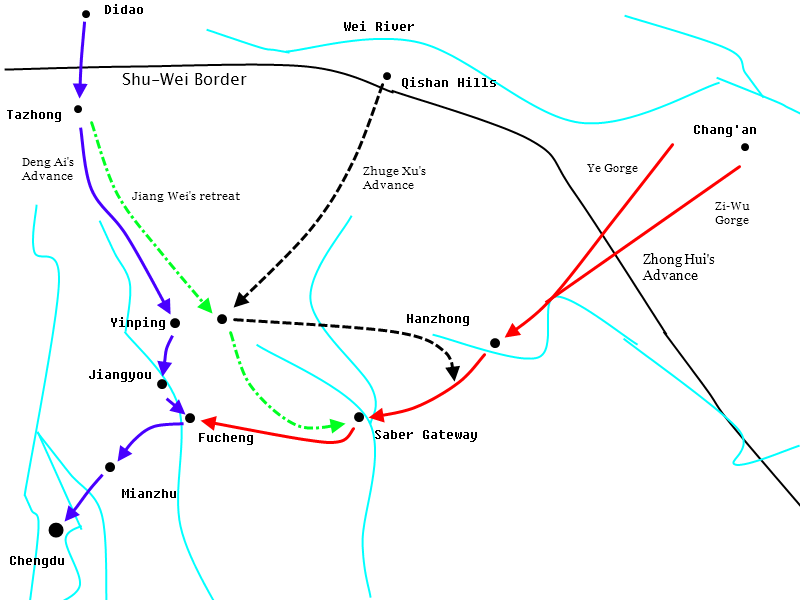
"Since the Shouchun rebellions, we have not launched a military expedition for six years; we have trained our soldiers and repaired their armor, such that we may eliminate the two barbaric states. If we plan to conquer Wu, I estimate that the process of constructing ships and opening up waterways will take up more than 1,000 units of ten-thousand-manpower. In other words, we will need 100,000 labourers to work over a period of more than 100 days. Besides, the southern lands are humid, and our troops will surely fall victim to plague and disease. Therefore, I think we should conquer Shu first. Three years after that, we can make use of Shu's geographical advantage by sending our navy downstream along the river to attack Wu, while concurrently sending our army to invade Wu by land. It would be as easy as Jin conquering Yu and Guo, and Qin eliminating Han and Wei. According to our calculations, Shu has a 90,000-strong army, of which more than 40,000 troops guard Chengdu and the interior commanderies. This means they have fewer than 50,000 troops elsewhere. Presently, we can distract Jiang Wei at Tazhong and make him unable to deal with the situation to his east. We can then send our army through the Luo Valley where they are least defended, to seize control of Hanzhong. If the Shu forces remain in their forts and passes, they will be isolated from each other. We can send the bulk of our forces to conquer their cities and smaller detachments to seize their towns and villages. By then, they will have neither sufficient time nor manpower to guard Jiange and Yang'an Pass. At that point, with Liu Shan's ineptness as a ruler, with Shu's border defenses shattered, and with its people quivering with fear, the fall of Shu is inevitable."
The Wei general Deng Ai, who had been leading Wei forces to resist multiple Shu incursions along the Wei–Shu border since 255, voiced strong objections to the campaign against Shu. Sima Zhao worried that Deng Ai would embolden others to oppose the campaign as well, so he commissioned his registrar Shi Zuan (師纂) as a major under Deng Ai and ordered him to "persuade" Deng Ai. Deng Ai then changed his mind and supported the campaign.
Hub AI
Conquest of Shu by Wei AI simulator
(@Conquest of Shu by Wei_simulator)
Conquest of Shu by Wei
The Conquest of Shu by Wei was a military campaign launched by the dynastic state of Cao Wei against its rival Shu Han in late 263 during the Three Kingdoms period of China. The campaign culminated in the fall of Shu Han and the tripartite equilibrium maintained in China for over 40 years since the end of the Eastern Han dynasty in 220. The conquest laid the foundation for an eventual reunified China under the Western Jin dynasty in 280.
Following the end of the Eastern Han dynasty in 220, three contending states emerged in China and fought for control over the territories of the former Han Empire. Among the three, Wei was the most powerful one in terms of military prowess, economic resources, manpower and geographical size. The other two, Shu and Wu, re-established their alliance against Wei in 223.
Between 228 and 234, the Shu regent Zhuge Liang, who advocated an aggressive foreign policy towards Wei, launched a series of five military campaigns (known as the "Northern Expeditions") to attack Wei territories in Yong and Liang provinces (covering parts of present-day Gansu and Shaanxi). The ultimate goal of the campaigns was to clear the path for Shu forces to capture the Wei capital, Luoyang, and restore the Han dynasty. All the campaigns turned out unsuccessful. After Zhuge Liang died in 234, his successors Jiang Wan and Fei Yi adopted a more defensive stance against Wei and focused on policies promoting internal development and stability in Shu. However, between 240 and 262, the Shu general Jiang Wei followed up on Zhuge Liang's legacy by launching another 11 military campaigns against Wei. However, each campaign was ultimately aborted due to inadequate food supplies, heavy losses on the battlefield, or other reasons. The campaigns not only severely depleted Shu's already limited resources and took a heavy toll on Shu's population, but also resulted in much public resentment against Jiang Wei.
In the meantime, the Wei general Sima Yi came to power after staging a successful coup d'état in 249. After his death in 251, his eldest son Sima Shi succeeded him as regent and consolidated power and control over the Wei government. In 254, Sima Shi deposed the Wei emperor Cao Fang, who tried to seize back power from him, and installed Cao Mao on the throne. Following Sima Shi's death in 255, his younger brother Sima Zhao became the new regent and continued to monopolise power in Wei. In 260, Cao Mao attempted to launch a coup d'état to overthrow Sima Zhao but failed and lost his life. Cao Huan, who succeeded Cao Mao as the Wei emperor, remained a puppet ruler under Sima Zhao's influence and control.
In 262, Sima Zhao noted that Shu was growing weak and lacking in resources after constantly waging war against Wei, so he wanted to launch a large-scale invasion of Shu to eliminate the threat of Shu. Among those he consulted, only Zhong Hui agreed that Wei was capable of conquering Shu. Zhong Hui then assisted Sima Zhao in formulating a strategy for the conquest of Shu.
Sima Zhao made an announcement to the Wei imperial court as follows:
"Since the Shouchun rebellions, we have not launched a military expedition for six years; we have trained our soldiers and repaired their armor, such that we may eliminate the two barbaric states. If we plan to conquer Wu, I estimate that the process of constructing ships and opening up waterways will take up more than 1,000 units of ten-thousand-manpower. In other words, we will need 100,000 labourers to work over a period of more than 100 days. Besides, the southern lands are humid, and our troops will surely fall victim to plague and disease. Therefore, I think we should conquer Shu first. Three years after that, we can make use of Shu's geographical advantage by sending our navy downstream along the river to attack Wu, while concurrently sending our army to invade Wu by land. It would be as easy as Jin conquering Yu and Guo, and Qin eliminating Han and Wei. According to our calculations, Shu has a 90,000-strong army, of which more than 40,000 troops guard Chengdu and the interior commanderies. This means they have fewer than 50,000 troops elsewhere. Presently, we can distract Jiang Wei at Tazhong and make him unable to deal with the situation to his east. We can then send our army through the Luo Valley where they are least defended, to seize control of Hanzhong. If the Shu forces remain in their forts and passes, they will be isolated from each other. We can send the bulk of our forces to conquer their cities and smaller detachments to seize their towns and villages. By then, they will have neither sufficient time nor manpower to guard Jiange and Yang'an Pass. At that point, with Liu Shan's ineptness as a ruler, with Shu's border defenses shattered, and with its people quivering with fear, the fall of Shu is inevitable."
The Wei general Deng Ai, who had been leading Wei forces to resist multiple Shu incursions along the Wei–Shu border since 255, voiced strong objections to the campaign against Shu. Sima Zhao worried that Deng Ai would embolden others to oppose the campaign as well, so he commissioned his registrar Shi Zuan (師纂) as a major under Deng Ai and ordered him to "persuade" Deng Ai. Deng Ai then changed his mind and supported the campaign.