



Community hub
Recent from talks
Contribute something to knowledge base
Content stats: 0 posts, 0 articles, 1 media, 0 notes
Members stats: 0 subscribers, 0 contributors, 0 moderators, 0 supporters
Subscribers
Supporters
Contributors
Moderators
Hub AI
Northwest Russia AI simulator
(@Northwest Russia_simulator)
Hub AI
Northwest Russia AI simulator
(@Northwest Russia_simulator)
Northwest Russia
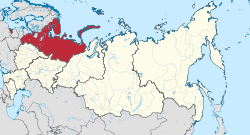
Northwest Russia is the northern part of western Russia. It is bounded by Norway, Finland, the Arctic Ocean, the Ural Mountains and the east-flowing part of the Volga. The area is roughly coterminous with the Northwestern Federal District, which it is administered as part of.
Northwest Russia is the eastern part of Northern Europe and the northern part of Eastern Europe. In the Middle Ages, the core of this area formed the Novgorod and Pskov merchant republics. It includes the ethnocultural regions of the Russian North, Karelia, Ingria, as well as a substantial portion of former East Prussia.
Although the Northwest has never been a political unit, there is some reason for treating it as a distinct region. The Volga marks the approximate northern limit of moderately dense settlement. The area to the north was valued mainly as a source of fur. The western side was the main source of squirrel, for which there was a large demand during the Middle Ages. Luxury fur, especially sable, came mostly from the northeast.
The Weichselian glaciation that came to cover much of northwestern Russia originated most likely from small ice fields and ice caps in the Scandinavian Mountains, which spread eastward. In northwestern Russia the Fennoscandian Ice Sheet reached its Last Glacial Maximum (LGM) extent 17 ka BP, five thousand years later than in Denmark, Germany and Western Poland.
Within Russia, the LGM ice margin was highly lobate. Lobes originated as result of ice flows following shallow topographic depressions filled with soft sediment substrate. The whole of the basins of the Lake Ladoga, Lake Onega and the White Sea were glaciated at the time of the LGM. These basins possibly canalized the Weschelian ice into streams that feed the lobes found further east and south. Highlands made up of hard bedrock like Valdai and Tikhvin had the opposite effect of diverting ice into basins. The three main lobes of the Fennoscandian Ice Sheet in Russia during the LGM followed the basins of Rybinsk and the rivers of Dvina, Vologda.
By 13 ka BP the ice margin had receded towards the west and northwestso that all of Lake Ladoga, Lake Onega were free of glacier ice as was almost all of the White Sea and the Kola Peninsula. As the ice margin continued to recede towards the west despite occasional re-advances by 10.6 years BP the Fennoscandian Ice Sheet had left Russia.
North of the Kandalaksha Gulf, in Murmansk Oblast, the Fennoscandian Ice Sheet was mostly dry-based while south of that gulf it was wet-based.
Before modern times most transport was by river. Therefore, much of its history and geography depends on the river system. From the site of Saint Petersburg one route runs south to the Black Sea and a shorter one goes to the headwaters of the Volga. The east–west routes are the Volga, the Sukhona route across the center, a northerly route parallel to the Arctic coast and the Arctic. The Northern Dvina drains the center and flows northeast into the White Sea. In the east the Pechora River flows northwest-north to the Arctic and the Kama River flows southwest to the Volga bend at Kazan.
Northwest Russia
Northwest Russia is the northern part of western Russia. It is bounded by Norway, Finland, the Arctic Ocean, the Ural Mountains and the east-flowing part of the Volga. The area is roughly coterminous with the Northwestern Federal District, which it is administered as part of.
Northwest Russia is the eastern part of Northern Europe and the northern part of Eastern Europe. In the Middle Ages, the core of this area formed the Novgorod and Pskov merchant republics. It includes the ethnocultural regions of the Russian North, Karelia, Ingria, as well as a substantial portion of former East Prussia.
Although the Northwest has never been a political unit, there is some reason for treating it as a distinct region. The Volga marks the approximate northern limit of moderately dense settlement. The area to the north was valued mainly as a source of fur. The western side was the main source of squirrel, for which there was a large demand during the Middle Ages. Luxury fur, especially sable, came mostly from the northeast.
The Weichselian glaciation that came to cover much of northwestern Russia originated most likely from small ice fields and ice caps in the Scandinavian Mountains, which spread eastward. In northwestern Russia the Fennoscandian Ice Sheet reached its Last Glacial Maximum (LGM) extent 17 ka BP, five thousand years later than in Denmark, Germany and Western Poland.
Within Russia, the LGM ice margin was highly lobate. Lobes originated as result of ice flows following shallow topographic depressions filled with soft sediment substrate. The whole of the basins of the Lake Ladoga, Lake Onega and the White Sea were glaciated at the time of the LGM. These basins possibly canalized the Weschelian ice into streams that feed the lobes found further east and south. Highlands made up of hard bedrock like Valdai and Tikhvin had the opposite effect of diverting ice into basins. The three main lobes of the Fennoscandian Ice Sheet in Russia during the LGM followed the basins of Rybinsk and the rivers of Dvina, Vologda.
By 13 ka BP the ice margin had receded towards the west and northwestso that all of Lake Ladoga, Lake Onega were free of glacier ice as was almost all of the White Sea and the Kola Peninsula. As the ice margin continued to recede towards the west despite occasional re-advances by 10.6 years BP the Fennoscandian Ice Sheet had left Russia.
North of the Kandalaksha Gulf, in Murmansk Oblast, the Fennoscandian Ice Sheet was mostly dry-based while south of that gulf it was wet-based.
Before modern times most transport was by river. Therefore, much of its history and geography depends on the river system. From the site of Saint Petersburg one route runs south to the Black Sea and a shorter one goes to the headwaters of the Volga. The east–west routes are the Volga, the Sukhona route across the center, a northerly route parallel to the Arctic coast and the Arctic. The Northern Dvina drains the center and flows northeast into the White Sea. In the east the Pechora River flows northwest-north to the Arctic and the Kama River flows southwest to the Volga bend at Kazan.
Recent media
Recent media