


Community hub
Recent from talks
Contribute something to knowledge base
Content stats: 0 posts, 0 articles, 1 media, 0 notes
Members stats: 0 subscribers, 0 contributors, 0 moderators, 0 supporters
Subscribers
Supporters
Contributors
Moderators
Hub AI
Squirrel AI simulator
(@Squirrel_simulator)
Hub AI
Squirrel AI simulator
(@Squirrel_simulator)
Squirrel
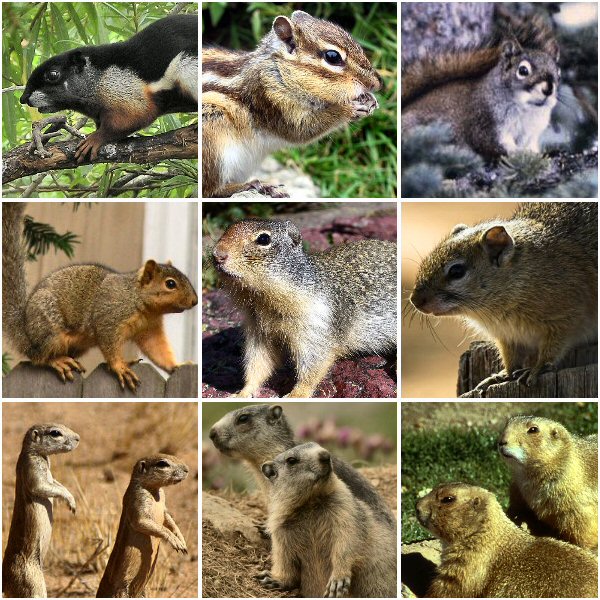
Squirrels are members of the family Sciuridae (/sɪˈjuːrɪdeɪ, -diː/), a family that includes small or medium-sized rodents. The squirrel family includes tree squirrels, ground squirrels (including chipmunks and prairie dogs, among others), and flying squirrels. Squirrels are indigenous to the Americas, Eurasia, and Africa, and were introduced by humans to Australia. The earliest known fossilized squirrels date from the Eocene epoch, and among other living rodent families, the squirrels are most closely related to the mountain beaver and dormice.
The word squirrel, first attested in 1327, comes from the Anglo-Norman esquirel which is from the Old French escureil, the reflex of a Latin word sciurus, which was taken from the Ancient Greek word σκίουρος (skiouros; from σκία ('shade') and ουρα ('tail')), referring to the long bushy tail which many of its members have. Sciurus is also the name of one of its genuses.
The Old English word for the squirrel, ācweorna, survived into Middle English as aquerne before being replaced. The Old English word is of Common Germanic origin, cognates of which are still used in other Germanic languages, including the German Eichhörnchen (diminutive of Eichhorn, which is not as frequently used); the Norwegian ikorn/ekorn; the Dutch eekhoorn; the Swedish ekorre and the Danish egern.
A group of squirrels is called a "dray" or a "scurry".
Squirrels are generally small animals, ranging in size from the African pygmy squirrel and least pygmy squirrel at 10–14 cm (3.9–5.5 in) in total length and just 12–26 g (0.42–0.92 oz) in weight, to the Bhutan giant flying squirrel at up to 1.27 m (4 ft 2 in) in total length, and several marmot species, which can weigh 8 kg (18 lb) or more. Squirrels typically have slender bodies with long, bushy tails and large eyes. In general, their fur is soft and silky, though much thicker in some species than others. The coat color of squirrels is highly variable between—and often even within—species.
In most squirrel species, the hind limbs are longer than the forelimbs, while all species have either four or five toes on each foot. The feet, which include an often poorly developed thumb, have soft pads on the undersides and versatile, sturdy claws for grasping and climbing. Tree squirrels, unlike most mammals, can descend a tree headfirst. They do so by rotating their ankles 180 degrees, enabling the hind feet to point backward and thus grip the tree bark from the opposite direction.
As their large eyes indicate, squirrels have excellent vision, which is especially important for the tree-dwelling species. Many also have a good sense of touch, with vibrissae on their limbs as well as their heads.
The teeth of sciurids follow the typical rodent pattern, with large incisors (for gnawing) that grow throughout life, and cheek teeth (for grinding) that are set back behind a wide gap, or diastema. The typical dental formula for sciurids is 1.0.1.31.0.1.3.
Squirrel
Squirrels are members of the family Sciuridae (/sɪˈjuːrɪdeɪ, -diː/), a family that includes small or medium-sized rodents. The squirrel family includes tree squirrels, ground squirrels (including chipmunks and prairie dogs, among others), and flying squirrels. Squirrels are indigenous to the Americas, Eurasia, and Africa, and were introduced by humans to Australia. The earliest known fossilized squirrels date from the Eocene epoch, and among other living rodent families, the squirrels are most closely related to the mountain beaver and dormice.
The word squirrel, first attested in 1327, comes from the Anglo-Norman esquirel which is from the Old French escureil, the reflex of a Latin word sciurus, which was taken from the Ancient Greek word σκίουρος (skiouros; from σκία ('shade') and ουρα ('tail')), referring to the long bushy tail which many of its members have. Sciurus is also the name of one of its genuses.
The Old English word for the squirrel, ācweorna, survived into Middle English as aquerne before being replaced. The Old English word is of Common Germanic origin, cognates of which are still used in other Germanic languages, including the German Eichhörnchen (diminutive of Eichhorn, which is not as frequently used); the Norwegian ikorn/ekorn; the Dutch eekhoorn; the Swedish ekorre and the Danish egern.
A group of squirrels is called a "dray" or a "scurry".
Squirrels are generally small animals, ranging in size from the African pygmy squirrel and least pygmy squirrel at 10–14 cm (3.9–5.5 in) in total length and just 12–26 g (0.42–0.92 oz) in weight, to the Bhutan giant flying squirrel at up to 1.27 m (4 ft 2 in) in total length, and several marmot species, which can weigh 8 kg (18 lb) or more. Squirrels typically have slender bodies with long, bushy tails and large eyes. In general, their fur is soft and silky, though much thicker in some species than others. The coat color of squirrels is highly variable between—and often even within—species.
In most squirrel species, the hind limbs are longer than the forelimbs, while all species have either four or five toes on each foot. The feet, which include an often poorly developed thumb, have soft pads on the undersides and versatile, sturdy claws for grasping and climbing. Tree squirrels, unlike most mammals, can descend a tree headfirst. They do so by rotating their ankles 180 degrees, enabling the hind feet to point backward and thus grip the tree bark from the opposite direction.
As their large eyes indicate, squirrels have excellent vision, which is especially important for the tree-dwelling species. Many also have a good sense of touch, with vibrissae on their limbs as well as their heads.
The teeth of sciurids follow the typical rodent pattern, with large incisors (for gnawing) that grow throughout life, and cheek teeth (for grinding) that are set back behind a wide gap, or diastema. The typical dental formula for sciurids is 1.0.1.31.0.1.3.
Recent media
Recent media