Hubbry Logo
Skaw, UnstSkaw, UnstMain
Open search
Skaw, Unst
Community hub
Skaw, Unst
logo
8 pages, 0 posts
0 subscribers
Be the first to start a discussion here.
Skaw, Unst
Skaw, Unst
from Wikipedia

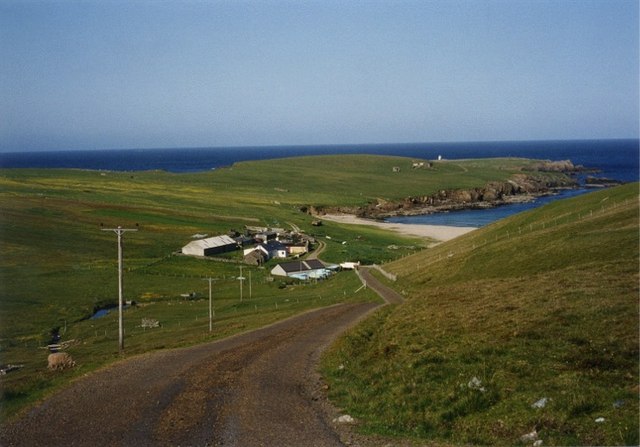
Skaw is a settlement in the Scottish archipelago of Shetland, located on the island of Unst. It is located north of Haroldswick on a peninsula in the northeast corner of the island, and is the most northerly settlement in the United Kingdom.[1] It is currently inhabited by a single inhabitant whose business is sheep farming.

Key Information

Etymology

[edit]

Skaw is derived from the Old Norse "Skagi" meaning a cape, headland, promontory or peninsula.[2][3]

Geography

[edit]

The burn of Skaw flows from the uplands to the west through the constellation of small crofts that make up Skaw, and then east into the Wick of Skaw, a bay of the North Sea. A sheltered sandy beach lines the coast of the Wick of Skaw. The unclassified road (Holsens Road) from the B9087 to Skaw is the most northerly road in the UK road network, and the northernmost road in the world to use left-hand traffic.

Wick of Scaw

History

[edit]

Walter Sutherland (died c. 1850), a former inhabitant of the northernmost cottage in Britain, was reportedly the last native speaker of the Norn language.

During World War II, the Royal Air Force built a Chain Home radar station at Skaw. The radar station was built in 1941 and closed in 1947. It was part of the defences of the RAF Sullom Voe flying boat base.[4]

A combined Coastal Defence U-boat and Chain Home Low station was also built during the Second World War at Saxa Vord; after the war this became a ROTOR radar station. RAF Saxa Vord continued as a radar station after the end of the ROTOR programme.

The settlement is near the SaxaVord Spaceport.[5]

See also

[edit]

References

[edit]
[edit]
Revisions and contributorsEdit on WikipediaRead on Wikipedia
from Grokipedia
Skaw is a remote and township situated on the northeast peninsula of , the northernmost inhabited island in the archipelago of , and it holds the distinction of being the northernmost permanent settlement in the . Comprising a small cluster of traditional stone-built crofts along the Wick of Skaw, where the Burn of Skaw meets the sea, the settlement overlooks a sheltered bay and is approximately 3 miles (5 km) north of Haroldswick and 7 miles (11 km) north of . The area is renowned for its natural beauty, including Skaw Beach, Britain's most northerly sandy beach, featuring fine white sand backed by wildflower meadows and dunes, providing a for diverse and fauna. Historically, Skaw has evidence of continuous human occupation dating back over a millennium, with visible remains of a Viking at Inner Skaw, part of a broader prehistoric and Norse settlement extending across the peninsula, including abandoned fields and lynchets from activities up to the . During the Second World War, the site hosted RAF Skaw, the northernmost radar station in the UK, operational from 1941 to provide early warning against aerial threats following the German invasion of ; the well-preserved complex of over 50 concrete and brick structures, including transmitter blocks and domestic quarters, spans Lamba Ness and was built using 15,000 tonnes of materials landed nearby. A station also operated from the site during the war, closing shortly after 1945.[](https://portal.historicenvironment.scot/apex/f?p=1505:300:::::VIEWTYPE,VIE WREF:designation,SM13097) Remnants of these military installations contribute to Skaw's archaeological significance as a of national importance. As of the 2020s, the sparsely populated locale, home to just one permanent resident engaged in , embodies Unst's rugged, windswept landscape and , attracting visitors for its isolation and historical depth.

Geography

Location and Accessibility

Skaw is situated on the northeastern peninsula of , the northernmost inhabited island in the archipelago, , at approximately 60°49′30″N 0°47′28″W, corresponding to the grid reference HP657163. This positions Skaw as the northernmost settlement in the , as well as home to the country's northernmost —Holsens Road, an unclassified single-track route connecting to the B9087—and its northernmost sandy beach along the Wick of Skaw. The settlement lies 348 miles (560 km) south of and 644 miles (1,036 km) south of , measured as straight-line distances that underscore its remote position in the . Access to Skaw is primarily by road via , reached from mainland Shetland through a series of inter-island ferries operated by the : first from Toft on Mainland to Ulsta on Yell (about 20 minutes), then from Gutcher on Yell to Belmont on (10 minutes). From Belmont, the A968 road leads north through Unst's main hub of , approximately 7 miles (11 km) south of Skaw, before branching onto Holsens Road for the final approach. The settlement shares the ZE2 postcode district and the 01957 dialling code typical of northern .

Physical Features and Environment

Skaw occupies a low-lying in the northeast of , featuring gently rolling terrain with expansive coastal meadows and areas of dunes that contribute to its pastoral character. The Burn of Skaw, a peat-stained , originates in the western uplands and flows eastward through the settlement before emptying into the Wick of Skaw, a sheltered renowned for its fine white beach. The region exhibits a maritime , characterized by mild winters with average temperatures of 3–6°C, cool summers ranging from 10–14°C, persistent high winds, and annual precipitation surpassing 1,000 mm, predominantly as rain. Ecologically, Skaw's coastal meadows support a vibrant display of wildflowers during spring and summer, enhancing in this windswept setting. Its proximity to the Hermaness National underscores its role in a broader vital for seabirds, including fulmars, gannets, puffins, and kittiwakes, as well as supporting in the surrounding waters.

History and Etymology

Etymology

The name Skaw derives from the term skagi, signifying a , , , or low point of land extending into the sea, aptly describing the settlement's position on a protruding coastal feature in northern . This origin exemplifies Shetland's extensive Norse linguistic legacy, introduced by Norwegian settlers from around 800 AD, whose language evolved locally into Norn, an extinct North Germanic dialect spoken in the until the mid-19th century and preserved in many place names. No significant historical variants of the name Skaw are recorded, though it combines with other Norse-derived elements in toponyms, such as Skaw Taing—where taing stems from Old Norse tangi, denoting a or spit of land—appearing, for instance, on the northeastern tip of Whalsay.

Historical Developments

The area of Skaw on saw early human habitation influenced by Norse colonization, which began in around the 8th to 9th centuries AD, with arriving from circa 850 AD and establishing settlements across the islands. , including Skaw, features one of the highest densities of rural Norse sites in Britain, with archaeological evidence of at least 60 indicating sustained Viking presence and integration into the local landscape. Archaeological evidence in Skaw includes the remains of a Viking at Inner Skaw, with grass-covered footings under croft buildings, suggesting continuous occupation possibly until the . By the 18th century, agricultural improvements laid the groundwork for communities in , with small-scale tenant farming systems emerging in to support subsistence livelihoods amid the islands' rugged terrain. These crofts, often combining with shared common grazing, became central to local society by the late 18th and early 19th centuries, reflecting a shift from earlier communal Norse farming practices. A significant cultural occurred around 1850 with the of Walter Sutherland, the last native speaker of Norn from Skaw, signaling the extinction of this Norse-derived language in after centuries of gradual replacement by Scots. This linguistic shift underscored the broader assimilation of Norse heritage into Scottish influences during the . Throughout the 19th and early 20th centuries, Skaw's economy centered on traditional supplemented by inshore , though communities faced severe poverty that drove widespread and contributed to across . While large-scale clearances were less common in Shetland than in the mainland Highlands, economic pressures from low yields and issues prompted out-migration, with Unst's peaking around 1861 before falling sharply due to these factors. During , the Royal Air Force constructed the Chain Home radar station at Skaw in 1941 as part of the UK's coastal defense network, enabling detection of aircraft up to 100 miles away following the German invasion of . The station, the northernmost in the Chain Home system, recorded over 100 aircraft observations in its first year and remained operational until 1947, supporting surveillance of threats. Post-war, the RAF Skaw site was decommissioned in , with much of the infrastructure dismantled or abandoned, allowing the surrounding land to revert primarily to and other civilian agricultural uses while preserving remnants as a historical .

Demographics and Economy

Skaw's demographic history illustrates the challenges of rural depopulation in Scotland's northernmost inhabited areas, with the settlement's peaking in the mid-19th century as a small community of crofting families engaged in and . This represented a stable community supported by the area's fertile coastal lands and traditional livelihoods, though exact figures are derived from local census summaries for parish, where Skaw is located. By the late , Skaw's had declined sharply to under 10 residents, driven by economic transitions, the closure of the RAF Saxa Vord station in 2006—which had temporarily boosted 's overall numbers—and widespread youth outmigration to mainland opportunities. This trend mirrored 's broader fall from over 1,000 residents during the era to around 600 by the early 21st century, leaving Skaw as one of the island's most sparsely populated hamlets. As of 2025, Skaw maintains only 1-2 permanent residents, primarily sheep farmers tending to local flocks amid the settlement's rugged landscape, contributing to Unst's total of approximately 632. The community lacks dedicated facilities such as a school or post office, with residents relying on those in nearby for services, underscoring Skaw's integration into the wider island fabric. Ongoing demographic pressures include an aging and continued outmigration of younger generations, perpetuating the decline observed across Shetland's remote settlements. However, emerging opportunities in —drawn to Skaw's pristine beaches and northernmost status—and the developing at nearby offer potential for stabilization, with infrastructure investments expected to create jobs and attract seasonal visitors without significantly altering the settlement's intimate scale.

Economic Activities

The economy of Skaw has long centered on and , with residents managing small-scale holdings of hardy native on communal grazing lands, a practice that sustains local self-sufficiency despite the challenging terrain. Historically, small-scale contributed to livelihoods, particularly through inshore activities tied to Unst's maritime heritage. In modern times, traditional agriculture has declined amid broader economic pressures on remote island communities, prompting a pivot toward tourism that capitalizes on Skaw's distinction as the United Kingdom's northernmost settlement and its access to pristine natural sites. Visitors are drawn to attractions like Skaw Beach and nearby wildlife reserves, fostering jobs in eco-tourism, guided nature experiences, and accommodation services. The opening of SaxaVord Spaceport in 2024, located on the former RAF Saxa Vord site adjacent to Skaw, marks a transformative development for the local economy, addressing post-military decline in Unst, with the first orbital launch anticipated in late 2025 or 2026. The facility is projected to generate 139 jobs in Unst through direct operations and supply chain roles, alongside £5 million in annual gross value added, with potential for resident involvement in launch support, engineering, logistics, and ancillary services like hospitality. Construction phases have already stimulated local businesses, providing contracts for equipment, roadworks, and materials to firms in the area. Overall employment opportunities in Skaw are constrained by its sparse and isolation, leading many residents to commute short distances to for administrative, retail, and service-based work.

Notable Landmarks

Natural Sites

Skaw's primary natural attraction is the Wick of Skaw, a featuring Britain's northernmost sandy , characterized by fine white sand and facing due east for shelter from . The is backed by a that bursts with a profusion of wildflowers during spring and summer, enhancing its scenic appeal and providing for local pollinators. This tranquil site draws visitors for its serene atmosphere and opportunities for , with nearby coastal cliffs supporting seabird colonies including puffins. The Burn of Skaw, a small peat-laden originating from the western uplands, flows eastward through the area and empties into the Wick of Skaw, enriching the coastal with freshwater input. This supports diverse local such as grasses and plants along its banks, while fostering habitats for small aquatic and contributing to the broader dynamics of northern . Access to these sites is facilitated by well-maintained paths along low cliffs and headlands, allowing low-impact exploration as part of Unst's informal nature trails. The small scale of the area encourages mindful visitation, with seasonal displays peaking in spring and summer, though the remote location requires preparation for variable weather.

Historical and Modern Structures

The RAF Skaw radar station, established during as part of Britain's early warning network, was constructed between 1941 and 1942 on Unst's northern tip to monitor potential threats from the north following the German invasion of . Operational from 1941 until 1945, the site recorded over 100 aircraft observations in its first year alone, contributing to coastal defense efforts. The station comprises two main areas: the primary site at Lamba Ness, spanning 1800m by 450m with transmitter masts exceeding 100m in height (now reduced to anchor points and plinths), receiving and transmitting blocks, a powerhouse, guardrooms, anti-aircraft positions, and domestic facilities like accommodation, a cookhouse, and a cinema; and a smaller reserve site measuring 200m by 200m, featuring transmission, reception, and defensive elements. Over 50 buildings and structures remain intact or in ruinous condition, including bunkers and radar remnants, preserved as a since 2012 to protect its historical integrity, though modern additions like a transmission mast and farm buildings are excluded from protection. Archaeological surveys have documented these features, highlighting their role in the system, complemented by a station at nearby Saxa Vord for low-altitude detection. Skaw's northernmost cottage stands as a traditional croft farmhouse, embodying the remote heritage of Shetland's outermost communities. This single dwelling, located at the peninsula's tip, serves as Britain's northernmost inhabited house, underscoring the profound isolation of Unst's residents amid the North Sea's harsh conditions. While occasionally appearing semi-abandoned due to seasonal occupancy patterns common in areas, it remains a lived-in symbol of endurance in one of the United Kingdom's most peripheral settlements. Holsens Road, an unclassified single-track path branching from the B9087 near Norwick, provides the primary access to Skaw and holds the distinction of being the United Kingdom's northernmost road. Characterized by its gravel surface and steep initial climb along the peninsula's side, the road winds through open moorland, facilitating travel to the hamlet despite the island's rugged terrain. In contemporary times, the area around Skaw connects to the emerging SaxaVord Spaceport at nearby Lamba Ness, where infrastructure developments include support buildings for launch operations and ground stations, licensed by the Civil Aviation Authority in December 2023 for vertical launches. Formal proposals for expanded facilities, including launch pads and control centres, have been advanced, with public exhibitions held to showcase viewing areas for spectators. As of September 2025, the project faces local community concerns over communication and environmental impact, alongside reported delays shifting initial launches to 2026; the founding CEO passed away in August 2025, with a deputy CEO appointed to lead. These modern additions, including preparation for orbital test flights, repurpose elements of the former RAF site while introducing new technical structures like payload integration buildings.

References

Add your contribution
Related Hubs
User Avatar
No comments yet.