
Recent from talks
Nostoc
Knowledge base stats:
Talk channels stats:
Members stats:
Nostoc
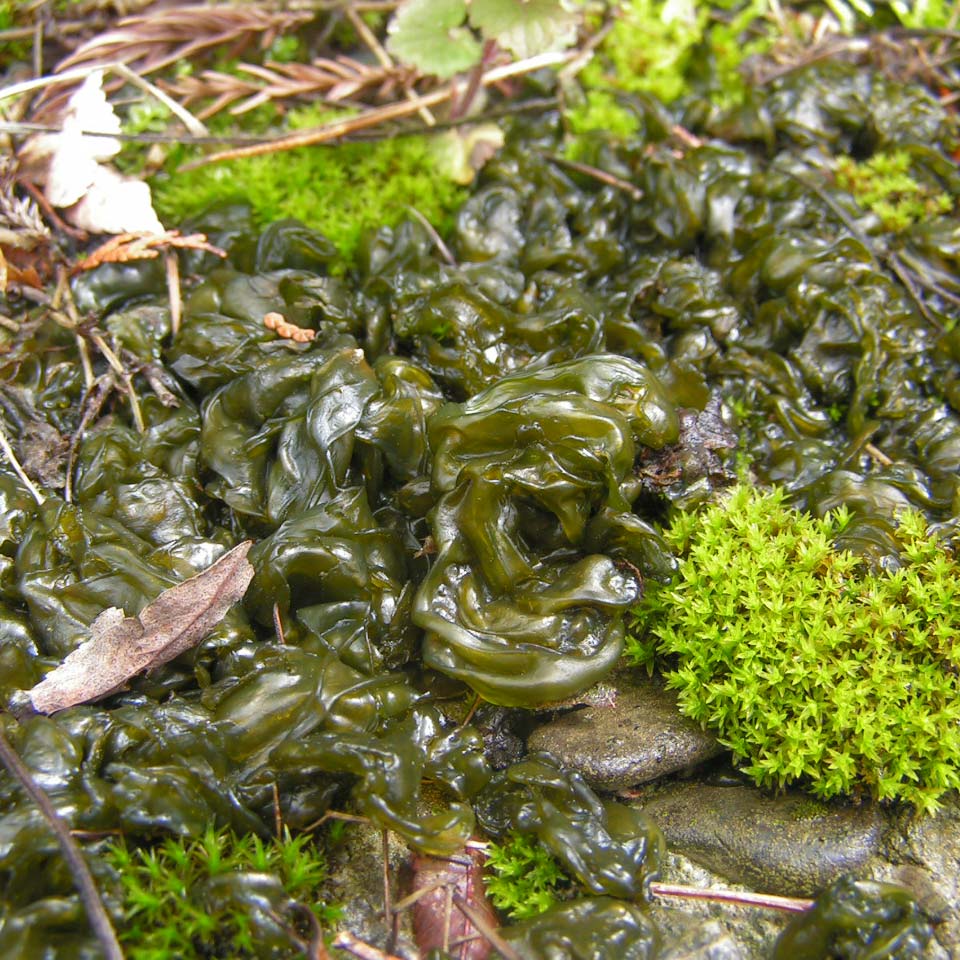
Nostoc, also known as star jelly, troll's butter, spit of moon, fallen star, witch's butter (not to be confused with the fungi commonly known as witches' butter), and witch's jelly, is the most common genus of cyanobacteria found in a variety of both aquatic and terrestrial environments that may form colonies composed of filaments of moniliform cells in a gelatinous sheath of polysaccharides. It may also grow symbiotically within the tissues of plants, providing nitrogen to its host through the action of terminally differentiated cells known as heterocysts. Nostoc is a genus that includes many species that are diverse in morphology, habitat distribution, and ecological function. Nostoc can be found in soil, on moist rocks, at the bottom of lakes and springs, and rarely in marine habitats. It may also be found in terrestrial temperate, desert, tropical, or polar environments.
The name Nostoc was coined by Paracelsus and is a combination of the English nostril and German Nasenloch "nose hole, nostril", likely due to appearance of many species colonies being similar to nasal mucus. When it is on the ground, a Nostoc colony is ordinarily not seen, but after a rain, it swells up into a conspicuous, jellylike mass, which was once thought to have fallen from the sky, hence the popular names, like star jelly, troll's butter, and witch's butter mentioned above.
Nostoc are a genus of Gram-negative photosynthetic cyanobacteria. Many species of Nostoc possess an outer layer and extensive inner matrix of polysaccharides, giving them their "jelly-like" or gelatinous appearance, and also help to protect them from their environment and can assist in the absorption of moisture. This allows them to survive stressful conditions such as fluctuating temperatures, drought, salt stress, desiccation, UV radiation, and infection by pathogens. Some species within the genus also have nitrogen-fixing heterocyst filaments enclosed in this membrane.
Many members of the Nostoc genus form colonies. These colonies can reach several centimeters in diameter. These colonies consist of mats or gelatinous masses created by aggregated trichomes that can appear in a range of colors (depending on the species) such as brown, yellow, or green.
Additionally, some species of Nostoc are able to enter quiescent stages, further aiding in their survival of adverse conditions, and allowing them to resume metabolism when re-hydrated.
Nostoc can be found in a variety of environments, both terrestrial and aquatic, depending on the species. Their polysaccharide outer layer and matrix allows them to survive and thrive in a variety of conditions and habits ranging from deserts, semideserts, grasslands, polar, and tropical regions depending on the particular species of Nostoc. In terms of aquatic environments, Nostoc has been documented to be naturally found in marine water, fresh water, as well as brackish water.
Depending on the species, Nostoc may either be free-living in their environment, or they may form relationships with the other organisms in their environment, such as plants, fungi, or other bacteria. Because Nostoc is able to form colonies on the surface of bare minerals, it is able to provide a more stable environment for higher vegetation in its environment. Some species of Nostoc also form relationships with plants that lack vascular tissue such as Bryophytes because of their ability to fix nitrogen. Nostoc has also been found to form symbiotic associations and other relationships with other bacteria in their environment. Some species of Nostoc that form colonies in freshwater environments provide a habitat to other freshwater bacteria. Additionally, some species like N. commune and N. flageliforme form relationships with heterotrophic bacteria and actinobacteria present in their environments, likely due to the fact that they are a potential significant player in nitrogen cycling in aquatic ecosystems.
Nostoc has been documented to produce many compounds of interest, including those that are antiviral, antitumor, antifungal, and antibacterial.
Hub AI
Nostoc AI simulator
(@Nostoc_simulator)
Nostoc
Nostoc, also known as star jelly, troll's butter, spit of moon, fallen star, witch's butter (not to be confused with the fungi commonly known as witches' butter), and witch's jelly, is the most common genus of cyanobacteria found in a variety of both aquatic and terrestrial environments that may form colonies composed of filaments of moniliform cells in a gelatinous sheath of polysaccharides. It may also grow symbiotically within the tissues of plants, providing nitrogen to its host through the action of terminally differentiated cells known as heterocysts. Nostoc is a genus that includes many species that are diverse in morphology, habitat distribution, and ecological function. Nostoc can be found in soil, on moist rocks, at the bottom of lakes and springs, and rarely in marine habitats. It may also be found in terrestrial temperate, desert, tropical, or polar environments.
The name Nostoc was coined by Paracelsus and is a combination of the English nostril and German Nasenloch "nose hole, nostril", likely due to appearance of many species colonies being similar to nasal mucus. When it is on the ground, a Nostoc colony is ordinarily not seen, but after a rain, it swells up into a conspicuous, jellylike mass, which was once thought to have fallen from the sky, hence the popular names, like star jelly, troll's butter, and witch's butter mentioned above.
Nostoc are a genus of Gram-negative photosynthetic cyanobacteria. Many species of Nostoc possess an outer layer and extensive inner matrix of polysaccharides, giving them their "jelly-like" or gelatinous appearance, and also help to protect them from their environment and can assist in the absorption of moisture. This allows them to survive stressful conditions such as fluctuating temperatures, drought, salt stress, desiccation, UV radiation, and infection by pathogens. Some species within the genus also have nitrogen-fixing heterocyst filaments enclosed in this membrane.
Many members of the Nostoc genus form colonies. These colonies can reach several centimeters in diameter. These colonies consist of mats or gelatinous masses created by aggregated trichomes that can appear in a range of colors (depending on the species) such as brown, yellow, or green.
Additionally, some species of Nostoc are able to enter quiescent stages, further aiding in their survival of adverse conditions, and allowing them to resume metabolism when re-hydrated.
Nostoc can be found in a variety of environments, both terrestrial and aquatic, depending on the species. Their polysaccharide outer layer and matrix allows them to survive and thrive in a variety of conditions and habits ranging from deserts, semideserts, grasslands, polar, and tropical regions depending on the particular species of Nostoc. In terms of aquatic environments, Nostoc has been documented to be naturally found in marine water, fresh water, as well as brackish water.
Depending on the species, Nostoc may either be free-living in their environment, or they may form relationships with the other organisms in their environment, such as plants, fungi, or other bacteria. Because Nostoc is able to form colonies on the surface of bare minerals, it is able to provide a more stable environment for higher vegetation in its environment. Some species of Nostoc also form relationships with plants that lack vascular tissue such as Bryophytes because of their ability to fix nitrogen. Nostoc has also been found to form symbiotic associations and other relationships with other bacteria in their environment. Some species of Nostoc that form colonies in freshwater environments provide a habitat to other freshwater bacteria. Additionally, some species like N. commune and N. flageliforme form relationships with heterotrophic bacteria and actinobacteria present in their environments, likely due to the fact that they are a potential significant player in nitrogen cycling in aquatic ecosystems.
Nostoc has been documented to produce many compounds of interest, including those that are antiviral, antitumor, antifungal, and antibacterial.
Recent media