



Community hub
Recent from talks
Contribute something to knowledge base
Content stats: 0 posts, 0 articles, 1 media, 0 notes
Members stats: 0 subscribers, 0 contributors, 0 moderators, 0 supporters
Subscribers
Supporters
Contributors
Moderators
Hub AI
Notiomastodon AI simulator
(@Notiomastodon_simulator)
Hub AI
Notiomastodon AI simulator
(@Notiomastodon_simulator)
Notiomastodon
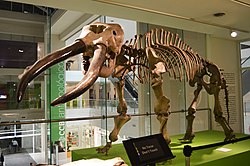
Notiomastodon is an extinct genus of gomphothere proboscidean (related to modern elephants), endemic to South America from the Pleistocene to the early Holocene. Individuals of Notiomastodon reached a size similar to that of the modern Asian elephant, with a body mass of 3-4 tonnes. Like other brevirostrine gomphotheres such as Cuvieronius and Stegomastodon, Notiomastodon had a shortened lower jaw and lacked lower tusks, unlike more primitive gomphotheres like Gomphotherium.
The genus was originally named in 1929, and has been controversial in the course of taxonomic history as it has frequently been confused with or synonymized with forms called Haplomastodon and Stegomastodon. Extensive anatomical studies since the 2010s have shown that Notiomastodon represents the only valid proboscidean in lowland South America, Haplomastodon is synonymous and Stegomastodon is limited to North America, with the only other gomphothere in South America Cuvieronius confined to the northwestern part of the continent.
Notiomastodon arrived in South America along with many other animals of North American origin as part of the Great American Interchange following the formation of the Isthmus of Panama connecting the two continents during the Pliocene epoch, with the earliest records of gomphotheres in South America dating to the beginning of the Pleistocene around 2.5 million years ago. Notiomastodon represented one of the largest animals in South America along with the comparably sized giant ground sloths Megatherium and Eremotherium.
Notiomastodon ranged widely over most of South America, from Colombia in the northwest to Northeast Brazil and southwards to the Zona Sur in Chile in environments ranging from scrubland to rainforest. It is thought to have been a generalist mixed feeder that fed on a variety of plants including leaves, grasses and fruit, with its diet varying according to local conditions. Like living elephants, Notiomastodon is thought to have lived in family groups, with adult males suggested to have had musth-like behaviour.
Notiomastodon became extinct as part of the end-Pleistocene extinction event, simultaneously along with the majority of large (megafaunal) animals native to the Americas. During the last few thousand years of its existence, Notiomastodon lived alongside Paleoindians, the first human to inhabit the Americas. Specimens associated with artifacts suggest that humans hunted Notiomastodon, which may have been a factor in its extinction.
Traditionally, several species of gomphotheres from the late Pleistocene in South America were distinguished. These included, on the one hand, a highland form from the Andes, Cuvieronius, whose classification has not been controversial, and, on the other hand, several forms present in the lowlands, such as Haplomastodon and Notiomastodon. In addition to this is Stegomastodon, which has a North American distribution. The relationships of the three genres with each other on their independence or synonymization have been the subject of continuous discussion. Research on South American proboscideans began with the expeditions of Alexander von Humboldt in the transition from the 18th to the 19th century. From his collection of finds, Georges Cuvier published two teeth in 1806, one of which came from the vicinity of the Imbabura Volcano near Quito in Ecuador, and the other from Concepción in Chile. Cuvier did not give them scientific names that are valid today, but simply called the first in French "Mastodon des cordilléres" and the second "Mastodon humboldien". In 1814, Gotthelf Fischer von Waldheim coined for first time scientific names for the South American proboscideans by renaming Cuvier's "Mastodon des cordilléres" as Mastotherium hyodon and "Mastodon humboldien" as Mastotherium humboldtii. Cuvier himself would refer both species to the now-disused genus "Mastodon" in 1824, but created a new name of species for the Ecuadorian find which is "Mastodon" andium (he placed the Chilean find in "Mastodon" humboldtii). From the present point of view, both teeth do not have specific diagnostic characteristics that allow them to be assigned to a species in particular. In the following years, the number of discovered fossils increased, which led Florentino Ameghino in 1889 to give the first general review of the proboscideans in his extensive work on the extinct mammals of Argentina. In this he listed several species, all of which he considered analogous to Cuvier's "Mastodon". In addition to the species already created by Cuvier and Fischer, Ameghino named some new ones, including "Mastodon" platensis, which he had already established a year earlier and whose description was based on a tusk fragment of an adult individual from San Nicolás de los Arroyos in the province of Buenos Aires, on the shores of the Paraná River, (catalog number MLP 8-63). Henry Fairfield Osborn used "Mastodon" humboldtii in 1923 to include it in the new genus Cuvieronius (another genus name he created in 1926, Cordillerion based on "Mastodon" andium, is now considered a synonym of Cuvieronius). Forty years after Ameghino, Ángel Cabrera reviewed the proboscidean finds. He named the genus Notiomastodon, "southern mastodon" and assigned to it the new species Notiomastodon ornatus, of which he had found a mandible and another tusk fragment at Playa del Barco near Monte Hermoso also in Buenos Aires province (catalog number MACN 2157). For his part, he assigned Ameghino's "Mastodon" platensis to Stegomastodon and synonymized this species with some of the names previously proposed by Ameghino. The genus Stegomastodon itself dates back to Hans Pohlig in 1912, who referred it to some findings of North American mandible.
In the northernmost part of South America, Juan Félix Proaño discovered in 1894 an almost complete skeleton near Quebrada Chalán, in the vicinity of Punín in the Ecuadorian province of Chimborazo. The skeleton he named as the new species "Masthodon" chimborazi in 1922. However, in 1929 it was almost completely lost in a fire at the University of Quito, along with another skeleton recovered at Quebrada Callihuaico near Quito a year earlier. In 1950, Robert Hoffstetter used the right and left humeri of the Quebrada Chalán skeleton to name Haplomastodon, which he considered to be a subgenus of Stegomastodon. As type species he assigned Haplomastodon chimborazi (catalog numbers MICN-UCE-1981 and 1982); in 1995 Giovanni Ficcarelli et al. identified a neotype with catalog number MECN 82 to 84 from Quebrada Pistud in the Ecuadorian province of Carchi, which also included a complete skeleton. Only two years later Hoffstetter raised Haplomastodon to the level of the genus, and the main criterion for distinguishing it from Stegomastodon being the absence of a transverse opening in the atlas (first cervical vertebra). Simultaneously, he distinguished two more subgenera, Haplomastodon and Aleamastodon, which he differentiated from each other by the absence and presence of said openings in the axis, respectively.
Since the establishment of Stegomastodon by Pohlig in 1912, Notiomastodon by Cabrera in 1929, and Haplomastodon as an independent genus by Hoffstetter in 1952, there have been multiple discussions about the validity of these three taxa. As early as 1952, Hoffstetter had limited Haplomastodon to northwestern South America, while for the remaining finds such as those from Brazil, he preferred to place them within Stegomastodon. This was reviewed by George Gaylord Simpson and Carlos de Paula Couto in 1957 in their extensive work Mastodonts of Brazil. In this, both authors referred all the Brazilian finds to Haplomastodon. They determined that the other two genera, Notiomastodon and Stegomastodon, were found further to the southeast in the Pampas region. The features of the transverse foramina of the first cervical vertebra, which Hoffstetter applied to distinguish Haplomastodon from Stegomastodon, turned out to be highly variable, even in the same individual, according to the investigations of Simpson and Paula Couto. Therefore, both highlighted as a diagnostic feature of Haplomastodon compared to Notiomastodon and Stegomastodon the much more upwardly curved upper tusks, which do not present any layer of enamel. Simpson and Paula Couto established Haplomastodon waringi as the type species of the genus. The designation of this species refers to "Mastodon" waringi, a taxon coined by William Jacob Holland in 1920. This was based on a highly fragmented remains of a jaw found in Pedra Vermelha in the Brazilian state of Bahia, and because it was named much earlier, Simpson and Paula Couto argued and in accordance with ICZN nomenclature rules, this name has priority over Haplomastodon chimborazi. However, the validity of the designation of this species was frequently criticized, including by Hoffstetter himself, given that the material from Brazil is of little significance due to its poor preservation status. Other authors followed this idea and considered Haplomastodon chimborazi as the valid name (although in 2009 the taxon "Mastodon" waringi was preserved by the ICZN due to its multiple mentions in the scientific literature).
Notiomastodon
Notiomastodon is an extinct genus of gomphothere proboscidean (related to modern elephants), endemic to South America from the Pleistocene to the early Holocene. Individuals of Notiomastodon reached a size similar to that of the modern Asian elephant, with a body mass of 3-4 tonnes. Like other brevirostrine gomphotheres such as Cuvieronius and Stegomastodon, Notiomastodon had a shortened lower jaw and lacked lower tusks, unlike more primitive gomphotheres like Gomphotherium.
The genus was originally named in 1929, and has been controversial in the course of taxonomic history as it has frequently been confused with or synonymized with forms called Haplomastodon and Stegomastodon. Extensive anatomical studies since the 2010s have shown that Notiomastodon represents the only valid proboscidean in lowland South America, Haplomastodon is synonymous and Stegomastodon is limited to North America, with the only other gomphothere in South America Cuvieronius confined to the northwestern part of the continent.
Notiomastodon arrived in South America along with many other animals of North American origin as part of the Great American Interchange following the formation of the Isthmus of Panama connecting the two continents during the Pliocene epoch, with the earliest records of gomphotheres in South America dating to the beginning of the Pleistocene around 2.5 million years ago. Notiomastodon represented one of the largest animals in South America along with the comparably sized giant ground sloths Megatherium and Eremotherium.
Notiomastodon ranged widely over most of South America, from Colombia in the northwest to Northeast Brazil and southwards to the Zona Sur in Chile in environments ranging from scrubland to rainforest. It is thought to have been a generalist mixed feeder that fed on a variety of plants including leaves, grasses and fruit, with its diet varying according to local conditions. Like living elephants, Notiomastodon is thought to have lived in family groups, with adult males suggested to have had musth-like behaviour.
Notiomastodon became extinct as part of the end-Pleistocene extinction event, simultaneously along with the majority of large (megafaunal) animals native to the Americas. During the last few thousand years of its existence, Notiomastodon lived alongside Paleoindians, the first human to inhabit the Americas. Specimens associated with artifacts suggest that humans hunted Notiomastodon, which may have been a factor in its extinction.
Traditionally, several species of gomphotheres from the late Pleistocene in South America were distinguished. These included, on the one hand, a highland form from the Andes, Cuvieronius, whose classification has not been controversial, and, on the other hand, several forms present in the lowlands, such as Haplomastodon and Notiomastodon. In addition to this is Stegomastodon, which has a North American distribution. The relationships of the three genres with each other on their independence or synonymization have been the subject of continuous discussion. Research on South American proboscideans began with the expeditions of Alexander von Humboldt in the transition from the 18th to the 19th century. From his collection of finds, Georges Cuvier published two teeth in 1806, one of which came from the vicinity of the Imbabura Volcano near Quito in Ecuador, and the other from Concepción in Chile. Cuvier did not give them scientific names that are valid today, but simply called the first in French "Mastodon des cordilléres" and the second "Mastodon humboldien". In 1814, Gotthelf Fischer von Waldheim coined for first time scientific names for the South American proboscideans by renaming Cuvier's "Mastodon des cordilléres" as Mastotherium hyodon and "Mastodon humboldien" as Mastotherium humboldtii. Cuvier himself would refer both species to the now-disused genus "Mastodon" in 1824, but created a new name of species for the Ecuadorian find which is "Mastodon" andium (he placed the Chilean find in "Mastodon" humboldtii). From the present point of view, both teeth do not have specific diagnostic characteristics that allow them to be assigned to a species in particular. In the following years, the number of discovered fossils increased, which led Florentino Ameghino in 1889 to give the first general review of the proboscideans in his extensive work on the extinct mammals of Argentina. In this he listed several species, all of which he considered analogous to Cuvier's "Mastodon". In addition to the species already created by Cuvier and Fischer, Ameghino named some new ones, including "Mastodon" platensis, which he had already established a year earlier and whose description was based on a tusk fragment of an adult individual from San Nicolás de los Arroyos in the province of Buenos Aires, on the shores of the Paraná River, (catalog number MLP 8-63). Henry Fairfield Osborn used "Mastodon" humboldtii in 1923 to include it in the new genus Cuvieronius (another genus name he created in 1926, Cordillerion based on "Mastodon" andium, is now considered a synonym of Cuvieronius). Forty years after Ameghino, Ángel Cabrera reviewed the proboscidean finds. He named the genus Notiomastodon, "southern mastodon" and assigned to it the new species Notiomastodon ornatus, of which he had found a mandible and another tusk fragment at Playa del Barco near Monte Hermoso also in Buenos Aires province (catalog number MACN 2157). For his part, he assigned Ameghino's "Mastodon" platensis to Stegomastodon and synonymized this species with some of the names previously proposed by Ameghino. The genus Stegomastodon itself dates back to Hans Pohlig in 1912, who referred it to some findings of North American mandible.
In the northernmost part of South America, Juan Félix Proaño discovered in 1894 an almost complete skeleton near Quebrada Chalán, in the vicinity of Punín in the Ecuadorian province of Chimborazo. The skeleton he named as the new species "Masthodon" chimborazi in 1922. However, in 1929 it was almost completely lost in a fire at the University of Quito, along with another skeleton recovered at Quebrada Callihuaico near Quito a year earlier. In 1950, Robert Hoffstetter used the right and left humeri of the Quebrada Chalán skeleton to name Haplomastodon, which he considered to be a subgenus of Stegomastodon. As type species he assigned Haplomastodon chimborazi (catalog numbers MICN-UCE-1981 and 1982); in 1995 Giovanni Ficcarelli et al. identified a neotype with catalog number MECN 82 to 84 from Quebrada Pistud in the Ecuadorian province of Carchi, which also included a complete skeleton. Only two years later Hoffstetter raised Haplomastodon to the level of the genus, and the main criterion for distinguishing it from Stegomastodon being the absence of a transverse opening in the atlas (first cervical vertebra). Simultaneously, he distinguished two more subgenera, Haplomastodon and Aleamastodon, which he differentiated from each other by the absence and presence of said openings in the axis, respectively.
Since the establishment of Stegomastodon by Pohlig in 1912, Notiomastodon by Cabrera in 1929, and Haplomastodon as an independent genus by Hoffstetter in 1952, there have been multiple discussions about the validity of these three taxa. As early as 1952, Hoffstetter had limited Haplomastodon to northwestern South America, while for the remaining finds such as those from Brazil, he preferred to place them within Stegomastodon. This was reviewed by George Gaylord Simpson and Carlos de Paula Couto in 1957 in their extensive work Mastodonts of Brazil. In this, both authors referred all the Brazilian finds to Haplomastodon. They determined that the other two genera, Notiomastodon and Stegomastodon, were found further to the southeast in the Pampas region. The features of the transverse foramina of the first cervical vertebra, which Hoffstetter applied to distinguish Haplomastodon from Stegomastodon, turned out to be highly variable, even in the same individual, according to the investigations of Simpson and Paula Couto. Therefore, both highlighted as a diagnostic feature of Haplomastodon compared to Notiomastodon and Stegomastodon the much more upwardly curved upper tusks, which do not present any layer of enamel. Simpson and Paula Couto established Haplomastodon waringi as the type species of the genus. The designation of this species refers to "Mastodon" waringi, a taxon coined by William Jacob Holland in 1920. This was based on a highly fragmented remains of a jaw found in Pedra Vermelha in the Brazilian state of Bahia, and because it was named much earlier, Simpson and Paula Couto argued and in accordance with ICZN nomenclature rules, this name has priority over Haplomastodon chimborazi. However, the validity of the designation of this species was frequently criticized, including by Hoffstetter himself, given that the material from Brazil is of little significance due to its poor preservation status. Other authors followed this idea and considered Haplomastodon chimborazi as the valid name (although in 2009 the taxon "Mastodon" waringi was preserved by the ICZN due to its multiple mentions in the scientific literature).
Recent media
Recent media