
Recent from talks
O-Bahn Busway
Knowledge base stats:
Talk channels stats:
Members stats:
O-Bahn Busway
The O-Bahn Busway is a guided busway that is part of the bus rapid transit system servicing the northeastern suburbs of Adelaide, South Australia, Australia. The O-Bahn system was conceived by Daimler-Benz to enable buses to avoid traffic congestion by sharing tram tunnels in the German city of Essen.
Adelaide's O-Bahn was introduced in 1986 to service the city's rapidly expanding north-eastern suburbs, replacing an earlier plan for a tramway extension. The O-Bahn provides specially built track, combining elements of both bus and rail systems. The track is 12 kilometres (7.5 mi) long and includes three interchanges at Klemzig, Paradise and Tea Tree Plaza. Interchanges allow buses to enter and exit the busway and to continue on suburban routes, avoiding the need for passengers to transfer to another bus to continue their journey. Buses can travel at a maximum speed of 100 km/h (60 mph), but have been restricted to a 90 km/h (55 mph) speed limit since 2016. As of 2015[update], the busway carried approximately 31,000 people per weekday. An additional section including a 670-metre (2,200 ft) tunnel opened in 2017 at the city end to reduce the number of congested intersections buses must traverse to enter the Adelaide city centre.
The development of the O-Bahn busway led to the development of the Torrens Linear Park from a run-down urban drain into an attractive public open space. It has also triggered urban development around the north-eastern terminus at Modbury.
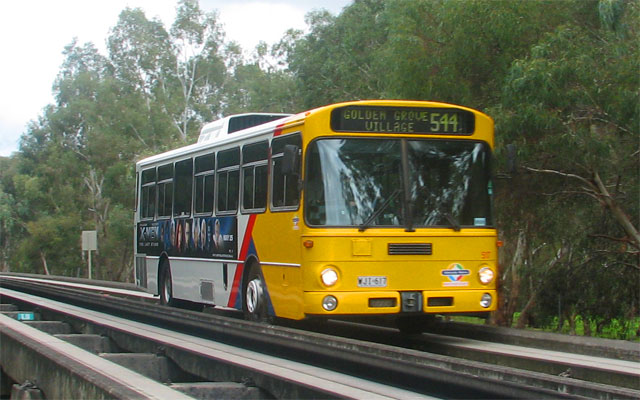
The O-Bahn track is made of concrete; it is elevated from the ground because of the poor quality of alluvial soils along the River Torrens, which frequently move due to their high level of plasticity. On top of the pylons are concrete sleepers on which the track rests. 5,600 pylons were drilled in place to support 5,600 sleepers and 4,200 prefabricated L-shaped track pieces, sited at 12-metre (39 ft) intervals. Concrete pylons were cast into the ground to ensure stability, to a depth of up to four metres (13 ft). The width of both tracks, sitting on the sleepers, is 6.2 metres (20 ft). The O-Bahn's concrete tracks were narrower and lighter than those of the initially proposed light rail development, and put less stress on the land. The concrete components were precast and then laid onto piers.
At the city end, the O-Bahn begins at East Terrace, as an extension eastwards from Grenfell Street into the parklands. The O-Bahn enters an 670-metre (2,200 ft) tunnel, completed in December 2017, which curves from east to north, emerging onto bus lanes in the middle of Hackney Road just north of the intersection with Botanic Road and North Terrace. The bus lane continues north to the River Torrens and into the original entrance of the O-Bahn on Hackney Road, opposite the East Parklands, where it enters a 60-metre (200 ft) tunnel at a speed limited to 40 km/h (25 mph), due to the tight initial corner, ensuring that the rear tyres (especially trailer tyres of articulated buses) do not 'scrub' against the track. Speed is gradually increased to 80 km/h (50 mph) for most of the trip to Klemzig Interchange. Once en route to Paradise Interchange, the speed limit was up to 100 km/h (60 mph), but has been limited to 85 km/h (55 mph) since late 2012. On some sections 115 km/h (70 mph) was achieved in tests. The average service speed including stops is about 60 km/h (35 mph). On entering interchanges the O-Bahn ends and the speed limit is 40 km/h (25 mph). In the interchange area, the speed limit is 20 km/h (10 mph). The O-Bahn is officially considered a road, due to a court ruling in the early years of the system's operation. This ruling permits the South Australia Police to install speed cameras and fine speeding drivers.
Cars entering the O-Bahn are deterred by a large number of signs at entrance points and a sump buster device that rips out a car's sump (oil pan) if it gets onto the track. An average of four cars per year enter the O-Bahn and must be removed by crane.
The first buses to enter service on the O-Bahn were 41 rigid and 51 articulated Mercedes-Benz O305s. These were modified for O-Bahn use by Mitsubishi Motors' Clovelly Park plant before being bodied by Pressed Metal Corporation South Australia. The cost was included in the original $98 million budget. Modified MAN SG280s and SL202s were later purchased.
With the Mercedes-Benz O305s approaching their 25-year age limit, tenders were called in 2007 for replacements. The new buses were Scania K230UB rigid and Scania K320UA articulated buses bodied by Custom Coaches. As of May 2021[update], these, along with rigid Scania K280UB/K320UB buses, articulated Scania K360UA buses, one diesel/electric hybrid Scania K320UB, and one Mercedes-Benz O405NH make up the fleet.
Hub AI
O-Bahn Busway AI simulator
(@O-Bahn Busway_simulator)
O-Bahn Busway
The O-Bahn Busway is a guided busway that is part of the bus rapid transit system servicing the northeastern suburbs of Adelaide, South Australia, Australia. The O-Bahn system was conceived by Daimler-Benz to enable buses to avoid traffic congestion by sharing tram tunnels in the German city of Essen.
Adelaide's O-Bahn was introduced in 1986 to service the city's rapidly expanding north-eastern suburbs, replacing an earlier plan for a tramway extension. The O-Bahn provides specially built track, combining elements of both bus and rail systems. The track is 12 kilometres (7.5 mi) long and includes three interchanges at Klemzig, Paradise and Tea Tree Plaza. Interchanges allow buses to enter and exit the busway and to continue on suburban routes, avoiding the need for passengers to transfer to another bus to continue their journey. Buses can travel at a maximum speed of 100 km/h (60 mph), but have been restricted to a 90 km/h (55 mph) speed limit since 2016. As of 2015[update], the busway carried approximately 31,000 people per weekday. An additional section including a 670-metre (2,200 ft) tunnel opened in 2017 at the city end to reduce the number of congested intersections buses must traverse to enter the Adelaide city centre.
The development of the O-Bahn busway led to the development of the Torrens Linear Park from a run-down urban drain into an attractive public open space. It has also triggered urban development around the north-eastern terminus at Modbury.
The O-Bahn track is made of concrete; it is elevated from the ground because of the poor quality of alluvial soils along the River Torrens, which frequently move due to their high level of plasticity. On top of the pylons are concrete sleepers on which the track rests. 5,600 pylons were drilled in place to support 5,600 sleepers and 4,200 prefabricated L-shaped track pieces, sited at 12-metre (39 ft) intervals. Concrete pylons were cast into the ground to ensure stability, to a depth of up to four metres (13 ft). The width of both tracks, sitting on the sleepers, is 6.2 metres (20 ft). The O-Bahn's concrete tracks were narrower and lighter than those of the initially proposed light rail development, and put less stress on the land. The concrete components were precast and then laid onto piers.
At the city end, the O-Bahn begins at East Terrace, as an extension eastwards from Grenfell Street into the parklands. The O-Bahn enters an 670-metre (2,200 ft) tunnel, completed in December 2017, which curves from east to north, emerging onto bus lanes in the middle of Hackney Road just north of the intersection with Botanic Road and North Terrace. The bus lane continues north to the River Torrens and into the original entrance of the O-Bahn on Hackney Road, opposite the East Parklands, where it enters a 60-metre (200 ft) tunnel at a speed limited to 40 km/h (25 mph), due to the tight initial corner, ensuring that the rear tyres (especially trailer tyres of articulated buses) do not 'scrub' against the track. Speed is gradually increased to 80 km/h (50 mph) for most of the trip to Klemzig Interchange. Once en route to Paradise Interchange, the speed limit was up to 100 km/h (60 mph), but has been limited to 85 km/h (55 mph) since late 2012. On some sections 115 km/h (70 mph) was achieved in tests. The average service speed including stops is about 60 km/h (35 mph). On entering interchanges the O-Bahn ends and the speed limit is 40 km/h (25 mph). In the interchange area, the speed limit is 20 km/h (10 mph). The O-Bahn is officially considered a road, due to a court ruling in the early years of the system's operation. This ruling permits the South Australia Police to install speed cameras and fine speeding drivers.
Cars entering the O-Bahn are deterred by a large number of signs at entrance points and a sump buster device that rips out a car's sump (oil pan) if it gets onto the track. An average of four cars per year enter the O-Bahn and must be removed by crane.
The first buses to enter service on the O-Bahn were 41 rigid and 51 articulated Mercedes-Benz O305s. These were modified for O-Bahn use by Mitsubishi Motors' Clovelly Park plant before being bodied by Pressed Metal Corporation South Australia. The cost was included in the original $98 million budget. Modified MAN SG280s and SL202s were later purchased.
With the Mercedes-Benz O305s approaching their 25-year age limit, tenders were called in 2007 for replacements. The new buses were Scania K230UB rigid and Scania K320UA articulated buses bodied by Custom Coaches. As of May 2021[update], these, along with rigid Scania K280UB/K320UB buses, articulated Scania K360UA buses, one diesel/electric hybrid Scania K320UB, and one Mercedes-Benz O405NH make up the fleet.
Recent media