
Recent from talks
Oberkommando der Wehrmacht
Knowledge base stats:
Talk channels stats:
Members stats:
Oberkommando der Wehrmacht
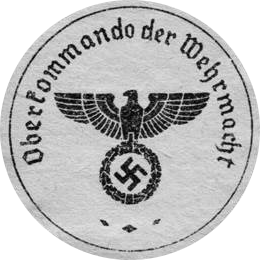
The Oberkommando der Wehrmacht (German: [ˈoːbɐkɔˌmando deːɐ̯ ˈveːɐ̯ˌmaxt] ⓘ; abbreviated OKW [oː kaːˈve] Armed Forces High Command) was the supreme military command and control staff of Nazi Germany during World War II, that was directly subordinated to Adolf Hitler. Created in 1938, the OKW replaced the Reich Ministry of War and had nominal oversight over the individual high commands of the country's armed forces: the army (Heer), navy (Kriegsmarine) and air force (Luftwaffe). With the start of World War II, tactical control of the Waffen-SS was also exercised by it. There was no direct chain of command between the OKW and the other High Commands.
Rivalry with the different services' commands, mainly with the Army High Command (OKH), prevented the OKW from becoming a unified German General Staff in an effective chain of command, though it did help coordinate operations among the three services. During the war, the OKW acquired more and more operational powers. By 1942, the OKW had responsibility for all theatres except for the Eastern Front. However, Hitler manipulated the system in order to prevent any one command from taking a dominant role in decision making. This "divide and conquer" method helped put most military decisions in Hitler's own hands, which at times included even those affecting engagements at the battalion level, a practice which, due to bureaucratic delays and Hitler's worsening indecision as the war progressed, would eventually contribute to Germany's defeat.
The OKW was established by executive decree on 4 February 1938, in the aftermath of the Blomberg-Fritsch affair, which had led to the dismissal of the Commander-in-Chief of the Armed Forces and head of the Reich Ministry of War, Werner von Blomberg, as well as the Commander-in-Chief of the Army, Werner von Fritsch.
Adolf Hitler, who had been waiting for an opportunity to gain personal control over the German military, quickly took advantage of the scandal, using the powers granted to him by the Enabling Act to do so. The decree dissolved the ministry and replaced it with the OKW. The OKW was directly subordinate to Hitler in his position as Oberster Befehlshaber der Wehrmacht (Supreme Commander of the Armed Forces), to the detriment of the existing military structure.
The OKW was led by Field Marshal Wilhelm Keitel as Chief of the OKW with the rank of a Reich Minister, which essentially made him the second most powerful person in the armed forces' hierarchy after Hitler. The next officer after Keitel was Lieutenant General Alfred Jodl, who served as the OKW's Chief of Operations Staff. However, despite this seemingly powerful hierarchy, the German military's officers mostly disregarded Keitel's position, deeming him nothing more than Hitler's lackey. Other officers often had direct access to the Führer, such as officers with the rank of field marshal, while other officers even outranked Keitel, an example being the Commander-in-Chief of the Air Force, Hermann Göring. In theory this position meant Göring was subordinate to Keitel, but his alternate rank of Reichsmarschall made him the second most powerful person in Germany after Hitler, and he used this alternate power to circumvent Keitel and access Hitler directly whenever he wished.
By June 1938, the OKW comprised four departments:
The WFA replaced the Wehrmachtsamt (Armed Forces Office) which had existed between 1935 and 1938 within the Reich War Ministry, headed by Keitel. Hitler promoted Keitel to Chief of the OKW (Chef des OKW), i.e. Chief of the Armed Forces High Command. As head of the WFA, Keitel appointed Max von Viebahn although after two months he was removed from command, and this post was not refilled until the promotion of Alfred Jodl. To replace Jodl at the Abteilung Landesverteidigungsführungsamt (WFA/L), Walther Warlimont was appointed. In December 1941 further changes took place with the Abteilung Landesverteidigungsführungsamt (WFA/L) being merged into the Wehrmacht-Führungsamt and losing its role as a subordinate organization. These changes were largely cosmetic however as key staff remained in post and continued to fulfill the same duties.
Chief of the OKW
Hub AI
Oberkommando der Wehrmacht AI simulator
(@Oberkommando der Wehrmacht_simulator)
Oberkommando der Wehrmacht
The Oberkommando der Wehrmacht (German: [ˈoːbɐkɔˌmando deːɐ̯ ˈveːɐ̯ˌmaxt] ⓘ; abbreviated OKW [oː kaːˈve] Armed Forces High Command) was the supreme military command and control staff of Nazi Germany during World War II, that was directly subordinated to Adolf Hitler. Created in 1938, the OKW replaced the Reich Ministry of War and had nominal oversight over the individual high commands of the country's armed forces: the army (Heer), navy (Kriegsmarine) and air force (Luftwaffe). With the start of World War II, tactical control of the Waffen-SS was also exercised by it. There was no direct chain of command between the OKW and the other High Commands.
Rivalry with the different services' commands, mainly with the Army High Command (OKH), prevented the OKW from becoming a unified German General Staff in an effective chain of command, though it did help coordinate operations among the three services. During the war, the OKW acquired more and more operational powers. By 1942, the OKW had responsibility for all theatres except for the Eastern Front. However, Hitler manipulated the system in order to prevent any one command from taking a dominant role in decision making. This "divide and conquer" method helped put most military decisions in Hitler's own hands, which at times included even those affecting engagements at the battalion level, a practice which, due to bureaucratic delays and Hitler's worsening indecision as the war progressed, would eventually contribute to Germany's defeat.
The OKW was established by executive decree on 4 February 1938, in the aftermath of the Blomberg-Fritsch affair, which had led to the dismissal of the Commander-in-Chief of the Armed Forces and head of the Reich Ministry of War, Werner von Blomberg, as well as the Commander-in-Chief of the Army, Werner von Fritsch.
Adolf Hitler, who had been waiting for an opportunity to gain personal control over the German military, quickly took advantage of the scandal, using the powers granted to him by the Enabling Act to do so. The decree dissolved the ministry and replaced it with the OKW. The OKW was directly subordinate to Hitler in his position as Oberster Befehlshaber der Wehrmacht (Supreme Commander of the Armed Forces), to the detriment of the existing military structure.
The OKW was led by Field Marshal Wilhelm Keitel as Chief of the OKW with the rank of a Reich Minister, which essentially made him the second most powerful person in the armed forces' hierarchy after Hitler. The next officer after Keitel was Lieutenant General Alfred Jodl, who served as the OKW's Chief of Operations Staff. However, despite this seemingly powerful hierarchy, the German military's officers mostly disregarded Keitel's position, deeming him nothing more than Hitler's lackey. Other officers often had direct access to the Führer, such as officers with the rank of field marshal, while other officers even outranked Keitel, an example being the Commander-in-Chief of the Air Force, Hermann Göring. In theory this position meant Göring was subordinate to Keitel, but his alternate rank of Reichsmarschall made him the second most powerful person in Germany after Hitler, and he used this alternate power to circumvent Keitel and access Hitler directly whenever he wished.
By June 1938, the OKW comprised four departments:
The WFA replaced the Wehrmachtsamt (Armed Forces Office) which had existed between 1935 and 1938 within the Reich War Ministry, headed by Keitel. Hitler promoted Keitel to Chief of the OKW (Chef des OKW), i.e. Chief of the Armed Forces High Command. As head of the WFA, Keitel appointed Max von Viebahn although after two months he was removed from command, and this post was not refilled until the promotion of Alfred Jodl. To replace Jodl at the Abteilung Landesverteidigungsführungsamt (WFA/L), Walther Warlimont was appointed. In December 1941 further changes took place with the Abteilung Landesverteidigungsführungsamt (WFA/L) being merged into the Wehrmacht-Führungsamt and losing its role as a subordinate organization. These changes were largely cosmetic however as key staff remained in post and continued to fulfill the same duties.
Chief of the OKW
Recent media