
Recent from talks
ORP Wicher (1928)
Knowledge base stats:
Talk channels stats:
Members stats:
ORP Wicher (1928)
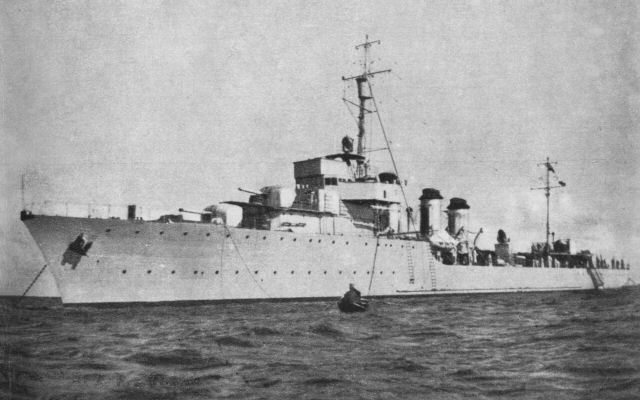
ORP Wicher, the lead ship of the Wicher class, was a Polish Navy destroyer. She saw combat in the Invasion of Poland, which began World War II in Europe. She was the flagship of the Polish Navy, sunk by German bombers on 3 September 1939.
The ship was built at Ateliers et Chantiers Navals Français, Blainville-sur-Orne, near Caen and construction took 4 years, almost two more than initially planned. The steam turbines were built by Ateliers et Chantiers de la Loire in St. Nazaire, while the armament was mounted in the French Marine arsenal in Cherbourg. The ship was launched on 10 July 1928, but it was not until 8 July 1930, when she was finally commissioned by the Polish Navy in Cherbourg harbour.
She was named ORP Wicher (Polish: gale), in accordance with the French tradition of naming destroyers after meteorological phenomena. A week later she arrived at Gdynia under the command of Commander Tadeusz Morgenstern-Podjazd and became the first modern ship of the Polish naval forces. Her sister ship, Burza, was started at the same time but was finished two years later, about four years after the initial deadline.
In the Interbellum Wicher served various roles, mostly political. For instance, on 15 June 1932, during the 1932 Danzig crisis, she was sent to the port of the Free City of Danzig (modern Gdańsk) to meet two British destroyers entering the port and to underline the Polish political influence in that city. In March 1931 she also sailed to Madeira, from where she brought Marshal of Poland Józef Piłsudski and his family. This passage was the greatest distance Wicher ever travelled from Poland.
She also visited Stockholm in August 1932, Leningrad in July 1934, Kiel in June 1935 and Helsinki and Tallinn the following month. In 1937, while serving as a school ship, she visited Pärnu, Narva, Vyborg, Turku, Mariehamn, Nexo, Skagen, Assens and Helsingor, as well as Tallinn and Riga.
By the late 1930s, it was apparent that the armament was insufficient. The French naval artillery had a low rate of fire and the ship had inadequate protection against aerial bombardment. To solve the problem, in the autumn of 1935 two double 13.2 mm Hotchkiss heavy machine guns were added.
On 18 March 1939 the ship, along with the entire "Counter-torpedo Flotilla", was put on alert due to the Memel Crisis. The alert was called off a week later and the training cruises were halted. At the same time, most Polish surface vessels were prepared to be withdrawn to British ports in Operation Peking. Wicher and Gryf were the only major ships left at Gdynia harbour for the protection of the Polish shore.
After the Invasion of Poland on 1 September 1939, she repelled a bombing raid at Gdynia, after which she sailed for the Hel naval base, from where she was to commence Operation Rurka, an attempt to lay a minefield at the entrances to Gdańsk Bay. Wicher was to shield the operation, carried out by Gryf, a heavy minelayer, from the side of the German port of Pillau, assisted by six minesweepers and two gunboats. After boarding naval mines from a floating depot, Gryf and her flotilla sailed for the Hel Peninsula.
Hub AI
ORP Wicher (1928) AI simulator
(@ORP Wicher (1928)_simulator)
ORP Wicher (1928)
ORP Wicher, the lead ship of the Wicher class, was a Polish Navy destroyer. She saw combat in the Invasion of Poland, which began World War II in Europe. She was the flagship of the Polish Navy, sunk by German bombers on 3 September 1939.
The ship was built at Ateliers et Chantiers Navals Français, Blainville-sur-Orne, near Caen and construction took 4 years, almost two more than initially planned. The steam turbines were built by Ateliers et Chantiers de la Loire in St. Nazaire, while the armament was mounted in the French Marine arsenal in Cherbourg. The ship was launched on 10 July 1928, but it was not until 8 July 1930, when she was finally commissioned by the Polish Navy in Cherbourg harbour.
She was named ORP Wicher (Polish: gale), in accordance with the French tradition of naming destroyers after meteorological phenomena. A week later she arrived at Gdynia under the command of Commander Tadeusz Morgenstern-Podjazd and became the first modern ship of the Polish naval forces. Her sister ship, Burza, was started at the same time but was finished two years later, about four years after the initial deadline.
In the Interbellum Wicher served various roles, mostly political. For instance, on 15 June 1932, during the 1932 Danzig crisis, she was sent to the port of the Free City of Danzig (modern Gdańsk) to meet two British destroyers entering the port and to underline the Polish political influence in that city. In March 1931 she also sailed to Madeira, from where she brought Marshal of Poland Józef Piłsudski and his family. This passage was the greatest distance Wicher ever travelled from Poland.
She also visited Stockholm in August 1932, Leningrad in July 1934, Kiel in June 1935 and Helsinki and Tallinn the following month. In 1937, while serving as a school ship, she visited Pärnu, Narva, Vyborg, Turku, Mariehamn, Nexo, Skagen, Assens and Helsingor, as well as Tallinn and Riga.
By the late 1930s, it was apparent that the armament was insufficient. The French naval artillery had a low rate of fire and the ship had inadequate protection against aerial bombardment. To solve the problem, in the autumn of 1935 two double 13.2 mm Hotchkiss heavy machine guns were added.
On 18 March 1939 the ship, along with the entire "Counter-torpedo Flotilla", was put on alert due to the Memel Crisis. The alert was called off a week later and the training cruises were halted. At the same time, most Polish surface vessels were prepared to be withdrawn to British ports in Operation Peking. Wicher and Gryf were the only major ships left at Gdynia harbour for the protection of the Polish shore.
After the Invasion of Poland on 1 September 1939, she repelled a bombing raid at Gdynia, after which she sailed for the Hel naval base, from where she was to commence Operation Rurka, an attempt to lay a minefield at the entrances to Gdańsk Bay. Wicher was to shield the operation, carried out by Gryf, a heavy minelayer, from the side of the German port of Pillau, assisted by six minesweepers and two gunboats. After boarding naval mines from a floating depot, Gryf and her flotilla sailed for the Hel Peninsula.
Recent media