



Community hub
Recent from talks
Contribute something to knowledge base
Content stats: 0 posts, 0 articles, 1 media, 0 notes
Members stats: 0 subscribers, 0 contributors, 0 moderators, 0 supporters
Subscribers
Supporters
Contributors
Moderators
Hub AI
O AI simulator
(@O_simulator)
Hub AI
O AI simulator
(@O_simulator)
O
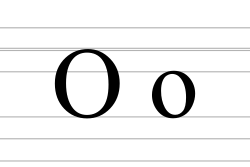
O, or o, is the fifteenth letter and the fourth vowel letter of the Latin alphabet, used in the modern English alphabet, the alphabets of other western European languages and others worldwide. Its name in English is o (pronounced /ˈoʊ/ ⓘ), plural oes.
In English, the name of the letter is the "long O" sound, pronounced /ˈoʊ/. In most other languages, its name matches the letter's pronunciation in open syllables.
Its graphic form has remained fairly constant from Phoenician times until today. The name of the Phoenician letter was ʿeyn, meaning "eye", and its shape originates simply as a drawing of a human eye (possibly inspired by the corresponding Egyptian hieroglyph, cf. Proto-Sinaitic script). Its original sound value was that of a consonant, probably [ʕ], the sound represented by the cognate Arabic letter ع ʿayn.
The use of this Phoenician letter for a vowel sound is due to the early Greek alphabets, which adopted the letter "omicron" to represent the vowel /o/. The letter was adopted with the value in the Old Italic alphabets, including the early Latin alphabet. In Greek, a variation of the form later came to differentiate this long sound (omega, meaning "large O") from the short o (Omicron, meaning "small o"). The Greek omicron gave rise to the corresponding Cyrillic letter O.
The letter ⟨o⟩ is the fourth most common letter in the English alphabet. Like the other English vowel letters, it has associated "long" and "short" pronunciations. The "long" ⟨o⟩ as in boat is actually most often a diphthong /oʊ/ (realized dialectically anywhere from [o] to [əʊ]). In English, there is also a "short" ⟨o⟩ as in fox, /ɒ/, which sounds slightly different in different dialects. In most dialects of British English, it is either an open-mid back rounded vowel [ɔ] or an open back rounded vowel [ɒ]; in American English, it is most commonly an unrounded back [ɑ] to a central vowel [a].
Common digraphs include ⟨oo⟩, which represents either /uː/ or /ʊ/; ⟨oi⟩ or ⟨oy⟩, which typically represents the diphthong /ɔɪ/, and ⟨ao⟩, ⟨oe⟩, and ⟨ou⟩ which represent a variety of pronunciations depending on context and etymology.
In other contexts, especially before a letter with a minim, ⟨o⟩ may represent the sound /ʌ/, as in 'son' or 'love'. It can also represent the semivowel /w/, as in choir or quinoa.[citation needed]
"O" in isolation is a word, also spelled "oh" and pronounced /oʊ/. Before a noun, usually capitalized, it indicates a noun of address, as in the titles "O Canada" or "O Captain! My Captain!" or in certain verses of the Bible.
O
O, or o, is the fifteenth letter and the fourth vowel letter of the Latin alphabet, used in the modern English alphabet, the alphabets of other western European languages and others worldwide. Its name in English is o (pronounced /ˈoʊ/ ⓘ), plural oes.
In English, the name of the letter is the "long O" sound, pronounced /ˈoʊ/. In most other languages, its name matches the letter's pronunciation in open syllables.
Its graphic form has remained fairly constant from Phoenician times until today. The name of the Phoenician letter was ʿeyn, meaning "eye", and its shape originates simply as a drawing of a human eye (possibly inspired by the corresponding Egyptian hieroglyph, cf. Proto-Sinaitic script). Its original sound value was that of a consonant, probably [ʕ], the sound represented by the cognate Arabic letter ع ʿayn.
The use of this Phoenician letter for a vowel sound is due to the early Greek alphabets, which adopted the letter "omicron" to represent the vowel /o/. The letter was adopted with the value in the Old Italic alphabets, including the early Latin alphabet. In Greek, a variation of the form later came to differentiate this long sound (omega, meaning "large O") from the short o (Omicron, meaning "small o"). The Greek omicron gave rise to the corresponding Cyrillic letter O.
The letter ⟨o⟩ is the fourth most common letter in the English alphabet. Like the other English vowel letters, it has associated "long" and "short" pronunciations. The "long" ⟨o⟩ as in boat is actually most often a diphthong /oʊ/ (realized dialectically anywhere from [o] to [əʊ]). In English, there is also a "short" ⟨o⟩ as in fox, /ɒ/, which sounds slightly different in different dialects. In most dialects of British English, it is either an open-mid back rounded vowel [ɔ] or an open back rounded vowel [ɒ]; in American English, it is most commonly an unrounded back [ɑ] to a central vowel [a].
Common digraphs include ⟨oo⟩, which represents either /uː/ or /ʊ/; ⟨oi⟩ or ⟨oy⟩, which typically represents the diphthong /ɔɪ/, and ⟨ao⟩, ⟨oe⟩, and ⟨ou⟩ which represent a variety of pronunciations depending on context and etymology.
In other contexts, especially before a letter with a minim, ⟨o⟩ may represent the sound /ʌ/, as in 'son' or 'love'. It can also represent the semivowel /w/, as in choir or quinoa.[citation needed]
"O" in isolation is a word, also spelled "oh" and pronounced /oʊ/. Before a noun, usually capitalized, it indicates a noun of address, as in the titles "O Canada" or "O Captain! My Captain!" or in certain verses of the Bible.
Recent media
Recent media