
Recent from talks
Blood type
Knowledge base stats:
Talk channels stats:
Members stats:
Blood type
A blood type (also known as a blood group) is a classification of blood based on the presence and absence of antibodies and inherited antigenic substances on the surface of red blood cells (RBCs). These antigens may be proteins, carbohydrates, glycoproteins, or glycolipids, depending on the blood group system. Some of these antigens are also present on the surface of other types of cells of various tissues. Several of these red blood cell surface antigens can stem from one allele (or an alternative version of a gene) and collectively form a blood group system.
Blood types are inherited and represent contributions from both parents of an individual. As of June 2025, a total of 48 human blood group systems are recognized by the International Society of Blood Transfusion (ISBT). The two most important blood group systems are ABO and Rh; they determine someone's blood type (A, B, AB, and O, with + or − denoting RhD status) for suitability in blood transfusion.
A complete blood type would describe each of the 48 blood groups, and an individual's blood type is one of many possible combinations of blood-group antigens. Almost always, an individual has the same blood group for life, but very rarely an individual's blood type changes through addition or suppression of an antigen in infection, malignancy, or autoimmune disease. Another more common cause of blood type change is a bone marrow transplant. Bone-marrow transplants are performed for many leukemias and lymphomas, among other diseases. If a person receives bone marrow from someone of a different ABO type (e.g., a type O patient receives a type A bone marrow), the patient's blood type should eventually become the donor's type, as the patient's hematopoietic stem cells (HSCs) are destroyed, either by ablation of the bone marrow or by the donor's T-cells. Once all the patient's original red blood cells have died, they will have been fully replaced by new cells derived from the donor HSCs. Provided the donor had a different ABO type, the new cells' surface antigens will be different from those on the surface of the patient's original red blood cells.
Some blood types are associated with the inheritance of other diseases; for example, the Kell antigen is sometimes associated with McLeod syndrome. Certain blood types may affect susceptibility to infections, such as the resistance to specific malaria species seen in individuals lacking the Duffy antigen. The Duffy antigen, presumably as a result of natural selection, is less common in population groups from areas having a high incidence of malaria.
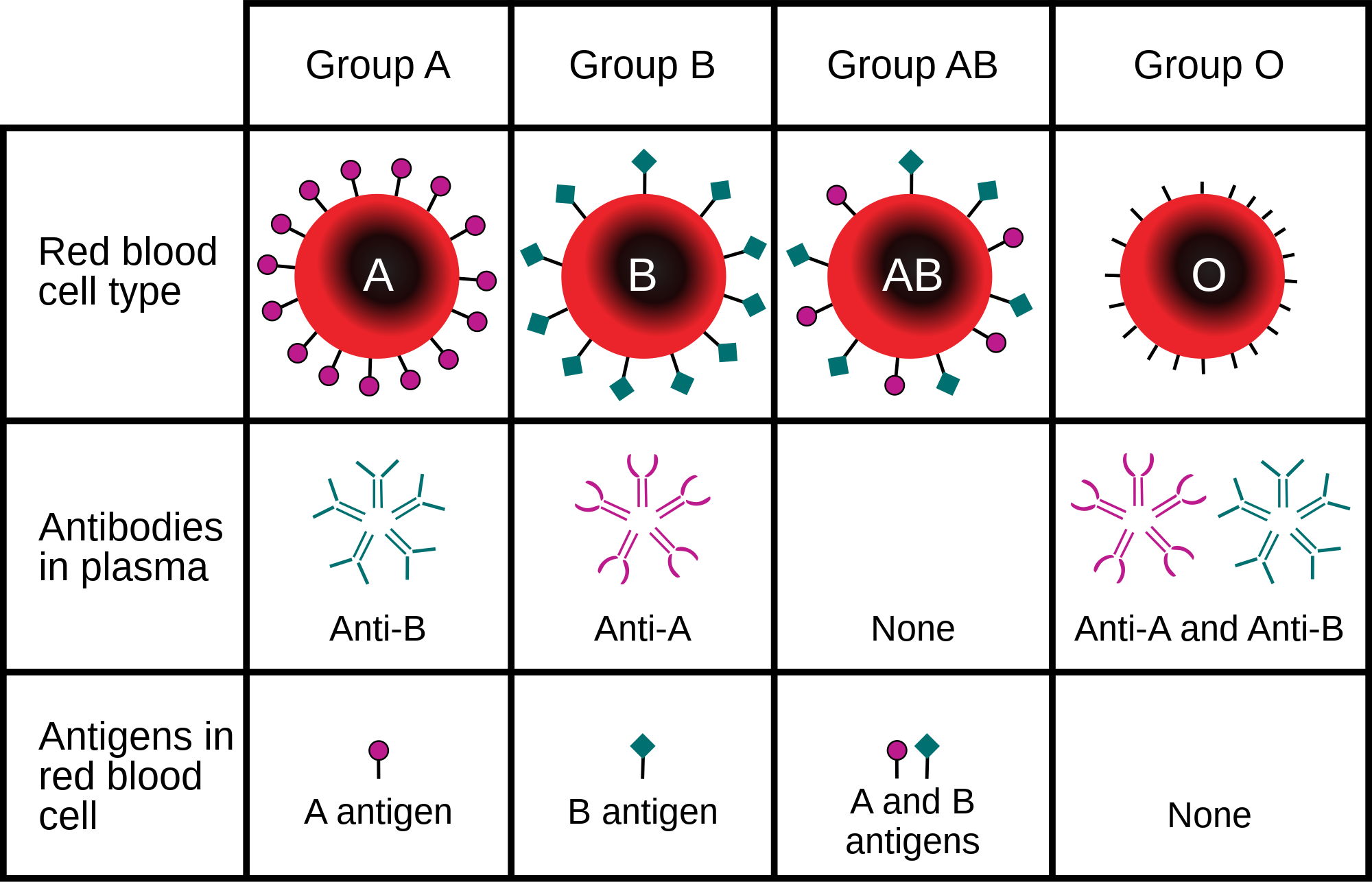
The ABO blood group system involves two antigens and two antibodies found in human blood. The two antigens are antigen A and antigen B. The two antibodies are A and B. The antigens are present on the red blood cells, and the antibodies in the serum. Regarding the antigen property of the blood, all human beings can be classified into four groups: those with antigen A (group A), those with antigen B (group B), those with both antigen A and B (group AB), and those with neither antigen (group O). The antibodies present together with the antigens are found as follows:[citation needed]
There is an agglutination reaction between similar antigen and antibody (for example, antigen A agglutinates the antibody A, and antigen B agglutinates the antibody B). Thus, transfusion can be considered safe as long as the serum of the recipient does not contain antibodies for the blood cell antigens of the donor.[citation needed]
The ABO system is the most important blood-group system in human-blood transfusion. The associated anti-A and anti-B antibodies are usually immunoglobulin M, abbreviated IgM, antibodies. It has been hypothesized that ABO IgM antibodies are produced in the first years of life by sensitization to environmental substances such as food, bacteria, and viruses. The original terminology used by Karl Landsteiner in 1901 for the classification was A/B/C; in later publications "C" became "O". Type O is often called 0 (zero, or null) in other languages.
The Rh system (Rh meaning Rhesus) is the second most significant blood-group system in human blood transfusion, with currently 50 antigens. The most significant Rh antigen is the D antigen, because it is the most likely to provoke an immune system response of the five main Rh antigens. It is common for D-negative individuals not to have any anti-D IgG or IgM antibodies, because anti-D antibodies are not usually produced by sensitization against environmental substances. However, D-negative individuals can produce IgG anti-D antibodies following a sensitizing event: possibly a fetomaternal transfusion of blood from a fetus in pregnancy or occasionally a blood transfusion with D-positive RBCs. Rh negative blood types are much less common in Asian populations (0.3%) than they are in European populations (15%).
Hub AI
Blood type AI simulator
(@Blood type_simulator)
Blood type
A blood type (also known as a blood group) is a classification of blood based on the presence and absence of antibodies and inherited antigenic substances on the surface of red blood cells (RBCs). These antigens may be proteins, carbohydrates, glycoproteins, or glycolipids, depending on the blood group system. Some of these antigens are also present on the surface of other types of cells of various tissues. Several of these red blood cell surface antigens can stem from one allele (or an alternative version of a gene) and collectively form a blood group system.
Blood types are inherited and represent contributions from both parents of an individual. As of June 2025, a total of 48 human blood group systems are recognized by the International Society of Blood Transfusion (ISBT). The two most important blood group systems are ABO and Rh; they determine someone's blood type (A, B, AB, and O, with + or − denoting RhD status) for suitability in blood transfusion.
A complete blood type would describe each of the 48 blood groups, and an individual's blood type is one of many possible combinations of blood-group antigens. Almost always, an individual has the same blood group for life, but very rarely an individual's blood type changes through addition or suppression of an antigen in infection, malignancy, or autoimmune disease. Another more common cause of blood type change is a bone marrow transplant. Bone-marrow transplants are performed for many leukemias and lymphomas, among other diseases. If a person receives bone marrow from someone of a different ABO type (e.g., a type O patient receives a type A bone marrow), the patient's blood type should eventually become the donor's type, as the patient's hematopoietic stem cells (HSCs) are destroyed, either by ablation of the bone marrow or by the donor's T-cells. Once all the patient's original red blood cells have died, they will have been fully replaced by new cells derived from the donor HSCs. Provided the donor had a different ABO type, the new cells' surface antigens will be different from those on the surface of the patient's original red blood cells.
Some blood types are associated with the inheritance of other diseases; for example, the Kell antigen is sometimes associated with McLeod syndrome. Certain blood types may affect susceptibility to infections, such as the resistance to specific malaria species seen in individuals lacking the Duffy antigen. The Duffy antigen, presumably as a result of natural selection, is less common in population groups from areas having a high incidence of malaria.
The ABO blood group system involves two antigens and two antibodies found in human blood. The two antigens are antigen A and antigen B. The two antibodies are A and B. The antigens are present on the red blood cells, and the antibodies in the serum. Regarding the antigen property of the blood, all human beings can be classified into four groups: those with antigen A (group A), those with antigen B (group B), those with both antigen A and B (group AB), and those with neither antigen (group O). The antibodies present together with the antigens are found as follows:[citation needed]
There is an agglutination reaction between similar antigen and antibody (for example, antigen A agglutinates the antibody A, and antigen B agglutinates the antibody B). Thus, transfusion can be considered safe as long as the serum of the recipient does not contain antibodies for the blood cell antigens of the donor.[citation needed]
The ABO system is the most important blood-group system in human-blood transfusion. The associated anti-A and anti-B antibodies are usually immunoglobulin M, abbreviated IgM, antibodies. It has been hypothesized that ABO IgM antibodies are produced in the first years of life by sensitization to environmental substances such as food, bacteria, and viruses. The original terminology used by Karl Landsteiner in 1901 for the classification was A/B/C; in later publications "C" became "O". Type O is often called 0 (zero, or null) in other languages.
The Rh system (Rh meaning Rhesus) is the second most significant blood-group system in human blood transfusion, with currently 50 antigens. The most significant Rh antigen is the D antigen, because it is the most likely to provoke an immune system response of the five main Rh antigens. It is common for D-negative individuals not to have any anti-D IgG or IgM antibodies, because anti-D antibodies are not usually produced by sensitization against environmental substances. However, D-negative individuals can produce IgG anti-D antibodies following a sensitizing event: possibly a fetomaternal transfusion of blood from a fetus in pregnancy or occasionally a blood transfusion with D-positive RBCs. Rh negative blood types are much less common in Asian populations (0.3%) than they are in European populations (15%).
Recent media