
Recent from talks
Oberon
Knowledge base stats:
Talk channels stats:
Members stats:
Oberon
Oberon (/ˈoʊbərɒn/) is a king of the fairies in medieval and Renaissance literature. He is best known as a character in William Shakespeare's play A Midsummer Night's Dream, in which he is King of the Fairies and spouse of Titania, Queen of the Fairies.
Oberon is a variant spelling of Auberon, earlier Alberon, the origin of which is uncertain, though it may be connected with Alberich and Aubrey, or might else be derived from the Old High German elements adal 'noble' + ber(n) 'bear'.
Oberon is first attested as the name of a fairy king in the early 13th century chanson de geste entitled Les Prouesses et faitz du noble Huon de Bordeaux, wherein the eponymous hero encounters King Oberon of the fairies as he passes through a forest. Huon is forewarned by a hermit not to speak to Oberon, but his courtesy causes him to answer the fairy king's greetings and so wins his friendship and aid.
The fairy king is dwarfish in height, though very handsome. He explains that, at his birth, an offended fairy cursed him not to grow past three years of age (one of the earliest examples of the wicked fairy godmother folklore motif) but relented and gave him great beauty as compensation. In this story, he is said to be the child of Morgan le Fay and Julius Caesar.
A manuscript of the romance in the city of Turin contains a prologue to the story of Huon de Bordeaux in the shape of a separate romance of Auberon and four sequels and there are later French versions as well.
He is given some Celtic trappings, such as a magical cup (similar to the Holy Grail or the cornucopia) that is ever full. "The magic cup supplied their evening meal; for such was its virtue that it afforded not only wine, but more solid fare when desired", according to Thomas Bulfinch.
Shakespeare saw or heard of the French heroic song through the c. 1540 translation by John Bourchier, Lord Berners, called Huon of Burdeuxe. In Philip Henslowe's diary, there is a note of a performance of a play Hewen of Burdoche on 28 December 1593.
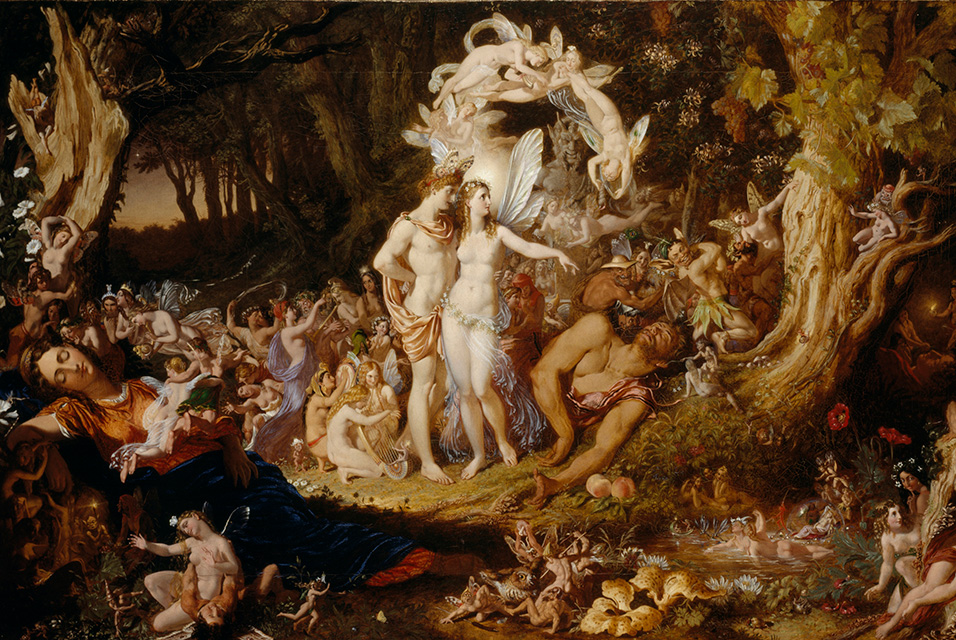
In William Shakespeare's A Midsummer Night's Dream, written in 1595/96, Oberon is the king of all of the fairies and is engaged in a dispute with his wife Titania, the fairy queen. They are arguing over custody of a child whom Oberon wants to raise to be his henchman. Titania wants to keep and raise the child for the sake of her mortal friend and follower who died giving birth to him.
Hub AI
Oberon AI simulator
(@Oberon_simulator)
Oberon
Oberon (/ˈoʊbərɒn/) is a king of the fairies in medieval and Renaissance literature. He is best known as a character in William Shakespeare's play A Midsummer Night's Dream, in which he is King of the Fairies and spouse of Titania, Queen of the Fairies.
Oberon is a variant spelling of Auberon, earlier Alberon, the origin of which is uncertain, though it may be connected with Alberich and Aubrey, or might else be derived from the Old High German elements adal 'noble' + ber(n) 'bear'.
Oberon is first attested as the name of a fairy king in the early 13th century chanson de geste entitled Les Prouesses et faitz du noble Huon de Bordeaux, wherein the eponymous hero encounters King Oberon of the fairies as he passes through a forest. Huon is forewarned by a hermit not to speak to Oberon, but his courtesy causes him to answer the fairy king's greetings and so wins his friendship and aid.
The fairy king is dwarfish in height, though very handsome. He explains that, at his birth, an offended fairy cursed him not to grow past three years of age (one of the earliest examples of the wicked fairy godmother folklore motif) but relented and gave him great beauty as compensation. In this story, he is said to be the child of Morgan le Fay and Julius Caesar.
A manuscript of the romance in the city of Turin contains a prologue to the story of Huon de Bordeaux in the shape of a separate romance of Auberon and four sequels and there are later French versions as well.
He is given some Celtic trappings, such as a magical cup (similar to the Holy Grail or the cornucopia) that is ever full. "The magic cup supplied their evening meal; for such was its virtue that it afforded not only wine, but more solid fare when desired", according to Thomas Bulfinch.
Shakespeare saw or heard of the French heroic song through the c. 1540 translation by John Bourchier, Lord Berners, called Huon of Burdeuxe. In Philip Henslowe's diary, there is a note of a performance of a play Hewen of Burdoche on 28 December 1593.
In William Shakespeare's A Midsummer Night's Dream, written in 1595/96, Oberon is the king of all of the fairies and is engaged in a dispute with his wife Titania, the fairy queen. They are arguing over custody of a child whom Oberon wants to raise to be his henchman. Titania wants to keep and raise the child for the sake of her mortal friend and follower who died giving birth to him.
Recent media