
Recent from talks
Ocean gyre
Knowledge base stats:
Talk channels stats:
Members stats:
Ocean gyre
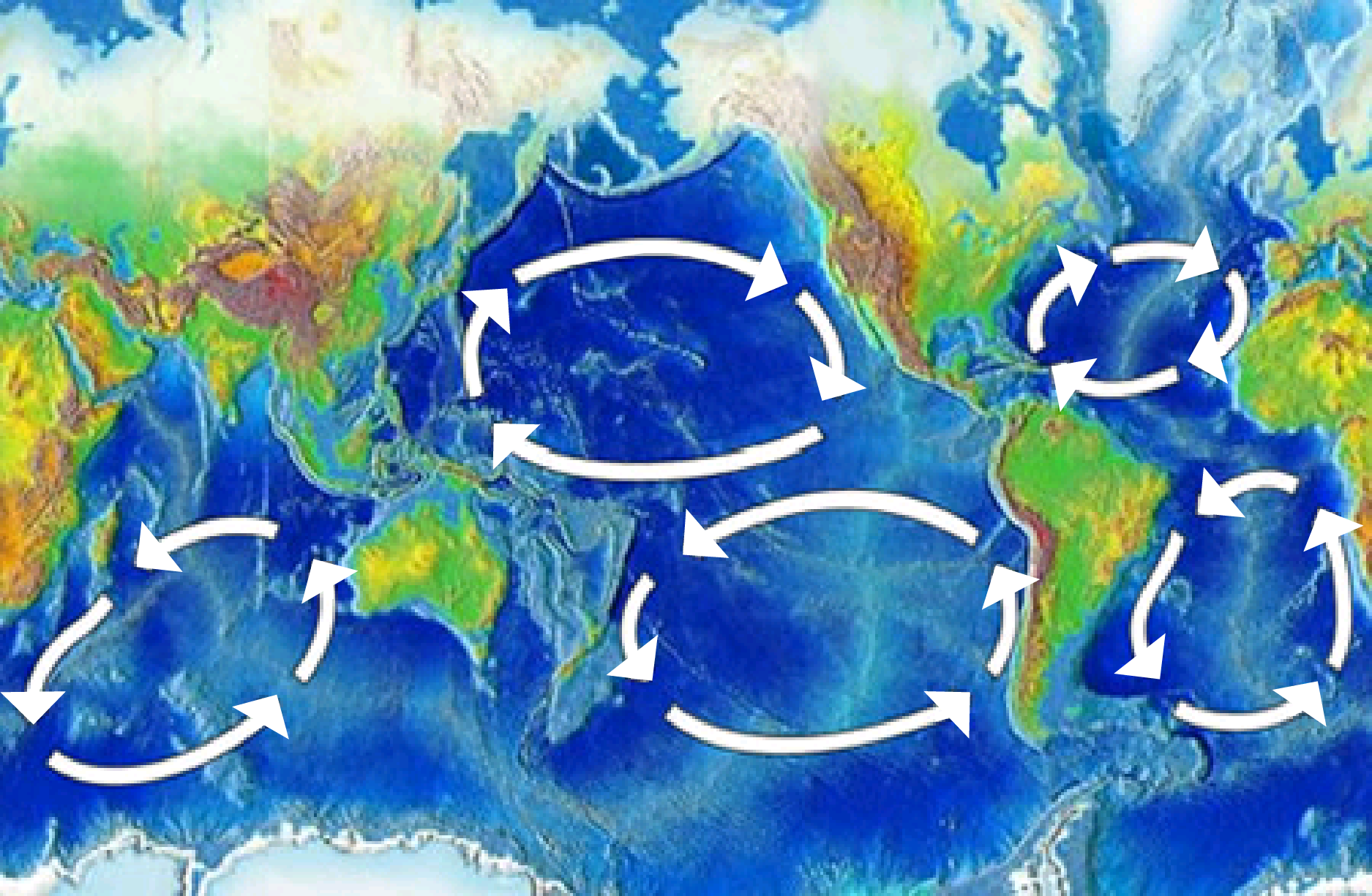
In oceanography, a gyre (/ˈdʒaɪər/) is a large system of ocean surface currents moving in a circular fashion driven by wind movements. Gyres are caused by the Coriolis effect; planetary vorticity, horizontal friction and vertical friction determine the circulatory patterns from the wind stress curl (torque). Gyre can refer to any type of vortex in an atmosphere or a sea, even one that is human-created, but it is most commonly used in terrestrial oceanography to refer to the major ocean systems.
The largest ocean gyres are wind-driven, meaning that their locations and dynamics are controlled by the prevailing global wind patterns: easterlies at the tropics and westerlies at the midlatitudes. These wind patterns result in a wind stress curl that drives Ekman pumping in the subtropics (resulting in downwelling) and Ekman suction in subpolar regions (resulting in upwelling). Ekman pumping results in an increased sea surface height at the center of the gyre and anticyclonic geostrophic currents in subtropical gyres. Ekman suction results in a depressed sea surface height and cyclonic geostrophic currents in subpolar gyres.
Gyres are asymmetrical, with stronger flows on their western boundary and weaker flows throughout their interior. The weak interior flow that is typical over most of the gyre is a result of the conservation of potential vorticity. In the shallow water equations (applicable for basin-scale flow as the horizontal length scale is much greater than the vertical length scale), potential vorticity is a function of relative (local) vorticity (zeta), planetary vorticity , and the depth , and is conserved with respect to the material derivative:


In the case of the subtropical ocean gyre, Ekman pumping results in water piling up in the center of the gyre, compressing water parcels. This results in a decrease in , so by the conservation of potential vorticity the numerator must also decrease. It can be further simplified by realizing that, in basin-scale ocean gyres, the relative vorticity is small, meaning that local changes in vorticity cannot account for the decrease in . Thus, the planetary vorticity must change accordingly. The only way to decrease the planetary vorticity is by moving the water parcel equatorward, so throughout the majority of subtropical gyres there is a weak equatorward flow. Harald Sverdrup quantified this phenomenon in his 1947 paper, "Wind Driven Currents in a Baroclinic Ocean", in which the (depth-integrated) Sverdrup balance is defined as:

Here, is the meridional mass transport (positive north), is the Rossby parameter, is the water density, and is the vertical Ekman velocity due to wind stress curl (positive up). For a negative Ekman velocity (e.g., Ekman pumping in subtropical gyres), meridional mass transport (Sverdrup transport) is negative (south, equatorward) in the northern hemisphere (). Conversely, for a positive Ekman velocity (e.g., Ekman suction in subpolar gyres), Sverdrup transport is positive (north, poleward) in the northern hemisphere.


As the Sverdrup balance argues, subtropical ocean gyres have a weak equatorward flow, and subpolar ocean gyres have a weak poleward flow over most of their area. However, there must be some return flow that goes against the Sverdrup transport in order to preserve mass balance. In this respect, the Sverdrup solution is incomplete, as it has no mechanism in which to predict this return flow. Contributions by both Henry Stommel and Walter Munk resolved this issue by showing that the return flow of gyres is done through an intensified western boundary current. Stommel's solution relies on a frictional bottom boundary layer which is not necessarily physical in a stratified ocean (currents do not always extend to the bottom).
Munk's solution instead relies on friction between the return flow and the sidewall of the basin. This allows for two cases: one with the return flow on the western boundary (western boundary current) and one with the return flow on the eastern boundary (eastern boundary current). A qualitative argument for the presence of western boundary current solutions over eastern boundary current solutions can be found through the conservation of potential vorticity. Considering again the case of a subtropical northern hemisphere gyre, the return flow must be northward. In order to move northward (an increase in ), there must be a source of positive relative vorticity to the system. The relative vorticity in the shallow-water system is:
Here is again the meridional velocity and is the zonal velocity. In the sense of a northward return flow, the zonal component is neglected and only the meridional velocity is important for relative vorticity. Thus, this solution requires that in order to increase the relative vorticity and have a valid northward return flow in the northern hemisphere subtropical gyre.


Hub AI
Ocean gyre AI simulator
(@Ocean gyre_simulator)
Ocean gyre
In oceanography, a gyre (/ˈdʒaɪər/) is a large system of ocean surface currents moving in a circular fashion driven by wind movements. Gyres are caused by the Coriolis effect; planetary vorticity, horizontal friction and vertical friction determine the circulatory patterns from the wind stress curl (torque). Gyre can refer to any type of vortex in an atmosphere or a sea, even one that is human-created, but it is most commonly used in terrestrial oceanography to refer to the major ocean systems.
The largest ocean gyres are wind-driven, meaning that their locations and dynamics are controlled by the prevailing global wind patterns: easterlies at the tropics and westerlies at the midlatitudes. These wind patterns result in a wind stress curl that drives Ekman pumping in the subtropics (resulting in downwelling) and Ekman suction in subpolar regions (resulting in upwelling). Ekman pumping results in an increased sea surface height at the center of the gyre and anticyclonic geostrophic currents in subtropical gyres. Ekman suction results in a depressed sea surface height and cyclonic geostrophic currents in subpolar gyres.
Gyres are asymmetrical, with stronger flows on their western boundary and weaker flows throughout their interior. The weak interior flow that is typical over most of the gyre is a result of the conservation of potential vorticity. In the shallow water equations (applicable for basin-scale flow as the horizontal length scale is much greater than the vertical length scale), potential vorticity is a function of relative (local) vorticity (zeta), planetary vorticity , and the depth , and is conserved with respect to the material derivative:
In the case of the subtropical ocean gyre, Ekman pumping results in water piling up in the center of the gyre, compressing water parcels. This results in a decrease in , so by the conservation of potential vorticity the numerator must also decrease. It can be further simplified by realizing that, in basin-scale ocean gyres, the relative vorticity is small, meaning that local changes in vorticity cannot account for the decrease in . Thus, the planetary vorticity must change accordingly. The only way to decrease the planetary vorticity is by moving the water parcel equatorward, so throughout the majority of subtropical gyres there is a weak equatorward flow. Harald Sverdrup quantified this phenomenon in his 1947 paper, "Wind Driven Currents in a Baroclinic Ocean", in which the (depth-integrated) Sverdrup balance is defined as:
Here, is the meridional mass transport (positive north), is the Rossby parameter, is the water density, and is the vertical Ekman velocity due to wind stress curl (positive up). For a negative Ekman velocity (e.g., Ekman pumping in subtropical gyres), meridional mass transport (Sverdrup transport) is negative (south, equatorward) in the northern hemisphere (). Conversely, for a positive Ekman velocity (e.g., Ekman suction in subpolar gyres), Sverdrup transport is positive (north, poleward) in the northern hemisphere.
As the Sverdrup balance argues, subtropical ocean gyres have a weak equatorward flow, and subpolar ocean gyres have a weak poleward flow over most of their area. However, there must be some return flow that goes against the Sverdrup transport in order to preserve mass balance. In this respect, the Sverdrup solution is incomplete, as it has no mechanism in which to predict this return flow. Contributions by both Henry Stommel and Walter Munk resolved this issue by showing that the return flow of gyres is done through an intensified western boundary current. Stommel's solution relies on a frictional bottom boundary layer which is not necessarily physical in a stratified ocean (currents do not always extend to the bottom).
Munk's solution instead relies on friction between the return flow and the sidewall of the basin. This allows for two cases: one with the return flow on the western boundary (western boundary current) and one with the return flow on the eastern boundary (eastern boundary current). A qualitative argument for the presence of western boundary current solutions over eastern boundary current solutions can be found through the conservation of potential vorticity. Considering again the case of a subtropical northern hemisphere gyre, the return flow must be northward. In order to move northward (an increase in ), there must be a source of positive relative vorticity to the system. The relative vorticity in the shallow-water system is:
Here is again the meridional velocity and is the zonal velocity. In the sense of a northward return flow, the zonal component is neglected and only the meridional velocity is important for relative vorticity. Thus, this solution requires that in order to increase the relative vorticity and have a valid northward return flow in the northern hemisphere subtropical gyre.
Recent media