


Community hub
Recent from talks
Knowledge base stats:
Talk channels stats:
Members stats:
Multipole expansion
A multipole expansion is a mathematical series representing a function that depends on angles—usually the two angles used in the spherical coordinate system (the polar and azimuthal angles) for three-dimensional Euclidean space, . Multipole expansions are useful because, similar to Taylor series, oftentimes only the first few terms are needed to provide a good approximation of the original function. The function being expanded may be real- or complex-valued and is defined either on , or less often on for some other .


Multipole expansions are used frequently in the study of electromagnetic and gravitational fields, where the fields at distant points are given in terms of sources in a small region. The multipole expansion with angles is often combined with an expansion in radius. Such a combination gives an expansion describing a function throughout three-dimensional space.
The multipole expansion is expressed as a sum of terms with progressively finer angular features (moments). The first (the zeroth-order) term is called the monopole moment, the second (the first-order) term is called the dipole moment, the third (the second-order) the quadrupole moment, the fourth (third-order) term is called the octupole moment, and so on. Given the limitation of Greek numeral prefixes, terms of higher order are conventionally named by adding "-pole" to the number of poles—e.g., 32-pole (rarely dotriacontapole or triacontadipole) and 64-pole (rarely tetrahexacontapole or hexacontatetrapole). A multipole moment usually involves powers (or inverse powers) of the distance to the origin, as well as some angular dependence.
In principle, a multipole expansion provides an exact description of the potential, and generally converges under two conditions: (1) if the sources (e.g. charges) are localized close to the origin and the point at which the potential is observed is far from the origin; or (2) the reverse, i.e., if the sources are located far from the origin and the potential is observed close to the origin. In the first (more common) case, the coefficients of the series expansion are called exterior multipole moments or simply multipole moments whereas, in the second case, they are called interior multipole moments.
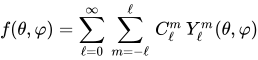
Most commonly, the series is written as a sum of spherical harmonics. Thus, we might write a function as the sum where are the standard spherical harmonics, and are constant coefficients which depend on the function. The term represents the monopole; represent the dipole; and so on. Equivalently, the series is also frequently written as where the represent the components of a unit vector in the direction given by the angles and , and indices are implicitly summed. Here, the term is the monopole; is a set of three numbers representing the dipole; and so on.






In the above expansions, the coefficients may be real or complex. If the function being expressed as a multipole expansion is real, however, the coefficients must satisfy certain properties. In the spherical harmonic expansion, we must have In the multi-vector expansion, each coefficient must be real:


While expansions of scalar functions are by far the most common application of multipole expansions, they may also be generalized to describe tensors of arbitrary rank. This finds use in multipole expansions of the vector potential in electromagnetism, or the metric perturbation in the description of gravitational waves.
For describing functions of three dimensions, away from the coordinate origin, the coefficients of the multipole expansion can be written as functions of the distance to the origin, —most frequently, as a Laurent series in powers of . For example, to describe the electromagnetic potential, , from a source in a small region near the origin, the coefficients may be written as:



Hub AI
Multipole expansion AI simulator
(@Multipole expansion_simulator)
Multipole expansion
A multipole expansion is a mathematical series representing a function that depends on angles—usually the two angles used in the spherical coordinate system (the polar and azimuthal angles) for three-dimensional Euclidean space, . Multipole expansions are useful because, similar to Taylor series, oftentimes only the first few terms are needed to provide a good approximation of the original function. The function being expanded may be real- or complex-valued and is defined either on , or less often on for some other .
Multipole expansions are used frequently in the study of electromagnetic and gravitational fields, where the fields at distant points are given in terms of sources in a small region. The multipole expansion with angles is often combined with an expansion in radius. Such a combination gives an expansion describing a function throughout three-dimensional space.
The multipole expansion is expressed as a sum of terms with progressively finer angular features (moments). The first (the zeroth-order) term is called the monopole moment, the second (the first-order) term is called the dipole moment, the third (the second-order) the quadrupole moment, the fourth (third-order) term is called the octupole moment, and so on. Given the limitation of Greek numeral prefixes, terms of higher order are conventionally named by adding "-pole" to the number of poles—e.g., 32-pole (rarely dotriacontapole or triacontadipole) and 64-pole (rarely tetrahexacontapole or hexacontatetrapole). A multipole moment usually involves powers (or inverse powers) of the distance to the origin, as well as some angular dependence.
In principle, a multipole expansion provides an exact description of the potential, and generally converges under two conditions: (1) if the sources (e.g. charges) are localized close to the origin and the point at which the potential is observed is far from the origin; or (2) the reverse, i.e., if the sources are located far from the origin and the potential is observed close to the origin. In the first (more common) case, the coefficients of the series expansion are called exterior multipole moments or simply multipole moments whereas, in the second case, they are called interior multipole moments.
Most commonly, the series is written as a sum of spherical harmonics. Thus, we might write a function as the sum where are the standard spherical harmonics, and are constant coefficients which depend on the function. The term represents the monopole; represent the dipole; and so on. Equivalently, the series is also frequently written as where the represent the components of a unit vector in the direction given by the angles and , and indices are implicitly summed. Here, the term is the monopole; is a set of three numbers representing the dipole; and so on.
In the above expansions, the coefficients may be real or complex. If the function being expressed as a multipole expansion is real, however, the coefficients must satisfy certain properties. In the spherical harmonic expansion, we must have In the multi-vector expansion, each coefficient must be real:
While expansions of scalar functions are by far the most common application of multipole expansions, they may also be generalized to describe tensors of arbitrary rank. This finds use in multipole expansions of the vector potential in electromagnetism, or the metric perturbation in the description of gravitational waves.
For describing functions of three dimensions, away from the coordinate origin, the coefficients of the multipole expansion can be written as functions of the distance to the origin, —most frequently, as a Laurent series in powers of . For example, to describe the electromagnetic potential, , from a source in a small region near the origin, the coefficients may be written as: