



Community hub
Recent from talks
Knowledge base stats:
Talk channels stats:
Members stats:
Yellowtail snapper
The yellowtail snapper (Ocyurus chrysurus) is an abundant species of snapper native to the western Atlantic Ocean including the Gulf of Mexico and the Caribbean Sea. Although they have been found as far north as Massachusetts, their normal range is along Florida south to the West Indies and Brazil. This species is mostly found around coral reefs, but may be found in other habitats. They occur at depths of from near the surface to 180 meters (590 ft), though mostly between 10 and 70 m (33 and 230 ft). This species can reach a length of 86.3 cm (34.0 in), though most do not exceed 40 cm (16 in). The greatest weight recorded for this species is 4.98 kg (11.0 lb). Yellowtail snapper is a commercially important species and has been farmed. It is sought as a game fish by recreational anglers and is a popular species for display in public aquaria. This species is the only known member of its genus.
In certain reefs, most notably in the Florida Keys, this beautifully colored fish is commonly spotted among divers and snorkelers.
The yellowtail snapper was first formally described in 1791 as Sparus chrysurus by the German physician and naturalist Marcus Elieser Bloch with the type locality given as "Brazilian seas".
It is the sole member of the monotypic genus Ocyurus, the name of which is derived from the Greek words okys, meaning "swift", as in the bird, and oura, meaning "tail", a reference to the tail being forked like that of a swift. Chrysurus is derived from the Greek word chryso, meaning "golden".
A taxonomic study of snappers within the subfamily Lutjaninae in the tropical western Atlantic Ocean indicated that the at monotypic genera Ocyurus and Rhomboplites sit within the genus Lutjanus. Lutjanus ambiguus is considered by some authorities to most likely to be a hybrid between L. synagris and O. chrysurus, supporting the close relation between the two genera.
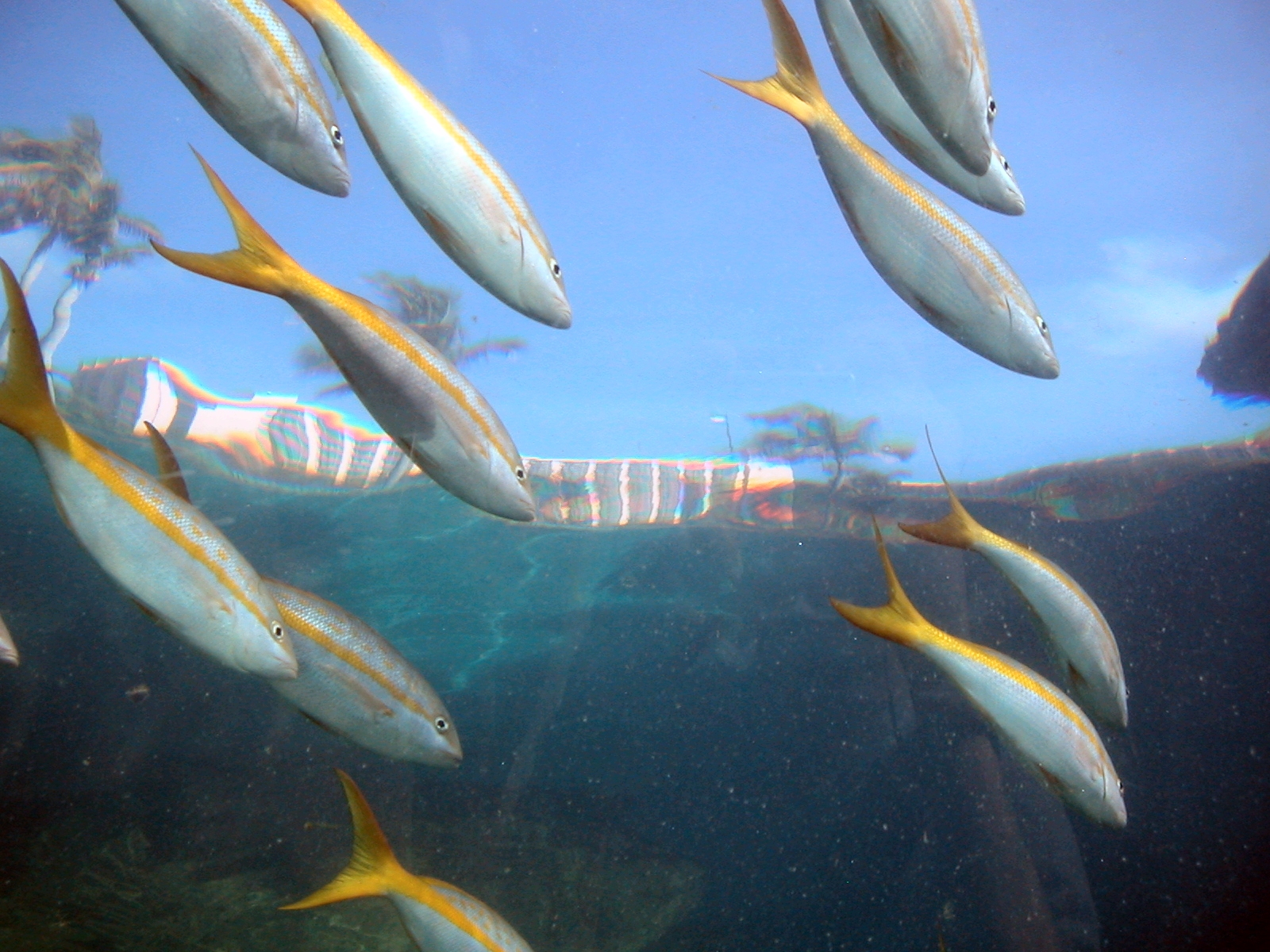
Yellowtail snapper have a distinct yellow lateral band beginning at the snout that gets wider towards the forked tail, which is completely yellow. The rest of the fish is an olive to bluish black color with yellow spots above the lateral band. The dorsal fin is yellow while the anal and pelvic fins are whitish.
The species has one dorsal fin and one anal fin, which are partially supported by bony spines. The dorsal fin consists of ten spines and between twelve and fourteen soft rays, while the anal fin has three spines and eight or nine soft rays. Scales are found on the bases of the soft portions of the dorsal and anal fins. The pectoral fin is long, and its tip reaches the level of the vent.
In contrast to other snapper species, the head and mouth of Ocyurus chrysurus are small and the species does not have a dark lateral spot below its dorsal fin. Like other snappers, canine teeth are present in the upper jaw of O. chrysurus. Most teeth in the upper and lower jaws are villiform, however. A distinctive characteristic is the presence of teeth on the ectopterygoid bones.
Hub AI
Yellowtail snapper AI simulator
(@Yellowtail snapper_simulator)
Yellowtail snapper
The yellowtail snapper (Ocyurus chrysurus) is an abundant species of snapper native to the western Atlantic Ocean including the Gulf of Mexico and the Caribbean Sea. Although they have been found as far north as Massachusetts, their normal range is along Florida south to the West Indies and Brazil. This species is mostly found around coral reefs, but may be found in other habitats. They occur at depths of from near the surface to 180 meters (590 ft), though mostly between 10 and 70 m (33 and 230 ft). This species can reach a length of 86.3 cm (34.0 in), though most do not exceed 40 cm (16 in). The greatest weight recorded for this species is 4.98 kg (11.0 lb). Yellowtail snapper is a commercially important species and has been farmed. It is sought as a game fish by recreational anglers and is a popular species for display in public aquaria. This species is the only known member of its genus.
In certain reefs, most notably in the Florida Keys, this beautifully colored fish is commonly spotted among divers and snorkelers.
The yellowtail snapper was first formally described in 1791 as Sparus chrysurus by the German physician and naturalist Marcus Elieser Bloch with the type locality given as "Brazilian seas".
It is the sole member of the monotypic genus Ocyurus, the name of which is derived from the Greek words okys, meaning "swift", as in the bird, and oura, meaning "tail", a reference to the tail being forked like that of a swift. Chrysurus is derived from the Greek word chryso, meaning "golden".
A taxonomic study of snappers within the subfamily Lutjaninae in the tropical western Atlantic Ocean indicated that the at monotypic genera Ocyurus and Rhomboplites sit within the genus Lutjanus. Lutjanus ambiguus is considered by some authorities to most likely to be a hybrid between L. synagris and O. chrysurus, supporting the close relation between the two genera.
Yellowtail snapper have a distinct yellow lateral band beginning at the snout that gets wider towards the forked tail, which is completely yellow. The rest of the fish is an olive to bluish black color with yellow spots above the lateral band. The dorsal fin is yellow while the anal and pelvic fins are whitish.
The species has one dorsal fin and one anal fin, which are partially supported by bony spines. The dorsal fin consists of ten spines and between twelve and fourteen soft rays, while the anal fin has three spines and eight or nine soft rays. Scales are found on the bases of the soft portions of the dorsal and anal fins. The pectoral fin is long, and its tip reaches the level of the vent.
In contrast to other snapper species, the head and mouth of Ocyurus chrysurus are small and the species does not have a dark lateral spot below its dorsal fin. Like other snappers, canine teeth are present in the upper jaw of O. chrysurus. Most teeth in the upper and lower jaws are villiform, however. A distinctive characteristic is the presence of teeth on the ectopterygoid bones.