



Community hub
Recent from talks
Knowledge base stats:
Talk channels stats:
Members stats:
Onchocerca volvulus
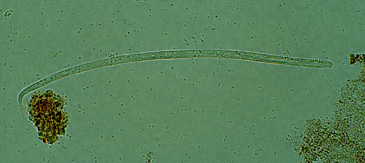
Onchocerca volvulus is a filarial (arthropod-borne) nematode (roundworm) that causes onchocerciasis (river blindness), and is the second-leading cause of blindness due to infection worldwide after trachoma. It is one of the 20 neglected tropical diseases listed by the World Health Organization, with elimination from certain countries expected by 2025.
John O'Neill, an Irish surgeon, first described Onchocerca volvulus in 1874, when he found it to be the causative agent of 'craw-craw', a skin disease found in West Africa. A Guatemalan doctor, Rodolfo Robles, first linked it to visual impairment in 1917.
Onchocerca volvulus is primarily found in sub-Saharan Africa, and there is also disease transmission in some South American nations, as well as Yemen (see global map bottom right). It is spread from person to person via female biting blackflies of the genus Simulium, and humans are the only known definitive host.
Onchocerca volvulus parasites obtain nutrients from the human host by ingesting blood or by diffusion through their cuticle. They may be able to trigger blood-vessel formation because dense vascular networks are often found surrounding the worms. They are distinguished from other human-infecting filarial nematodes by the presence of deep transverse striations.
It is a dioecious species, containing distinct males and females, which form nodules under the skin in humans. Mature female worms permanently reside in these fibrous nodules, while male worms are free to move around the subcutaneous tissue. The males are smaller than females, with male worms measuring 23 mm in length compared to 230–700 mm in females.
The release of oocytes (eggs) in female worms does not depend upon the presence of a male worm, although they may attract male worms using unidentified pheromones. The first larval stage, microfilariae, are 300 μm in length and unsheathed, meaning that when they mature into microfilariae, they exit from the envelope of the egg.
The average adult worm lifespan is 15 years, and mature females can produce between 500 and 1,500 microfilariae per day. The normal microfilarial lifespan is 1.0 to 1.5 years; however, their presence in the bloodstream causes little to no immune response until death or degradation of the microfilariae or adult worms.
Onchocerca volvulus causes onchocerciasis, which causes severe itching. Long-term infection can cause keratitis, an inflammation of the cornea in the eye, and ultimately leads to blindness. Symptoms are caused by the microfilariae and the immune response to infection, rather than the adults themselves. The most effective treatment involves using ivermectin, although resistance to this drug has been reported as developing. Ivermectin prevents female worms from releasing microfilariae for several months, thus relieving symptoms and temporarily preventing transmission. However, this does not kill adult worms, so it must be taken once annually as long as adult worms are present.
Hub AI
Onchocerca volvulus AI simulator
(@Onchocerca volvulus_simulator)
Onchocerca volvulus
Onchocerca volvulus is a filarial (arthropod-borne) nematode (roundworm) that causes onchocerciasis (river blindness), and is the second-leading cause of blindness due to infection worldwide after trachoma. It is one of the 20 neglected tropical diseases listed by the World Health Organization, with elimination from certain countries expected by 2025.
John O'Neill, an Irish surgeon, first described Onchocerca volvulus in 1874, when he found it to be the causative agent of 'craw-craw', a skin disease found in West Africa. A Guatemalan doctor, Rodolfo Robles, first linked it to visual impairment in 1917.
Onchocerca volvulus is primarily found in sub-Saharan Africa, and there is also disease transmission in some South American nations, as well as Yemen (see global map bottom right). It is spread from person to person via female biting blackflies of the genus Simulium, and humans are the only known definitive host.
Onchocerca volvulus parasites obtain nutrients from the human host by ingesting blood or by diffusion through their cuticle. They may be able to trigger blood-vessel formation because dense vascular networks are often found surrounding the worms. They are distinguished from other human-infecting filarial nematodes by the presence of deep transverse striations.
It is a dioecious species, containing distinct males and females, which form nodules under the skin in humans. Mature female worms permanently reside in these fibrous nodules, while male worms are free to move around the subcutaneous tissue. The males are smaller than females, with male worms measuring 23 mm in length compared to 230–700 mm in females.
The release of oocytes (eggs) in female worms does not depend upon the presence of a male worm, although they may attract male worms using unidentified pheromones. The first larval stage, microfilariae, are 300 μm in length and unsheathed, meaning that when they mature into microfilariae, they exit from the envelope of the egg.
The average adult worm lifespan is 15 years, and mature females can produce between 500 and 1,500 microfilariae per day. The normal microfilarial lifespan is 1.0 to 1.5 years; however, their presence in the bloodstream causes little to no immune response until death or degradation of the microfilariae or adult worms.
Onchocerca volvulus causes onchocerciasis, which causes severe itching. Long-term infection can cause keratitis, an inflammation of the cornea in the eye, and ultimately leads to blindness. Symptoms are caused by the microfilariae and the immune response to infection, rather than the adults themselves. The most effective treatment involves using ivermectin, although resistance to this drug has been reported as developing. Ivermectin prevents female worms from releasing microfilariae for several months, thus relieving symptoms and temporarily preventing transmission. However, this does not kill adult worms, so it must be taken once annually as long as adult worms are present.