Hubbry Logo
C0-semigroupC0-semigroupMain
Open search
C0-semigroup
Community hub
C0-semigroup
logo
7 pages, 0 posts
0 subscribers
Be the first to start a discussion here.
C0-semigroup
C0-semigroup
from Wikipedia

In mathematical analysis, a C0-semigroup, also known as a strongly continuous one-parameter semigroup, is a generalization of the exponential function. Just as exponential functions provide solutions of scalar linear constant coefficient ordinary differential equations, strongly continuous semigroups provide solutions of linear constant coefficient ordinary differential equations in Banach spaces. Such differential equations in Banach spaces arise from e.g. delay differential equations and partial differential equations.

Formally, a strongly continuous semigroup is a representation of the semigroup (R+, +) on some Banach space X that is continuous in the strong operator topology.

Formal definition

[edit]

A strongly continuous semigroup on a Banach space is a map (where is the space of bounded operators on ) such that


  1. ,   (the identity operator on )
  2. , as .

The first two axioms are algebraic, and state that is a representation of the semigroup ; the last is topological, and states that the map is continuous in the strong operator topology.

Infinitesimal generator

[edit]

The infinitesimal generator A of a strongly continuous semigroup T is defined by

whenever the limit exists. The domain of A, D(A), is the set of xX for which this limit does exist; D(A) is a linear subspace and A is linear on this domain.[1] The operator A is closed, although not necessarily bounded, and the domain is dense in X.[2]

The strongly continuous semigroup T with generator A is often denoted by the symbol (or, equivalently, ). This notation is compatible with the notation for matrix exponentials, and for functions of an operator defined via functional calculus (for example, via the spectral theorem).

Uniformly continuous semigroup

[edit]

A uniformly continuous semigroup is a strongly continuous semigroup T such that
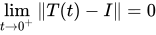
holds. In this case, the infinitesimal generator A of T is bounded and we have

and
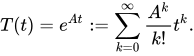
Conversely, any bounded operator

is the infinitesimal generator of a uniformly continuous semigroup given by

.

Thus, a linear operator A is the infinitesimal generator of a uniformly continuous semigroup if and only if A is a bounded linear operator.[3] If X is a finite-dimensional Banach space, then any strongly continuous semigroup is a uniformly continuous semigroup. For a strongly continuous semigroup which is not a uniformly continuous semigroup the infinitesimal generator A is not bounded. In this case, does not need to converge.

Examples

[edit]

Multiplication semigroup

[edit]

Consider the Banach space endowed with the sup norm . Let be a continuous function with . The operator with domain is a closed densely defined operator and generates the multiplication semigroup where Multiplication operators can be viewed as the infinite dimensional generalisation of diagonal matrices and a lot of the properties of can be derived by properties of . For example is bounded on if and only if is bounded.[4]

Translation semigroup

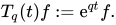
[edit]

Let be the space of bounded, uniformly continuous functions on endowed with the sup norm. The (left) translation semigroup is given by .

Its generator is the derivative with domain .[5]

Abstract Cauchy problems

[edit]

Consider the abstract Cauchy problem:

where A is a closed operator on a Banach space X and xX. There are two concepts of solution of this problem:

  • a continuously differentiable function u: [0, ∞) → X is called a classical solution of the Cauchy problem if u(t ) ∈ D(A) for all t > 0 and it satisfies the initial value problem,
  • a continuous function u: [0, ∞) → X is called a mild solution of the Cauchy problem if

Any classical solution is a mild solution. A mild solution is a classical solution if and only if it is continuously differentiable.[6]

The following theorem connects abstract Cauchy problems and strongly continuous semigroups.

Theorem:[7] Let A be a closed operator on a Banach space X. The following assertions are equivalent:

  1. for all xX there exists a unique mild solution of the abstract Cauchy problem,
  2. the operator A generates a strongly continuous semigroup,
  3. the resolvent set of A is nonempty and for all xD(A) there exists a unique classical solution of the Cauchy problem.

When these assertions hold, the solution of the Cauchy problem is given by u(t ) = T(t )x with T the strongly continuous semigroup generated by A.

Generation theorems

[edit]

In connection with Cauchy problems, usually a linear operator A is given and the question is whether this is the generator of a strongly continuous semigroup. Theorems which answer this question are called generation theorems. A complete characterization of operators that generate exponentially bounded strongly continuous semigroups is given by the Hille–Yosida theorem. Of more practical importance are however the much easier to verify conditions given by the Lumer–Phillips theorem.

Special classes of semigroups

[edit]

Uniformly continuous semigroups

[edit]

The strongly continuous semigroup T is called uniformly continuous if the map t → T(t ) is continuous from [0, ∞) to L(X).

The generator of a uniformly continuous semigroup is a bounded operator.

Analytic semigroups

[edit]

Contraction semigroups

[edit]

A C0-semigroup Γ(t), t ≥ 0, is called a quasicontraction semigroup if there is a constant ω such that ||Γ(t)|| ≤ exp(ωt) for all t ≥ 0. Γ(t) is called a contraction semigroup if ||Γ(t)|| ≤ 1 for all t ≥ 0.[8]

Differentiable semigroups

[edit]

A strongly continuous semigroup T is called eventually differentiable if there exists a t0 > 0 such that T(t0)XD(A) (equivalently: T(t )XD(A) for all t ≥ t0) and T is immediately differentiable if T(t )X ⊂ D(A) for all t > 0.

Every analytic semigroup is immediately differentiable.

An equivalent characterization in terms of Cauchy problems is the following: the strongly continuous semigroup generated by A is eventually differentiable if and only if there exists a t1 ≥ 0 such that for all x ∈ X the solution u of the abstract Cauchy problem is differentiable on (t1, ∞). The semigroup is immediately differentiable if t1 can be chosen to be zero.

Compact semigroups

[edit]

A strongly continuous semigroup T is called eventually compact if there exists a t0 > 0 such that T(t0) is a compact operator (equivalently[9] if T(t ) is a compact operator for all t ≥ t0) . The semigroup is called immediately compact if T(t ) is a compact operator for all t > 0.

Norm continuous semigroups

[edit]

A strongly continuous semigroup is called eventually norm continuous if there exists a t0 ≥ 0 such that the map t → T(t ) is continuous from (t0, ∞) to L(X). The semigroup is called immediately norm continuous if t0 can be chosen to be zero.

Note that for an immediately norm continuous semigroup the map t → T(t ) may not be continuous in t = 0 (that would make the semigroup uniformly continuous).

Analytic semigroups, (eventually) differentiable semigroups and (eventually) compact semigroups are all eventually norm continuous.[10]

Stability

[edit]

Exponential stability

[edit]

The growth bound of a semigroup T is the constant
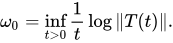
It is so called as this number is also the infimum of all real numbers ω such that there exists a constant M (≥ 1) with

for all t ≥ 0.

The following are equivalent:[11]

  1. There exist M,ω>0 such that for all t ≥ 0:
  2. The growth bound is negative: ω0 < 0,
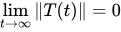
  3. The semigroup converges to zero in the uniform operator topology: ,
  4. There exists a t0 > 0 such that ,
  5. There exists a t1 > 0 such that the spectral radius of T(t1) is strictly smaller than 1,
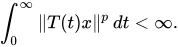
  6. There exists a p ∈ [1, ∞) such that for all x ∈ X: ,
  7. For all p ∈ [1, ∞) and all x ∈ X:

A semigroup that satisfies these equivalent conditions is called exponentially stable or uniformly stable (either of the first three of the above statements is taken as the definition in certain parts of the literature). That the Lp conditions are equivalent to exponential stability is called the Datko-Pazy theorem.

In case X is a Hilbert space there is another condition that is equivalent to exponential stability in terms of the resolvent operator of the generator:[12] all λ with positive real part belong to the resolvent set of A and the resolvent operator is uniformly bounded on the right half plane, i.e. (λI − A)−1 belongs to the Hardy space . This is called the Gearhart-Pruss theorem.

The spectral bound of an operator A is the constant

,

with the convention that s(A) = −∞ if the spectrum of A is empty.

The growth bound of a semigroup and the spectral bound of its generator are related by[13] s(A) ≤ ω0(T ). There are examples[14] where s(A) < ω0(T ). If s(A) = ω0(T ), then T is said to satisfy the spectral determined growth condition. Eventually norm-continuous semigroups satisfy the spectral determined growth condition.[15] This gives another equivalent characterization of exponential stability for these semigroups:

  • An eventually norm-continuous semigroup is exponentially stable if and only if s(A) < 0.

Note that eventually compact, eventually differentiable, analytic and uniformly continuous semigroups are eventually norm-continuous so that the spectral determined growth condition holds in particular for those semigroups.

Strong stability

[edit]

A strongly continuous semigroup T is called strongly stable or asymptotically stable if for all x ∈ X: .

Exponential stability implies strong stability, but the converse is not generally true if X is infinite-dimensional (it is true for X finite-dimensional).

The following sufficient condition for strong stability is called the Arendt–Batty–Lyubich–Phong theorem:[16][17] Assume that

  1. T is bounded: there exists a M ≥ 1 such that ,
  2. A has not point spectrum on the imaginary axis, and
  3. The spectrum of A located on the imaginary axis is countable.

Then T is strongly stable.

If X is reflexive then the conditions simplify: if T is bounded, A has no eigenvalues on the imaginary axis and the spectrum of A located on the imaginary axis is countable, then T is strongly stable.

See also

[edit]

Notes

[edit]

References

[edit]
Revisions and contributorsEdit on WikipediaRead on Wikipedia
from Grokipedia
A C0C_0-semigroup (also called a strongly continuous one-parameter semigroup) on a [[Banach space]] XX is a family {T(t)}t0\{T(t)\}_{t \geq 0} of bounded linear operators on XX satisfying three conditions: T(0)=IT(0) = I, the identity operator; the semigroup property T(t+s)=T(t)T(s)T(t + s) = T(t) T(s) for all t,s0t, s \geq 0; and strong continuity, meaning limt0+T(t)xx=0\lim_{t \to 0^+} \| T(t) x - x \| = 0 for every xXx \in X. The infinitesimal generator AA of such a semigroup is the (possibly unbounded) linear operator defined on its domain D(A)={xX:limt0+T(t)xxtD(A) = \{ x \in X : \lim_{t \to 0^+} \frac{T(t)x - x}{t} exists}\} by Ax=limt0+T(t)xxtA x = \lim_{t \to 0^+} \frac{T(t)x - x}{t}; this domain is dense in XX, and AA is closed. The Hille–Yosida theorem provides a complete characterization of generators: a densely defined, closed operator AA generates a C0C_0-semigroup if and only if there exists ωR\omega \in \mathbb{R} such that (ω,)ρ(A)(\omega, \infty) \subset \rho(A) (the resolvent set of AA) and Rλ(A)nM(λω)n\| R_\lambda(A)^n \| \leq \frac{M}{(\lambda - \omega)^n} for some M1M \geq 1, every positive integer nn, and all λ>ω\lambda > \omega, where Rλ(A)=(λIA)1R_\lambda(A) = (\lambda I - A)^{-1}. For contraction semigroups (where T(t)1\| T(t) \| \leq 1 for all t0t \geq 0), the theorem simplifies to (0,)ρ(A)(0, \infty) \subset \rho(A) and Rλ(A)1λ\| R_\lambda(A) \| \leq \frac{1}{\lambda} for λ>0\lambda > 0. C0C_0-semigroups form the foundation for solving abstract Cauchy problems of the form u(t)=Au(t)u'(t) = A u(t), t0t \geq 0, with initial condition u(0)=xu(0) = x, where the mild solution is given by u(t)=T(t)xu(t) = T(t) x. They extend finite-dimensional exponential solutions eAte^{A t} to infinite-dimensional settings and are essential in the well-posedness theory for linear partial differential equations, such as the heat equation, wave equation, and Schrödinger equation, by associating differential operators (e.g., the Laplacian) with semigroup generators. Subclasses like analytic semigroups, where T(t)T(t) extends holomorphically to a sector in the complex plane, enable further analyticity results for solutions.

Fundamentals

Fundamentals

Definition

A C0C_0-semigroup on a Banach space XX is a family {T(t)}t0\{T(t)\}_{t \geq 0} of bounded linear operators T(t):XXT(t): X \to X satisfying T(0)=IT(0) = I, the identity operator on XX, and the semigroup property T(s+t)=T(s)T(t)T(s + t) = T(s) T(t) for all s,t0s, t \geq 0. The defining feature of a C0C_0-semigroup is its strong continuity at t=0t = 0, meaning that limt0+T(t)xx=0\lim_{t \to 0^+} \|T(t)x - x\| = 0 for every xXx \in X. This strong continuity distinguishes C0C_0-semigroups from more general semigroups of operators, which may lack this continuity property. Each T(t)T(t) is bounded for fixed t0t \geq 0, but the family need not be uniformly bounded; in some cases, joint continuity holds in the operator norm for t>0t > 0, though this is not required in the definition. The concept originated in the late 1940s through independent work by Einar Hille and Kōsaku Yosida, who developed it to address abstract evolution equations in functional analysis.

Infinitesimal Generator

The infinitesimal generator AA of a C0C_0-semigroup {T(t)}t0\{T(t)\}_{t \geq 0} of bounded linear operators on a Banach space XX is the linear operator defined on the domain D(A)={xXlimt0+T(t)xxt exists in the norm topology of X},D(A) = \{ x \in X \mid \lim_{t \to 0^+} \frac{T(t)x - x}{t} \text{ exists in the norm topology of } X \}, by Ax=limt0+T(t)xxt.Ax = \lim_{t \to 0^+} \frac{T(t)x - x}{t}. The domain D(A)D(A) consists of those elements whose orbits under the semigroup are differentiable at t=0t=0, and this definition captures the "infinitesimal" rate of change induced by the semigroup action. Linearity of AA follows directly from the definition, as the difference quotient T(t)t\frac{T(t)\cdot - \cdot}{t} is linear for each fixed t>0t > 0, and the pointwise limit of linear operators is linear on the common domain. To establish that AA is densely defined, consider that for any xXx \in X and t>0t > 0, the element y=0tT(s)xdsy = \int_0^t T(s)x \, ds lies in D(A)D(A), since the orbit T()yT(\cdot)y is continuously differentiable with derivative T(t)xxT(t)x - x, and the set of such yy (over varying tt) is dense in XX by the strong continuity of the semigroup. Closedness of AA is shown by verifying that its graph is closed in X×XX \times X: if a sequence {xn}D(A)\{x_n\} \subset D(A) satisfies xnxx_n \to x and AxnyAx_n \to y in the norm, then using the semigroup property and strong continuity, xD(A)x \in D(A) and Ax=yAx = y. Thus, AA is a densely defined, closed linear operator on XX. For λ\lambda with Reλ>ω(T)\operatorname{Re} \lambda > \omega(T), where ω(T)\omega(T) is the growth bound of the semigroup, the resolvent R(λ,A)=(λIA)1R(\lambda, A) = (\lambda I - A)^{-1} exists as a bounded operator and admits the integral representation R(λ,A)x=0eλtT(t)xdt,xX.R(\lambda, A)x = \int_0^\infty e^{-\lambda t} T(t)x \, dt, \quad x \in X. This formula arises from resolving the abstract Cauchy problem and follows from the exponential decay ensuring convergence of the Bochner integral, with the bound R(λ,A)Mλω(T)\|R(\lambda, A)\| \leq \frac{M}{\lambda - \omega(T)} for some M1M \geq 1. The generator AA relates to the semigroup via the integral equation: for xD(A)x \in D(A) and t0t \geq 0, T(t)x=x+0tAT(s)xds=x+0tT(s)Axds,T(t)x = x + \int_0^t A T(s)x \, ds = x + \int_0^t T(s) A x \, ds, where the equality holds by the invariance of D(A)D(A) under T(t)T(t) and commutativity on the domain. This representation expresses the semigroup orbit as the solution to the inhomogeneous equation u(s)=Au(s)u'(s) = A u(s) with initial condition xx. A core for the generator AA is a linear subspace MD(A)M \subset D(A) that is dense in D(A)D(A) with respect to the graph norm xA=x+Ax\|x\|_A = \|x\| + \|Ax\| and such that the closure of the restriction AMA|_M coincides with AA. In particular, the unrestricted core consists of those dense subspaces where the limit defining AxAx holds uniformly or without approximation for all elements in the subspace, facilitating approximations and extensions in applications. Spaces like n=1D(An)\bigcup_{n=1}^\infty D(A^n) or n=1D(An)\bigcap_{n=1}^\infty D(A^n) serve as cores, ensuring that AA can be reconstructed from its action on such subspaces.

Continuity Properties

Strong Continuity

Strong continuity of a one-parameter semigroup {T(t)}t0\{T(t)\}_{t \geq 0} on a Banach space XX is characterized by the condition that limt0+T(t)x=x\lim_{t \to 0^+} T(t)x = x for every xXx \in X. This pointwise convergence at t=0t=0 is equivalent to the continuity of the orbit map tT(t)xt \mapsto T(t)x from [0,)[0, \infty) into XX for each fixed xXx \in X. To see this equivalence, note that continuity at t=0t=0 follows directly from the limit condition, while for any t0>0t_0 > 0, continuity at t0t_0 holds because T(t0+h)xT(t0)x=T(t0)(T(h)xx)T(t0)T(h)xx0\|T(t_0 + h)x - T(t_0)x\| = \|T(t_0)(T(h)x - x)\| \leq \|T(t_0)\| \cdot \|T(h)x - x\| \to 0 as h0h \to 0, using the boundedness of T(t0)T(t_0) and the semigroup property. Another equivalent formulation is uniform continuity on compact subsets of XX: for every compact set KXK \subset X, supxKT(t)xx0\sup_{x \in K} \|T(t)x - x\| \to 0 as t0+t \to 0^+. This follows from the uniform boundedness principle applied to the family {T(t)}0<t1\{T(t)\}_{0 < t \leq 1}, ensuring that the pointwise limit extends uniformly on bounded sets, and compactness strengthens this to uniform convergence on KK. Strongly continuous semigroups can be approximated by smoother ones, such as analytic semigroups, under suitable conditions on the generators. The Trotter–Kato approximation theorems provide a framework for this: if {Tn(t)}t0\{T_n(t)\}_{t \geq 0} is a strongly continuous semigroup on a Banach space XnX_n with generator AnA_n, and there exists a consistent approximation scheme satisfying certain resolvent and consistency conditions, then Tn(t)xnT(t)xT_n(t)x_n \to T(t)x strongly for t>0t > 0 and xD(A)x \in D(A), where {T(t)}t0\{T(t)\}_{t \geq 0} is the limit semigroup with generator AA. These theorems, originally developed by Trotter and Kato in the late 1950s, enable the approximation of C0C_0-semigroups by finite-dimensional or more regular semigroups, facilitating numerical and analytical treatments. Not all algebraically defined semigroups satisfy strong continuity. A classic non-example is the right-shift semigroup on L(R)L^\infty(\mathbb{R}), defined by (T(t)f)(x)=f(x+t)(T(t)f)(x) = f(x + t) for fL(R)f \in L^\infty(\mathbb{R}) and t0t \geq 0. This satisfies the semigroup property T(t+s)=T(t)T(s)T(t+s) = T(t)T(s) and T(0)=IT(0) = I, but fails strong continuity: for f(x)=sign(x)f(x) = \operatorname{sign}(x), T(t)ff=1\|T(t)f - f\|_\infty = 1 for all t>0t > 0, so limt0+T(t)ff\lim_{t \to 0^+} T(t)f \neq f. In contrast, the left-shift semigroup on L1(R)L^1(\mathbb{R}), given by (T(t)f)(x)=f(xt)(T(t)f)(x) = f(x - t), is strongly continuous. Strong continuity implies exponential boundedness: there exist constants M1M \geq 1 and ωR\omega \in \mathbb{R} such that T(t)Meωt\|T(t)\| \leq M e^{\omega t} for all t0t \geq 0. The growth bound is defined as ω0(T)=inft>01tlogT(t)\omega_0(T) = \inf_{t > 0} \frac{1}{t} \log \|T(t)\|, and it satisfies ω0(T)ω\omega_0(T) \leq \omega for any such bound. This follows from the uniform boundedness on [0,1][0,1] (via strong continuity at zero) and the semigroup property, which extends the bound exponentially.

Uniform Continuity

A C0C_0-semigroup {T(t)}t0\{T(t)\}_{t\geq 0} on a Banach space XX is uniformly continuous if limt0+T(t)I=0,\lim_{t\to 0^+} \|T(t) - I\| = 0, where \|\cdot\| denotes the operator norm on B(X)\mathcal{B}(X), the algebra of bounded linear operators on XX. This condition ensures that the mapping tT(t)t\mapsto T(t) is uniformly continuous as a function from [0,)[0,\infty) into B(X)\mathcal{B}(X) equipped with the operator norm topology. Unlike strong continuity, which requires only pointwise convergence in the strong operator topology, uniform continuity provides global convergence in the operator norm near t=0t=0, making it a stricter property that holds for all elements of XX simultaneously. Uniform continuity of a C0C_0-semigroup is equivalent to its infinitesimal generator AA being a bounded linear operator defined on the entire space XX. In this case, the semigroup admits the explicit representation T(t)=etAT(t) = e^{tA} for all t0t\geq 0, where the exponential is defined via the holomorphic functional calculus or the Dyson series. This characterization highlights that uniformly continuous C0C_0-semigroups are precisely those generated by bounded operators, distinguishing them from the general case where AA may be unbounded and densely defined. Moreover, the growth bound of such a semigroup satisfies ω0(T)=s(A)\omega_0(T) = s(A), the spectral bound of AA, which need not be non-positive but determines the long-term exponential growth or decay. Examples of uniformly continuous C0C_0-semigroups include those arising in finite-dimensional settings, where every C0C_0-semigroup is automatically uniformly continuous because the strong and uniform operator topologies coincide on finite-dimensional spaces. Another class consists of semigroups generated by nilpotent operators; for instance, if AA is nilpotent (i.e., Ak=0A^k = 0 for some kNk\in\mathbb{N}), then AA is bounded, and T(t)=etA=n=0k1(tA)nn!T(t) = e^{tA} = \sum_{n=0}^{k-1} \frac{(tA)^n}{n!} is a polynomial in tt that satisfies the uniform continuity condition. In contexts where the generator is sectorial, uniform continuity implies that the semigroup is analytic, meaning T(t)T(t) extends holomorphically to a sector in the complex plane for tt near zero. This follows directly from the boundedness of AA, which ensures the necessary resolvent estimates for analytic continuation without requiring additional sectoriality assumptions beyond those inherent to bounded operators.

Norm Continuity

A C0C_0-semigroup {T(t)}t0\{T(t)\}_{t \geq 0} on a Banach space XX is norm-continuous if the map tT(t)t \mapsto T(t) is continuous from [0,)[0, \infty) into the Banach space B(X)B(X) of bounded linear operators on XX endowed with the operator norm \|\cdot\|. Norm continuity of a C0C_0-semigroup is characterized by the boundedness of its infinitesimal generator AA: the semigroup is norm-continuous if and only if AB(X)A \in B(X), in which case T(t)=etAT(t) = e^{tA} for all t0t \geq 0 via the exponential series, and the semigroup is uniformly continuous. In infinite-dimensional Banach spaces, norm-continuous C0C_0-semigroups are exceptional, as they necessitate a bounded generator; typical generators for evolution equations, such as differential operators, are unbounded, precluding norm continuity except in finite dimensions or specific finite-rank perturbations. Norm continuity at every t>0t > 0 is equivalent to uniform continuity of the semigroup (both hold if and only if the generator AA is bounded). The study of norm continuity gained prominence in perturbation theory for semigroups following developments in the 1960s, building on earlier foundational work by Hille and Phillips.

Examples

Multiplication Semigroup

A prominent example of a C0C_0-semigroup arises from multiplication operators on Lebesgue spaces. Consider the space Lp(R,μ)L^p(\mathbb{R}, \mu) where 1p<1 \leq p < \infty and μ\mu is a σ\sigma-finite measure on R\mathbb{R}, and let a:RCa: \mathbb{R} \to \mathbb{C} be a measurable function with esssupxRRea(x)<\mathrm{ess\,sup}_{x \in \mathbb{R}} \operatorname{Re} a(x) < \infty. The family of operators {T(t)}t0\{T(t)\}_{t \geq 0} is defined by (T(t)f)(x)=eta(x)f(x),fLp(R,μ),(T(t)f)(x) = e^{t a(x)} f(x), \quad f \in L^p(\mathbb{R}, \mu), for almost every xRx \in \mathbb{R}. This construction yields bounded linear operators on Lp(R,μ)L^p(\mathbb{R}, \mu). The multiplication semigroup satisfies the semigroup property: for all s,t0s, t \geq 0, T(s+t)f=T(s)(T(t)f),T(s+t)f = T(s)(T(t)f), since e(s+t)a(x)=esa(x)eta(x)e^{(s+t)a(x)} = e^{s a(x)} e^{t a(x)} pointwise almost everywhere. Additionally, T(0)=IT(0) = I, the identity operator. To verify strong continuity, fix fLp(R,μ)f \in L^p(\mathbb{R}, \mu). Then T(t)f(x)f(x)T(t)f(x) \to f(x) pointwise almost everywhere as t0+t \to 0^+, and T(t)f(x)f(x)2etMf(x)|T(t)f(x) - f(x)| \leq 2 e^{t M} |f(x)| where M=esssupRea(x)M = \mathrm{ess\,sup} \operatorname{Re} a(x), which is integrable. By the dominated convergence theorem, T(t)ffLp0\|T(t)f - f\|_{L^p} \to 0. Thus, {T(t)}t0\{T(t)\}_{t \geq 0} is a C0C_0-semigroup. The infinitesimal generator AA of {T(t)}t0\{T(t)\}_{t \geq 0} is given by multiplication by aa: Af=afA f = a f for functions ff in the domain D(A)={fLp(R,μ)afLp(R,μ)}.D(A) = \{ f \in L^p(\mathbb{R}, \mu) \mid a f \in L^p(\mathbb{R}, \mu) \}. This domain is dense in Lp(R,μ)L^p(\mathbb{R}, \mu) since simple functions with compact support belong to it, assuming aa is locally bounded or similar conditions hold measurably. The operator AA is closed and densely defined. If aa is unbounded, then AA is an unbounded operator, illustrating how generators of C0C_0-semigroups need not be bounded. The growth bound of the semigroup, denoted ω0(T)=inf{ωRT(t)Meωt for some M1,t0}\omega_0(T) = \inf \{ \omega \in \mathbb{R} \mid \|T(t)\| \leq M e^{\omega t} \text{ for some } M \geq 1, t \geq 0 \}, equals the essential supremum of the real part of aa: ω0(T)=esssupxRRea(x).\omega_0(T) = \mathrm{ess\,sup}_{x \in \mathbb{R}} \operatorname{Re} a(x). This follows from T(t)f=(eta(x)f(x)pdμ)1/petesssupReaf\|T(t)f\| = \left( \int |e^{t a(x)} f(x)|^p \, d\mu \right)^{1/p} \leq e^{t \cdot \mathrm{ess\,sup} \operatorname{Re} a} \|f\|, with equality achievable for suitable ff approximating the essential supremum. Such multiplication semigroups model the reaction term in reaction-diffusion equations, where a(x)a(x) represents a spatially varying reaction rate, providing a diagonal action that simplifies analysis in the abstract Cauchy problem framework without transport effects.

Translation Semigroup

The translation semigroup provides a canonical example of a C0C_0-semigroup on the space Lp(Rd)L^p(\mathbb{R}^d) for 1p<1 \leq p < \infty. It is defined by (T(t)f)(x)=f(x+te1)(T(t)f)(x) = f(x + t e_1) for t0t \geq 0, fLp(Rd)f \in L^p(\mathbb{R}^d), and xRdx \in \mathbb{R}^d, where e1e_1 is the unit vector in the first coordinate. This operator represents a left translation of the function ff. The family {T(t)}t0\{T(t)\}_{t \geq 0} satisfies the semigroup property: T(t)T(s)f=T(t+s)fT(t) T(s) f = T(t+s) f for all t,s0t, s \geq 0 and fLp(Rd)f \in L^p(\mathbb{R}^d), since composition of shifts yields (T(t)T(s)f)(x)=T(s)f(x+te1)=f((x+te1)+se1)=f(x+(t+s)e1)=(T(t+s)f)(x)(T(t) T(s) f)(x) = T(s) f(x + t e_1) = f((x + t e_1) + s e_1) = f(x + (t+s) e_1) = (T(t+s) f)(x). Additionally, T(0)=IT(0) = I, the identity operator. Strong continuity holds, meaning limt0+T(t)ffp=0\lim_{t \to 0^+} \|T(t) f - f\|_p = 0 for every fLp(Rd)f \in L^p(\mathbb{R}^d). This is verified by the density of the space of continuous functions with compact support Cc(Rd)C_c(\mathbb{R}^d) in Lp(Rd)L^p(\mathbb{R}^d): for fCc(Rd)f \in C_c(\mathbb{R}^d), uniform continuity of ff implies T(t)ffp0\|T(t) f - f\|_p \to 0 as t0+t \to 0^+, and extension to general ff follows by approximation. The infinitesimal generator AA of {T(t)}t0\{T(t)\}_{t \geq 0} is given by Af=fx1A f = \frac{\partial f}{\partial x_1} (the directional derivative in the first coordinate, with analogous form for other directions), defined on the domain D(A)=W1,p(Rd)D(A) = W^{1,p}(\mathbb{R}^d), the Sobolev space of functions in Lp(Rd)L^p(\mathbb{R}^d) whose weak partial derivatives are also in Lp(Rd)L^p(\mathbb{R}^d). This follows from the characterization of the generator via the limit limt0+T(t)fft=Af\lim_{t \to 0^+} \frac{T(t) f - f}{t} = A f for fD(A)f \in D(A), where the derivative exists in the LpL^p-norm. The space Cc(Rd)C_c^\infty(\mathbb{R}^d) serves as a core for AA. The operators T(t)T(t) are isometries, satisfying T(t)=1\|T(t)\| = 1 for all t0t \geq 0, since T(t)fpp=Rdf(x+te1)pdx=Rdf(y)pdy=fpp\|T(t) f\|_p^p = \int_{\mathbb{R}^d} |f(x + t e_1)|^p \, dx = \int_{\mathbb{R}^d} |f(y)|^p \, dy = \|f\|_p^p by substitution y=x+te1y = x + t e_1. Thus, {T(t)}t0\{T(t)\}_{t \geq 0} is a contraction semigroup (in the strong sense, with supt0T(t)1\sup_{t \geq 0} \|T(t)\| \leq 1). Variations include the right shift semigroup defined by (T(t)f)(x)=f(xte1)(T(t) f)(x) = f(x - t e_1), whose generator is Af=fx1A f = -\frac{\partial f}{\partial x_1} on the same domain, yielding a similar C0C_0-semigroup structure. On the half-line space Lp([0,))L^p([0, \infty)), the left shift semigroup (T(t)f)(x)=f(x+t)(T(t) f)(x) = f(x + t) for x0x \geq 0 is a C0C_0-semigroup without requiring specification of inflow at the boundary; its generator is the derivative operator on the Sobolev space W1,p([0,))W^{1,p}([0, \infty)). In contrast, the right shift semigroup requires boundary conditions, such as Dirichlet conditions at x=0x=0, to define it properly.

Generation Results

Hille–Yosida Theorem

The Hille–Yosida theorem provides necessary and sufficient conditions for a densely defined closed linear operator AA on a Banach space XX to generate a C0C_0-semigroup {T(t)}t0\{T(t)\}_{t \geq 0} on XX. Specifically, AA is the infinitesimal generator of a C0C_0-semigroup if and only if there exist constants M1M \geq 1 and ωR\omega \in \mathbb{R} such that the half-line (ω,)(\omega, \infty) is contained in the resolvent set ρ(A)\rho(A) and R(λ,A)nM(λω)n\|R(\lambda, A)^n\| \leq \frac{M}{(\lambda - \omega)^n} for all λ>ω\lambda > \omega and all integers n1n \geq 1, where R(λ,A)=(λIA)1R(\lambda, A) = (\lambda I - A)^{-1} denotes the resolvent operator. This theorem was developed independently by Einar Hille in his 1948 monograph on functional analysis and semigroups, and by Kōsaku Yosida in his contemporaneous paper on the differentiability and representation of one-parameter semigroups of linear operators. It forms a cornerstone of generation theory for C0C_0-semigroups, enabling the characterization of generators through spectral properties of the resolvent rather than direct construction of the semigroup. The proof proceeds in two directions: necessity follows from the analytic properties of the semigroup's resolvent and growth bounds on T(t)T(t), while sufficiency constructs T(t)T(t) via inversion of the Laplace transform applied to the resolvent. One common approach uses the Dunford functional calculus to define T(t)T(t) as an integral over a suitable contour in the complex plane enclosing the spectrum of AA. Alternatively, the Post–Widder inversion formula provides an explicit representation by taking limits of differences of resolvents, ensuring strong continuity at t=0t=0. A notable variant arises for contraction semigroups, where M=1M=1 and ω=0\omega = 0, reducing the condition to n=1n=1: R(λ,A)1/λ\|R(\lambda, A)\| \leq 1/\lambda for all λ>0\lambda > 0. This simplified form, often termed the Feller condition in the context of semigroups on spaces of continuous functions vanishing at infinity, characterizes generators of contraction C0C_0-semigroups. Despite its generality, the Hille–Yosida theorem has limitations in practical verification, as the required resolvent estimates can be difficult to establish directly for operators like self-adjoint ones, where alternative characterizations (such as the spectral theorem) are more straightforward.

Lumer–Phillips Theorem

The Lumer–Phillips theorem provides a characterization of the infinitesimal generators of contraction C0C_0-semigroups on Banach spaces. Specifically, let XX be a Banach space and A:D(A)XXA: D(A) \subseteq X \to X a densely defined, closed linear operator. Then AA generates a contraction C0C_0-semigroup (T(t))t0(T(t))_{t \geq 0} on XX if and only if AA is dissipative, meaning ReAx,x0\operatorname{Re} \langle Ax, x^* \rangle \leq 0 for all xD(A)x \in D(A) and all xXx^* \in X^* with x=1\|x^*\| = 1 and x,x=x\langle x, x^* \rangle = \|x\|, and the range of IAI - A is all of XX. This result, established by Günter Lumer and Ralph Phillips in 1961, simplifies the more general Hille–Yosida theorem by focusing on contraction semigroups through the accessible conditions of dissipativity and surjectivity of IAI - A, avoiding the need for detailed resolvent growth bounds. The proof of sufficiency proceeds by first verifying that dissipativity implies ReR(λ,A)1/λ\|\operatorname{Re} R(\lambda, A)\| \leq 1/\lambda for λ>0\lambda > 0, ensuring the resolvent exists on the right half-plane and satisfies the necessary estimates to invoke the Hille–Yosida theorem; alternatively, a direct approach constructs the semigroup via the contraction mapping principle applied to the mild solution integral equation u(t)=x+0tAu(s)dsu(t) = x + \int_0^t A u(s) \, ds in an appropriate exponential weighted space, confirming strong continuity and contractivity. Necessity follows from the properties of generators of contraction semigroups, where dissipativity arises from T(t)xx\|T(t)x\| \leq \|x\| implying ReAx,x0\operatorname{Re} \langle Ax, x^* \rangle \leq 0, and surjectivity of IAI - A from the bounded invertibility of the resolvent at 1. The theorem extends to semigroups of bounded growth via perturbation by bounded operators: if AA generates a contraction C0C_0-semigroup and BL(X)B \in L(X) is bounded, then A+BA + B with domain D(A)D(A) generates a C0C_0-semigroup (S(t))t0(S(t))_{t \geq 0} satisfying S(t)eBt\|S(t)\| \leq e^{\|B\| t} for t0t \geq 0, as the perturbation shifts the growth bound by at most B\|B\|. Examples of dissipative operators satisfying the theorem's conditions include differential operators with suitable boundary conditions. For the Laplacian Af=fA f = f'' on X=L2(0,π)X = L^2(0, \pi) with Dirichlet boundary conditions D(A)={fH2(0,π):f(0)=f(π)=0}D(A) = \{ f \in H^2(0, \pi) : f(0) = f(\pi) = 0 \}, dissipativity holds via Af,f=0πf(s)2ds0\langle A f, f \rangle = -\int_0^\pi |f'(s)|^2 \, ds \leq 0, and λIA\lambda I - A is surjective for λ>0\lambda > 0, generating the contraction semigroup T(t)f(x)=n=1eλntf,ϕnϕn(x)T(t) f(x) = \sum_{n=1}^\infty e^{-\lambda_n t} \langle f, \phi_n \rangle \phi_n(x) where λn=n2\lambda_n = n^2 and {ϕn}\{\phi_n\} are sine eigenfunctions. Similarly, for Neumann boundary conditions on X=C([0,1])X = C([0,1]), Af=fA f = f'' with D(A)={fC2([0,1]):f(0)=f(1)=0}D(A) = \{ f \in C^2([0,1]) : f'(0) = f'(1) = 0 \} is dissipative using the duality ReAf,f(s0)δs0=f(s0)f(s0)0\operatorname{Re} \langle A f, f(s_0) \delta_{s_0} \rangle = f''(s_0) \overline{f(s_0)} \leq 0 for appropriate test functionals, and again satisfies the range condition, yielding a contraction semigroup.

Evolution Equations

Abstract Cauchy Problem

The abstract Cauchy problem (ACP) provides a general framework for studying initial value problems of the form ddtu(t)=Au(t),t0,u(0)=x,\frac{d}{dt} u(t) = A u(t), \quad t \geq 0, \quad u(0) = x, where XX is a Banach space, A:D(A)XXA: D(A) \subset X \to X is a (possibly unbounded) linear operator serving as the infinitesimal generator, and xXx \in X. This formulation abstracts concrete evolution equations arising in partial differential equations (PDEs), such as the heat equation tu=Δu\partial_t u = \Delta u on a domain (with A=ΔA = \Delta and appropriate boundary conditions) or the wave equation t2u=Δu\partial_t^2 u = \Delta u (reformulated as a first-order system with AA as the associated operator matrix), unifying their analysis in the operator-theoretic setting. If AA generates a C0C_0-semigroup {T(t)}t0\{T(t)\}_{t \geq 0} on XX, then the function u(t)=T(t)xu(t) = T(t) x provides the mild solution to the ACP, satisfying the equation in an integral sense and inheriting the semigroup properties T(0)=IT(0) = I and T(t+s)=T(t)T(s)T(t+s) = T(t) T(s). The ACP is well-posed in the mild sense—meaning a unique mild solution exists for every xXx \in X with continuous dependence on the initial data—if and only if AA generates a C0C_0-semigroup. For the inhomogeneous variant ddtu(t)=Au(t)+f(t)\frac{d}{dt} u(t) = A u(t) + f(t), t0t \geq 0, u(0)=xu(0) = x with fLloc1([0,);X)f \in L^1_{\mathrm{loc}}([0,\infty); X), the mild solution is given by the Duhamel formula u(t)=T(t)x+0tT(ts)f(s)ds,u(t) = T(t) x + \int_0^t T(t-s) f(s) \, ds, which extends the homogeneous case by incorporating the forcing term through convolution with the semigroup. This integral representation ensures well-posedness under the same generation assumption on AA.

Solution Concepts

In the theory of C0C_0-semigroups, solutions to the abstract Cauchy problem u(t)=Au(t)u'(t) = A u(t), u(0)=xu(0) = x on a Banach space XX, where AA generates the semigroup (T(t))t0(T(t))_{t \geq 0}, are classified based on their regularity. A mild solution is given by u(t)=T(t)xu(t) = T(t) x for t0t \geq 0, which exists for every xXx \in X and belongs to C([0,);X)C([0,\infty); X) by the strong continuity of the semigroup. A classical solution requires higher regularity: uC([0,);D(A))C1([0,);X)u \in C([0,\infty); D(A)) \cap C^1([0,\infty); X), where D(A)D(A) is the domain of AA equipped with the graph norm, such that u(0)=xu(0) = x and u(t)=Au(t)u'(t) = A u(t) pointwise for all t0t \geq 0. Classical solutions coincide with the mild solution u(t)=T(t)xu(t) = T(t) x. Classical solutions exist if xD(A)x \in D(A) and AA generates an analytic semigroup, ensuring the necessary smoothness. A strong solution is a function uC([0,);X)u \in C([0,\infty); X) such that u(t)D(A)u(t) \in D(A) for all t>0t > 0, uu is norm differentiable on (0,)(0,\infty), and u(t)=Au(t)u'(t) = A u(t) in the norm topology for t>0t > 0, with u(0)=xu(0) = x. Every classical solution is strong, but strong solutions may lack continuity up to t=0t=0 in D(A)D(A). Strong solutions arise when the semigroup is regularizing, meaning T(t)XD(A)T(t) X \subset D(A) for t>0t > 0 and tT(t)xt \mapsto T(t) x is differentiable in XX for xXx \in X. For the heat equation on a bounded domain with smooth initial data x \in D(A)&#36;, where A$ is the Laplacian with suitable boundary conditions generating an analytic semigroup, classical solutions exist globally in time.

Special Classes

Analytic Semigroups

An analytic semigroup is a strongly continuous semigroup {T(t)}t0\{T(t)\}_{t \geq 0} on a Banach space XX that admits a holomorphic extension to a sector Σθ={λC{0}:argλ<θ}\Sigma_\theta = \{\lambda \in \mathbb{C} \setminus \{0\} : |\arg \lambda| < \theta\} for some θ(0,π/2]\theta \in (0, \pi/2], satisfying the semigroup property T(z)T(w)=T(z+w)T(z)T(w) = T(z+w) for z,wΣθz, w \in \Sigma_\theta with z+wΣθz+w \in \Sigma_\theta, and T(0)=IT(0) = I. This extension ensures boundedness on every subsector ΣθΣθ\Sigma_{\theta'} \subset \Sigma_\theta with θ<θ\theta' < \theta. The infinitesimal generator AA of an analytic semigroup is a sectorial operator of angle ϕ<π/2\phi < \pi/2, meaning that the spectrum σ(A)\sigma(A) is contained in a left half-plane Σπ/2+ϕc={λC:arg(λ)π/2+ϕ}\Sigma_{\pi/2 + \phi}^c = \{\lambda \in \mathbb{C} : |\arg (-\lambda)| \leq \pi/2 + \phi\} and the resolvent R(λ,A)R(\lambda, A) satisfies λR(λ,A)M\| \lambda R(\lambda, A) \| \leq M for some M>0M > 0 and all λΣπ/2+ϕ\lambda \in \Sigma_{\pi/2 + \phi}. The spectrum lies in the closed left half-plane, ensuring stability properties inherent to the sectorial nature. Key properties of analytic semigroups include immediate smoothing, where T(t)XD(A)=n=1D(An)T(t)X \subset D(A^\infty) = \bigcap_{n=1}^\infty D(A^n) for every t>0t > 0, providing infinite differentiability in the operator sense and high regularity of solutions. For bounded operators AA, the semigroup approximates the classical exponential etAe^{tA} in the strong topology. Generation results follow from a variant of the Hille–Yosida theorem, stating that a densely defined sectorial operator of angle less than π/2\pi/2 generates an analytic semigroup. Analytic semigroups arise prominently in the theory of parabolic partial differential equations, such as the heat equation ut=Δuu_t = \Delta u on a domain, where the generator is the Laplacian Δ\Delta with suitable boundary conditions, which is sectorial and generates an analytic semigroup providing classical solutions with smoothing effects.

Contraction Semigroups

A contraction C0C_0-semigroup on a Banach space XX is a strongly continuous semigroup {T(t)}t0\{T(t)\}_{t \geq 0} of bounded linear operators satisfying T(t)1\|T(t)\| \leq 1 for all t0t \geq 0. This boundedness in operator norm implies that the semigroup is uniformly bounded, with growth bound ω00\omega_0 \leq 0. The infinitesimal generator AA of a contraction C0C_0-semigroup is characterized as an mm-dissipative operator: AA is dissipative, meaning x+λAxx\|x + \lambda Ax\| \geq \|x\| for all xD(A)x \in D(A) and λ>0\lambda > 0, and IAI - A is surjective. By the Lumer--Phillips theorem, a densely defined dissipative operator AA generates a contraction C0C_0-semigroup if and only if λA\lambda - A is surjective for some (equivalently, all) λ>0\lambda > 0. This provides a practical criterion for verifying generation in applications. Key properties of contraction semigroups include the fact that the adjoint semigroup {T(t)}\{T(t)^*\} on the dual space XX^* is also a contraction semigroup. Moreover, if YXY \subset X is a closed invariant subspace under {T(t)}\{T(t)\}, then the restriction {T(t)Y}\{T(t)|_Y\} is a contraction semigroup on YY. Bounded perturbations of the generator preserve the property of generating a C0C_0-semigroup, though not necessarily a contraction semigroup. Small bounded perturbations can preserve mm-dissipativity under suitable conditions. Representative examples include the left translation semigroup on Lp(R+)L^p(\mathbb{R}_+) defined by (T(t)f)(x)=f(x+t)(T(t)f)(x) = f(x + t) for fLp(R+)f \in L^p(\mathbb{R}_+), t0t \geq 0, which is a contraction (actually an isometry). Another class consists of substochastic Markov semigroups on L1L^1 spaces, where each T(t)T(t) maps positive functions to positive functions with T(t)f1f1\|T(t)f\|_1 \leq \|f\|_1 for nonnegative ff.

Compact Semigroups

A C0C_0-semigroup (T(t))t0(T(t))_{t \geq 0} on a Banach space XX is called compact if T(t)T(t) is a compact operator for every t>0t > 0. Equivalently, the semigroup is eventually compact, meaning there exists t0>0t_0 > 0 such that T(t0)T(t_0) is compact, which implies T(t)T(t) is compact for all tt0t \geq t_0 since the composition of a bounded operator with a compact operator remains compact. This property ensures that bounded sets are mapped to precompact sets by T(t)T(t) for t>0t > 0, facilitating finite-dimensional approximations of the dynamics. Compact semigroups often arise in the context of analytic semigroups generated by sectorial operators. The generator AA of a compact C0C_0-semigroup has the property that its resolvent R(λ,A)R(\lambda, A) is compact for λ\lambda in a suitable right half-plane, leading to a discrete spectrum for AA except possibly at $0.Specifically,. Specifically, \sigma(A) \setminus {0} consists of isolated eigenvalues of finite algebraic multiplicity, with &#36;0 being either not in the spectrum or a pole of the resolvent of finite order. The essential spectrum σess(A)\sigma_{\text{ess}}(A) is either empty or {0}\{0\}, ensuring that the non-zero part of the spectrum does not accumulate anywhere except possibly at $0.Fortheimaginaryaxis,ifthesemigroupispositive,thespectrumof. For the imaginary axis, if the semigroup is positive, the spectrum of Arestrictedtorestricted toi\mathbb{R}$ is bounded, which aids in analyzing asymptotic behavior. Compact C0C_0-semigroups are generated by sectorial operators with compact resolvent. If A-A is a sectorial operator of spectral angle less than π/2\pi/2 with compact resolvent R(λ,A)R(\lambda, A) for some λ>0\lambda > 0 with Reλ>0\operatorname{Re} \lambda > 0, then AA generates an analytic compact semigroup. This generation theorem extends the Hille--Yosida framework to operators where compactness of the resolvent implies the resulting semigroup operators T(t)T(t) are compact for all t>0t > 0. Examples include the Laplacian on bounded domains with Dirichlet boundary conditions, where the resolvent is compact due to the embedding of Sobolev spaces into LpL^p. In applications, compact semigroups allow for finite-rank approximations of the operators T(t)T(t), as compact operators can be approximated in the operator norm by finite-rank operators, which is useful for numerical simulations of evolution equations. Integral operators, such as those arising in Volterra equations or heat conduction models, often generate compact semigroups when the kernel ensures compactness, enabling spectral decomposition and error estimates in approximations. The Riesz--Schauder theory for compact operators, which characterizes the spectrum as discrete with finite-multiplicity eigenvalues accumulating only at $0,extendsnaturallytocompact, extends naturally to compact C_0semigroupsviathespectralmappingtheorem:-semigroups via the spectral mapping theorem: \sigma(T(t)) \setminus {0} = e^{t \sigma(A)}forfort > 0$. This extension implies that the dynamics can be decomposed into finite-dimensional invariant subspaces corresponding to eigenvalues, facilitating modal analysis in control and stability studies.

Differentiable Semigroups

A C0C_0-semigroup (T(t))t0(T(t))_{t \geq 0} on a Banach space XX is said to have differentiable orbits if, for every xD(A)x \in D(A), the map tT(t)xt \mapsto T(t)x is norm-differentiable on (0,)(0, \infty), with derivative T(t)x=AT(t)xT'(t)x = AT(t)x. This property holds for every C0C_0-semigroup generated by a densely defined closed operator AA, and the derivative satisfies the commutation relation AT(t)x=T(t)AxAT(t)x = T(t)Ax for all xD(A)x \in D(A) and t>0t > 0. Equivalently, T(t)D(A)D(A)T(t)D(A) \subseteq D(A) for t>0t > 0, ensuring the orbit remains in the domain of AA. For higher regularity, the semigroup admits kk-th order derivatives if the orbits are Ck((0,))C^k((0,\infty)) for xD(Ak)x \in D(A^k), with the nn-th derivative given by T(n)(t)x=AnT(t)xT^{(n)}(t)x = A^n T(t)x for nkn \leq k and xD(An)x \in D(A^n). A CC^\infty-semigroup extends this to all orders, where T(n)(t)x=AnT(t)xT^{(n)}(t)x = A^n T(t)x for all nNn \in \mathbb{N}, t>0t > 0, and xD(An)=m=1D(Am)x \in D(A^n) = \bigcap_{m=1}^\infty D(A^m). Such semigroups arise when the generator AA admits bounded imaginary powers, meaning the operators AiθA^{i\theta} are uniformly bounded for θR\theta \in \mathbb{R}. Beyond CC^\infty, Gevrey class semigroups provide ultra-differentiable regularity intermediate between CC^\infty and analyticity. A semigroup belongs to the Gevrey class of order s>1s > 1 if there exist constants C,K>0C, K > 0 such that T(n)(t)xCn!stnx\|T^{(n)}(t)x\| \leq C \frac{n!^s}{t^n} \|x\| for all nNn \in \mathbb{N}, t>0t > 0, and xXx \in X, capturing smoother behavior than general CC^\infty but without the exponential estimates of analytic semigroups. These classes are generated by operators whose resolvents satisfy specific growth bounds outside certain parabolic regions in the complex plane. Analytic semigroups, a special case of differentiable semigroups, are generated by sectorial operators AA, where the resolvent R(λ,A)R(\lambda, A) is bounded by M/λM/|\lambda| for λ\lambda in a sector argλ<θ|\arg \lambda| < \theta with θ<π/2\theta < \pi/2. In finite-dimensional spaces, nilpotent operators provide representative examples of differentiable semigroups. For a nilpotent matrix NN with Nk=0N^k = 0 for some kk, the semigroup T(t)=exp(tN)T(t) = \exp(tN) is a finite polynomial in tt of degree k1k-1, hence CC^\infty with explicit higher derivatives T(n)(t)=Nnexp(tN)T^{(n)}(t) = N^n \exp(tN) for n<kn < k and zero thereafter.

Stability

Exponential Stability

A C0C_0-semigroup {T(t)}t0\{T(t)\}_{t\geq 0} of bounded linear operators on a Banach space XX is exponentially stable if there exist constants M1M\geq 1 and ω>0\omega>0 such that T(t)Meωt\|T(t)\|\leq M e^{-\omega t} for all t0t\geq 0. This uniform exponential decay implies that the growth bound ω0(T)=inf{ωR:T(t)Meωt for some M1, t0}<0\omega_0(T)=\inf\{\omega\in\mathbb{R}:\|T(t)\|\leq M e^{\omega t}\ \text{for some}\ M\geq 1,\ t\geq 0\}<0. A necessary condition for exponential stability is that the spectrum of the generator AA satisfies σ(A){λC:λ<0}\sigma(A)\subset\{\lambda\in\mathbb{C}:\Re\lambda<0\}. In general Banach spaces, the converse requires additional assumptions, such as the semigroup being Riesz spectral (meaning AA has a Riesz basis of generalized eigenvectors), in which case σ(A){λ<0}\sigma(A)\subset\{\Re\lambda<0\} and appropriate resolvent growth bounds suffice for exponential stability. In Hilbert spaces, the Gearhart--Prüss theorem provides a complete characterization: the semigroup is exponentially stable if and only if σ(A)iR=\sigma(A)\cap i\mathbb{R}=\emptyset and supsRR(is,A)<\sup_{s\in\mathbb{R}}\|R(is,A)\|<\infty, where R(,A)R(\cdot,A) denotes the resolvent of AA. In Hilbert spaces, a sufficient condition for exponential stability is that the numerical range W(A)={Ax,x/x2:xD(A),x=1}W(A)=\{\langle Ax,x\rangle/\|x\|^2:x\in D(A),\|x\|=1\} is contained in {λC:λδ}\{\lambda\in\mathbb{C}:\Re\lambda\leq -\delta\} for some δ>0\delta>0; in this case, ω0(T)δ\omega_0(T)\leq -\delta. This follows from the fact that the numerical range bounds the growth of the semigroup from above. Examples of exponentially stable C0C_0-semigroups arise in the analysis of stable linear dynamical systems, such as the unforced system x˙=Ax\dot{x}=Ax where AA generates an exponentially stable semigroup, ensuring that solutions decay uniformly to zero. A concrete partial differential equation example is the damped wave equation utt+αutΔu=0u_{tt}+\alpha u_t-\Delta u=0 on a bounded domain with α>0\alpha>0 constant and suitable boundary conditions; the associated operator generates an exponentially stable C0C_0-semigroup on the energy space H1(Ω)×L2(Ω)H^1(\Omega)\times L^2(\Omega).

Strong Stability

Strong stability refers to a property of C0C_0-semigroups where the orbits converge pointwise to zero without requiring uniform decay rates. A C0C_0-semigroup (T(t))t0(T(t))_{t \geq 0} on a Banach space XX is strongly stable if limtT(t)x=0\lim_{t \to \infty} T(t)x = 0 for every xXx \in X. The Arendt–Batty–Lyubich–Vũ theorem provides a spectral characterization of strong stability for bounded C0C_0-semigroups. For a bounded C0C_0-semigroup on a Hilbert space with generator AA, if iRρ(A)i\mathbb{R} \subset \rho(A) and supyRR(iy,A)<\sup_{y \in \mathbb{R}} \|R(iy, A)\| < \infty, then the semigroup is strongly stable. This result extends to reflexive Banach spaces with appropriate adjustments for the adjoint spectrum. Examples of strongly stable semigroups that exhibit non-uniform behavior include shift semigroups. The left shift semigroup on L2(R+,H0)L^2(\mathbb{R}_+, H_0), where H0H_0 is a Hilbert space, is strongly stable since orbits shift functions to infinity, leading to pointwise decay to zero, but it is not uniformly stable because the spectrum of the generator fills the entire left half-plane. In contrast, for unitary groups, strong stability fails whenever there are eigenvalues on iRi\mathbb{R}. Unitary groups preserve norms, so orbits cannot converge to zero unless the initial data is zero; the presence of eigenvalues on iRi\mathbb{R} ensures persistent oscillations that prevent pointwise decay. The Fuglede–Kato theorem plays a role in analyzing perturbations of generators while preserving stability properties. It ensures that for a generator AA and small perturbation BB, the ranges of AzA - z and (A+B)z(A + B) - z coincide for zz with positive imaginary part, which helps maintain the absence of eigenvalues on iRi\mathbb{R} under bounded perturbations.

Uniform Stability

Uniform stability of a C0C_0-semigroup (T(t))t0(T(t))_{t \geq 0} on a Banach space XX on an invariant subspace YXY \subseteq X is defined by the condition that limtT(t)Y=0\lim_{t \to \infty} \|T(t)|_Y\| = 0, where T(t)YT(t)|_Y denotes the restriction of T(t)T(t) to YY and \|\cdot\| is the operator norm induced by the norm on YY. This notion captures asymptotic uniformity of decay on YY, bridging pointwise strong stability on XX—where T(t)x0T(t)x \to 0 as tt \to \infty for each xXx \in X—and exponential stability, which requires a uniform exponential decay rate across the entire space. For contraction semigroups (i.e., those satisfying T(t)1\|T(t)\| \leq 1 for all t0t \geq 0), uniform stability on an invariant subspace YY is equivalent to the surjectivity of T(t)YT(t)|_Y for all sufficiently large t>0t > 0. This characterization highlights the role of range properties in ensuring uniform decay, particularly in Hilbert space settings where contraction semigroups admit unitary dilations. The Datko–Pazy theorem provides a key integrability criterion linking weaker stability notions to exponential stability: if (T(t))t0(T(t))_{t \geq 0} is a C0C_0-semigroup on a Banach space XX such that 0T(t)xpdt<\int_0^\infty \|T(t)x\|^p \, dt < \infty for some p1p \geq 1 and all xXx \in X, then the semigroup is exponentially stable, i.e., there exist M1M \geq 1 and ω>0\omega > 0 such that T(t)Meωt\|T(t)\| \leq M e^{-\omega t} for all t0t \geq 0. Originally established by Datko for p=2p=2 on Hilbert spaces with contraction semigroups, Pazy extended it to general Banach spaces and p1p \geq 1. To derive this, one first notes that the integrability implies boundedness of the orbits in Lp([0,);X)L^p([0,\infty); X), and by applying the closed graph theorem to the generator's resolvent, the growth bound ω0(T)<0\omega_0(T) < 0 follows, yielding exponential stability via the spectral radius formula for semigroups. In control theory applications, uniform stability on invariant subspaces arises in the analysis of stabilizable systems, such as damped wave equations utt+butΔu=0u_{tt} + b u_t - \Delta u = 0 on manifolds, where the semigroup exhibits uniform decay on the stable subspace corresponding to modes with negative real parts in the spectrum. Here, feedback control ensures surjectivity conditions on the restriction, leading to asymptotic uniformity despite potential logarithmic decay rates overall. Partial uniformity refers to uniform stability restricted to finite-dimensional invariant subspaces, such as the span of generalized eigenspaces for eigenvalues with negative real parts. On such a Y=span{x1,,xn}Y = \mathrm{span}\{x_1, \dots, x_n\}, the finite-dimensional nature implies that strong stability of T(t)YT(t)|_Y automatically yields uniform stability, as operator norms converge uniformly on finite dimensions. This decomposition allows global strong stability to incorporate uniform behavior on low-dimensional components while accommodating slower decay elsewhere.

References

Add your contribution
Related Hubs
User Avatar
No comments yet.