


Community hub
Recent from talks
Contribute something
Nothing was collected or created yet.
One-third octave
View on Wikipedia
A one-third octave is a logarithmic unit of frequency ratio equal to either one third of an octave (1200/3 = 400 cents: major third) or one tenth of a decade (3986.31/10 = 398.631 cents: M3 ⓘ).[1] An alternative (unambiguous) term for one tenth of a decade is a decidecade.[2][3]
Definitions
[edit]Base 2
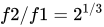
[edit]ISO 18405:2017 defines a "one-third octave" (or "one-third octave (base 2)") as one third of an octave, corresponding to a frequency ratio of . A one-third octave (base 2) is precisely 400 cents.

Base 10
[edit]IEC 61260-1:2014 and ANSI S1.6-2016 define a "one-third octave" as one tenth of a decade, corresponding to a frequency ratio of . This unit is referred to by ISO 18405 as a "decidecade" or "one-third octave (base 10)".[4]

One decidecade is equal to 100 savarts (approximately 398.631 cents).
See also
[edit]References
[edit]- ^ Malcolm J. Crocker, Handbook of Acoustics (1997)
- ^ von Benda-Beckmann, A. M., Aarts, G., Sertlek, H. Ö., Lucke, K., Verboom, W. C., Kastelein, R. A., ... & Ainslie, M. A. (2015). Assessing the impact of underwater clearance of unexploded ordnance on harbour porpoises (Phocoena phocoena) in the Southern North Sea. Aquatic Mammals, 41(4), 503.
- ^ ISO 18405 Underwater Acoustics - Terminology (International Organization for Standardization, Geneva, 2017)
- ^ (This makes sense as, if we want one third of an octave, the ratio will be , and if we log10 both members of equation we have, , which is approximately 0,1.

Further reading
[edit]- Ainslie, Michael A.; Halvorsen, Michele B.; Robinson, Stephen P. (January 2022) [2021-11-09]. "A terminology standard for underwater acoustics and the benefits of international standardization". IEEE Journal of Oceanic Engineering. 47 (1). IEEE: 179–200. doi:10.1109/JOE.2021.3085947. eISSN 1558-1691. ISSN 0364-9059. S2CID 243948953. [1] (22 pages)
One-third octave
View on GrokipediaFundamentals
Octaves in Frequency
An octave represents a fundamental interval in frequency scales, defined as the range between two frequencies where the upper frequency is precisely double the lower one. For instance, the band from 100 Hz to 200 Hz spans exactly one octave.[5] This ratio-based definition arises from the physical properties of sound waves, where doubling the frequency produces a perceptually distinct yet harmonically related tone. The concept of the octave originated in music theory, tracing back to ancient Greek terminology where it was known as the "diapason," denoting an all-embracing interval between the first and last notes of a scale. In modern usage, the term "octave" derives from the Latin word for eight, referring to the eight notes in the diatonic scale from a given note to its higher counterpart, such as C to the next C. This musical foundation extended to acoustics through the adoption of equal temperament, a tuning system that logarithmically divides the octave into 12 equal semitones to facilitate harmonic compatibility across instruments.[6][7] Human perception of pitch follows a logarithmic scale with respect to frequency, such that equal multiplicative changes in frequency yield equal perceptual intervals, making the octave a natural perceptual unit. The octave ratio is mathematically expressed aswhere is the lower frequency and is the upper frequency. This logarithmic relationship ensures that the perceived distance between notes remains consistent across the audible spectrum, regardless of absolute frequency values.[8][9] To determine the number of octaves between any two frequencies, the formula
is applied, where is the number of octaves. For example, between 250 Hz and 1000 Hz, , indicating two full octaves. This calculation underscores the octave's role as a logarithmic building block in frequency analysis.[10] This octave interval forms the foundation for subdivisions like fractional octaves in more detailed acoustic measurements.
Fractional Octaves
Fractional octaves represent subdivisions of the octave interval on a logarithmic frequency scale, where the octave itself doubles the frequency ratio, serving as the parent unit for such divisions. These fractions, denoted as 1/n octaves, divide the octave into n equal parts logarithmically, ensuring that each sub-band spans a frequency ratio of . For instance, a one-third octave corresponds to , yielding a ratio of approximately 1.26, which allows for more granular segmentation of the spectrum compared to full octaves.[11] The bandwidth of a fractional octave band is determined by this logarithmic division, with the relative bandwidth given by the formula , where is the bandwidth and is the center frequency. This expression captures the proportional width of the band relative to its center, facilitating consistent scaling across frequencies in acoustic analyses.[11] Fractional octave bands offer enhanced resolution over full octaves, enabling finer analysis of non-uniform frequency responses in sound and vibration spectra by grouping energy into perceptually relevant intervals that approximate the human ear's sensitivity. This improved detail aids in identifying specific tonal components or resonances that might be obscured in broader bands, supporting applications in noise assessment and signal processing.[11][12] The adoption of fractional octaves in engineering standards emerged post-World War II, driven by the need for precise noise measurement techniques amid industrial expansion and auditory health concerns. Early standardization efforts, such as ANSI S1.11-1966, formalized base-2 fractional bands like one-third octaves for acoustical measurements, influencing subsequent international guidelines.[11][13]Mathematical Definition
Band Width Calculation
The bandwidth of a one-third octave band is derived from the logarithmic division of a full octave, where a full octave spans a frequency ratio of 2 (from to ). Dividing this into three equal logarithmic parts yields a bandwidth ratio of , meaning the upper frequency to lower frequency satisfies . The center frequency is defined as the geometric mean of and , leading to the expressions and , since and . This formulation ensures constant relative bandwidth across the spectrum, aligning with perceptual scaling in acoustics.[1][11] The exact linear bandwidth is , which evaluates to approximately . For narrow bands at higher frequencies, a rough linear approximation is , but this overestimates slightly; more precise engineering contexts use to reflect the relative bandwidth proportion. The logarithmic nature must be emphasized for accuracy, as linear approximations degrade at low frequencies where the absolute bandwidth widens significantly relative to , potentially leading to overlap or misrepresentation in spectral analysis.[14][15] To illustrate, consider a center frequency of Hz. First, compute , so Hz. Then, Hz. The bandwidth ratio is , confirming , and Hz, or about 23.2% of . This step-by-step derivation highlights the precision required in applications like noise measurement. In standards, the band is often taken as 891 Hz to 1122 Hz.[2][1] The base-2 logarithm is employed because an octave fundamentally represents a frequency doubling ( to ), where , providing a natural unit for perceptual frequency scaling in acoustics and music. In contrast, base-10 logarithms define decades (frequency multiplication by 10, ), which are more common in electrical engineering but less aligned with auditory octave divisions. This choice ensures one-third octave bands maintain perceptual uniformity across the audible spectrum.[11]Center Frequency Selection
In one-third octave band analysis, the center frequency of each band is defined as the geometric mean of the lower band frequency and the upper band frequency , given by the formulaThis choice ensures that the band spans equally on a logarithmic frequency scale, providing consistent proportional coverage across the audio spectrum and aligning with the perceptual nature of human hearing, where frequency differences are better represented logarithmically.[11] The selection of center frequencies follows an iterative process to generate a geometric series that avoids overlaps and ensures contiguous bands. Starting from a reference frequency, typically 1,000 Hz as specified in international standards, subsequent center frequencies are obtained by multiplying the previous one by . This ratio corresponds to one-third of an octave interval on the base-2 logarithmic scale, allowing the entire frequency spectrum to be divided into non-overlapping bands. The process can extend bidirectionally: for the next higher band, ; for the previous lower band, . For example, beginning at 1,000 Hz, the next center frequency is approximately 1,259.9 Hz, and the previous is approximately 793.7 Hz. In standards like ISO 266, these are rounded to preferred values (e.g., 800 Hz and 1,250 Hz) from the R10 series.[11] Special considerations apply to edge bands at low and high frequencies to maintain coverage of the audible spectrum, which typically ranges from about 20 Hz to 20,000 Hz. At these extremes, the iterative multiplication may result in frequencies outside practical measurement ranges, so the series is truncated accordingly. Additionally, calculated values are often rounded to preferred numbers based on standardized series (such as the R10 series) to ensure compatibility with measurement equipment and minimizing deviations—maximum less than 0.6% relative to the calculated geometric progression—while preserving the logarithmic spacing. This rounding facilitates practical implementation without significantly altering the spacing.[16]
Standards and Implementation
ISO and ANSI Specifications
The development of standards for one-third octave bands traces its origins to the 1960s, when the International Electrotechnical Commission (IEC) published IEC 225:1966, titled "Octave, half-octave and third-octave band filters intended for the analysis of sounds and vibrations." This document established foundational specifications for passive and active bandpass filters used in acoustical analysis, emphasizing performance criteria for filter shapes and tolerances to ensure consistent measurement of sound and vibration spectra. Subsequent international standardization efforts culminated in ISO 266:1997, "Acoustics — Preferred frequencies," which serves as the primary reference for defining preferred center frequencies across a wide range from 1 Hz to 80 kHz. This standard adopts a geometric series based on the R10 preferred numbers from ISO 3, with a reference frequency of 1,000 Hz, to facilitate comparable acoustical measurements; in the audible range (approximately 20 Hz to 20 kHz), it encompasses 31 one-third octave bands. The standard was last confirmed in 2023.[17] In parallel, the American National Standards Institute (ANSI) addressed implementation through ANSI/ASA S1.11-2014/Part 1/IEC 61260-1:2014 (R2023), "Electroacoustics — Octave-band and fractional-octave-band filters — Part 1: Specifications." This standard outlines performance requirements for bandpass filter sets, including one-third octave configurations, applicable to both analog and digital systems. It defines two classes of instruments: Class 1 for precision applications with stricter tolerances (e.g., ±0.5 dB ripple within the passband) and Class 2 for general purposes with relaxed limits (e.g., ±1 dB ripple), ensuring accurate spectral analysis while accommodating practical instrumentation constraints.[18] Both standards emphasize constant percentage bandwidth, where each band's width is approximately 23% of its center frequency (derived from the one-third octave ratio of ), to maintain proportional resolution across the spectrum. Integration limits are specified as the lower and upper cutoff frequencies bounding each band, typically at and relative to the center frequency , enabling precise energy integration within defined intervals. Calibration requirements mandate periodic verification of filter responses against reference signals, often using standards like IEC 61672 for sound level meters, to achieve traceability and minimize measurement uncertainties in practical deployments.[18]Preferred Frequency Bands
The preferred one-third octave center frequencies are standardized nominal values defined in ISO 266 for consistent acoustic measurements across a wide frequency spectrum. These frequencies form a geometric series where each subsequent band is approximately 1.26 times the previous one ( ), ensuring uniform logarithmic spacing. The full set comprises approximately 50 bands, extending from sub-audible frequencies below 20 Hz to ultrasonic frequencies above 20 kHz. The audible human hearing range of 20 Hz to 20 kHz is covered by about 31 of these bands, providing detailed resolution for applications in sound analysis. Below 20 Hz, bands capture infrasonic content, while extensions above 20 kHz address ultrasonic phenomena, though practical implementations often focus on the core audible spectrum. The nominal center frequencies closely approximate the preferred number series from ISO 3, scaled relative to 1,000 Hz, suitable for logarithmic displays. The exact scaling follows ratios relative to a reference frequency, with the approximation aligning due to . In practice, bands are numbered such that band 21 corresponds to the 1 kHz center frequency, facilitating easy reference in octave band charts; for non-standard ranges, additional bands can be derived by continuing the geometric progression beyond the preferred set.[19] The following table lists the preferred nominal one-third octave center frequencies in Hz, from 0.8 Hz to 20 kHz, as commonly implemented per ISO 266:| Band Number | Nominal Center Frequency (Hz) |
|---|---|
| -10 | 0.8 |
| -9 | 1 |
| -8 | 1.25 |
| -7 | 1.6 |
| -6 | 2 |
| -5 | 2.5 |
| -4 | 3.15 |
| -3 | 4 |
| -2 | 5 |
| -1 | 6.3 |
| 0 | 8 |
| 1 | 10 |
| 2 | 12.5 |
| 3 | 16 |
| 4 | 20 |
| 5 | 25 |
| 6 | 31.5 |
| 7 | 40 |
| 8 | 50 |
| 9 | 63 |
| 10 | 80 |
| 11 | 100 |
| 12 | 125 |
| 13 | 160 |
| 14 | 200 |
| 15 | 250 |
| 16 | 315 |
| 17 | 400 |
| 18 | 500 |
| 19 | 630 |
| 20 | 800 |
| 21 | 1000 |
| 22 | 1250 |
| 23 | 1600 |
| 24 | 2000 |
| 25 | 2500 |
| 26 | 3150 |
| 27 | 4000 |
| 28 | 5000 |
| 29 | 6300 |
| 30 | 8000 |
| 31 | 10000 |
| 32 | 12500 |
| 33 | 16000 |
| 34 | 20000 |
Applications
Noise and Vibration Analysis
In noise and vibration analysis, one-third octave bands play a crucial role in sound level meters, enabling detailed spectral decomposition of environmental noise for exposure assessment. These bands facilitate A-weighted one-third octave analysis, which approximates human hearing sensitivity while providing frequency-resolved data to evaluate environmental noise impacts on communities, as specified in ISO 1996-1 and ISO 1996-2 for basic quantities, measurement procedures, and determination of environmental noise levels. This approach allows for the identification of dominant frequency components contributing to overall exposure, supporting compliance with community noise regulations by integrating band-specific levels into metrics like the equivalent continuous sound level (L_eq). For vibration measurement, one-third octave bands are employed to isolate tonal components in road surface profiling, where they help characterize the acoustic and vibratory signatures of vehicle-tyre interactions on standardized test tracks. ISO 10844 specifies the essential characteristics of these test surfaces, ensuring reproducible measurements of noise emissions that indirectly inform vibration analysis by filtering out broadband noise and highlighting resonant frequencies in the 50 Hz to 10 kHz range. This band resolution is particularly useful in industrial acoustics to assess structure-borne vibrations from road vehicles, aiding in the design of quieter pavements and mitigation strategies for tonal excitations. A practical example in noise analysis involves calculating the overall sound pressure level by incoherently summing the levels from individual one-third octave bands, using the formulawhere represents the sound pressure level in each band; this method accounts for the logarithmic nature of decibels and is fundamental to aggregating spectral data in environmental assessments.[20] In aircraft noise certification, one-third octave bands are integral to identifying dominant frequencies under FAR Part 36, where spectral analysis during flyover tests determines compliance with noise limits by computing the effective perceived noise level from band-resolved data. This process, outlined in Appendix A, ensures that tonal noise sources like engines are precisely quantified, contributing to regulatory limits that protect communities near airports. Preferred one-third octave bands serve as the standardized frequency set for such analyses.