
Recent from talks
Onsager reciprocal relations
Knowledge base stats:
Talk channels stats:
Members stats:
Onsager reciprocal relations
In thermodynamics, the Onsager reciprocal relations express the equality of certain ratios between flows and forces in thermodynamic systems out of equilibrium, but where a notion of local equilibrium exists.
"Reciprocal relations" occur between different pairs of forces and flows in a variety of physical systems. For example, consider fluid systems described in terms of temperature, matter density, and pressure. In this class of systems, it is known that temperature differences lead to heat flows from the warmer to the colder parts of the system; similarly, pressure differences will lead to matter flow from high-pressure to low-pressure regions. What is remarkable is the observation that, when both pressure and temperature vary, temperature differences at constant pressure can cause matter flow (as in convection) and pressure differences at constant temperature can cause heat flow. Perhaps surprisingly, the heat flow per unit of pressure difference and the density (matter) flow per unit of temperature difference are equal. This equality was shown to be necessary by Lars Onsager using statistical mechanics as a consequence of the time reversibility of microscopic dynamics (microscopic reversibility). The theory developed by Onsager is much more general than this example and capable of treating more than two thermodynamic forces at once, with the limitation that "the principle of dynamical reversibility does not apply when (external) magnetic fields or Coriolis forces are present", in which case "the reciprocal relations break down".
Though the fluid system is perhaps described most intuitively, the high precision of electrical measurements makes experimental realisations of Onsager's reciprocity easier in systems involving electrical phenomena. In fact, Onsager's 1931 paper refers to thermoelectricity and transport phenomena in electrolytes as well known from the 19th century, including "quasi-thermodynamic" theories by Thomson and Helmholtz respectively. Onsager's reciprocity in the thermoelectric effect manifests itself in the equality of the Peltier (heat flow caused by a voltage difference) and Seebeck (electric current caused by a temperature difference) coefficients of a thermoelectric material. Similarly, the so-called "direct piezoelectric" (electric current produced by mechanical stress) and "reverse piezoelectric" (deformation produced by a voltage difference) coefficients are equal. For many kinetic systems, like the Boltzmann equation or chemical kinetics, the Onsager relations are closely connected to the principle of detailed balance and follow from them in the linear approximation near equilibrium.
Experimental verifications of the Onsager reciprocal relations were collected and analyzed by D. G. Miller for many classes of irreversible processes, namely for thermoelectricity, electrokinetics, transference in electrolytic solutions, diffusion, conduction of heat and electricity in anisotropic solids, thermomagnetism and galvanomagnetism. In this classical review, chemical reactions are considered as "cases with meager" and inconclusive evidence. Further theoretical analysis and experiments support the reciprocal relations for chemical kinetics with transport. Kirchhoff's law of thermal radiation is another special case of the Onsager reciprocal relations applied to the wavelength-specific radiative emission and absorption by a material body in thermodynamic equilibrium.
For his discovery of these reciprocal relations, Lars Onsager was awarded the 1968 Nobel Prize in Chemistry. The presentation speech referred to the three laws of thermodynamics and then added "It can be said that Onsager's reciprocal relations represent a further law making a thermodynamic study of irreversible processes possible." Some authors have even described Onsager's relations as the "Fourth law of thermodynamics".
The basic thermodynamic potential is internal energy. In a simple fluid system, neglecting the effects of viscosity, the fundamental thermodynamic equation is written: where U is the internal energy, T is temperature, S is entropy, P is the hydrostatic pressure, V is the volume, is the chemical potential, and M mass. In terms of the internal energy density, u, entropy density s, and mass density , the fundamental equation at fixed volume is written:




For non-fluid or more complex systems there will be a different collection of variables describing the work term, but the principle is the same. The above equation may be solved for the entropy density:
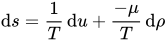
The above expression of the first law in terms of entropy change defines the entropic conjugate variables of and , which are and and are intensive quantities analogous to potential energies; their gradients are called thermodynamic forces as they cause flows of the corresponding extensive variables as expressed in the following equations.


Hub AI
Onsager reciprocal relations AI simulator
(@Onsager reciprocal relations_simulator)
Onsager reciprocal relations
In thermodynamics, the Onsager reciprocal relations express the equality of certain ratios between flows and forces in thermodynamic systems out of equilibrium, but where a notion of local equilibrium exists.
"Reciprocal relations" occur between different pairs of forces and flows in a variety of physical systems. For example, consider fluid systems described in terms of temperature, matter density, and pressure. In this class of systems, it is known that temperature differences lead to heat flows from the warmer to the colder parts of the system; similarly, pressure differences will lead to matter flow from high-pressure to low-pressure regions. What is remarkable is the observation that, when both pressure and temperature vary, temperature differences at constant pressure can cause matter flow (as in convection) and pressure differences at constant temperature can cause heat flow. Perhaps surprisingly, the heat flow per unit of pressure difference and the density (matter) flow per unit of temperature difference are equal. This equality was shown to be necessary by Lars Onsager using statistical mechanics as a consequence of the time reversibility of microscopic dynamics (microscopic reversibility). The theory developed by Onsager is much more general than this example and capable of treating more than two thermodynamic forces at once, with the limitation that "the principle of dynamical reversibility does not apply when (external) magnetic fields or Coriolis forces are present", in which case "the reciprocal relations break down".
Though the fluid system is perhaps described most intuitively, the high precision of electrical measurements makes experimental realisations of Onsager's reciprocity easier in systems involving electrical phenomena. In fact, Onsager's 1931 paper refers to thermoelectricity and transport phenomena in electrolytes as well known from the 19th century, including "quasi-thermodynamic" theories by Thomson and Helmholtz respectively. Onsager's reciprocity in the thermoelectric effect manifests itself in the equality of the Peltier (heat flow caused by a voltage difference) and Seebeck (electric current caused by a temperature difference) coefficients of a thermoelectric material. Similarly, the so-called "direct piezoelectric" (electric current produced by mechanical stress) and "reverse piezoelectric" (deformation produced by a voltage difference) coefficients are equal. For many kinetic systems, like the Boltzmann equation or chemical kinetics, the Onsager relations are closely connected to the principle of detailed balance and follow from them in the linear approximation near equilibrium.
Experimental verifications of the Onsager reciprocal relations were collected and analyzed by D. G. Miller for many classes of irreversible processes, namely for thermoelectricity, electrokinetics, transference in electrolytic solutions, diffusion, conduction of heat and electricity in anisotropic solids, thermomagnetism and galvanomagnetism. In this classical review, chemical reactions are considered as "cases with meager" and inconclusive evidence. Further theoretical analysis and experiments support the reciprocal relations for chemical kinetics with transport. Kirchhoff's law of thermal radiation is another special case of the Onsager reciprocal relations applied to the wavelength-specific radiative emission and absorption by a material body in thermodynamic equilibrium.
For his discovery of these reciprocal relations, Lars Onsager was awarded the 1968 Nobel Prize in Chemistry. The presentation speech referred to the three laws of thermodynamics and then added "It can be said that Onsager's reciprocal relations represent a further law making a thermodynamic study of irreversible processes possible." Some authors have even described Onsager's relations as the "Fourth law of thermodynamics".
The basic thermodynamic potential is internal energy. In a simple fluid system, neglecting the effects of viscosity, the fundamental thermodynamic equation is written: where U is the internal energy, T is temperature, S is entropy, P is the hydrostatic pressure, V is the volume, is the chemical potential, and M mass. In terms of the internal energy density, u, entropy density s, and mass density , the fundamental equation at fixed volume is written:
For non-fluid or more complex systems there will be a different collection of variables describing the work term, but the principle is the same. The above equation may be solved for the entropy density:
The above expression of the first law in terms of entropy change defines the entropic conjugate variables of and , which are and and are intensive quantities analogous to potential energies; their gradients are called thermodynamic forces as they cause flows of the corresponding extensive variables as expressed in the following equations.
Recent media