
Hubbry Logo
Operating leverageOperating leverageMain
Open search
Operating leverage
Community hub
Operating leverage
logo
7 pages, 0 posts
0 subscribers
Be the first to start a discussion here.
Contribute something
Operating leverage
Operating leverage
from Wikipedia

Operating leverage is a measure of how revenue growth translates into growth in operating income. It is a measure of leverage, and of how risky, or volatile, a company's operating income is.

Definition

[edit]

There are various measures of operating leverage,[1] which can be interpreted analogously to financial leverage.

Costs

[edit]

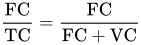
One analogy is "fixed costs + variable costs = total costs . . . is similar to . . . debt + equity = assets". This analogy is partly motivated because, for a given amount of debt, debt servicing is a fixed cost. This leads to two measures of operating leverage:

One measure is fixed costs to total costs:
Compare to debt to value, which is
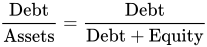
Another measure is fixed costs to variable costs:

Compare to debt to equity ratio:

Both of these measures depend on sales: if the unit variable cost is constant, then as sales increase, operating leverage (as measured by fixed costs to total costs or variable costs) decreases.

Contribution

[edit]

Contribution Margin is a measure of operating leverage: the higher the contribution margin is (the lower variable costs are as a percentage of total costs), the faster the profits increase with sales. Note that unlike other measures of operating leverage, in the linear Cost-Volume-Profit Analysis Model, contribution margin is a fixed quantity, and does not change with Sales. Contribution = Sales - Variable Cost

DOL and Operating income

[edit]

Operating leverage can also be measured in terms of change in operating income for a given change in sales (revenue).

The Degree of Operating Leverage (DOL) can be computed in a number of equivalent ways; one way it is defined as the ratio of the percentage change in Operating Income for a given percentage change in Sales (Brigham 1995, p. 426):

This can also be computed as Total Contribution Margin over Operating Income:

The above equivalence follows as the relative change in operating income with one more unit dX equals the contribution margin divided by operating income while the relative change in sales with one more unit dX equals price divided by revenue (or, in other words, 1 / X with X being the quantity).

Alternatively, as Contribution Margin Ratio over Operating Margin:

For instance, if a company has sales of 1,000,000 units, at price $50, unit variable cost of $10, and fixed costs of $10,000,000, then its unit contribution is $40, its Total Contribution is $40m, and its Operating Income is $30m, so its DOL is
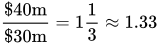
This could also be computed as 80% = $40m/$50m Contribution Margin Ratio divided by 60% = $30m/$50m Operating Margin.

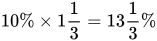
It currently has Sales of $50m and Operating Income of $30m, so additional Unit Sales (say of 100,000 units) yield $5m more Sales and $4m more Operating Income: a 10% increase in Sales and a increase in Operating Income.
Assuming the model, for a given level of sales, the DOL is higher the higher fixed costs are (an example): for a given level of sales and profit, a company with higher fixed costs has a lower Operating Income, and hence its Operating Income increases more rapidly with Sales than a company with lower fixed costs (and correspondingly lower contribution margin and higher Operating Income).

If a company has no fixed costs (and hence breaks even at zero), then its DOL equals 1: a 10% increase in Sales yields a 10% increase in Operating Income, and its operating margin equals its contribution margin:

DOL is highest near the break-even point; in fact, at the break-even point, DOL is undefined, because it is infinite: an increase of 10% in sales, say, increases Operating Income for 0 to some positive number (say, $10), which is an infinite (or undefined) percentage change; in terms of margins, its Operating Margin is zero, so its DOL is undefined. Similarly, for a very small positive Operating Income (say, $.1), a 10% increase in sales may increase Operating Income to $10, a 100x (or 9,900%) increase, for a DOL of 990; in terms of margins, its Operating Margin is very small, so its DOL is very large.

DOL is closely related to the rate of increase in the operating margin: as sales increase past the break-even point, operating margin rapidly increases from 0% (reflected in a high DOL), and as sales increase, asymptotically approaches the contribution margin: thus the rate of change in operating margin decreases, as does the DOL, which asymptotically approaches 1.

Industry-specific

[edit]

Examples of companies with high operating leverage include companies with high R&D costs, such as pharmaceuticals: it can cost billions to develop a drug, but then pennies to produce it. Hence from a life cycle cost analysis perspective, the ratio of preproduction costs (e.g. design widgets) versus incremental production costs (e.g. produce a widget) is a useful measure of operating leverage.

Outsourcing

[edit]

Outsourcing a product or service is a method used to change the ratio of fixed costs to variable costs in a business. Outsourcing can be used to change the balance of this ratio by offering a move from fixed to variable cost and also by making variable costs more predictable.

See also

[edit]

References

[edit]
[edit]
Revisions and contributorsEdit on WikipediaRead on Wikipedia
from Grokipedia
Operating leverage refers to the extent to which a company's operating changes in response to fluctuations in revenue, primarily driven by the proportion of fixed costs versus variable costs in its cost structure. High operating leverage occurs when a firm has a significant portion of fixed costs, such as rent or salaries, which remain constant regardless of production volume, allowing profits to increase disproportionately as rise once these costs are covered. Conversely, low operating leverage is characterized by higher variable costs, like raw materials that scale directly with output, resulting in more stable but less amplified profit growth. The degree of operating leverage (DOL) quantifies this relationship and is calculated using the formula: DOL = (Percentage change in operating income) / (Percentage change in sales), or alternatively, DOL = Contribution margin / Operating income, where contribution margin is sales revenue minus variable costs. For instance, a DOL of 2.0 indicates that a 10% increase in sales would lead to a 20% increase in operating income, highlighting the magnifying effect of fixed costs on profitability. This metric is particularly useful for assessing operating risk: companies with high DOL, such as those in manufacturing or telecommunications, benefit greatly from revenue growth but face heightened vulnerability during downturns due to the fixed cost burden. While operating leverage can enhance scalability and profit potential in growing markets, it also amplifies losses if sales fall short of the point, where equals total costs. Industries with high fixed costs, like airlines (with leases) or software firms (with development expenses), exemplify high operating leverage, whereas service-based businesses like consulting, reliant on labor costs, typically exhibit low leverage. Managers use this concept to inform pricing strategies, , and investment decisions, balancing the trade-off between risk and reward in their operational framework.

Fundamentals

Definition

Operating leverage is a financial and managerial concept that describes the extent to which a company's operating can be amplified by changes in , primarily due to the proportion of fixed in its overall cost structure. It quantifies how a firm's reliance on fixed —rather than variable —magnifies the impact of fluctuations on profitability, leading to greater variability in when rise or fall. This amplification occurs because fixed are incurred regardless of output levels, spreading their burden more thinly over higher volumes but intensifying losses during downturns. The term "operating leverage" originated in the within managerial accounting literature, where it was introduced to analyze cost-volume-profit relationships and the sensitivity of operating profits to changes in activity. Early formulations in this era emphasized the between fixed and variable costs as a mechanism to enhance and profitability at given output levels, influencing subsequent developments in theory. At its core, operating leverage applies to operating income, which represents revenue minus operating expenses such as and administrative costs, but excludes non-operating items like and taxes. For instance, a firm with substantial fixed costs (e.g., factory and equipment leases) will see disproportionately large profit increases from a modest uptick, compared to a service-based like consulting, where costs are predominantly variable (e.g., hourly wages) and profit swings are more muted. This illustrates how operating leverage heightens both potential returns and risk in capital-intensive industries.

Fixed and Variable Costs

Fixed costs are expenses that remain constant regardless of the level of production or volume within a relevant range, such as rent, salaries for administrative staff, premiums, and on equipment. These costs must be incurred even if output is zero, providing a stable base but requiring coverage before profitability is achieved. In contrast, variable costs fluctuate directly with changes in production or volume, scaling proportionally as more units are produced or sold; examples include raw materials, direct labor wages, and commissions. Unlike fixed costs, variable costs approach zero when production halts, allowing greater flexibility in low-volume scenarios but reducing per-unit profitability as volume expands only if prices exceed these costs. The presence of fixed costs generates operating leverage by distributing these unchanging expenses across an increasing number of units as production rises, which amplifies profit margins once fixed costs are covered; however, at lower volumes, the same fixed costs magnify operating losses since they are spread over fewer units. This leverage effect arises because a larger proportion of fixed costs relative to variable costs heightens the sensitivity of operating to changes in sales volume. Industries like airlines exemplify high fixed costs, where substantial investments in facilities, and crew salaries persist irrespective of load, leading to significant leverage as additional seats filled incur minimal extra variable costs like fuel per . Conversely, software consulting firms typically feature high variable costs dominated by billable labor hours that vary with client projects, resulting in lower operating leverage since expenses adjust closely with fluctuations. These cost structures form the foundation for analyzing contribution margins, where minus variable costs reveals the portion available to cover fixed costs and generate profit.

Contribution Margin

The contribution margin is defined as the difference between sales revenue and variable costs, representing the portion of revenue available to cover fixed costs and contribute to operating profit. This metric is fundamental in cost-volume-profit analysis, as it isolates the impact of variable expenses on profitability before accounting for fixed overheads. Contribution margin can be expressed on a per-unit or total basis. The per-unit contribution margin is calculated as the sales price per unit minus the variable cost per unit, given by the formula: Per-Unit Contribution Margin=PV\text{Per-Unit Contribution Margin} = P - V where PP is the price per unit and VV is the variable cost per unit. The total contribution margin, meanwhile, is total revenue minus total variable costs: Total Contribution Margin=Total RevenueTotal Variable Costs\text{Total Contribution Margin} = \text{Total Revenue} - \text{Total Variable Costs} These formulations highlight how each unit sold contributes incrementally to absorbing fixed costs after covering production-related variables. In the context of operating leverage, a higher amplifies the effects of growth in structures with substantial s, as the excess more rapidly covers those fixed expenses and boosts profits. This relationship underscores why businesses with elevated fixed costs—such as firms—benefit disproportionately from revenue increases once the sufficiently offsets overheads. For instance, consider a product sold at $100 per unit with a variable cost of $40 per unit, yielding a $60 per-unit ; if annual fixed costs total $500,000, selling 10,000 units generates $600,000 in total contribution margin, fully covering fixed costs and yielding $100,000 in profit, with further scaling profits more aggressively due to the fixed cost base.

Measurement

Degree of Operating Leverage

The degree of operating leverage (DOL) is a financial metric that quantifies the sensitivity of a company's operating to fluctuations in its volume, defined as the change in operating divided by the change in . This measure highlights how a firm's structure, particularly the proportion of fixed versus variable costs, amplifies the impact of changes on profitability. The core formula for DOL at a specific sales level is: DOL=Contribution MarginOperating Income\text{DOL} = \frac{\text{Contribution Margin}}{\text{Operating Income}} where contribution margin represents sales revenue minus variable costs. An equivalent expression is: DOL=SalesVariable CostsSalesVariable CostsFixed Costs\text{DOL} = \frac{\text{Sales} - \text{Variable Costs}}{\text{Sales} - \text{Variable Costs} - \text{Fixed Costs}} This formulation underscores the role of fixed costs in magnifying operating income variability. In interpretation, a DOL value of 3 indicates that a 10% increase in would result in a 30% increase in operating , assuming constant cost proportions; conversely, higher DOL values signal greater operating leverage and thus heightened sensitivity to sales downturns. The DOL analysis operates under key assumptions, including evaluation at a particular operating level and exclusion of or expenses, to isolate the effects of the operating cost structure.

Calculation Approaches

The degree of operating leverage (DOL) can be computed in marginal or average forms, depending on the analytical context. Marginal DOL measures the instantaneous sensitivity of operating to a small change in at a specific point, often derived using as the of operating with respect to multiplied by over operating , which equals 1 plus the ratio of fixed costs to operating . This approach is useful for continuous analysis in dynamic models where vary smoothly. In contrast, average DOL captures the overall sensitivity over a range of levels, typically calculated via regression of the logarithm of operating profit on the logarithm of , yielding the elasticity as the slope coefficient over a multi-year period such as five years. DOL integrates closely with break-even analysis, where the metric reflects the distance from the break-even point. At the break-even quantity QBEQ_{BE}, where operating income is zero, DOL becomes infinite because any incremental sales generate outsized percentage changes in income relative to the zero base. As sales quantity QQ exceeds QBEQ_{BE}, DOL decreases toward 1, indicating diminishing leverage effects. The formula tying DOL to break-even is: DOL=QQQBE\text{DOL} = \frac{Q}{Q - Q_{BE}} where QBE=Fixed CostsContribution Margin per UnitQ_{BE} = \frac{\text{Fixed Costs}}{\text{Contribution Margin per Unit}}. This expression highlights how proximity to break-even amplifies operating risk. For multi-product firms, DOL requires adjustment for varying contribution margins across products, using a weighted average based on sales mix proportions to aggregate leverage effects. The overall DOL is computed as the total contribution margin divided by operating income, with weights derived from each product's share of total production or sales volume, such as pm=Prodqpm = \frac{\text{Prod}}{q} for weighted average price in mixed output scenarios. This method accounts for shifts in product mix that could alter the effective fixed-to-variable cost ratio. Consider a firm with $1 million in revenue, $600,000 in variable costs, and $200,000 in fixed costs. The is $400,000, and operating income is $200,000, yielding DOL = \frac{400,000}{200,000} = 2. This indicates that a 10% increase in would raise operating income by 20%. Practical of DOL often employs spreadsheets like or accounting software such as for scenario analysis, enabling users to model cost structures, simulate changes, and visualize leverage impacts through what-if formulas and charts.

Implications

Profitability Effects

Operating leverage significantly amplifies profitability during periods of sales growth by leveraging the fixed cost structure of a . When sales increase, the fixed costs—such as rent, salaries, and —are spread over a larger volume of output, resulting in a disproportionate rise in operating income. For instance, companies with high fixed costs relative to variable costs experience "supercharged" profit growth from each additional unit sold, as marginal costs remain low. This effect is particularly pronounced above the break-even point, where revenues cover fixed expenses. In project-based industries such as construction, rigid cost structures with high fixed costs like equipment and overhead lead to significant profitability fluctuations due to variations in revenue from project acquisitions, amplifying gains when demand is high. The threshold nature of operating leverage means that profitability only emerges after fixed costs are fully covered, but once achieved, it accelerates growth rapidly. Below the level, merely offset fixed and variable costs, yielding no profit; however, surpassing this threshold allows additional revenues to flow more directly to the bottom line, enhancing margins with each incremental sale. This dynamic underscores the leverage's role in magnifying earnings potential post-breakeven, as fixed costs no longer dilute per-unit profitability. The degree of operating leverage (DOL) quantifies this amplification, where a higher DOL indicates greater sensitivity of operating to changes. To illustrate, consider two firms facing a 20% sales increase: one with high operating leverage (DOL = 4) and another with low leverage (DOL = 1.2). The high-leverage firm would experience an 80% surge in operating , as the fixed costs are diluted across higher volume, while the low-leverage firm sees only a 24% rise due to a greater proportion of variable costs absorbing the growth. This comparative outcome highlights how operating leverage transforms modest upturns into substantial profit gains. In the long term, operating leverage encourages for expanding firms by rewarding volume growth with higher margins, provided demand remains stable to justify the commitments. Firms investing in scalable , such as or R&D, can achieve sustained profitability as output rises without proportional cost increases. supports this, showing that high operating leverage firms exhibit amplified profit growth during economic booms; for example, low-productivity firms with elevated leverage see operating income rise by approximately 6% for every 1% GDP increase, outperforming lower-leverage peers. In the tech sector post-2000s, software companies like exemplified this during recovery and expansion phases, where high fixed development costs led to outsized earnings from scaling sales.

Risk Considerations

High operating leverage amplifies the downside effects of sales declines, as fixed costs remain constant regardless of revenue levels, leading to disproportionately larger reductions in operating income. For instance, if a firm experiences a 10% drop in and its degree of operating leverage (DOL) is 3, operating income could decline by 30%, exacerbating losses during economic contractions. In project-based industries such as construction, these rigid cost structures heighten profitability fluctuations, causing significant losses when revenue varies due to inconsistent project availability. This structure also elevates the break-even point, the sales volume required to cover all costs, making firms more vulnerable to downturns since higher fixed costs demand greater to avoid losses. Companies with substantial fixed expenses, such as and , must achieve significantly higher sales thresholds to remain profitable, increasing the risk of if falls short. Firms in cyclical industries face heightened volatility from operating leverage due to fluctuating tied to economic cycles or , where swings are magnified into extreme profit instability. For example, retail businesses with high fixed costs like store leases and systems experience amplified drops during off-peak seasons or recessions, as sales variability interacts with inflexible expenses. To mitigate these risks, companies can pursue cost flexibility by shifting toward variable expenses, such as or performance-based contracts, and diversify streams across less correlated markets to buffer against demand shocks. While high operating leverage can enhance profitability during expansions—as the flip side of its amplification effect—it demands proactive to counter the loss potential in adverse conditions. The airline industry's experience during the 2008 recession illustrates these dangers, where high operating leverage from fixed costs like aircraft leases and , combined with a sharp drop, contributed to widespread among carriers unable to cover expenses amid reduced . Ten U.S. airlines filed for bankruptcy protection that year, underscoring how economic downturns can overwhelm highly leveraged operations in capital-intensive sectors.

Applications

Industry Examples

In the manufacturing sector, high fixed costs from investments in machinery, plants, and equipment result in elevated degrees of operating leverage, where changes in sales volume significantly amplify fluctuations in operating income. Automakers like Ford illustrate this dynamic, as their substantial commitments to production facilities create a structure in which growth beyond the point leads to disproportionate profit increases, though downturns pose amplified risks. Software companies in the technology industry demonstrate high operating leverage due to large upfront fixed costs in , followed by minimal variable costs for distributing digital products. For instance, incurs significant initial expenses for software creation and , enabling substantial margin expansion as sales scale without proportional cost increases. The services sector, including consulting firms, generally features low operating leverage because expenses are largely variable and tied to labor and project-specific needs. Companies like McKinsey, which depend on consultant that adjust directly with client demand, experience operating income changes roughly in line with variations, offering flexibility but limited magnification of profits. Retail businesses exhibit moderate operating leverage, balancing fixed costs such as store leases and distribution centers against variable expenses like purchases and hourly wages. Walmart's vast network of physical locations provides scale advantages, yet its cost structure—for example, a degree of operating leverage of approximately 2.65 based on 2018 data—yields more stable but less explosive profit responses to sales shifts compared to capital-intensive sectors. Project-based industries, such as construction and engineering, often exhibit high operating leverage due to rigid cost structures characterized by substantial fixed costs for equipment, facilities, and skilled personnel that persist regardless of project volumes. This leads to significant profitability fluctuations as revenue varies with the acquisition and completion of projects, influenced by economic cycles or market conditions. For instance, during periods of high demand, increased project volumes result in amplified profits, whereas downturns can cause sharp declines if fixed costs exceed reduced revenues. These industry variations highlight how cost structures influence leverage levels, with , , construction, and engineering often showing higher degrees compared to services and retail, underscoring the role of fixed costs in driving sensitivity to changes.

Strategic Uses

Managers strategically adjust operating leverage by making capacity decisions that involve investing in fixed assets, such as machinery and production facilities, to lower per-unit costs and position the firm for expansion in growing markets. This approach spreads fixed costs over a larger volume of output, amplifying profit margins as increase, though it heightens sensitivity to fluctuations. For instance, a firm might install new production lines to capitalize on anticipated market growth, thereby enhancing and competitive positioning once scale is achieved. In contrast, firms may reduce operating leverage through , which converts fixed costs like in-house production facilities into variable costs paid to external providers, thereby lowering risk exposure in volatile environments. Insourcing, by maintaining or expanding internal operations, increases fixed and leverage to gain greater control and potential advantages at scale. Apple's reliance on to partners like since the early 2000s maintains a structure with variable supplier payments rather than fixed investments in factories, enabling rapid scaling while mitigating fixed asset risks amid fluctuating electronics demand. Automation trends, particularly the adoption of robotics since the 2010s, have enabled managers to intentionally elevate operating leverage in labor-intensive industries by substituting variable labor costs with upfront fixed investments in technology. This shift enhances productivity and cost predictability, as robots operate consistently without overtime or benefits variations, leading to greater profit amplification from sales growth. Empirical evidence shows that a 1% increase in industrial robot usage reduces operating costs by up to 0.167% during sales declines, providing a buffer in downturns while boosting leverage for recovery phases. Scenario planning integrates the degree of operating leverage into budgeting processes to weigh growth opportunities against downside risks, allowing managers to simulate outcomes under varying volumes. By modeling high-leverage scenarios with elevated fixed s for aggressive expansion versus low-leverage ones prioritizing variable s for stability, firms can align structures with forecasts and reserves, optimizing for predictable markets while hedging . This proactive analysis helps balance the profit potential of leverage with its volatility, informing decisions on commitments. In the evolving post-COVID context, supply chain disruptions have prompted a strategic pivot toward flexible models with lower operating leverage to enhance resilience, favoring arrangements like diversified suppliers over rigid fixed investments. firms adopting such flexibility during the experienced fewer job cuts, better , and sustained without proportional escalations, underscoring the value of reduced leverage for adapting to shocks like port closures and volatility. This trend reflects a broader emphasis on operational adaptability over pure gains.

References

Add your contribution
Related Hubs
Contribute something
User Avatar
No comments yet.