



Community hub
Recent from talks
Knowledge base stats:
Talk channels stats:
Members stats:
Operation Barrel Roll
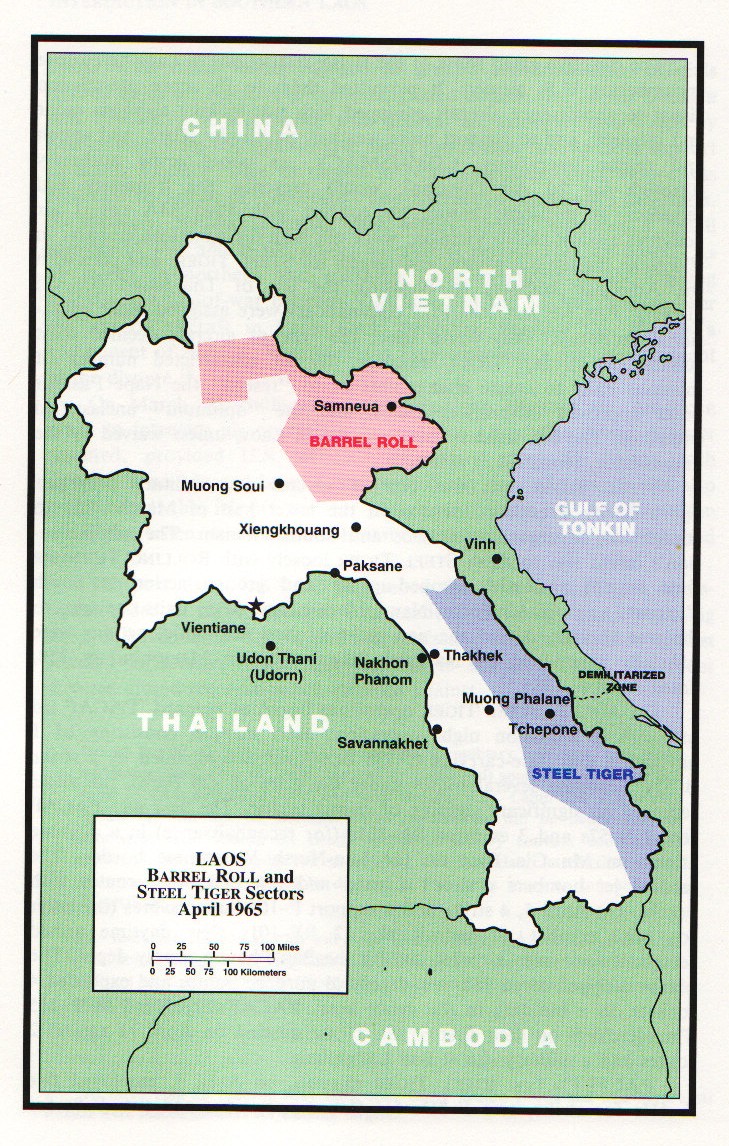
Operation Barrel Roll was a covert interdiction and close air support campaign conducted in the Kingdom of Laos by the U.S. Air Force 2nd Air Division and U.S. Navy Task Force 77 between 5 March 1964 and 29 March 1973, concurrent with the Vietnam War.
The operation was launched to persuade North Vietnam to stop supporting the insurgency in South Vietnam. It became an interdiction campaign against the Ho Chi Minh trail, North Vietnam's main logistical corridor, which ran from southwestern North Vietnam, through southeastern Laos, and into South Vietnam. The operation also increasingly provided close air support for Royal Lao Armed Forces, CIA-backed tribal allies, and Thai Volunteer Defense Corps in a covert ground war in northern and northeastern Laos. Barrel Roll and the "Secret Army" attempted to stem an increasing tide of People's Army of Vietnam (PAVN) and Pathet Lao offensives.
Barrel Roll was one of the most closely held secrets of the American military commitment in Southeast Asia. Due to the ostensible neutrality of Laos, guaranteed by the Geneva Conference of 1954 and the Declaration on the Neutrality of Laos of 1962, both the U.S. and North Vietnam strove to maintain the secrecy of their operations and only slowly escalated military actions there. In 1975, Laos emerged from nine years of war as devastated as any of the other Asian participants in the Vietnam War.
After a series of political and military machinations conducted by the U.S., the Pathet Lao, and the North Vietnamese in Laos that are described in the History of Laos since 1945, the Declaration on the Neutrality of Laos was signed in Geneva, Switzerland on 23 July 1962. The agreement, an attempt to end a civil war between the Communist-dominated (and North Vietnamese-directed) Pathet Lao, neutralists, and American-backed rightists, included provisions that required the removal of all foreign military forces and precluded the use of Lao territory for interfering in the internal affairs of another country – a blatant effort to shut down North Vietnam's growing logistical corridor through southeastern Laos that would become known as the Ho Chi Minh Trail.
A coalition Government of National Union was installed in the capital of Vientiane, but it soon ran into difficulties. By the 2 October 1962 deadline for the removal of foreign troops, the North Vietnamese had pulled out only 40 personnel, leaving approximately 6,000 troops in the eastern half of the country. Meanwhile, rightist elements (in control of the army) opposed the new government. The U.S. played its part by increasing its assistance to the right by covertly supplying the army through Thailand. Despite another international accord, Laos remained ensnared by the political and territorial ambitions of communist neighbors, the security concerns of Thailand and the United States, and geographic fate.
Fighting soon erupted between elements of the Pathet Lao and the Royal Lao Army. Although tentative negotiations resumed between the factions, matters took a turn for the worse when neutralist Prime Minister Prince Souvanna Phouma was arrested during a right-wing coup attempt. U.S. Ambassador Leonard S. Unger then notified the generals that the U.S. government would continue to support Souvanna. This turn of events had a profound effect on Laotian politics: First, it affirmed American support for Souvanna, only a few years after the U.S. had denounced him as a tool of the leftists; It also caused the neutralists to shift political allies from the left to the right; Finally, in May 1964, Souvanna announced the political union of the rightists and neutralists against the left.
Heavy fighting broke out on the Plain of Jars as the members of each political grouping chose sides. Souvanna called upon the U.S. for support and was answered in the affirmative by President Lyndon B. Johnson, who was eager to support a rightist/neutralist alliance in Laos. In November 1963 General Maxwell D. Taylor, chairman of the Joint Chiefs of Staff had proposed that U.S. armed reconnaissance missions be conducted over Laos as part of a two phase program that would warn Hanoi of U.S. determination to support the South Vietnamese government. The missions were to take place along North Vietnamese infiltration routes then developing in the Laotian panhandle.
On 19 May 1964 low-level photo reconnaissance flights (codenamed Yankee Team) over southern Laos were authorized and launched by RF-101 Voodoo aircraft. When they were fired upon during a mission, escort aircraft were provided. Two days later American aircraft began flying low-level photo recon missions over the northern part of the country, serving as the beginning of the American aerial commitment to the covert war.
Hub AI
Operation Barrel Roll AI simulator
(@Operation Barrel Roll_simulator)
Operation Barrel Roll
Operation Barrel Roll was a covert interdiction and close air support campaign conducted in the Kingdom of Laos by the U.S. Air Force 2nd Air Division and U.S. Navy Task Force 77 between 5 March 1964 and 29 March 1973, concurrent with the Vietnam War.
The operation was launched to persuade North Vietnam to stop supporting the insurgency in South Vietnam. It became an interdiction campaign against the Ho Chi Minh trail, North Vietnam's main logistical corridor, which ran from southwestern North Vietnam, through southeastern Laos, and into South Vietnam. The operation also increasingly provided close air support for Royal Lao Armed Forces, CIA-backed tribal allies, and Thai Volunteer Defense Corps in a covert ground war in northern and northeastern Laos. Barrel Roll and the "Secret Army" attempted to stem an increasing tide of People's Army of Vietnam (PAVN) and Pathet Lao offensives.
Barrel Roll was one of the most closely held secrets of the American military commitment in Southeast Asia. Due to the ostensible neutrality of Laos, guaranteed by the Geneva Conference of 1954 and the Declaration on the Neutrality of Laos of 1962, both the U.S. and North Vietnam strove to maintain the secrecy of their operations and only slowly escalated military actions there. In 1975, Laos emerged from nine years of war as devastated as any of the other Asian participants in the Vietnam War.
After a series of political and military machinations conducted by the U.S., the Pathet Lao, and the North Vietnamese in Laos that are described in the History of Laos since 1945, the Declaration on the Neutrality of Laos was signed in Geneva, Switzerland on 23 July 1962. The agreement, an attempt to end a civil war between the Communist-dominated (and North Vietnamese-directed) Pathet Lao, neutralists, and American-backed rightists, included provisions that required the removal of all foreign military forces and precluded the use of Lao territory for interfering in the internal affairs of another country – a blatant effort to shut down North Vietnam's growing logistical corridor through southeastern Laos that would become known as the Ho Chi Minh Trail.
A coalition Government of National Union was installed in the capital of Vientiane, but it soon ran into difficulties. By the 2 October 1962 deadline for the removal of foreign troops, the North Vietnamese had pulled out only 40 personnel, leaving approximately 6,000 troops in the eastern half of the country. Meanwhile, rightist elements (in control of the army) opposed the new government. The U.S. played its part by increasing its assistance to the right by covertly supplying the army through Thailand. Despite another international accord, Laos remained ensnared by the political and territorial ambitions of communist neighbors, the security concerns of Thailand and the United States, and geographic fate.
Fighting soon erupted between elements of the Pathet Lao and the Royal Lao Army. Although tentative negotiations resumed between the factions, matters took a turn for the worse when neutralist Prime Minister Prince Souvanna Phouma was arrested during a right-wing coup attempt. U.S. Ambassador Leonard S. Unger then notified the generals that the U.S. government would continue to support Souvanna. This turn of events had a profound effect on Laotian politics: First, it affirmed American support for Souvanna, only a few years after the U.S. had denounced him as a tool of the leftists; It also caused the neutralists to shift political allies from the left to the right; Finally, in May 1964, Souvanna announced the political union of the rightists and neutralists against the left.
Heavy fighting broke out on the Plain of Jars as the members of each political grouping chose sides. Souvanna called upon the U.S. for support and was answered in the affirmative by President Lyndon B. Johnson, who was eager to support a rightist/neutralist alliance in Laos. In November 1963 General Maxwell D. Taylor, chairman of the Joint Chiefs of Staff had proposed that U.S. armed reconnaissance missions be conducted over Laos as part of a two phase program that would warn Hanoi of U.S. determination to support the South Vietnamese government. The missions were to take place along North Vietnamese infiltration routes then developing in the Laotian panhandle.
On 19 May 1964 low-level photo reconnaissance flights (codenamed Yankee Team) over southern Laos were authorized and launched by RF-101 Voodoo aircraft. When they were fired upon during a mission, escort aircraft were provided. Two days later American aircraft began flying low-level photo recon missions over the northern part of the country, serving as the beginning of the American aerial commitment to the covert war.