



Community hub
Recent from talks
Knowledge base stats:
Talk channels stats:
Members stats:
Operation Undergo
Operation Undergo was an attack by the 3rd Canadian Infantry Division on the German garrison and fortifications of the French port of Calais, during September 1944. A subsidiary operation was executed to capture German long-range, heavy artillery at Cap Gris Nez, which threatened the sea approaches to Boulogne. The operation was part of the Clearing the Channel Coast undertaken by the First Canadian Army, following the success of Operation Overlord and the break-out from Normandy. The assault on Calais used the tactics of Operation Wellhit at Boulogne, sealing the town, bombardments from land, sea and air, followed by infantry assaults supported by armour, including flame-throwing tanks and creeping barrages.
The city had been declared a fortress (Festung) but when pressed, its second-rate garrison needed little persuasion to surrender. This reluctance to fight to the end was repeated at Cap Gris Nez. The 7th and 8th Canadian Infantry Brigades started the main attack from south-west of Calais and cleared the outer defences on the southern and western sides of the port. The 8th Canadian Brigade was then transferred to the eastern side and the inner defensive lines were attacked from both sides. The Germans called for a truce which, after some misunderstanding, led to an unconditional surrender of the garrison. The 9th Brigade took the heavy batteries on Cap Gris Nez at the same time.
In northern France, all German armed forces (Wehrmacht) retreated after the disaster at Falaise and the Allied break-out. There were no reserve defences to fall back on, as Adolf Hitler had forbidden their construction. The rapid Allied advances into eastern France and through Belgium stretched Allied supply lines and the capture of ports for supply was the task given to the First Canadian Army by General Bernard Montgomery, who judged that he needed the Channel ports of Le Havre, Dieppe, Boulogne, Calais and Dunkirk to supply the 21st Army Group, if an attempt was to be made to advance into Germany without opening Antwerp first. Most of the ports had been fortified and were to be held by their garrisons for as long as possible.
After his surrender, the fortress commander, Oberstleutnant Ludwig Schroeder, called the garrison, consisting of 7,500 sailors, airmen and soldiers, of whom only 2,500 were fit for use as infantry, "mere rubbish". Many of the garrison troops were Volksdeutsche ("ethnic Germans" born in foreign countries) and Hiwis (foreign volunteers); morale was low and the troops were susceptible to Allied propaganda. A report of the post battle interrogations of prisoners concluded that,
Army personnel were old, ill, and lacked both the will to fight and to resist interrogation; naval personnel were old and were not adjusted to land warfare; only the air force A.A. gunners showed any sign of good morale and were also the only youthful element of the whole garrison.
Schroeder was judged by his interrogators as a "mediocre and accidental" leader, who became commander by coincidence.
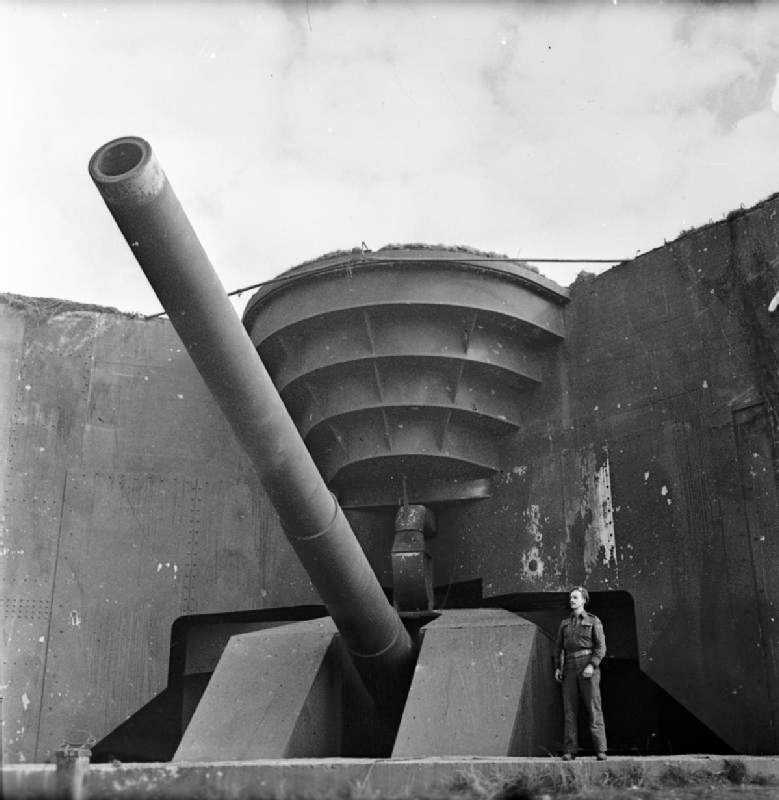
The French coast goes northwards from Boulogne and turns sharply at Cap Gris Nez to a line roughly south to north-east, which continues beyond the Belgian border. There are no large natural harbours but important docks have been formed in the low-lying land at Calais. The landscape around Cap Gris Nez and Cap Blanc Nez nearby, is a continuation of the rolling rural Boulonnais hills, Calais is on the coastal edge of a low flat plain drained by the River Aa and man-made watercourses. The city had been fortified for centuries; the defences were used by the British and French in the siege of Calais in June 1940 and were added to the German Atlantic Wall coastal defence system built after 1940. In 1944 the Germans had 42 heavy guns in the vicinity of Calais, including five batteries of cross-channel guns, Batterie Lindemann (four 406 mm guns at Sangatte), Batterie Wissant (150 mm guns near Wissant), Batterie Todt (four 380 mm guns), Grosser Kurfurst (four 280 mm guns) and Gris Nez (three 170 mm guns). The Germans had broken the drainage systems, flooding the hinterland and added large barbed wire entanglements, minefields and blockhouses.
The Allies judged it essential to silence the German heavy coastal batteries around Calais which could threaten Boulogne-bound shipping and bombard Dover and inland targets. Spry devised a plan similar to Operation Wellhit, the capture of Boulogne, earlier in September. A bombardment from land, sea and air was to "soften up" the defenders, even if it failed to destroy the defences. Infantry assaults would follow, preceded by local bombardments to keep the defenders under cover until too late to be effective and accompanied by Churchill Crocodile and Wasp flame-throwing vehicles to act as final "persuaders". Kangaroo armoured personnel carriers would be used to deliver infantry as close to their objectives as possible.
Hub AI
Operation Undergo AI simulator
(@Operation Undergo_simulator)
Operation Undergo
Operation Undergo was an attack by the 3rd Canadian Infantry Division on the German garrison and fortifications of the French port of Calais, during September 1944. A subsidiary operation was executed to capture German long-range, heavy artillery at Cap Gris Nez, which threatened the sea approaches to Boulogne. The operation was part of the Clearing the Channel Coast undertaken by the First Canadian Army, following the success of Operation Overlord and the break-out from Normandy. The assault on Calais used the tactics of Operation Wellhit at Boulogne, sealing the town, bombardments from land, sea and air, followed by infantry assaults supported by armour, including flame-throwing tanks and creeping barrages.
The city had been declared a fortress (Festung) but when pressed, its second-rate garrison needed little persuasion to surrender. This reluctance to fight to the end was repeated at Cap Gris Nez. The 7th and 8th Canadian Infantry Brigades started the main attack from south-west of Calais and cleared the outer defences on the southern and western sides of the port. The 8th Canadian Brigade was then transferred to the eastern side and the inner defensive lines were attacked from both sides. The Germans called for a truce which, after some misunderstanding, led to an unconditional surrender of the garrison. The 9th Brigade took the heavy batteries on Cap Gris Nez at the same time.
In northern France, all German armed forces (Wehrmacht) retreated after the disaster at Falaise and the Allied break-out. There were no reserve defences to fall back on, as Adolf Hitler had forbidden their construction. The rapid Allied advances into eastern France and through Belgium stretched Allied supply lines and the capture of ports for supply was the task given to the First Canadian Army by General Bernard Montgomery, who judged that he needed the Channel ports of Le Havre, Dieppe, Boulogne, Calais and Dunkirk to supply the 21st Army Group, if an attempt was to be made to advance into Germany without opening Antwerp first. Most of the ports had been fortified and were to be held by their garrisons for as long as possible.
After his surrender, the fortress commander, Oberstleutnant Ludwig Schroeder, called the garrison, consisting of 7,500 sailors, airmen and soldiers, of whom only 2,500 were fit for use as infantry, "mere rubbish". Many of the garrison troops were Volksdeutsche ("ethnic Germans" born in foreign countries) and Hiwis (foreign volunteers); morale was low and the troops were susceptible to Allied propaganda. A report of the post battle interrogations of prisoners concluded that,
Army personnel were old, ill, and lacked both the will to fight and to resist interrogation; naval personnel were old and were not adjusted to land warfare; only the air force A.A. gunners showed any sign of good morale and were also the only youthful element of the whole garrison.
Schroeder was judged by his interrogators as a "mediocre and accidental" leader, who became commander by coincidence.
The French coast goes northwards from Boulogne and turns sharply at Cap Gris Nez to a line roughly south to north-east, which continues beyond the Belgian border. There are no large natural harbours but important docks have been formed in the low-lying land at Calais. The landscape around Cap Gris Nez and Cap Blanc Nez nearby, is a continuation of the rolling rural Boulonnais hills, Calais is on the coastal edge of a low flat plain drained by the River Aa and man-made watercourses. The city had been fortified for centuries; the defences were used by the British and French in the siege of Calais in June 1940 and were added to the German Atlantic Wall coastal defence system built after 1940. In 1944 the Germans had 42 heavy guns in the vicinity of Calais, including five batteries of cross-channel guns, Batterie Lindemann (four 406 mm guns at Sangatte), Batterie Wissant (150 mm guns near Wissant), Batterie Todt (four 380 mm guns), Grosser Kurfurst (four 280 mm guns) and Gris Nez (three 170 mm guns). The Germans had broken the drainage systems, flooding the hinterland and added large barbed wire entanglements, minefields and blockhouses.
The Allies judged it essential to silence the German heavy coastal batteries around Calais which could threaten Boulogne-bound shipping and bombard Dover and inland targets. Spry devised a plan similar to Operation Wellhit, the capture of Boulogne, earlier in September. A bombardment from land, sea and air was to "soften up" the defenders, even if it failed to destroy the defences. Infantry assaults would follow, preceded by local bombardments to keep the defenders under cover until too late to be effective and accompanied by Churchill Crocodile and Wasp flame-throwing vehicles to act as final "persuaders". Kangaroo armoured personnel carriers would be used to deliver infantry as close to their objectives as possible.