


Community hub
Recent from talks
Contribute something
Nothing was collected or created yet.
Opuntia macrorhiza
View on Wikipedia
| Opuntia macrorhiza | |
|---|---|

| |
Scientific classification 
| |
| Kingdom: | Plantae |
| Clade: | Tracheophytes |
| Clade: | Angiosperms |
| Clade: | Eudicots |
| Order: | Caryophyllales |
| Family: | Cactaceae |
| Genus: | Opuntia |
| Species: | O. macrorhiza
|
| Binomial name | |
| Opuntia macrorhiza | |
| Synonyms[3] | |
| |


Opuntia macrorhiza, also called plains pricklypear or prairie pricklypear or western pricklypear, is a common and widespread species of cactus.
Description
[edit]O. macrorhiza is one of the shorter species of the genus, rarely over 30 cm (1 foot) tall, spreading horizontally and forming wide clumps. Flowers are showy and bright yellow, often with red markings near the base of the petals. Fruits are narrow, red, juicy and edible.[4]
Distribution and habitat
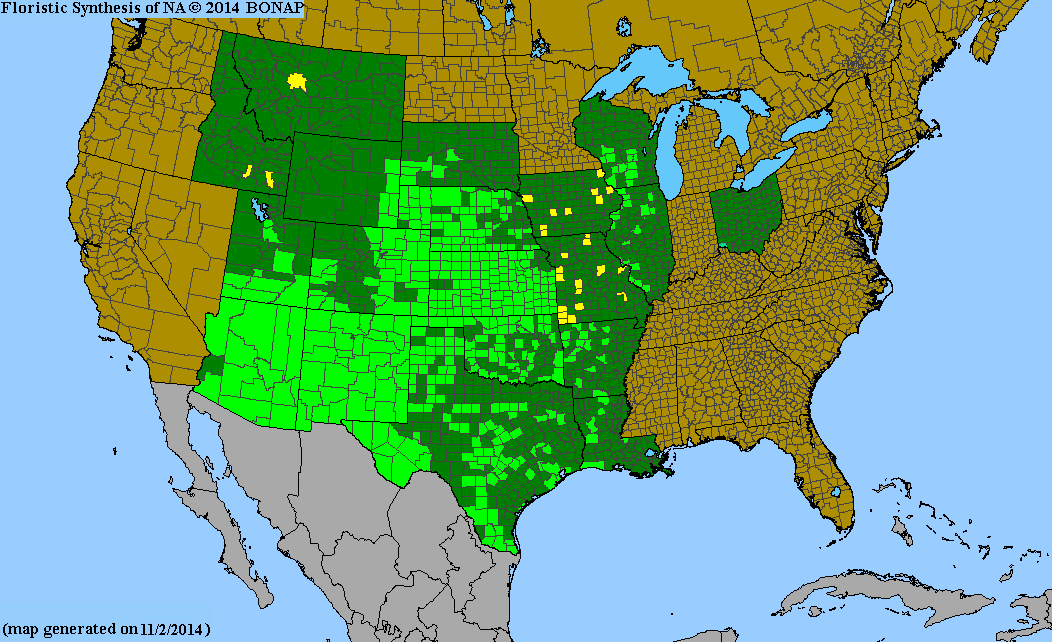
[edit]The species prefers well-drained, sandy or gravelly soils, mostly in grassland areas. It is found throughout the Great Plains of the United States, from Texas to Minnesota, and west into the Rocky Mountain states to New Mexico, Utah, and perhaps Idaho, with sporadic populations in the Mississippi and Ohio Valleys.[5] It is also reported from northern Mexico in the states of Chihuahua, Sonora, Coahuila, Nuevo León, Durango, Tamaulipas, and San Luís Potosí.,[6][7][8] though all Arizona and Mexican records should be considered with caution due to confusion with other similar species. The species is cultivated as an ornamental in other locations.
Subdivisions
[edit]Some subspecies and varieties have proposed within the species. None are accepted by Plants of the World Online as of October 2022[update],[3] which treats Opuntia macrorhiza subsp. pottsii (Salm-Dyck) U.Guzmán & Mandujano and Opuntia macrorhiza var. pottsii (Salm-Dyck) L.D.Benson as the separate species Opuntia pottsii.[9]
References
[edit]- ^ Heil, K., Terry, M. & Corral-Díaz, R. 2017. Opuntia macrorhiza (amended version of 2013 assessment). The IUCN Red List of Threatened Species 2017: e.T152371A121590513. Retrieved 16 September 2021.
- ^ NatureServe (2024). "Opuntia macrorhiza". Arlington, Virginia. Retrieved 6 January 2024.
- ^ a b c "Opuntia macrorhiza Engelm". Plants of the World Online. Royal Botanic Gardens, Kew. Retrieved 2022-10-17.
- ^ Flora of North America, Opuntia macrorhiza Engelmann, 1850. Western pricklypear
- ^ United States Department of Agriculture Plants Profile
- ^ Encyclopedia of Life
- ^ Biota of North America Program, 2014 county distribution map
- ^ SEINet, Southwestern Biodiversity, Arizona chapter photos, description, distribution map
- ^ "Opuntia pottsii Salm-Dyck", Plants of the World Online, Royal Botanic Gardens, Kew, retrieved 2022-10-18
External links
[edit]
 | This Cactaceae article is a stub. You can help Wikipedia by adding missing information. |