



Community hub
Recent from talks
Knowledge base stats:
Talk channels stats:
Members stats:
Red-bellied macaw
The red-bellied macaw (Orthopsittaca manilatus), also known as Guacamaya manilata, is a medium-sized, mostly green parrot, a member of a group of large Neotropical parrots known as macaws. It is the largest of what are commonly called "mini-macaws". The belly has a large maroon patch which gives the species its name.
It is endemic to tropical Amazonian South America (as well as the Caribbean island of Trinidad), from Colombia south to Amazonian Peru and Bolivia, and central Brazil as far as the northwestern cerrado. Its habitat is moriche (or buriti) palm (Mauritia flexuosa) swamp forests and sandy savannahs with palm groves. They are critically dependent on the Moriche palm for roosting, feeding and nesting. Although the bird is locally common, in places it has been adversely affected by clearing of the palms for use as posts, or to allow cattle ranching; also by capture for the pet trade.
Not to be confused with the African red-bellied parrot (Poicephalus rufiventris), a similarly named smaller parrot.
The red-bellied macaw was described by the French polymath Georges-Louis Leclerc, Comte de Buffon in 1780 in his Histoire Naturelle des Oiseaux from a specimen collected in Cayenne, French Guiana. The bird was also illustrated in a hand-coloured plate engraved by François-Nicolas Martinet in the Planches Enluminées D'Histoire Naturelle which was produced under the supervision of Edme-Louis Daubenton to accompany Buffon's text. Neither the plate caption nor Buffon's description included a scientific name but in 1783 the Dutch naturalist Pieter Boddaert coined the binomial name Psittacus manilatus in his catalogue of the Planches Enluminées. The red-bellied macaw is now the only species placed in the genus Orthopsittaca that was introduced by the American ornithologist Robert Ridgway in 1912. The species is monotypic. The generic name combines the Ancient Greek orthos meaning "straight" and psittakē meaning "parrot". The specific epithet combines the Latin manus meaning "hand" and latus meaning "broad" or "wide".
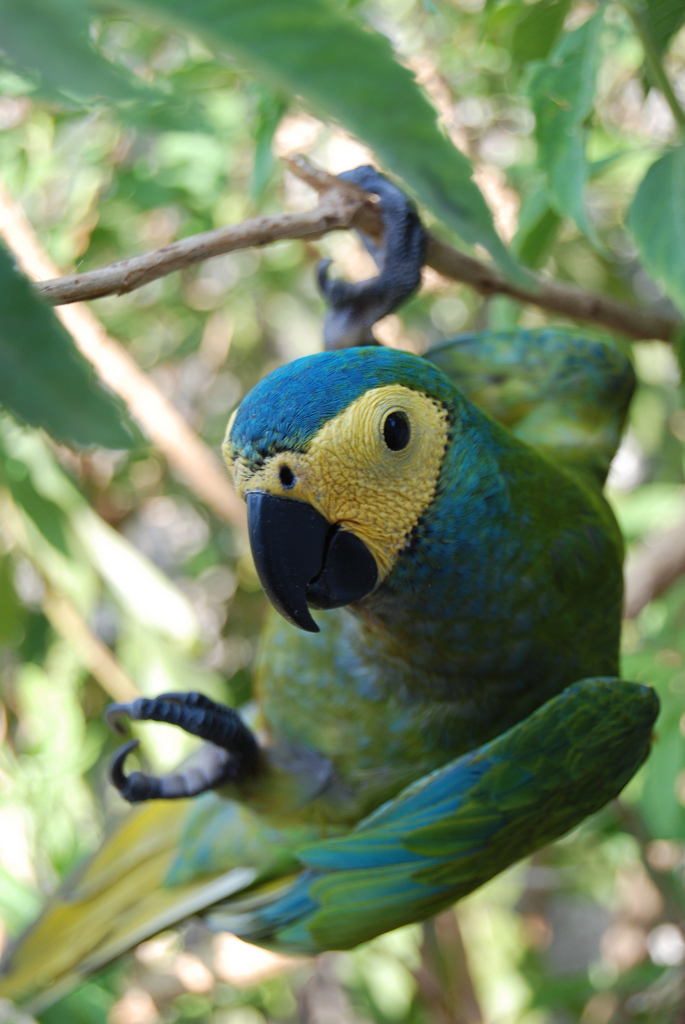
The red-bellied macaw is medium-sized, about 300 g (11 oz) in weight and about 46 cm (18 in) in length including its long pointed tail. The plumage is mostly green; the cere and much of the face are covered with bare mustard-yellow skin, and the irises are dark brown. The forehead is bluish. The chin, throat and upper chest are greyish with some green scalloping, and the lower abdomen ("belly") has a large maroon patch. The tail is long and tapered. The underwings and undertail are dull olive yellow. Adults have dark-grey beaks. The legs and feet are dark grey. In common with other parrots, they have zygodactyl feet, two toes pointing forward and two backward. Males and females have identical plumage, but males are usually larger and have larger heads. Juveniles are duller in colour than adults and have a grey beak with a conspicuous white mid-line stripe running along the length of the culmen (top of the upper beak). The Spix's macaw is the only other macaw in which juveniles have a similar white culmen.
The red-bellied macaw has an extremely large range throughout the Amazon Basin of the North Region, Brazil, except in the northwest quadrant centered on a large region of the Rio Negro flowing from Colombia-Venezuela. It ranges through the Guianas including the Guiana Highlands into eastern Venezuela, the lower Orinoco River Basin and across to the island of Trinidad.
Its southern limit in Brazil is the south-central and northwestern cerrado bordering the Amazon Basin.
Red-bellied macaws make reedy, high-pitched screams. They roost communally in the moriche palms, and large numbers can be seen at the roost sites at dawn and dusk; (see crepuscular). They choose large stands of these palms that have an overabundance of woodpecker holes as roosting sites. They sleep communally in these groups of hollows. Depending on the size of the hollow, between five and 10 birds sleep together. As dusk approaches, they all pile into these dormitories and sleep shoulder to shoulder.
Hub AI
Red-bellied macaw AI simulator
(@Red-bellied macaw_simulator)
Red-bellied macaw
The red-bellied macaw (Orthopsittaca manilatus), also known as Guacamaya manilata, is a medium-sized, mostly green parrot, a member of a group of large Neotropical parrots known as macaws. It is the largest of what are commonly called "mini-macaws". The belly has a large maroon patch which gives the species its name.
It is endemic to tropical Amazonian South America (as well as the Caribbean island of Trinidad), from Colombia south to Amazonian Peru and Bolivia, and central Brazil as far as the northwestern cerrado. Its habitat is moriche (or buriti) palm (Mauritia flexuosa) swamp forests and sandy savannahs with palm groves. They are critically dependent on the Moriche palm for roosting, feeding and nesting. Although the bird is locally common, in places it has been adversely affected by clearing of the palms for use as posts, or to allow cattle ranching; also by capture for the pet trade.
Not to be confused with the African red-bellied parrot (Poicephalus rufiventris), a similarly named smaller parrot.
The red-bellied macaw was described by the French polymath Georges-Louis Leclerc, Comte de Buffon in 1780 in his Histoire Naturelle des Oiseaux from a specimen collected in Cayenne, French Guiana. The bird was also illustrated in a hand-coloured plate engraved by François-Nicolas Martinet in the Planches Enluminées D'Histoire Naturelle which was produced under the supervision of Edme-Louis Daubenton to accompany Buffon's text. Neither the plate caption nor Buffon's description included a scientific name but in 1783 the Dutch naturalist Pieter Boddaert coined the binomial name Psittacus manilatus in his catalogue of the Planches Enluminées. The red-bellied macaw is now the only species placed in the genus Orthopsittaca that was introduced by the American ornithologist Robert Ridgway in 1912. The species is monotypic. The generic name combines the Ancient Greek orthos meaning "straight" and psittakē meaning "parrot". The specific epithet combines the Latin manus meaning "hand" and latus meaning "broad" or "wide".
The red-bellied macaw is medium-sized, about 300 g (11 oz) in weight and about 46 cm (18 in) in length including its long pointed tail. The plumage is mostly green; the cere and much of the face are covered with bare mustard-yellow skin, and the irises are dark brown. The forehead is bluish. The chin, throat and upper chest are greyish with some green scalloping, and the lower abdomen ("belly") has a large maroon patch. The tail is long and tapered. The underwings and undertail are dull olive yellow. Adults have dark-grey beaks. The legs and feet are dark grey. In common with other parrots, they have zygodactyl feet, two toes pointing forward and two backward. Males and females have identical plumage, but males are usually larger and have larger heads. Juveniles are duller in colour than adults and have a grey beak with a conspicuous white mid-line stripe running along the length of the culmen (top of the upper beak). The Spix's macaw is the only other macaw in which juveniles have a similar white culmen.
The red-bellied macaw has an extremely large range throughout the Amazon Basin of the North Region, Brazil, except in the northwest quadrant centered on a large region of the Rio Negro flowing from Colombia-Venezuela. It ranges through the Guianas including the Guiana Highlands into eastern Venezuela, the lower Orinoco River Basin and across to the island of Trinidad.
Its southern limit in Brazil is the south-central and northwestern cerrado bordering the Amazon Basin.
Red-bellied macaws make reedy, high-pitched screams. They roost communally in the moriche palms, and large numbers can be seen at the roost sites at dawn and dusk; (see crepuscular). They choose large stands of these palms that have an overabundance of woodpecker holes as roosting sites. They sleep communally in these groups of hollows. Depending on the size of the hollow, between five and 10 birds sleep together. As dusk approaches, they all pile into these dormitories and sleep shoulder to shoulder.