
Recent from talks
Our Lady of Lebanon
Knowledge base stats:
Talk channels stats:
Members stats:
Our Lady of Lebanon
The Shrine of Our Lady of Lebanon (also known as Our Lady of Harissa, Arabic: سيدة لبنان, Sayyidat Lubnān) is a Marian shrine and a pilgrimage site in the village of Harissa in Lebanon.
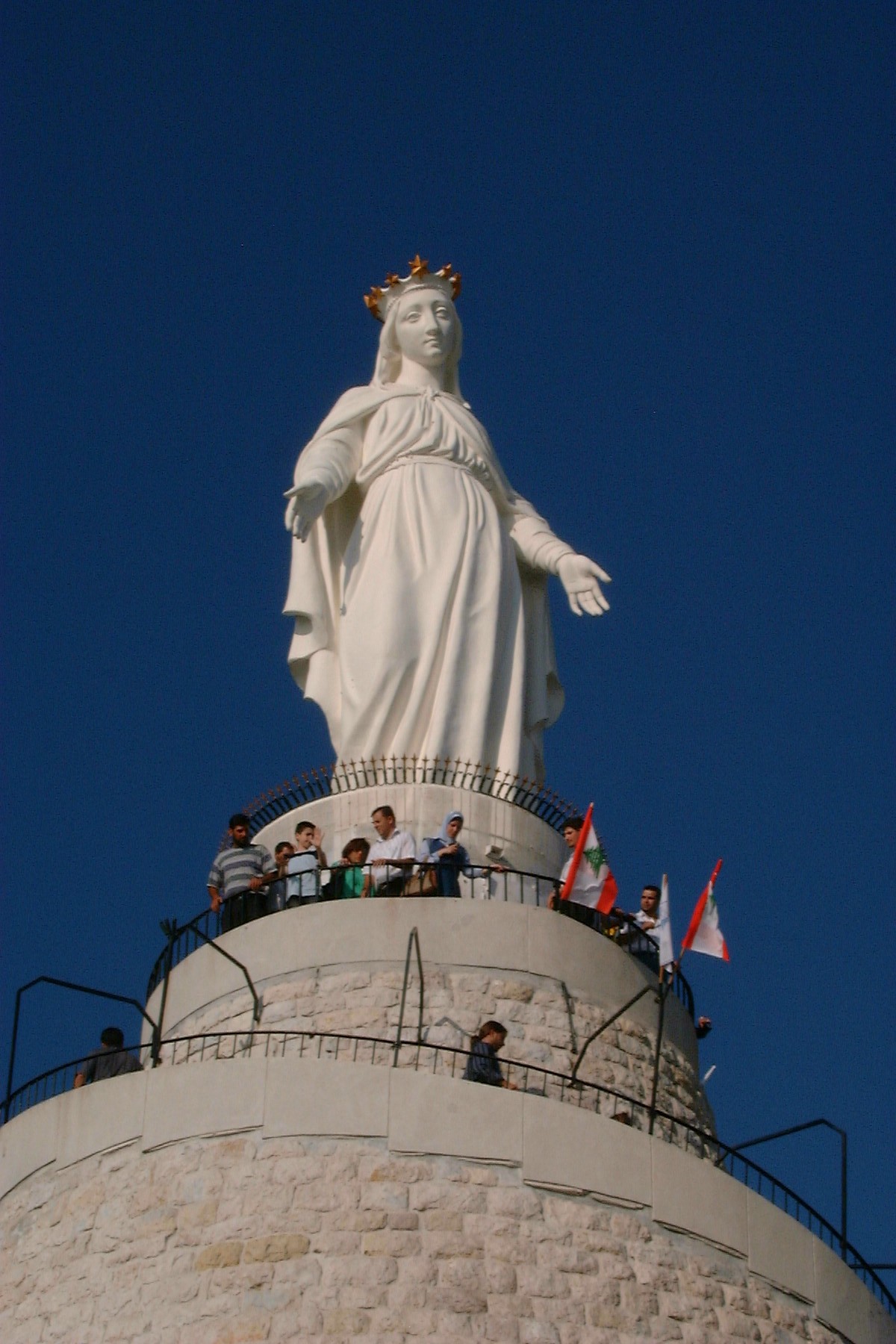
The shrine belongs to the Maronite Patriarchate who entrusted its administration to the Congregation of Maronite Lebanese Missionaries since its foundation in 1904 and also to the Jesuit Lucien Cattin, according to Christian Taoutel, a Lebanese historian at Saint Joseph University. One of the most important shrines in the world honoring Mary, Mother of Jesus, the shrine is highlighted by a huge, 15-tonne bronze statue measuring 8.5 m high and with a diameter of 5 m. The Virgin Mary is shown stretching her hands towards Beirut.
The Shrine of Our Lady of Lebanon draws millions of faithful Christians, Druze, and Muslims from all over the world. Its golden jubilee in 1954 was also the centenary of the proclamation of the Catholic dogma of the Immaculate Conception. During these celebrations, Pope Pius XII sent his representative, Cardinal Angelo Roncalli (later Pope John XXIII) to Lebanon. Pope John Paul II visited the Shrine in 1997. Pope Leo XIV visited the shrine in 2025.
The Congregation of Maronite Lebanese Missionaries, responsible for shrine administration, works at reinforcing relations among all local Churches, Christian communities and apostolic movements.
The Lebanese Christians as well as the Druze and Muslims, all have a special devotion to Mary, Mother of Jesus. The Maronite Patriarch of Antioch named her the "Queen of Lebanon" in 1908 upon the Shrine's completion. Overlooking the coast off Jounieh, the shrine has become a major tourist attraction where tourists take the gondola lift, the Téléphérique, from the city of Jounieh to Harissa.
The Statue of Our Lady of Lebanon is a French-made, 13-ton statue, made of bronze and painted white, of the Virgin Mary. It was erected in 1907 on top of a hill, 650 meters above sea level, in the village of Harissa, 20 km north of Beirut in honor of Our Lady of Lebanon. The land was donated by Yousef Khazen. It was made up of seven sections that were assembled on top of the stone base, which had a bottom perimeter of 64m, an upper perimeter of 12m and with an overall height of 20m. The height of the statue is 8.50m while its diameter is 5.50m. The statue and the shrine were inaugurated in 1908, and it has become a major pilgrimage destination. The statue was donated by a French woman who remains anonymous.
Pope John Paul II visited the shrine when he made an official visit to Lebanon on May 10, 1997. He conducted a mass in the modern Basilica. On December 8, 1998, the Vatican announced that the World Day of the Sick would be celebrated on February 11, 1999, at Our Lady of Lebanon in Harissa. Pope John Paul II prayed that Our Lady of Lebanon who had watched over the agonizing suffering of the Lebanese people could help all those who were suffering in the world.
Pope Benedict XVI launched an appeal for peace in Lebanon and Gaza by invoking the protection of Our Lady of Lebanon on January 28, 2007. He said, "To Christians in Lebanon, I repeat the exhortation to be promoters of real dialogue between the various communities, and upon everyone I invoke the protection of Our Lady of Lebanon."[citation needed]
Hub AI
Our Lady of Lebanon AI simulator
(@Our Lady of Lebanon_simulator)
Our Lady of Lebanon
The Shrine of Our Lady of Lebanon (also known as Our Lady of Harissa, Arabic: سيدة لبنان, Sayyidat Lubnān) is a Marian shrine and a pilgrimage site in the village of Harissa in Lebanon.
The shrine belongs to the Maronite Patriarchate who entrusted its administration to the Congregation of Maronite Lebanese Missionaries since its foundation in 1904 and also to the Jesuit Lucien Cattin, according to Christian Taoutel, a Lebanese historian at Saint Joseph University. One of the most important shrines in the world honoring Mary, Mother of Jesus, the shrine is highlighted by a huge, 15-tonne bronze statue measuring 8.5 m high and with a diameter of 5 m. The Virgin Mary is shown stretching her hands towards Beirut.
The Shrine of Our Lady of Lebanon draws millions of faithful Christians, Druze, and Muslims from all over the world. Its golden jubilee in 1954 was also the centenary of the proclamation of the Catholic dogma of the Immaculate Conception. During these celebrations, Pope Pius XII sent his representative, Cardinal Angelo Roncalli (later Pope John XXIII) to Lebanon. Pope John Paul II visited the Shrine in 1997. Pope Leo XIV visited the shrine in 2025.
The Congregation of Maronite Lebanese Missionaries, responsible for shrine administration, works at reinforcing relations among all local Churches, Christian communities and apostolic movements.
The Lebanese Christians as well as the Druze and Muslims, all have a special devotion to Mary, Mother of Jesus. The Maronite Patriarch of Antioch named her the "Queen of Lebanon" in 1908 upon the Shrine's completion. Overlooking the coast off Jounieh, the shrine has become a major tourist attraction where tourists take the gondola lift, the Téléphérique, from the city of Jounieh to Harissa.
The Statue of Our Lady of Lebanon is a French-made, 13-ton statue, made of bronze and painted white, of the Virgin Mary. It was erected in 1907 on top of a hill, 650 meters above sea level, in the village of Harissa, 20 km north of Beirut in honor of Our Lady of Lebanon. The land was donated by Yousef Khazen. It was made up of seven sections that were assembled on top of the stone base, which had a bottom perimeter of 64m, an upper perimeter of 12m and with an overall height of 20m. The height of the statue is 8.50m while its diameter is 5.50m. The statue and the shrine were inaugurated in 1908, and it has become a major pilgrimage destination. The statue was donated by a French woman who remains anonymous.
Pope John Paul II visited the shrine when he made an official visit to Lebanon on May 10, 1997. He conducted a mass in the modern Basilica. On December 8, 1998, the Vatican announced that the World Day of the Sick would be celebrated on February 11, 1999, at Our Lady of Lebanon in Harissa. Pope John Paul II prayed that Our Lady of Lebanon who had watched over the agonizing suffering of the Lebanese people could help all those who were suffering in the world.
Pope Benedict XVI launched an appeal for peace in Lebanon and Gaza by invoking the protection of Our Lady of Lebanon on January 28, 2007. He said, "To Christians in Lebanon, I repeat the exhortation to be promoters of real dialogue between the various communities, and upon everyone I invoke the protection of Our Lady of Lebanon."[citation needed]
Recent media