



Community hub
Recent from talks
Knowledge base stats:
Talk channels stats:
Members stats:
Ouroboros
The ouroboros (/ˌʊərəˈbɒrəs/) or uroboros (/ˌjʊərəˈbɒrəs/) is an ancient symbol depicting a snake or dragon eating its own tail. The ouroboros entered Western tradition via ancient Egyptian iconography and the Greek magical tradition. It was adopted as a symbol in Gnosticism and Hermeticism and, most notably, in alchemy. Some snakes, such as rat snakes, have been known to consume themselves.
The term derives from Ancient Greek οὐροβόρος, from οὐρά oura 'tail' plus -βορός -boros '-eating'.
The ouroboros is often interpreted as a symbol for eternal cyclic renewal or a cycle of life, death and rebirth; the snake's skin sloughing symbolises the transmigration of souls. The snake biting its own tail is a fertility symbol in some religions: the tail is a phallic symbol and the mouth is a yonic or womb-like symbol.
One of the earliest known ouroboros motifs is found in the Enigmatic Book of the Netherworld, an ancient Egyptian funerary text in KV62, the tomb of Tutankhamun, in the 14th century BCE. The text concerns the actions of Ra and his union with Osiris in the underworld. The ouroboros is depicted twice on the figure: holding their tails in their mouths, one encircling the head and upper chest, the other surrounding the feet of a large figure, which may represent the unified Ra-Osiris (Osiris born again as Ra). Both serpents are manifestations of the deity Mehen, who in other funerary texts protects Ra in his underworld journey. The whole divine figure represents the beginning and the end of time.
The ouroboros appears elsewhere in Egyptian sources, where, like many Egyptian serpent deities, it represents the formless disorder that surrounds the orderly world and is involved in that world's periodic renewal. The symbol persisted from Egyptian into Roman times, when it frequently appeared on magical talismans, sometimes in combination with other magical emblems. The 4th-century CE Latin commentator Servius was aware of the Egyptian use of the symbol, noting that the image of a snake biting its tail represents the cyclical nature of the year.
In Gnosticism, a serpent biting its tail symbolised eternity and the soul of the world. The Gnostic Pistis Sophia (c. 400 CE) describes the ouroboros as a twelve-part dragon surrounding the world with its tail in its mouth.
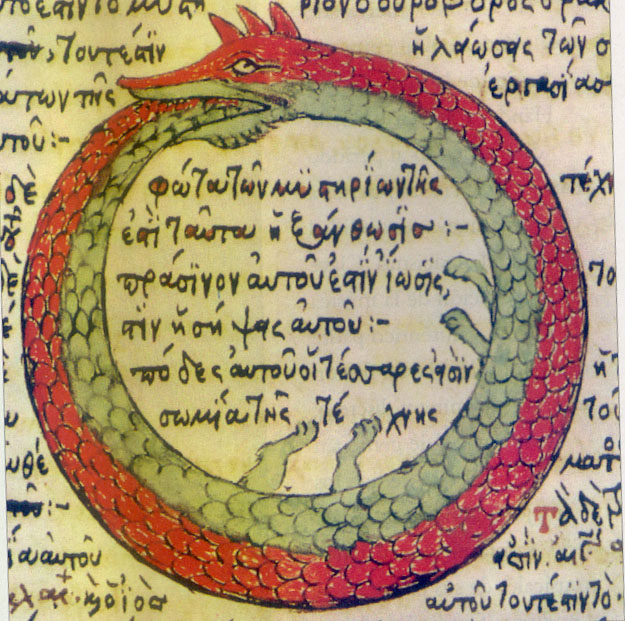
The famous ouroboros drawing from the early alchemical text, The Chrysopoeia of Cleopatra (Κλεοπάτρας χρυσοποιία), probably originally dating to the 3rd century Alexandria, but first known in a 10th-century copy, encloses the words hen to pan (ἓν τὸ πᾶν), "the all is one". Its black and white halves may perhaps represent a Gnostic duality of existence, analogous to the Taoist yin and yang symbol. The chrysopoeia ouroboros of Cleopatra the Alchemist is one of the oldest images of the ouroboros to be linked with the legendary opus of the alchemists, the philosopher's stone.[citation needed]
A 15th-century alchemical manuscript, The Aurora Consurgens, features the ouroboros, where it is used among symbols of the sun, moon, and mercury.
Hub AI
Ouroboros AI simulator
(@Ouroboros_simulator)
Ouroboros
The ouroboros (/ˌʊərəˈbɒrəs/) or uroboros (/ˌjʊərəˈbɒrəs/) is an ancient symbol depicting a snake or dragon eating its own tail. The ouroboros entered Western tradition via ancient Egyptian iconography and the Greek magical tradition. It was adopted as a symbol in Gnosticism and Hermeticism and, most notably, in alchemy. Some snakes, such as rat snakes, have been known to consume themselves.
The term derives from Ancient Greek οὐροβόρος, from οὐρά oura 'tail' plus -βορός -boros '-eating'.
The ouroboros is often interpreted as a symbol for eternal cyclic renewal or a cycle of life, death and rebirth; the snake's skin sloughing symbolises the transmigration of souls. The snake biting its own tail is a fertility symbol in some religions: the tail is a phallic symbol and the mouth is a yonic or womb-like symbol.
One of the earliest known ouroboros motifs is found in the Enigmatic Book of the Netherworld, an ancient Egyptian funerary text in KV62, the tomb of Tutankhamun, in the 14th century BCE. The text concerns the actions of Ra and his union with Osiris in the underworld. The ouroboros is depicted twice on the figure: holding their tails in their mouths, one encircling the head and upper chest, the other surrounding the feet of a large figure, which may represent the unified Ra-Osiris (Osiris born again as Ra). Both serpents are manifestations of the deity Mehen, who in other funerary texts protects Ra in his underworld journey. The whole divine figure represents the beginning and the end of time.
The ouroboros appears elsewhere in Egyptian sources, where, like many Egyptian serpent deities, it represents the formless disorder that surrounds the orderly world and is involved in that world's periodic renewal. The symbol persisted from Egyptian into Roman times, when it frequently appeared on magical talismans, sometimes in combination with other magical emblems. The 4th-century CE Latin commentator Servius was aware of the Egyptian use of the symbol, noting that the image of a snake biting its tail represents the cyclical nature of the year.
In Gnosticism, a serpent biting its tail symbolised eternity and the soul of the world. The Gnostic Pistis Sophia (c. 400 CE) describes the ouroboros as a twelve-part dragon surrounding the world with its tail in its mouth.
The famous ouroboros drawing from the early alchemical text, The Chrysopoeia of Cleopatra (Κλεοπάτρας χρυσοποιία), probably originally dating to the 3rd century Alexandria, but first known in a 10th-century copy, encloses the words hen to pan (ἓν τὸ πᾶν), "the all is one". Its black and white halves may perhaps represent a Gnostic duality of existence, analogous to the Taoist yin and yang symbol. The chrysopoeia ouroboros of Cleopatra the Alchemist is one of the oldest images of the ouroboros to be linked with the legendary opus of the alchemists, the philosopher's stone.[citation needed]
A 15th-century alchemical manuscript, The Aurora Consurgens, features the ouroboros, where it is used among symbols of the sun, moon, and mercury.