Hubbry Logo
Rat snakeRat snakeMain
Open search
Rat snake
Community hub
Rat snake
logo
8 pages, 0 posts
0 subscribers
Be the first to start a discussion here.
Rat snake
Rat snake
from Wikipedia

Rat snake
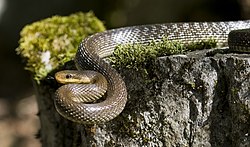
Aesculapian snake (Zamenis longissimus)
Scientific classificationEdit this classification
Kingdom: Animalia
Phylum: Chordata
Class: Reptilia
Order: Squamata
Suborder: Serpentes
Family: Colubridae
Subfamily: Colubrinae
Genera

See text

Rat snakes are members – along with kingsnakes, milk snakes, vine snakes and indigo snakes – of the subfamily Colubrinae of the family Colubridae. They are medium to large constrictors and are found throughout much of the Northern Hemisphere. They feed primarily on rodents. Many species make attractive and docile pets and one, the corn snake, is one of the most popular reptile pets in the world. Like all snakes, they can be defensive when approached too closely, handled, or restrained. However, rat snake bites are not dangerous to humans. Like most colubrids, rat snakes pose no threat to humans. Rat snakes were long believed to be completely nonvenomous, but recent studies have shown that some Old World species do possess small amounts of venom, though the amount is negligible relative to humans.[1]

Previously, most rat snakes were assigned to the genus Elaphe, but many have been since renamed following mitochondrial DNA analysis performed in 2002. For the purpose of this article, names will be harmonized with the TIGR Database.

Species

[edit]

Old World rat snakes

[edit]
Red-tailed green rat snake, Gonyosoma oxycephalum
Rhinoceros ratsnake, Rhynchophis boulengeri
Mandarin rat snake, Euprepiophis mandarinus

Coelognathus spp.

Elaphe spp.

Euprepiophis spp.

Gonyosoma spp.

Oreocryptophis spp.

Orthriophis spp.

Ptyas spp.

Rhadinophis spp.

Rhynchophis spp.

Zamenis spp.

New World rat snakes

[edit]
Gray rat snake, Pantherophis spiloides
Black ratsnake, Pantherophis obsoletus (formerly Elaphe obsoleta obsoleta): The blue eyes indicate the snake is in a shed cycle.
Yellow rat snake Pantherophis sp. (formerly Elaphe obsoleta quadrivittata) from Florida

Bogertophis spp.

Pantherophis spp.

Pseudelaphe spp.

Senticolis spp.

Spilotes spp.

  • Chicken snake or yellow rat snake, S. pullatus (Linnaeus, 1758)

Nota bene: In the above species lists, an authority's name in parentheses indicates that the species was originally described in a different genus. An authority's name not in parentheses indicates that the species is still assigned to the original genus in which it was described.

Taxonomy

[edit]

In recent years, some taxonomic controversy has occurred over the genus of North American rat snakes. Based on mitochondrial DNA, Utiger et al. (2002) showed that North American rat snakes of the genus Elaphe, along with closely related genera such as Pituophis and Lampropeltis, form a monophyletic group separate from Old World members of the genus. They therefore suggested the resurrection of the available name Pantherophis Fitzinger for all North American taxa (north of Mexico).[2][3] Crother et al. (2008) accepted the taxonomic change to Pantherophis.[4]

Venom

[edit]

Like nearly all colubrids, rat snakes pose no threat to humans. Although rat snakes were long believed to be completely nonvenomous, recent studies have shown that some Old World species do possess small amounts of venom, though the amount is negligible relative to humans.[1] Rat snakes usually hunt and kill mice and other small animals by grasping with their teeth to prevent escape, wrapping their body around that of the prey, and suffocating the prey by constriction.

In captivity

[edit]

Rat snakes are commonly kept as pets by reptile enthusiasts. The corn snake, one of the most popular pet reptiles, is a rat snake. New World species are generally thought to be more docile in captivity than Old World rat snakes.[5]

Effects of climate change on rat snakes

[edit]

Positive impacts

[edit]

All snakes are ectotherm species, meaning they depend on the temperature of the environment to maintain homeostasis.[6] Although it is predicted that the current rate of climate change will be too rapid for many reptiles and amphibian species to adapt or to evolve,[7] studies have suggested that a warmer climate may actually be beneficial to rat snake species. Global warming also poses less threats to rat snakes in temperate zones than in tropical zones as rat snake species in temperate zones can tolerate broader ranges of temperature.[8] Global climate change will increase both day and night time temperatures. This will make the night time environment more thermally suitable for rat snakes to hunt, thereby making them more active at night.[9] Increasing night time activity allows rat snakes to catch larger prey such as birds, since female birds usually incubate their eggs in the nest at night and have decreased ability to detect rat snakes due to poor visibility conditions. Global warming may also lead to changes in predation. Rat snakes are prey species to predators like hawks. While rat snakes are being hunted during the day, being more active at night due to warmer temperatures may allow rat snakes to be less vulnerable to predation from hawks.[9] A warming climate also enhances food digestion in rat snakes thereby making them more efficient, which enables rat snake individuals to grow larger in size and allowing them to consume more prey.[10] In comparison to rat snake species at relatively colder regions, rat snake species at lower latitudes tend to be larger in size due to warmer climate conditions. As the global climate warms, the average body size of rat snakes at higher latitudes will become larger, which will allow the species to catch more prey and thus increase their overall reproductive success.[11]

Negative impacts

[edit]

Eastern rat snake species in North America are experiencing negative shifts in their behaviour due to Global Warming and increasing temperatures. These shifts differ between the large distribution of rat snakes that range from Ontario to Texas.[8] The increasing Global Warming can negatively impact this species and can be responsible for population declines in some areas.

Rat snake populations from their northern range, such as Ontario, are experiencing a shift in hibernation emergence.[12] The populations in these regions typically emerge from hibernation in late April.[12] However, the increasing variability in temperature may cause rat snakes to emerge on a warm sunny day in the months of February or March.[8] Climate change has caused winters that can have weather turn back very quickly from sunny periods with high temperatures to snow and below freezing temperatures. The early emergence of these rat snakes will begin to expose them to these fatal conditions if a snake cannot return to its hibernaculum in time.[8] Therefore, the fluctuations in temperature affect the thermoregulation that rat snakes need for bodily functions like digestion and movement.[10] The unpredictability of the weather is causing more rat snakes in their northern range to get caught in these cold snaps and freeze to death.[12]

Increasing temperatures due to climate change have increased the nocturnal activity of rat snakes, especially in warmer climates such as Texas.[8] This has allowed them to alter their predation habits and feed more on nesting birds and other accessible prey.[13] However, their increased nocturnal activity puts them at risk to a new range of nocturnal predators. Rat snakes may not be used to the presence of nocturnal predators such as raccoons and owls and may be more vulnerable as prey.[14] Until rat snakes are able to adapt to their relatively new predators, populations may be at risk due to heavy predation.

Life history alterations in Ontario gray rat snakes

[edit]

As rat snakes are ectothermic species, they require sunlight and heat to maintain their body temperatures. Across their range in North America each species of rat snake has different ideal body temperatures. In Ontario, the average ideal body temperature of a rat snake is 28.1 degrees Celsius with free ranging gravid females tending to require a bit higher in order to meet their thermoregulatory requirements for gestation.[15] With ambient air temperatures over the course of their entire active season (from May to September) almost never reaching the required 28.1 °C, rat snakes in Ontario resort to basking habitats where conditions allow temperatures to rise above normal and up to 43 degrees Celsius at the hottest times of day and year.[15] These habitats include areas such as rock outcrops, bare ground, or edge habitat where they can bask on tree branches fully exposed to the sun. However, with climate change and an associated increase in ambient air temperature by 3 °C, the amount of required time spent by snakes in these habitats will decrease.[16] This will result in alterations in the amount and time of activity of rat snakes in the province. They will have the potential to be generally more active during both the day and night as it will be easier for them to maintain their ideal body temperature. Habitat choices may also shift with increased temperatures. More time could be spent in areas such as forests or barns where the temperatures are currently too low for the snakes to spend most of their time.[15] There will be less of a need to expose themselves in their open basking habitats, causing decreases in predator vulnerability as well as increases in thermoregulatory ability and foraging time. In addition, rat snakes in Ontario have a slower growth and maturation rates due to the cooler climate and shorter active seasons compared to other species of rat snakes further South in North America.[17] This means that Ontario's rat snakes are more vulnerable to population declines. But, with an increase in temperature and an increase in the duration of the active season from climate change, it is possible that the growth and maturation rates of these snakes will increase.[18]

See also

[edit]

References

[edit]
Revisions and contributorsEdit on WikipediaRead on Wikipedia
from Grokipedia
Rat snakes comprise a group of nonvenomous colubrid snakes primarily in the genus Pantherophis, native to North America and Central America, distinguished by their diet dominated by rodents such as rats and mice, which they subdue through constriction. These medium- to large-sized reptiles, with adults typically measuring 1 to 2 meters in length, inhabit diverse environments including woodlands, farmlands, and suburban areas, where they contribute to natural rodent population control. Species exhibit varied coloration for camouflage, ranging from black to gray with patterns, and are oviparous, laying eggs in concealed sites during warmer months. While generally beneficial to ecosystems, they occasionally enter human structures in pursuit of prey, leading to occasional conflicts, though they pose no venomous threat and are popular in herpetoculture for their docile nature in captivity.

Taxonomy and Classification

Historical Developments

In the 19th and early 20th centuries, rat snakes were broadly classified under the genus , with North American species such as the grouped as Elaphe obsoleta and forms encompassed in the same expansive , reflecting limited morphological distinctions and a lack of genetic data at the time. This lumping persisted due to similarities in non-venomous constrictor habits and squarish pupils, despite geographic separation across the Holarctic region. Phylogenetic revisions accelerated in the early 2000s following analyses of (mtDNA) sequences, including 12S rRNA and subunit I (COI), which demonstrated that New World rat snakes constituted a monophyletic distinct from Old World Elaphe, prompting the resurrection of Pantherophis for North American colubrids around 2002. Complementary evidence from hemipenial morphology further supported this split, highlighting structural differences not evident in earlier lumpings. Subsequent genomic studies reinforced these boundaries, emphasizing dispersal events and evolutionary divergence between hemispheres. Refinements continued in the 2010s, with the Pantherophis obsoletus complex dissected into distinct species—such as P. alleghaniensis (central ranges), P. spiloides (gray forms), and P. quadrivittatus (eastern variants)—based on population genomic data revealing phylogeographic structure, patterns, and hybrid zones. These divisions addressed cryptic variation overlooked in prior , prioritizing empirical genetic divergence over superficial patterns. Recent discoveries include Elaphe urartica in 2019, identified via mtDNA and biogeographic analysis in the , representing a cryptic lineage differentiated from related Elaphe species. In 2024, Ptyas bachmaensis, a green rat snake from , was described using morphological traits and MT-CYB gene sequences, expanding recognized diversity in Southeast Asian colubrids.

Current Species Recognized

The genus Pantherophis dominates rat snakes, encompassing approximately 10-12 primarily distributed across , characterized by robust bodies adapted for climbing and , with diets centered on . Key recognized include P. guttatus, the , noted for its vibrant red-orange coloration with blotched patterns; P. obsoletus, the western rat snake, which exhibits black dorsal blotches fading with age; P. alleghaniensis, the central rat snake; P. spiloides, the eastern rat snake; P. emoryi, the rat snake, distinguished by its grayish background and darker blotches; and P. ramspotti, the western foxsnake, featuring a yellowish base with brown blotches. In the Old World, rat snakes span multiple genera with over 40 , often arboreal or semi-arboreal, featuring slender builds and varied scalation for diverse habitats from forests to grasslands. The Elaphe includes prominent such as E. climacophora, the , identifiable by its olive-green body with black stripes, and E. sauromates, the blotched rat snake, with bold dark dorsal spots on a light background. Other notable genera encompass Orthriophis, with like O. taeniura (), marked by striking longitudinal stripes and iridescent scales; Gonyosoma, including G. oxycephalum (red-tailed green rat snake), noted for its emerald body and elongated snout; Euprepiophis, such as E. mandarinus (mandarin rat snake) and E. perlacea (Szechwan rat snake), the latter of which underwent distribution modeling in 2023 using MaxEnt to predict effects on its range in China's Yingjing area. Taxonomic classifications remain dynamic due to ongoing molecular revisions, though wild hybridization is infrequent despite common occurrence in captivity among congeners.

Phylogenetic Relationships

Rat snakes are classified within the family , where molecular phylogenies indicate they form a monophyletic excluding genera such as Gonyosoma and Coelognathus, as resolved through species-tree analyses of 304 nuclear loci. This placement reflects an origin followed by dispersal to the , with biogeographic patterns tied causally to continental configurations and ecological opportunities rather than arbitrary vicariance. Within , rat snakes exhibit in traditional Elaphe groupings, with (mtDNA) sequences from genes like 12S rRNA and cytochrome c oxidase subunit I (COI) distinguishing Elaphe from New World forms now assigned to Pantherophis. The divergence between Old World Elaphe and New World Pantherophis clades occurred approximately 20–25 million years ago during the early Miocene, based on calibrated mtDNA phylogenies incorporating cytochrome b (cytb) and other markers, coinciding with faunal exchanges across Beringia amid cooling climates that favored rodent proliferation as prey. Traits such as keeled scales and constriction hunting—key adaptations for subduing rodents—evolved convergently across these lineages and other colubrids, as evidenced by comparative morphology and independent origins in unrelated squamate groups, underscoring selection by prey availability over deep phylogenetic homology. Claims of advanced venom glands homologous to those in viperids lack support; mild oral secretions in some rat snakes derive from plesiomorphic Duvernoy's glands in Colubridae, without evidence of elaborated delivery systems or toxin diversification akin to caenophidian elapids or viperids. Post-2020 phylogenomic studies using genome-wide nuclear loci have clarified relationships within the P. obsoletus complex, confirming four distinct lineages (e.g., corresponding to P. obsoletus, P. spiloides, and others) with limited admixture, rejecting prior lumping into a single as it obscures evolutionary independence and potential conservation units despite hybridization. These splits, dated to the –Pleistocene via coalescent models, align with and glacial cycles driving isolation, prioritizing empirical genomic delimitation over morphological conservatism. Such resolutions emphasize causal drivers like prey-driven niche specialization over biogeographic happenstance, with nuclear data mitigating mtDNA biases from incomplete lineage sorting.

Physical Characteristics

Morphology and Size Variation

Rat snakes comprise medium to large colubrid species with slender, cylindrical bodies adapted for and , typically attaining adult lengths of 1 to 2.5 meters. For example, the () measures 1.1 to 1.8 meters on average, with maximum recorded lengths exceeding 2.5 meters. Their dorsal scales are keeled, providing enhanced traction on rough surfaces and bark during ascent. The head is moderately distinct from the neck, equipped with large eyes but lacking facial pits for detection, distinguishing them from viperids. Jaws feature flexible mandibles and recurved teeth of varying sizes, enabling the engulfing of prey whole through mandibular and muscular constriction. Morphological variation reflects ecological adaptations, with arboreal forms like certain Oriental rat snakes exhibiting elongated, prehensile tails for gripping branches, while more terrestrial species such as the black rat snake display proportionally shorter, less specialized tails and stockier torsos. Juveniles hatch at 25-40 cm and exhibit rapid ontogenetic growth, often doubling in length within months under optimal conditions, though precise rates vary by species, nutrition, and environment; sexual maturity is reached at approximately 1-2 meters.

Coloration, Patterns, and Sexual Dimorphism

Juveniles of many rat snake species, such as Pantherophis obsoletus, exhibit bold dorsal patterns of dark brown or gray blotches on a gray or light brown ground color, facilitating crypsis in leaf litter and vegetation. These markings often include a white or yellowish venter with darker square or rectangular blotches. In species like the corn snake (Pantherophis guttatus), juveniles display orange-red saddles outlined in black, contrasting with the more subdued tones in other congeners. Adult coloration shifts ontogenetically, with patterns fading or obscured by in forested populations of P. obsoletus and related taxa, resulting in a uniform dorsum that enhances concealment against tree bark and reduces visibility to predators in shaded understories, as evidenced by higher melanistic in wetter, forested habitats rather than purely drivers. Regional variation is pronounced in North American species: northern and montane Pantherophis individuals are predominantly glossy , while coastal or southern forms retain yellowish- hues with faint blotches or stripes. Gray rat snakes (P. spiloides) maintain pale gray or light brown dorsums with persistent dark spots into adulthood. rat snakes, such as those in Gonyosoma, feature vibrant body coloration for arboreal , as in G. prasinum with its bright dorsum and cream venter, or G. oxycephalum with a green body transitioning to red on the tail. Sexual dimorphism in coloration and patterns is negligible across rat snake taxa, with no consistent differences in hue, blotch intensity, or melanism prevalence between sexes. Dimorphism manifests primarily in morphology: males of Pantherophis spp. average 14% larger in snout-vent length than females on average, though this varies by population (2–25%), potentially linked to male-male combat during breeding. Males possess proportionally longer tails relative to body length, aiding in copulatory grasping, while females may exhibit relatively broader trunks to accommodate eggs, but without altering surface patterns. In Old World species like Ptyas mucosa, females are less robustly built than males of equivalent length, reinforcing minimal visual differentiation.

Distribution and Habitat

Global Geographic Range

Rat snakes, encompassing genera such as Pantherophis in the and in the , occupy a Holarctic distribution confined to and , with verified records extending from southern southward to in the west and from eastward to , including and . No native populations exist in , , or other southern continents, reflecting their adaptation to temperate and subtropical zones of the . In , Pantherophis species range across central and eastern regions, with P. alleghaniensis documented from and southward to Georgia, while P. quadrivittatus is restricted to the , including the of . Other taxa like P. obsoletus occur west of the , from southwestern to , , and P. emoryi inhabits at elevations of 300–600 meters. Eurasian Elaphe species exhibit broad longitudinal spread, with records from the and (E. sauromates) to the , Ponto-Caspian steppes, and further east to Province in and the (E. climacophora). Related forms like Euprepiophis perlacea, the Szechwan rat snake, maintain empirical distributions centered in , with core populations verified in areas such as near Yunwu Mountain as of occurrence records through 2023. Introduced populations remain rare and localized, lacking the invasive spread seen in species like Burmese pythons; examples include Pantherophis sp. in the , , and E. schrenckii near , , established from captive releases in without subsequent widespread establishment.

Habitat Preferences and Microhabitats

Rat snakes primarily inhabit forested areas, woodland edges, and farmlands, selections influenced by high rodent densities that support their predatory lifestyle. Species in the genus Pantherophis, such as the eastern rat snake, favor deciduous and mixed woodlands alongside agricultural fields, where structural cover aids ambush foraging. Old World Elaphe species similarly occupy evergreen and deciduous forests, meadows, and wetlands, prioritizing environments with abundant small mammal prey over undisturbed wilderness. Climbing adaptations enable utilization of arboreal microhabitats; many perch in trees, shrubs, or vines for refuge and hunting. The rhino rat snake (Gonyosoma boulengeri), for example, selects moist subtropical with dense vegetation, frequently occupying vine tangles and branches in and southern . data reveal consistent preferences for edge habitats—transitions between and open fields—over interiors or cleared areas, as these zones enhance and prey encounter rates. Elevational tolerance spans to montane zones, with Pantherophis populations documented up to 3,000 feet (914 meters) in the Appalachian foothills and higher in rocky uplands. This adaptability extends to anthropogenic landscapes, including suburban edges and derelict farm buildings, where persistent infestations sustain populations. For brumation, individuals seek sheltered microhabitats like south-facing rock crevices or complexes, which maintain humidity and stable temperatures during . microhabitats emphasize mature hardwoods, such as oaks, providing bark crevices for concealment, as evidenced by radiotracking in oak-dominated edges.

Behavior and Ecology

Daily and Seasonal Activity Patterns

Rat snakes, as ectothermic reptiles, exhibit activity patterns primarily driven by thermoregulatory needs, with behavioral adjustments to optimize body temperatures within their preferred range of approximately 28–35°C. In temperate regions, species such as (eastern rat snake) are predominantly diurnal during cooler spring months, basking and foraging actively by day to maintain thermal optima, but shift toward crepuscular or nocturnal activity in summer when daytime temperatures exceed optimal levels, reducing diurnal movement by up to 51% under suboptimal heat to prevent overheating. This facultative nocturnalism is evidenced by consistent low-level nighttime movement across breeding seasons, distributed evenly from May to , allowing access to resources while minimizing and predation risks during peak heat. Seasonally, activity peaks in late spring and early summer, with P. obsoletus showing minimal movement in March (around 10% of annual activity) and maximum in May–June (16%), followed by a decline in July (14%), correlating with prey availability and favorable temperatures before midsummer heat prompts reduced exposure. In northern portions of their range, rat snakes undergo brumation—a dormancy state akin to hibernation but with intermittent arousal—from roughly late October through March, retreating to underground dens or rock crevices where temperatures stabilize above freezing, conserving energy during periods when ectothermic metabolism cannot sustain activity below 10–15°C. In subtropical habitats, such as those occupied by southern populations or related Old World species like Elaphe spp., individuals remain active year-round, though with reduced winter foraging due to lower temperatures, relying on milder microclimates for thermoregulation without full brumation. These patterns underscore the causal role of ambient temperature in modulating ectotherm behavior, independent of unsubstantiated claims of rapid climatic shifts absent long-term datasets.

Foraging Strategies and Diet

Rat snakes, as non-venomous colubrids, primarily employ to subdue prey, coiling their muscular bodies around victims to restrict breathing and circulation until death occurs, enabling subsequent swallowing head-first. This method is efficient for handling vertebrates of varying sizes, with strikes initiated from positions in cover or during active pursuit along the ground, in trees, or within structures like barns. often involves climbing to raid nests for eggs or nestlings, or probing burrows and crevices, reflecting opportunistic adaptation to available microhabitats. Juveniles, limited by smaller gape size, target proportionally tinier items such as hatchling , small , or amphibians, transitioning to larger prey as they grow. The diet centers on small mammals, particularly like mice and rats, which form the bulk of consumed due to their abundance in rat snake habitats; analyses of contents from such as the () confirm mammals as predominant, often exceeding other categories in frequency and energetic value. Supplementary prey includes birds and their eggs—accessed via arboreal raids—as well as occasional amphibians, , or even nest-raiding for , though these contribute less to overall nutrition. This emphasis underscores an ecological role in regulating pest populations without selectivity for rare or protected , as predation aligns with local prey density rather than targeted preferences. Recent observations, such as a 2023 study on the red-tailed green rat snake (), document rapid and handling of agile mammalian prey like squirrels, highlighting the precision and speed of predatory sequences that minimize energy expenditure while maximizing capture success in diverse environments. Such behaviors reinforce the efficiency of constriction-mediated across rat snake taxa, adapting to both terrestrial and arboreal opportunities without reliance on .

Reproduction and Development

Rat snakes are oviparous, with females typically laying 5 to 30 eggs per clutch in concealed sites such as decaying logs, leaf litter, or hollow trees during late spring or early summer in temperate species. Clutch sizes vary by species and maternal body size, averaging 12 to 24 eggs in many North American taxa like Pantherophis emoryi and 10 to 20 in Pantherophis obsoletus. Eggs incubate for 55 to 75 days under natural conditions, hatching into independent juveniles without parental care; optimal temperatures for development in captivity range from 28 to 32°C, though wild incubation relies on environmental fluctuations. Sexual maturity is attained at 2 to 3 years in temperate species, with males often engaging in ritualized combat—entwining and wrestling—to compete for access to receptive females during the breeding season. Tropical rat snakes, such as Ptyas mucosa, exhibit greater reproductive flexibility, reaching maturity as early as 9 months and potentially producing multiple clutches annually in aseasonal patterns driven by consistent environmental cues rather than strict photoperiods. Captive breeding protocols have proven effective across , with females often showing significant pre-laying weight gain (e.g., doubling in some gray rat snakes) and high hatching success, contributing to reduced reliance on wild collection for commercial purposes.

Predation, Defense, and Predators

Natural Predators

Juvenile rat snakes face predation primarily from avian predators such as hawks and owls, as well as mammalian species including foxes and raccoons. These predators target smaller individuals, which lack the size to deter attacks effectively. Adult rat snakes encounter fewer predators due to their larger body size, but they remain prey for raptors like red-tailed hawks (Buteo jamaicensis) and broad-winged hawks (Buteo platypterus), along with owls such as eastern screech owls (Megascops asio). In regions like Kansas, hawks constitute the main predators of western rat snakes (Pantherophis obsoletus), supplemented by occasional predation from mammals and larger snakes. Direct observations confirm these interactions, though comprehensive scat analyses quantifying rat snake remains in predator diets are limited. Rat snakes occupy a mid-trophic position, with empirical data indicating relatively high adult survival rates attributable to their size, underscoring their role as prey rather than apex predators in ecosystems.

Defensive Behaviors and Adaptations

Rat snakes primarily evade predation through and flight, utilizing cryptic coloration that matches debris, bark, or branches to avoid detection. When motionless, they adopt a kinked posture, arching and bending the body irregularly to resemble a fallen branch or twig, enhancing against visual predators. These snakes are proficient climbers, often retreating to trees or structures as a first response upon sensing threat, leveraging their muscular bodies for rapid ascent. If escape proves impossible, rat snakes escalate to aposematic and deterrent displays. They vibrate their tails rapidly against substrate, producing a buzzing sound that mimics the rattle of venomous rattlesnakes, a convergent antedating the of true rattles. Concurrently, they may expel foul-smelling from cloacal glands to repel attackers via olfactory aversion, often combined with for added deterrence. Bluff strikes—lunging forward with open mouth but rarely inflicting deep bites—serve to intimidate without committing to prolonged combat, as is reserved exclusively for prey immobilization rather than defense. These tactics reflect evolutionary pressures in diverse habitats balancing abundant prey with risks from avian, mammalian, and reptilian predators; non-venomous colubrids like rat snakes prioritize cost-effective avoidance over risky aggression, as empirical observations show higher survival via evasion in open woodlands and edges. Such adaptations enable persistence in predator-present niches without reliance on morphological weaponry, aligning with where energy conservation favors flight and deception over confrontation.

Human Interactions

Role in Pest Control and Agriculture

Rat snakes function as key predators of in agricultural environments, consuming s, mice, and other small mammals that inflict significant damage to crops and stored grains. Species such as the (Pantherophis obsoletus) in prey on these pests, thereby reducing populations without reliance on chemical rodenticides. A single can destroy approximately 15 kg of food per year through consumption and contamination, underscoring the economic value of such natural predation. Historically, farmers in the United States during colonial times valued rat snakes for their control services around barns and fields, recognizing their utility in limiting pest-related losses. In , the Oriental rat snake (Ptyas mucosa) inhabits open agricultural habitats and targets as primary prey, helping to curb infestations in rice paddies and similar systems. The Amur rat snake () similarly plays a documented role in suppressing numbers in Northeast Asian farmlands. Rat snakes integrate effectively into broader (IPM) frameworks by providing consistent biological control, with their presence alone potentially deterring from farm areas. Empirical assessments affirm their net positive contribution, as suppression outweighs minor impacts on other , with no studies demonstrating overall harm to . This aligns with causal dynamics where sustained predation pressure maintains pest equilibrium below damaging thresholds.

Captivity, Breeding, and Pet Trade

Certain species of rat snakes, notably the corn snake (Pantherophis guttatus), rank among the most popular colubrid snakes in the captive pet trade owing to their manageable size, hardy disposition, and straightforward husbandry requirements. These snakes thrive in secure enclosures providing ample space for and hiding; recommended minimum dimensions for adults are 48 inches long by 24 inches wide by 24 inches high to accommodate natural behaviors such as climbing and burrowing. Temperature gradients must span a cool side of 75-82°F to a warm side of 80-85°F, with a localized basking zone reaching 88-92°F to support and activity; under-tank heaters or emitters are commonly employed to maintain these conditions without excessive humidity, which can lead to respiratory issues if prolonged above 60%. Breeding rat snakes in captivity typically relies on inducing a brumation-like cooling period to mimic seasonal cues, cooling adults to 50-65°F for 8-10 weeks during winter months before gradual rewarming to stimulate and . This method yields high across genera; for the rat snake (Bogertophis subocularis), detailed protocols implemented in captive settings as of 2013 emphasize separate housing during cooling, visual sexing via cloacal probing, and pairing only post-brumation, resulting in clutches of 6-12 eggs with hatch rates exceeding 80% under controlled incubation at 82-86°F. Ethical breeding prioritizes and avoids overbreeding morphs to prevent , with neonates requiring isolated rearing to minimize risks. The pet trade for rat snakes overwhelmingly favors captive-bred individuals, which constitute the vast majority of specimens available commercially and thereby curtail incentives for wild harvesting, particularly for less common Asian or exotic species. Captive propagation mitigates importation-related stressors such as parasites or novel pathogens, rendering health complications infrequent—respiratory infections or dysecdysis occur in under 5% of properly managed collections—provided quarantine protocols and veterinary screening for inclusions like inclusion body disease are followed. For arboreal species like the rhino rat snake (Rhynchophis boulengeri), husbandry guidelines stress enriched vertical enclosures with misting systems and vigilant monitoring of paired adults for combat injuries during breeding attempts, as males may exhibit aggressive biting that necessitates separation if unchecked.

Conservation Status and Threats

The conservation status of most rat snake species, such as Pantherophis obsoletus (eastern ratsnake), is rated as Least Concern on the IUCN Red List, reflecting their broad distributions and resilient populations across North America and Eurasia. Regional assessments vary; for instance, the eastern ratsnake is state-endangered in Maine and threatened in Vermont due to localized pressures, while the gray ratsnake (Pantherophis spiloides) holds special concern status in Ontario, Canada. Certain Asian species, like the Amur ratsnake (Elaphe schrenckii), face higher risks, classified as nationally endangered in parts of Korea from habitat degradation and collection. Primary threats stem from anthropogenic factors rather than climatic shifts, with habitat loss and fragmentation from , , and infrastructure development reducing suitable forested and edge habitats essential for and . Road networks exacerbate these issues by causing direct vehicular mortality—snakes crossing roads during dispersal or hunting—and acting as barriers that isolate subpopulations, as evidenced by higher mortality hotspots near high-traffic edges in reptile studies. persecution, driven by and misidentification with venomous species, contributes significantly to mortality, often outweighing natural predation in populated areas. Climate change effects are empirically mixed and non-catastrophic for rat snakes, with 2013 modeling indicating potential gains and range expansions for North American species under warming scenarios due to extended activity seasons and thermal buffering in forests. Behavioral adaptations, such as predicted shifts toward nocturnal activity in response to higher daytime temperatures, may reduce avian predation exposure during vulnerable periods like nest raiding. Recent population monitoring, including 2023 observations in , suggests stability or localized growth rather than decline, underscoring the genus's adaptability over alarmist projections. Conservation interventions require minimal broad-scale action for most populations, prioritizing targeted measures like road underpasses, public to curb killing, and habitat connectivity restoration in fragmented regions, as rat snakes demonstrate high resilience without evidence of systemic collapse. Overemphasis on speculative threats risks diverting resources from verifiable human-induced pressures.

Myths, Misconceptions, and Cultural Significance

Common Myths Debunked

A common misconception holds that rat snakes are venomous or capable of delivering a toxic bite harmful to humans. Rat snakes are constrictors without functional venom glands; while some colubrid species possess Duvernoy's glands producing mild salivary secretions, these lack the potency or delivery mechanism to cause significant effects beyond minor irritation in rare bites. Folklore persists that rat snakes hybridize with venomous species such as copperheads or rattlesnakes, yielding offspring more dangerous than either parent. Genetic distances between colubrids like rat snakes and viperids preclude viable hybrids, compounded by reproductive mismatches—rat snakes lay eggs, whereas pit vipers bear live young. Myths portray black rat snakes as aggressive "pilot" snakes that lead venomous reptiles to dens for or . Such behaviors lack empirical support; occasional shared hibernacula reflect opportunistic use, not guidance or interbreeding. These snakes exhibit defensive posturing—hissing, , or tail vibration—only when cornered, preferring flight over confrontation. Assertions that rat snake tails possess stinging or poisonous capabilities are baseless; no such apparatus exists in snakes, and tail injuries or vibrations mimic rattlesnake sounds solely as camouflage, not weaponry. Rat snakes are sometimes deemed pests for preying on birds and eggs, overshadowing their ecological value. Their consumption of rodents—primary diet components—provides superior pest suppression compared to incidental avian predation, reducing crop damage and disease vectors without chemical interventions. Confusion arises from 2025 research on woodrat (Neotoma spp.) venom resistance, where cooler temperatures diminish serum efficacy against toxins; this pertains exclusively to viperid predation dynamics and bears no relation to rat snake biology or associated myths.

Cultural and Historical References

Rat snakes, particularly species like the (), were historically referred to as "pilot snakes" in North American regional , a term documented as early as 1900 in herpetological . The designation "rat snake" itself dates to 1818, reflecting their primary diet of . In agricultural contexts, rat snakes have long been recognized for preying on pest rodents such as rats and mice, which inflict billions in annual and storage damage; this ecological role led farmers to tolerate their presence near barns and fields to mitigate infestations without chemical interventions. Scientifically, early descriptions of North American rat snakes include Thomas Say's 1823 classification of the as Coluber obsoletus, with subsequent taxonomic contributions by and Charles Frédéric Girard in for related forms. These works laid foundational herpetological documentation, emphasizing the snakes' adaptability across habitats from forests to farmlands.

References

Add your contribution
Related Hubs
User Avatar
No comments yet.