


Community hub
Recent from talks
Contribute something
Nothing was collected or created yet.
Ron Bass (wrestler)
View on Wikipedia
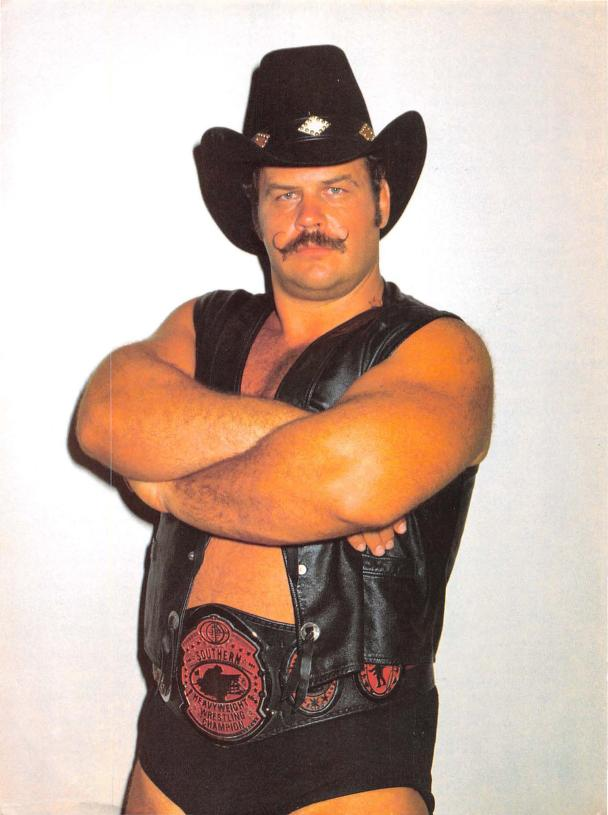
Ronald Heard (December 21, 1948 – March 7, 2017) was an American professional wrestler, best known under the name "The Outlaw" Ron Bass. His gimmick was a Texan cowboy who entered World Wrestling Federation (WWF) rings to the sound of a bullwhip.[4]
Key Information


Professional wrestling career
[edit]National Wrestling Alliance (1971–1987)
[edit]Heard started wrestling as Ron Bass in 1971 in the Gulf Coast territory.[2] Throughout the 1970s, he performed primarily in National Wrestling Alliance territories.[5] He was known as "Cowboy" Ron Bass,[6] Sam Oliver Bass, and "Outlaw" Ron Bass, depending on which territory he was working at the time.[7]
In the early 1980s, he wrestled in Championship Wrestling from Florida and Jim Crockett Promotions, frequently teaming with Black Bart as The Long Riders in both promotions.[2] He also teamed and feuded with Barry Windham in Florida. As a face he would feud with Angelo Mosca and Kendo Nagasaki. Bass would later turn heel after turning on Dusty Rhodes during a match where Bass was a special referee in a match against Harley Race, costing Rhodes the NWA title. Bass' feud with Barry Windham (over a saddle given to Bass by Dusty Rhodes) led to Windham losing a "loser-leaves-town" match to Bass and coming back to wrestle as the masked "Dirty Yellow Dog. "[8]
World Wrestling Federation (1987–1989)
[edit]In 1987, Bass (using the "Outlaw" name) went to the World Wrestling Federation (WWF), where he voiced challenges to the likes of WWF champion Hulk Hogan and Brutus Beefcake. A feud between Bass and Blackjack Mulligan appeared to be in the works over which one was the toughest wrestler to come out of Texas, but Mulligan abruptly left the WWF before any matches could take place between the two. Bass would then settle into a role in the midcard position, wrestling against Hillbilly Jim, Lanny Poffo and Sam Houston.[2] Later on he was part of the five-man team captained by The Honky Tonk Man at the inaugural Survivor Series pay-per-view on Thanksgiving Day 1987.[9] He also participated in the very first Royal Rumble[9] and the 20-man battle royal at WrestleMania IV.[10][11] He was eliminated at the latter event by the Junkyard Dog; a feud between the two began in the months after WrestleMania after Bass choked and dragged the Dog with his bullwhip, "Miss Betsy," in a sneak attack on Wrestling Challenge.[12] He also joined Gorilla Monsoon at the broadcast table one week on Wrestling Challenge to cover for Bobby "The Brain" Heenan, who was recovering from his storyline injury from Ken Patera.
At the 1988 King of the Ring tournament, Bass qualified for the final after beating a young Shawn Michaels but was paid by Ted DiBiase to fake an injury.[13] Bass began a feud with Beefcake in August 1988, gouging Beefcake's head open with his spurs ("Bret" and "Bart") on an episode of Superstars of Wrestling; the attack caused Beefcake to miss his scheduled Intercontinental championship match against the Honky Tonk Man at the first SummerSlam event on August 29.[14] Bass and Honky co-captained a five-man contingent against a team captained by Beefcake and the Ultimate Warrior at the second Survivor Series in November. Bass and teammate Greg Valentine were eliminated by Warrior in succession in the final minute of the match.[15] On the January 7, 1989 Saturday Night's Main Event XIX, Bass lost to Beefcake via sleeperhold in a hair vs. hair match.[4][16] He competed in the 1989 Royal Rumble (sans hair).[3] After Bass' feud with Beefcake, he was used mainly as a preliminary wrestler and left the WWF in March.[12]
Retirement
[edit]Bass wrestled in the independents before retiring in 1991 due to the injuries sustained over his career.[4]
In 2005, he returned to wrestling making an appearance at WrestleReunion on January 29 and teamed with Larry Zbyszko to defeat Barry Windham and Mike Rotunda.[17] He continued to work in the independents until retiring for good in 2013.
Bass and Brian Blair both starred in the film Silent Times directed by Geoff Blanchette and Christopher Annino,[18] which was released in 2018. Bass plays a 1920s professional football coach named Coach Joseph Arcarese.[2]
Personal life and death
[edit]After retiring, Heard returned to Tampa, Florida, where he golfed, became religious, and earned his bachelor's degree from Arkansas State University.[2][4] Subsequently, he worked in sales in Florida's construction market.[4] He also became an Amway salesman in the Tampa area. He had one son, named Joe, who debuted as a professional wrestler in September 2019, competing under the ring name Ron Bass Jr.[4]
In July 2016, Heard was named part of a class action lawsuit filed against WWE which alleged that wrestlers incurred traumatic brain injuries during their tenure and that the company concealed the risks of injury. The suit was litigated by attorney Konstantine Kyros, who has been involved in a number of other lawsuits against WWE, primarily after the chronic traumatic encephalopathy investigation into Chris Benoit and other wrestlers.[19] Following his death in March 2017, Kyros' law firm received a postmortem report in December 2018 from the Heard family stating he had suffered from chronic traumatic encephalopathy, which has become common among professional wrestlers. Over a year after his death, US District Judge Vanessa Lynne Bryant dismissed the lawsuit in September 2018.[20]
In March 2017, Heard was hospitalized due to a burst appendix.[2] He died on March 7, 2017, at the age of 68 due to complications following surgery.[21][2]
Championships and accomplishments
[edit].png)
- All Japan Pro Wrestling
- Central States Wrestling
- NWA Central States World Tag Team Championship (2 times) - with Dutch Mantell[23]
- Championship Wrestling from Florida
- NWA Florida Bahamian Championship (1 time)[24]
- NWA Florida Global Tag Team Championship (1 time) - with Barry Windham[25]
- NWA Florida Heavyweight Championship (2 times)[26]
- NWA Southern Heavyweight Championship (Florida version) (2 times)[27]
- NWA United States Tag Team Championship (Florida version) (4 times) - with Black Bart (3), and One Man Gang (1)[28]
- Georgia Championship Wrestling
- Gulf Coast Championship Wrestling - Southeastern Championship Wrestling
- NWA Gulf Coast Heavyweight Championship (1 time)[30]
- NWA Gulf Coast Tag Team Championship (2 times) – with Don Bass (1) and Dutch Bass (1)[31]
- NWA Southeastern Heavyweight Championship (Northern Division) (1 time)[32]
- NWA Southeastern Tag Team Championship (1 time) - with Randy Rose[33]
- NWA Tennessee Tag Team Championship (2 times) - with Don Bass[34]
- Mid-Atlantic Championship Wrestling / Jim Crockett Promotions
- NWA Hollywood Wrestling
- NWA Americas Tag Team Championship (3 times) - with Dr. Hiro Ota (1), Moondog Lonnie Mayne (1), and Roddy Piper (1)[40]
- NWA Mid-America / Continental Wrestling Association
- NWA Tri-State
- Pacific Northwest Wrestling
- NWA Pacific Northwest Heavyweight Championship (1 time)[48]
- NWA Pacific Northwest Tag Team Championship (2 times) - with John Anson (1) and Moondog Mayne (1)[49]
- Pro Wrestling Illustrated
- PWI ranked him # 294 of the 500 best singles wrestlers during the "PWI Years" in 2003.[50]
- Ring Around The Northwest Newsletter
- Wrestler of the Year (1977)[51]
- Other Titles
- Fort Myers Heavyweight Championship ( 2 times )
References
[edit]- ^ a b Shields, Brian; Sullivan, Kevin (2009). WWE Encyclopedia. Dorling Kindersley. p. 229. ISBN 978-0-7566-4190-0.
- ^ a b c d e f g h i j Oliver, Greg (March 7, 2017). "'Outlaw' Ron Bass dead at 68". SLAM! Wrestling. Archived from the original on March 8, 2017. Retrieved March 7, 2017.
- ^ a b c "Ron Bass profile". Online World of Wrestling. Retrieved March 9, 2017.
- ^ a b c d e f Brett Hoffman (January 29, 2007). "Catching up with The Outlaw". World Wrestling Entertainment. Retrieved March 12, 2008.
- ^ Glasspiegel, Ryan (March 8, 2017). "Pro Wrestlers Pay Tribute to "The Outlaw" Ron Bass". The Big Lead. Retrieved March 9, 2017.
- ^ "Former professional wrestler 'Cowboy' Ron Bass dies at TGH". WFLA.com. March 7, 2017. Retrieved March 9, 2017.
- ^ Gnetz, Brandon (March 7, 2017). "Former WWE Star "Outlaw" Ron Bass Passes Away". ComicBook. Retrieved March 9, 2017.
- ^ "'The Outlaw' Ron Bass passes away at 68". Cageside Seats. March 8, 2017. Retrieved March 9, 2017.
- ^ a b Holroyd, Caitlyn (March 8, 2017). "Former WWE star 'The Outlaw' Ron Bass dies at 68". theScore.com. Retrieved March 9, 2017.
- ^ Undelson, Ben (2013). Fiction. A Nostalgic Guide to Growing up with the WWF. Lulu.com. p. 90. ISBN 9781304101907.
- ^ "WWE wrestler DIES from burst appendix". Tuko.ce.ke. March 8, 2017. Retrieved March 9, 2017.
- ^ a b Thomas, Jeremy (March 8, 2017). "UPDATED: WWE Issues Statement on "Outlaw" Ron Bass' Passing". 411 Mania. Retrieved March 9, 2017.
- ^ Ted DiBiase: The Million Dollar Man, p.162, Ted DiBiase with Tom Caiazzo, Pocket Books, New York, NY, 2008, ISBN 978-1-4165-5890-3
- ^ "World Wrestling Entertainment Substitutions". Softwolves. Retrieved January 28, 2008.
- ^ "Survivor Series 1988". Pro Wrestling History. Retrieved January 28, 2008.
- ^ "Saturday Night's Main Event #19". Pro Wrestling History. Retrieved January 28, 2008.
- ^ "WrestleReunion Wrestling Card: January 29, 2005". Online World of Wrestling. Retrieved January 28, 2008.
- ^ Annino, Christopher (January 29, 2019), Silent Times, Geoff Blanchette, Saschia Johnson, Olga Kurkulina, retrieved June 7, 2018
- ^ "WWE sued in wrestler class action lawsuit featuring Jimmy 'Superfly' Snuka, Paul 'Mr Wonderful' Orndorff". FoxSports.com. Fox Entertainment Group (21st Century Fox). July 18, 2015. Retrieved July 20, 2016.
- ^ Robinson, Byron (September 22, 2018). "Piledriver: WWE uses 'Hell in a Cell' as springboard to future shows". Montgomery Advertiser. Retrieved May 17, 2019.
- ^ "Former professional wrestler ‘Cowboy’ Ron Bass dies at Tampa General Hospital", by WFLA Web Staff
- ^ "NWA International Tag Team Title". Wrestling Titles. Retrieved January 28, 2008.
- ^ "NWA World Tag Team Title (Central States)". Wrestling Titles. Retrieved January 29, 2008.
- ^ "NWA Bahamas Heavyweight Title". Wrestling Titles. Retrieved January 28, 2008.
- ^ "NWA Global Tag Team Title". Wrestling Titles. Retrieved January 29, 2008.
- ^ "Florida Heavyweight Title". Wrestling Titles. Retrieved January 28, 2008.
- ^ "NWA Southern Heavyweight Title (Florida)". Wrestling Titles. Retrieved January 29, 2008.
- ^ "NWA United States Tag Team Title (Florida)". Wrestling Titles. Retrieved January 29, 2008.
- ^ "NWA National Heavyweight Title". Wrestling Titles. Retrieved January 28, 2008.
- ^ "NWA Gulf Coast Heavyweight Title". Wrestling Titles. Retrieved January 29, 2008.
- ^ "Gulf Coast Tag Team Title". Wrestling Titles. Retrieved January 28, 2008.
- ^ "NWA Southeastern Heavyweight Title". Wrestling Titles. Retrieved January 28, 2008.
- ^ "NWA Southeastern Tag Team Title". Wrestling Titles. Retrieved January 28, 2008.
- ^ "NWA Tennessee Tag Team Title". Wrestling Titles. Retrieved January 28, 2008.
- ^ "Bass Knuckles Title (Mid-Atlantic)". Wrestling Titles. Retrieved January 29, 2008.
- ^ Hoops, Brian (January 17, 2019). "Pro wrestling history (01/17): Vader wins IWGP heavyweight title". Wrestling Observer Figure Four Online. Retrieved January 18, 2019.
- ^ "NWA Mid-Atlantic Heavyweight Title". Wrestling Titles. Retrieved January 29, 2008.
- ^ "NWA Mid-Atlantic Tag Team Title". Wrestling Titles. Retrieved January 29, 2008.
- ^ "NWA Television Title". Wrestling Titles. Retrieved January 29, 2008.
- ^ "NWA Americas Tag Team Title". Wrestling Titles. Retrieved January 28, 2008.
- ^ "NWA/AWA Southern Heavyweight Title". Wrestling Titles. Retrieved January 28, 2008.
- ^ Duncan, Royal; Will, Gary (2006) [2000.]. "(Memphis, Nashville) Tennessee: Southern Tag Team Title [Roy Welsch & Nick Gulas, Jerry Jarrett from 1977]". Wrestling title histories: professional wrestling champions around the world from the 19th century to the present. Waterloo, Ontario: Archeus Communications. pp. 185–189. ISBN 0-9698161-5-4.
- ^ "Southern Tag Team Title". Wrestling-Titles. Retrieved January 19, 2020.
- ^ "NWA Mid-America Heavyweight Title". Wrestling Titles. Retrieved January 28, 2008.
- ^ Royal Duncan and Gary Will (2000). "Tennessee: U.S. Tag Team Title". Wrestling Title Histories. Archeus Communications. p. 194. ISBN 0-9698161-5-4.
- ^ "NWA United States Tag Team Title (Mid-America)". wrestling-titles.com. Retrieved April 23, 2015.
- ^ "NWA Arkansas Heavyweight Title". Wrestling Titles. Retrieved January 28, 2008.
- ^ "NWA Pacific Northwest Heavyweight Title". Wrestling Titles. Retrieved January 28, 2008.
- ^ "NWA Pacific Northwest Tag Team Title". Wrestling Titles. Retrieved January 28, 2008.
- ^ "Pro Wrestling Illustrated's Top 500 Wrestlers of the PWI Years". Wrestling Information Archive. Archived from the original on July 7, 2011. Retrieved January 28, 2008.
- ^ Rodgers, Mike (2004). "Regional Territories: PNW #16". KayfabeMemories.com.
External links
[edit]
- Ron Bass biography at WWE's Where are they Now? page
- Ron Bass's profile at Cagematch , Wrestlingdata , Internet Wrestling Database

Ron Bass (wrestler)
View on GrokipediaEarly life and training
Childhood and family background
Ronald Heard was born on December 21, 1948, in Harrisburg, a small rural town in Poinsett County, Arkansas.[8][9][10] Biographical accounts provide scant details on his immediate family or formative childhood years, with no verified records of parental occupations or sibling relationships publicly available from reputable sources.[2] His early life in Arkansas's agricultural Delta region, however, aligned with Southern cultural elements of self-reliance and outdoor labor that paralleled the cowboy archetype he later embodied, though this connection stems primarily from his professional billing rather than explicit personal anecdotes.[4]Education and initial athletic pursuits
Ronald Heard, professionally known as Ron Bass, was born on December 21, 1948, in Harrisburg, Arkansas, and completed his secondary education at Central High School, from which he graduated in 1966.[11] [12] Heard subsequently attended Arkansas State University in Jonesboro, Arkansas, earning a Bachelor of Science degree in 1971.[10] [12] This period of formal education provided a structured foundation prior to his transition into professional endeavors, though specific details on collegiate athletic participation remain undocumented in available records.[10] Following his university graduation, Heard entered professional wrestling in 1971 without recorded intervening pursuits in amateur sports or manual labor such as ranching.[1] His rural Arkansas upbringing in Poinsett County likely instilled baseline physical resilience, aligning with the demands of his later career.[10]Entry into professional wrestling
Ronald Heard, performing under the ring name Ron Bass, entered professional wrestling in the early 1970s by starting in small towns across Texas and Oklahoma, learning the trade through hands-on experience rather than formal schooling.[1] At approximately 6 feet 4 inches tall and 290 pounds, he debuted professionally in 1971, initially competing in the Gulf Coast territory under variations of his name that reflected his physical presence.[1] Bass drew early inspiration for his rugged persona from his genuine Texas roots, incorporating cowboy attire and mannerisms that aligned with his background in ranch life near Pampa, Texas.[4] His initial training emphasized practical fundamentals gained from regional promoters and independent shows, where he honed basics like brawling and power moves amid sparse crowds.[1] Debut matches showcased Bass's reliance on brute strength and intimidation over chain wrestling or aerial techniques, quickly establishing him as a territorial heavyweight capable of dominating through sheer force in short, intense encounters.[1] This approach, described by Bass himself as doing it "the hard way," allowed him to build credibility as an enforcer without prior amateur wrestling credentials, transitioning directly from civilian pursuits to the demanding physicality of pro bouts.[1]Professional wrestling career
Territorial promotions (1971–1987)
Ronald Heard debuted professionally as Ron Bass in 1971 within the Gulf Coast Wrestling territory, affiliated with the National Wrestling Alliance (NWA).[1] He secured his first championship by defeating The Lumberjack for the NWA Gulf Coast Heavyweight Title on July 28, 1973, establishing an early reputation for rugged, brawling matches suited to the territorial system's emphasis on regional authenticity.[9] Throughout the 1970s, Bass competed across multiple NWA-affiliated promotions in the Southeast, adapting his cowboy outlaw persona to draw crowds through physical, unyielding confrontations that often incorporated weapons like chains and his signature bullwhip, reflecting the era's gritty, less choreographed style.[13] In Georgia Championship Wrestling during the late 1970s, Bass rose as a prominent mid-card competitor, capturing the NWA National Heavyweight Championship and engaging in high-stakes feuds that highlighted his toughness against established stars.[4] His tenure there involved consistent performances in tag and singles bouts, contributing to the promotion's lineup of hard-hitting Southern wrestling. Transitioning to Florida Championship Wrestling in the early 1980s, Bass achieved greater success, winning the NWA Florida Heavyweight Championship twice and forming the tag team The Long Riders with Black Bart, which contended for regional tag titles amid the territory's competitive landscape.[1] These runs underscored his versatility, shifting from solo brawler to effective partner in defenses against top acts. A defining element of Bass's territorial work was his intense rivalry with Dusty Rhodes in Florida, spanning multiple Texas bullrope matches—estimated by Bass himself at around 50 encounters—where the stipulation amplified the physical risks and crowd appeal of their clashes.[5] This feud, marked by Bass's heel turn and betrayals, exemplified the narrative-driven violence of the period, with Rhodes gifting Bass a saddle that later fueled a spin-off rivalry with Barry Windham, culminating in a loser-leaves-town stipulation.[14] By 1987, Bass's accumulation of regional accolades, including Southern Heavyweight honors, positioned him as a reliable draw in the fading territorial system, known for unscripted resilience rather than acrobatic flair.[15] His bullwhip usage, often cracking opponents in no-disqualification bouts, reinforced a persona rooted in Texan bravado, earning respect for enduring the era's demanding schedules across promotions like Jim Crockett's.[13]World Wrestling Federation tenure (1987–1989)
Ron Bass debuted in the World Wrestling Federation (WWF) in early 1987, adopting the "Outlaw" Ron Bass persona characterized by a rugged cowboy gimmick, complete with spurs and a focus on brawling tactics to generate heel heat.[3] This alignment fit the WWF's expanding national product, positioning Bass as a mid-card antagonist emphasizing territorial toughness over high-flying athleticism.[1] Bass quickly integrated into WWF programming, appearing in house shows and television tapings, including a victory over Salvatore Bellomo on April 6, 1987.[16] He participated in the inaugural Survivor Series on November 26, 1987, as part of a five-man heel team captained by The Honky Tonk Man, alongside King Harley Race, Hercules, and Danny Davis, facing Randy Savage's squad in an elimination match that highlighted the event's team format but did not advance Bass to the final survivors.[17] His role remained consistent in subsequent events, such as Survivor Series 1988, where he teamed with The Honky Tonk Man, Greg Valentine, and Bad News Brown in another elimination bout, underscoring his utility in multi-man heel stables amid roster expansion.[18] A prominent mid-card feud developed with Brutus Beefcake in mid-1988, ignited when Bass ambushed Beefcake post-match on an August 27 episode of WWF Superstars of Wrestling, using his spurs to gouge Beefcake's eyes in a graphic assault that drew censorship for its bloodiness and prompted WWF disclaimers on future airings.[1] The angle escalated with retaliatory segments, culminating in Beefcake defeating Bass via sleeperhold in a hair vs. hair match on the January 7, 1989, edition of Saturday Night's Main Event, where Beefcake shaved Bass's head.[17] Bass also clashed with other babyfaces like the Junkyard Dog, Hillbilly Jim, and Sam Houston, leveraging his outlaw character for street-fight style encounters that prioritized intensity over technical prowess.[1] By early 1989, Bass's bookings shifted toward preliminary matches, including an entry in the Royal Rumble on January 22, where he was eliminated without notable impact.[19] He continued in house show circuits, defeating opponents like Tim Horner on January 26, 1989, but creative decisions amid WWF's evolving emphasis on larger-than-life stars limited his push.[19] Bass departed the promotion in March 1989, concluding a tenure marked by consistent mid-card exposure during the WWF's transition to pay-per-view dominance.[1]Retirement from active competition
Bass departed from the World Wrestling Federation (WWF) in early 1989 following a series of losses, including a hair vs. hair match defeat to Brutus Beefcake on the January 7, 1989, episode of Saturday Night's Main Event, where he was shaved bald, and participation in the 1989 Royal Rumble match.[20] This exit marked the end of his full-time wrestling schedule after 18 years in the industry, primarily attributed to the cumulative physical strain from high-impact brawling styles without the protective booking afforded to top-tier performers or modern medical protocols. Upon entering WWF in 1987, Bass already carried a severe shoulder injury—a complete rotator cuff tear—that exacerbated over time due to the era's limited injury management and reliance on painkillers rather than rest or surgery.[4] Post-WWF, Bass made sporadic appearances on the independent circuit from 1989 to 1991, wrestling in smaller promotions amid the territorial system's decline and WWF's consolidation of national prominence, which diminished opportunities for mid-card veterans like himself.[21] These limited bouts reflected a deliberate scaling back from regular ring work, driven by persistent injuries accumulated from two decades of untreated wear, including joint damage common in pre-steroid trial and concussion awareness eras where wrestlers often continued despite acute issues.[1] By 1991, Bass fully retired from in-ring competition, shifting focus away from professional wrestling to avoid further health deterioration from the physically demanding schedule.[17]Wrestling persona and in-ring style
Character development and gimmick
Ron Bass developed his "Outlaw" persona as a rugged cowboy heel, drawing on Western archetypes to depict a lawless frontiersman who wielded violence without restraint. Billed from Pampa, Texas, despite his Arkansas birth, Bass portrayed a character evoking authentic Old West brutality rather than theatrical parody, often entering arenas with a black cowboy hat, long coat, and a menacing mustache to underscore his role as an unrepentant antagonist.[1][4] In territorial promotions during the 1970s and 1980s, he competed under variations like "Cowboy" Ron Bass or Sam Oliver Bass, using promos laced with anti-authority rhetoric that appealed to regional audiences valuing raw defiance over polished narratives.[22] This foundation emphasized causal aggression—direct threats and physical intimidation—that mirrored the gritty preferences of Southern wrestling crowds, generating heat through perceived realism rather than exaggerated spectacle.[20] The gimmick reached its zenith in the World Wrestling Federation starting in January 1987, where Bass transitioned from an initial branding iron prop to the signature bullwhip dubbed "Miss Betsy," which he cracked during entrances to amplify visceral crowd revulsion.[20][4] These theatrical yet grounded elements, including the whip's sharp report simulating frontier punishment, heightened his heel status by blending territorial toughness with national television's demand for memorable visuals, prompting boos and chants through implied menace without relying on scripted overkill.[1] Critics and peers noted the character's endurance stemmed from Bass's commitment to unvarnished menace, avoiding the cartoonish flair of contemporaries and instead channeling a believable outlaw ethos that sustained fan investment across promotions.[4] This approach proved effective in drawing authentic reactions, as the persona's focus on primal lawlessness aligned with wrestling's core appeal to audiences seeking cathartic villainy.[20]Techniques and match style
Ron Bass utilized a brawling style rooted in stiff, hard-hitting strikes, including punches, stomps, and clotheslines, which delivered high-impact offense suited to the fast-paced demands of television tapings and house show bouts.[4] His matches emphasized raw power and ground-based dominance, with frequent use of the bullwhip—branded "Miss Betsy"—for dramatic lashes that often provoked disqualifications, enhancing heel heat without requiring prolonged athletic exchanges.[13] Bass avoided high-flying maneuvers, prioritizing realism through inverted suplex slams, facebusters like the Texas Gourdbuster, and submission holds such as the skull vice, which proved effective in territorial feuds against mid-sized opponents but offered limited versatility amid the WWF's shift toward spectacle-driven athleticism in the late 1980s.[22] This approach yielded consistent victories via power moves in shorter contests, as evidenced by his territorial win streaks, though it constrained adaptation to longer, highlight-reel formats that favored agility over endurance brawling.[1]Championships and accomplishments
Major title wins
Ron Bass secured multiple regional heavyweight championships across National Wrestling Alliance (NWA) territories from the mid-1970s to the late 1980s, establishing dominance in southern and mid-Atlantic promotions without contending for or winning any world titles.[3] These victories, often resulting from territorial booking decisions, highlighted his reliability as a mid-to-upper card performer capable of drawing in local feuds and carrying storylines.[3] Key singles title wins included the NWA Gulf Coast Heavyweight Championship, captured on July 28, 1973, by defeating The Lumberjack, marking his early breakthrough in Alabama-based Gulf Coast Wrestling.[3] He later claimed the AWA Southern Heavyweight Title twice in 1979, first defeating Robert Fuller in June and then Randy Taylor on July 2.[3] In 1981, Bass won the NWA Southeastern Heavyweight Championship on March 30 by beating Ken Lucas, followed by the NWA Georgia National Heavyweight Title on March 15, 1982, against Tommy Rich.[3][23] Bass also held versions of the NWA Southern Heavyweight Championship twice in Florida Championship Wrestling, defeating Frank Dusek on April 30, 1983, and Mike Rotunda on November 23, 1983.[3] Further successes encompassed the NWA Mid-Atlantic Heavyweight Championship on August 29, 1984, over Angelo Mosca Jr., and dual reigns with the NWA Florida Heavyweight Title in 1986, beating Kendall Windham on July 15 and Barry Windham on September 16.[3] These accolades, while prestigious within their regional contexts, were typically short-term bookings overshadowed by the era's national promotions like WWF, underscoring Bass's territorial-level impact rather than global stardom.[3]| Championship | Promotion/Variation | Date Won | Opponent Defeated |
|---|---|---|---|
| NWA Gulf Coast Heavyweight | Gulf Coast Wrestling | July 28, 1973 | The Lumberjack[3] |
| AWA Southern Heavyweight | Continental Wrestling Association | July 2, 1979 | Randy Taylor[3][24] |
| NWA Southeastern Heavyweight | Southeastern Championship Wrestling | March 30, 1981 | Ken Lucas[3] |
| NWA Georgia National Heavyweight | Georgia Championship Wrestling | March 15, 1982 | Tommy Rich[3][23] |
| NWA Florida Southern Heavyweight | Championship Wrestling from Florida | April 30, 1983 | Frank Dusek[3] |
| NWA Mid-Atlantic Heavyweight | Mid-Atlantic Championship Wrestling | August 29, 1984 | Angelo Mosca Jr.[3] |
| NWA Florida Heavyweight | Championship Wrestling from Florida | September 16, 1986 | Barry Windham[3] |
Notable feuds and matches
One of Ron Bass's prominent territorial rivalries occurred in Championship Wrestling from Florida during 1983, where he initially aligned with Dusty Rhodes before turning on him during Rhodes's NWA World Heavyweight Championship defense against Harley Race in the summer of that year, establishing Bass as a treacherous heel character.[25] This betrayal fueled a intense personal animosity, culminating in a Texas Bullrope match on August 27, 1983, at the Bayfront Center in St. Petersburg, Florida, where Rhodes defeated Bass by touching all four corners first after a grueling brawl emphasizing Bass's rugged endurance and willingness to incorporate environmental elements like the rope for leverage.[14] The feud highlighted Bass's shift toward hardcore-leaning tactics without excessive gore, setting a precedent for weapon-assisted confrontations in regional promotions while prioritizing narrative betrayal over athletic showcases. Bass's most extended territorial storyline developed with Barry Windham in Florida Championship Wrestling throughout 1983, sparked by a disputed saddle awarded to Bass by Rhodes, which escalated into matches blending personal stakes with title implications.[22] A pivotal bout on October 12, 1983, pitted Windham's Florida Heavyweight Championship against the saddle, with Bass dominating through aggressive stomps and holds to retain his possession and assert territorial dominance.[26] The rivalry peaked in a loser-leaves-town match, which Bass won via pinfall after a series of lariats and suplexes, forcing Windham's temporary departure—though Windham returned incognito as the masked "Yellow Dog" to continue the antagonism, underscoring Bass's role in drawing sustained crowds through escalating stipulations like barbwire encounters that tested physical resilience without derailing booking toward unsustainable pushes.[20] These contests demonstrated Bass's brawling proficiency in weapon-influenced environments, contributing to early hardcore elements by focusing on realistic injury risks over theatrical excess. In the World Wrestling Federation, Bass engaged in a high-profile 1988 feud with Brutus Beefcake, ignited by Bass's post-match assault using his signature spurs ("Bret" and "Bart") on the August 27 episode of WWF Superstars of Wrestling, inflicting lacerations severe enough to prompt on-air censorship of the blood for broadcast standards.[27] The angle portrayed Bass's outlaw persona as a credible threat, emphasizing spur strikes and stomps that simulated authentic barroom violence, yet WWF booking constrained it to midcard status, reflecting a preference for draw-based elevation over Bass's demonstrated intensity in prior territories.[4] The rivalry concluded in a hair vs. hair match on December 7, 1988, at Saturday Night's Main Event in Tampa, Florida, where Beefcake secured victory via sleeper hold submission at 7:40, trimming Bass's hair post-match to resolve the storyline without propelling Bass toward main-event contention.[28] This encounter reinforced Bass's reputation for visceral, endurance-testing brawls but illustrated causal limitations in national promotion dynamics, where popularity metrics overshadowed territorial-proven grit.Personal life
Family and residences
Ronald Heard, professionally known as Ron Bass, maintained a private family life away from public scrutiny, fathering three children: sons Scott Heard and Joseph Heard, and daughter Julie Heard Willard.[7] His son Joseph later entered professional wrestling under the ring name Ron Bass Jr., debuting in September 2019.[7] Bass's residences aligned with his career's territorial demands, with early years linked to Texas promotions where he was frequently billed from areas like Pampa and Houston.[22] Post-retirement, he settled in Thonotosassa, Florida, a suburb of Tampa, prioritizing personal stability over the industry's nomadic lifestyle.[2][29] This move reflected a deliberate shift to a quieter existence, unmarred by publicized personal controversies.[7]Health and death
Ronald Heard, known professionally as Ron Bass, died on March 7, 2017, at the age of 68 from complications following surgery to address a burst appendix.[2][30] He passed away at Tampa General Hospital in Tampa, Florida, where he had been admitted after delaying medical attention for approximately one week following the onset of symptoms.[30][7] The burst appendix, a condition that can lead to peritonitis and sepsis if untreated, necessitated emergency surgery, but postoperative recovery failed, resulting in his death.[2][10] This outcome reflects risks associated with delayed intervention in abdominal emergencies, particularly in older individuals with potential comorbidities from decades of physical exertion in professional wrestling, though no specific chronic conditions were publicly detailed in medical reports prior to the incident.[30]Legacy and evaluation
Contributions to wrestling
Ron Bass played a key role in sustaining National Wrestling Alliance (NWA) territories during the 1970s and 1980s by serving as a dependable midcard heel capable of generating heat through prolonged feuds and consistent performances across regional promotions. Active primarily from 1971 to 1989, he appeared in territories such as Gulf Coast, Tri-State, Florida, and Georgia Championship Wrestling, where his bookings contributed to event viability by filling cards with credible threats to established stars.[1][4] This reliability, spanning over 18 years in a highly competitive environment, prioritized drawing power over individual stardom, aiding the pre-WWF era's decentralized structure against national expansion pressures.[31] His in-ring approach emphasized brawling and street-fight realism, incorporating props like spurs for attacks and specialties such as Texas bullrope matches, which foreshadowed mid-1980s territory trends toward unscripted violence before the explicit hardcore format of the 1990s.[31] These elements added grit to undercard bouts, enhancing feud dynamics by portraying an authentic outlaw toughness that resonated with audiences seeking visceral confrontations in live settings. Peers described him as ego-free and collaborative, traits that facilitated seamless integration into booking rotations and elevated lesser-known opponents through structured aggression.Reception and criticisms
Ron Bass received praise from wrestling insiders for his reliability as a territorial performer and his ability to portray a convincing outlaw heel character. Colleagues and observers noted his believability in the ring, emphasizing that Bass "looked the part" of a rugged antagonist and executed stiff, realistic brawling that enhanced match authenticity without relying on exaggerated theatrics.[1] This style earned him respect as a "workhorse" in promotions like NWA/Crockett, where he contributed to drawing crowds through intense, physical feuds prior to his WWF tenure.[35] Critics of Bass's career trajectory point to his stagnation in the WWF from 1986 to 1988, where he remained confined to mid-card roles despite territorial success, amid an era prioritizing larger-than-life, high-flying or promo-dominant talents like Hulk Hogan over traditional brawlers. Booking decisions reflected a shift toward spectacle-driven entertainment, sidelining wrestlers like Bass whose grounded, hard-hitting approach lacked the flash to break into main-event contention, though no verifiable evidence suggests deliberate underutilization beyond market preferences.[36] His physical, no-frills style, while praised for realism, contributed to accelerated bodily wear over decades, aligning with patterns observed in territory-era veterans who prioritized stiff work over safer, athletic maneuvers. Fan and insider recollections highlight enduring appreciation for Bass's authenticity over manufactured hype, countering unsubstantiated claims of untapped "superstar" potential by underscoring his consistent but non-headlining contributions across promotions.[37]References
- https://www.[youtube](/page/YouTube).com/watch?v=_gJQPGxBEWM
- https://www.[wwe](/page/WWE).com/classics/wherearetheynow/ronbass
- https://www.[facebook](/page/Facebook).com/groups/ProfessionalWrestlingHistoricalSociety/posts/608780829169413/