Recent from talks
Nothing was collected or created yet.
Perry Saturn
View on Wikipedia
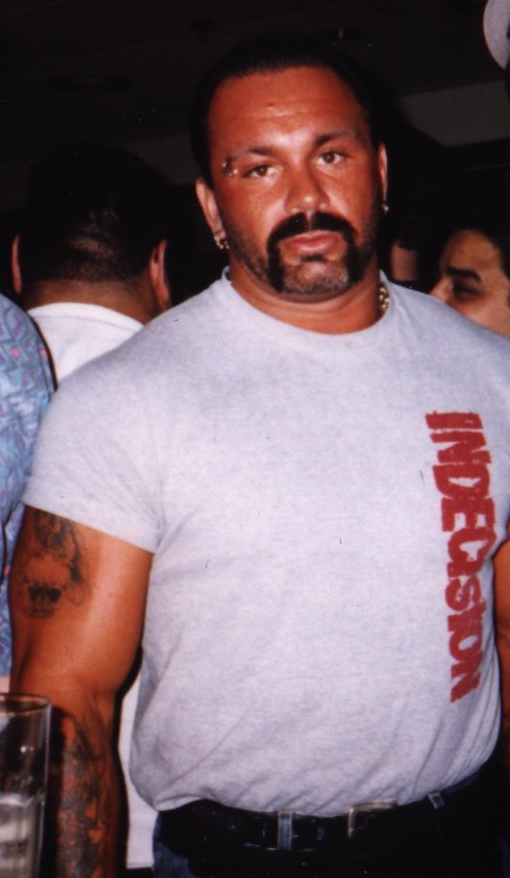
Perry Arthur Satullo (born October 25, 1966)[4] is an American retired professional wrestler known by his ring name, Perry Saturn. Since debuting in 1990, Saturn wrestled for promotions including Extreme Championship Wrestling (ECW), World Championship Wrestling (WCW), the World Wrestling Federation (WWF, now WWE) and Total Nonstop Action Wrestling (TNA). He is a former ECW World Tag Team Champion, WCW World Tag Team Champion, WCW World Television Champion, WWF European Champion and WWF Hardcore Champion.[3]
Key Information
Early life
[edit]Satullo enlisted in the United States Army for four years at the age of seventeen, before eventually embarking on a career in professional wrestling.[5] Satullo finished a bachelor's degree before he became a full-time wrestler.[6] Satullo is also a certified graduate of the U.S. Army Ranger School and has served in the United States Army Rangers.[7]
Professional wrestling career
[edit]Early career (1990–1995)
[edit]Satullo began training as a professional wrestler at Killer Kowalski's school in Malden, Massachusetts around 1988, taking the ring name Saturn from the Roman god of the same name before later tweaking it to Perry Saturn. He debuted on October 27, 1990, in Waltham, Massachusetts.[citation needed] Satullo also wrestled in Kowalski's International Wrestling Federation as "The Iron Horseman", a cowboy[1] complete with black leather stetson and chaps. Satullo eventually won the IWF Light Heavyweight Championship. Satullo began wrestling for independent promotions throughout New England, as well as touring Japan with New Japan Pro-Wrestling in 1993. In June 1992 he worked as enhancement talent as Peter Motts in WWF where he lost to Tatanka and The Legion Of Doom.[8]
While working as the manager of a nightclub in Boston, Satullo met bouncer George Caiazzo, who expressed an interest in becoming a wrestler. Satullo sent Caiazzo to Kowalski's school to train, and then offered to form a tag team with him.[1] The Greek equivalent of the god Saturn was Cronus, so Satullo chose the ring name "John Kronus" for Caiazzo. As Saturn and Cronus were their cultures' respective gods of the harvest, Satullo proposed that they be known as "The Harvesters of Sorrow". Promoter Jerry Lawler advised Satullo that the significance of the name would not be evident to many fans, so they became known as The Eliminators.
The Eliminators wrestled their first match together at a United States Wrestling Association (USWA) house show in 1993 in Tennessee. They were hired at a starting salary of $40 a week (they later successfully negotiated a 100% pay raise), and shared an apartment with four other wrestlers. The Eliminators won the World Tag Team Championship on May 2, 1994, from Satullo's mentor, Eddie Gilbert, and Brian Christopher. They held the titles until June 13 when they were defeated by PG-13. Satullo later traveled to Japan with Caiazzo to wrestle for Wrestle Association "R" from 1994 to 1995. On March 22, 1994, Saturn wrestled a dark match at a WWF Superstars taping in Lowell, MA.[9] On April 2, 1995, The Eliminators wrestled for WCW Saturday Night in Atlanta defeating Barry Houston and Kenny Kendall.[10] Then on August 17, 1995, The Eliminators wrestled in a house show for WWF in Manchester, New Hampshire defeating Smooth Operator and Tim McNeeany.[11]
Extreme Championship Wrestling (1995–1997)
[edit]
The compactly-built and heavily tattooed Satullo and the high-flying Caiazzo caught the attention of Paul Heyman's Extreme Championship Wrestling (ECW) when they were brought in to job to the Steiner Brothers (Rick and Scott), and the Eliminators were hired by ECW in 1995.[12] Heyman quickly abandoned plans to give them a sadism and masochism gimmick and instead booked them as an unstoppable force in the ECW tag division, giving them a manager, Jason. The Eliminators captured the ECW Tag Team Titles three times between 1996 and 1997, and feuded with teams such as The Gangstas and The Pitbulls. After The Pitbulls' manager Francine cut Saturn's hair, he shaved his head in a homage to Mickey Knox, the character depicted by Woody Harrelson in Natural Born Killers (in reality, Satullo was beginning to go bald).
Satullo was a trainer in the ECW House of Hardcore, a professional wrestling school[1] at which Taz and Mikey Whipwreck also taught. Saturn was respected for his focus and drive on fundamentals and technical wrestling.
On May 31, 1997, in Trenton, New Jersey, Satullo tore his ACL when he landed on a crutch while executing a kick on Big Dick Dudley. After intense reconstructive surgery, he was given a recovery time of up to a year. He began rehabilitating after two months and returned to action in August. Impatient with what he regarded as Caiazzo's lack of motivation and dedication, he refused to reform the Eliminators.[1] Paul Heyman offered to release him from his contract if he could find alternative employment, and Satullo entered into negotiations with World Championship Wrestling (WCW).
World Championship Wrestling (1997–2000)
[edit]Raven's Flock (1997–1998)
[edit]On August 28, 1997, Satullo was offered a job by WCW road agent Terry Taylor, who had been impressed by a bump that Satullo had taken in a scaffold match. He debuted in WCW on September 8, facing Billy Kidman, but was sidelined for a month afterward as his knee had not entirely healed. Later that year, he and Kidman joined The Flock, a heel stable of misfits and misanthropists led by the nihilistic Raven. Saturn's childhood was referenced, with Raven bringing up the violence Saturn incurred at the hands of his stepfather. The enforcer of The Flock, Saturn won gold on November 3, 1997, when he defeated Disco Inferno to win the World Television Championship. He held the title for a month before losing it back to Inferno in a rematch.
Beginning in 1998, Saturn began feuding with Glacier after Saturn's usage of the Super Kick offended Glacier, who deemed it a plagiarism of his Cryonic Kick finisher. Later in the year, Saturn was defeated by fellow Flock member Van Hammer in a "Loser Leaves The Flock" match. Raven threw Hammer out of the Flock instead. Problems arose between Raven and Saturn, and the latter eventually left The Flock, turning face by standing up to the domineering Raven. Raven held all the other Flock members in thrall, so Saturn challenged him to match for the September 13 Fall Brawl pay-per-view. If Saturn won, The Flock would be freed, but if Raven won, Saturn would become his slave.
In the meantime, on Nitro, Raven's lackey Lodi challenged him to a match, with the stipulation that Lodi would leave The Flock if Saturn won, and Saturn would become Lodi's servant until Fall Brawl if he lost. Saturn unexpectedly lost following copious interference from The Flock, and Lodi forced Saturn to carry his bags, made him hold up pro-Lodi signs at ringside, and ordered him to chant Lodi's name while Lodi wrestled. Lodi also used Saturn to defeat the enemies of The Flock.
Raven began questioning whether Saturn could "hurt those he wants to free so badly" and forced him to face Riggs. Saturn won cleanly, but refused Raven's order to break Riggs' fingers. When Saturn refused, Raven broke his fingers (Saturn would not break his agreement with Lodi because of a personal honor code, and Lodi ordered him to allow Raven to harm him). Raven repeatedly tried to goad Saturn into breaking his word, but was unable to do so. Finally, on September 13 at Fall Brawl, Saturn defeated Raven with help from Kidman, disbanding The Flock forever.[13]
The Revolution (1999–2000)
[edit]Saturn went on to feud with Eddie Guerrero and Ernest Miller before beginning a rivalry with Chris Jericho. After Jericho cost Saturn a number of matches with the help of crooked referee Scott Dickinson, he mocked Saturn's complaints and accused him of crying "like a schoolgirl." This led to Jericho challenging Saturn to a "loser wears a dress for ninety days" match at Souled Out on January 17, 1999, which he won after some suspect officiating from Dickinson. Taking on a bizarre, goth transvestite gimmick, Saturn began wearing a variety of dresses to the ring and using a variation of Marilyn Manson's "The Beautiful People" as his entrance music. He appeared to begin enjoying wearing dresses and even wore cosmetics to complement them. Saturn finally stopped wearing them after defeating Jericho in a dog collar match at Uncensored on March 14, 1999.[14][15]
Raven and Saturn reunited in March 1999, feuding with Dean Malenko and Chris Benoit, members of the Four Horsemen. At Slamboree the former Flock members defeated Benoit and Malenko and champions Rey Misterio, Jr. and Billy Kidman for the World Tag Team Championship. After Raven was injured, Saturn lost the titles to Bam Bam Bigelow and Diamond Dallas Page when Chris Kanyon, who substituted for Raven, betrayed him. He then teamed with Benoit in order to regain the titles. They were successful, but lost the titles several days later to Page and Kanyon. Benoit and Saturn continued to team together, and eventually formed a stable with Shane Douglas and Dean Malenko known as The Revolution. After Benoit left the Revolution to align himself with Bret Hart, the remainder of the stable began feuding with him. They then moved on to feuds with Jim Duggan and The Filthy Animals before disbanding.
Booker Kevin Sullivan opined that Saturn was incapable of getting over with fans, prompting the wrestler to negotiate with the World Wrestling Federation (WWF). In January 2000, Saturn, along with Benoit, Malenko and Eddie Guerrero, was granted a release from WCW and signed a three-year contract with the WWF.[12][15][16]
World Wrestling Federation/Entertainment (2000–2002)
[edit]The Radicalz (2000–2001)
[edit]Benoit, Guerrero, Saturn, and Malenko, dubbed The Radicalz, debuted in the WWF during the Attitude Era on January 31, 2000. They appeared in the front row of a live episode of Raw and brawled with the New Age Outlaws after The Road Dogg literally fell into their laps. Cactus Jack urged them to help him fight the heel McMahon-Helmsley Faction, but they quickly turned on Jack in order to gain employment from Triple H, who was then controlling the WWF. Benoit left the group on amicable terms when he became sidetracked by his feud with Chris Jericho, and the three remaining Radicalz began feuding with Too Cool and Chyna. After Guerrero left to be with Chyna, Saturn and Malenko teamed together for a while before disbanding.[12][17]
Saturn moved into the Hardcore division, pursuing then-champion Crash Holly. After Malenko tried to win the Hardcore Championship for himself, the former partners turned on one another. Guerrero was drawn into their feud, leading to a triple threat match at Judgment Day on May 21 with Guerrero's European Championship on the line. Guerrero was able to retain with the assistance of Chyna.
Saturn was later joined by Terri Runnels, who became his manager and onscreen girlfriend. After failing to proceed in the King of the Ring tournament, Saturn went after the European Championship once more, finally beating Guerrero at Fully Loaded on July 23. Terri's rivalry with The Kat led to a feud between Saturn and Al Snow, and on the August 31 episode of SmackDown! Snow defeated Saturn for the European Championship.[18]
The Radicalz reformed in late 2000, feuding with the revived D-Generation X (DX) and defeating them at Survivor Series on November 19. That same evening, the Radicalz attacked Stone Cold Steve Austin during his match with Triple H, briefly reforging their alliance with Triple H.
Dean Malenko began trying to win the affections of Lita, the valet of The Hardy Boyz. This led to a feud between the Radicalz and The Hardy Boyz, with The Radicalz defeating The Hardy Boyz at Armageddon on December 10. Saturn helped Guerrero defeat Test at WrestleMania X-Seven on April 1, 2001, but Guerrero later left the Radicalz once more, again reducing the faction to just Saturn and Malenko (Benoit had left in early 2001), with Terri still accompanying Saturn. The remaining Radicalz returned to the tag team division.
"Moppy" and departure (2001–2002)
[edit]After a match on the May 17 episode of Jakked, in which he legitimately attacked jobber Mike Bell, Saturn immediately underwent a significant gimmick change and, possibly as punishment for his actions, was involved in storylines about his becoming infatuated with a mop. After receiving head trauma in matches against The Acolytes Protection Agency (APA) and Raven, Saturn began acting eccentrically and speaking nonsensically, allegedly as the result of a concussion. Saturn began uttering the phrase "you're welcome" at inopportune intervals, and then fell in love with Moppy, an inanimate mop which he believed was alive, similar to Wilson the volleyball in the 2000 film Cast Away. This gimmick went over well with the fans, leading to a face turn. Terri Runnels told Saturn to choose between Moppy and her, and was infuriated when Saturn chose the mop. She left Saturn for Raven, who helped her enact vengeance on Saturn by stealing Moppy and feeding her into a woodchipper. Saturn in turn gained a measure of revenge when he defeated Raven at Unforgiven on September 23. After this, Saturn dropped the gimmick, but still remained a face, casually wrestling in tag matches at Sunday Night Heat.
In March 2002 the WWF initiated its brand extension in which Raw and SmackDown! had their own rosters of WWF wrestlers. During the draft, Saturn was SmackDown!'s 29th pick, the 58th pick overall and the final pick of the entire draft. Saturn's last WWF match was a tag team match with Hugh Morrus defeating Mr. Perfect and Shawn Stasiak on March 28 at a house show. Then just a month later Saturn reinjured his ACL, sidelining him for seven months, before being released by the company in November 2002.
Total Nonstop Action Wrestling (2003)
[edit]Saturn debuted in the Nashville, Tennessee-based promotion NWA-TNA on March 26, 2003, teaming with The Sandman and The Disciples of the New Church (Brian Lee and Slash) to defeat the Harris Brothers and Triple X (Christopher Daniels and Elix Skipper). Saturn and The Sandman formed a short-lived stable known as "Team Extreme" with fellow ECW alumni Justin Credible and New Jack.[19] On April 16, 2003, Saturn faced the debuting Mike Awesome, losing by disqualification after his stablemates interfered on his behalf. One week later, Saturn, New Jack and The Sandman defeated Awesome and The New Church in a hardcore match. Saturn wrestled his final match with NWA-TNA on June 18, 2003, defeating Kenzo Suzuki by disqualification.
International promotions (2002–2004)
[edit]Immediately after leaving the WWF, Saturn toured Europe with the World Wrestling All-Stars promotion in their European tour, mainly working against Sabu. Saturn worked for New Japan Pro-Wrestling, Hawaii and on the American independent circuit before retiring from professional wrestling due to injuries in 2004. His last amtch at that time was on December 4, 2004, teaming with TS Aggressor, defeating Brian Ash and Glen Octane for Impact Pro Wrestling in Delta, Iowa. He would be homeless for years due to drug addiction and his whereabouts were unknown.
Return to Wrestling (2011–2013)
[edit]Saturn returned to wrestling in 2011, wrestling his first match in over seven years on October 15, 2011, at the AWE Night of the Legends pay-per-view show from Fishersville, Virginia facing CW Anderson.[20] Saturn won the match. Saturn won his first championship in over a decade as he defeated Arik Cannon & Sir Bradley Charles in a Triple Threat match for the 3XW Pure Wrestling championship on April 27 in Des Moines, Iowa. In March 2013, Saturn wrestled at Jerry Lynn's retirement show for Heavy On Wrestling in Minneapolis, MN. He competed in the opening six-man tag match, where his team came out victorious.[21] Saturn entered the Extreme Rising World Championship tournament which was eventually won by Stevie Richards, he was defeated in the first round by Luke Hawx.[22]
Other appearances
[edit]In October 2021, Saturn appeared at Awesome Wrestling Entertainment's Night of the Legends in Fishersville, Virginia.[23]
Personal life
[edit]Satullo claims to have been involved in an April 2004 altercation with two men when he came to the aid of a woman they were in the process of raping behind a strip club.[24] He reportedly fought the men and was shot with a .25 caliber handgun in the back of the neck and in the right shoulder, to which he originally thought he had received a punch, as a result of the scuffle.[25] After being shot, Satullo became addicted to methamphetamine and was homeless for two and a half years.[26][27] Satullo disappeared from public view and was not seen for several years, with his family and friends unaware of his whereabouts.[7] Satullo re-emerged in 2010, having resolved his addiction.[27]
Satullo married Lisa Marie Kuhlemeier in June 2009. He had been married on three prior occasions. He has a teenage grandson that he looks after, in addition to an adult son and daughter.[24]
During an interview with Bill Apter in September 2016, Satullo revealed that he was dealing with a "traumatic brain injury" that limited his abilities.[25][28] In November 2016, The Boston Globe reported that Satullo had joined a class action lawsuit against WWE, litigated by Konstantine Kyros, who has been involved in a number of other lawsuits against them, alleging that "he is suffering from multiple symptoms of repetitive traumatic brain injuries and is undergoing neurological care."[29] US District judge Vanessa Lynne Bryant dismissed the lawsuit in late 2018.[30]
Championships and accomplishments
[edit]- 3XWrestling
- 3XW Pure Wrestling Championship (1 time)[31]
- Extreme Championship Wrestling
- Impact Pro Wrestling
- IPW Tag Team Championship (1 time) - with James Jeffries
- International Wrestling Federation
- IWF Light Heavyweight Championship (2 times)[33]
- IWF North American Championship (1 time)[33]
- IWF Tag Team Championship (1 time) - with Terra Ryzing
- New England Pro Wrestling Hall of Fame
- Class of 2018
- Pro Wrestling Illustrated
- United States Wrestling Association
- USWA World Tag Team Championship (1 time)[36] – with John Kronus[37]
- World Championship Wrestling
- WCW World Tag Team Championship (2 times) – with Raven (1) and Chris Benoit (1)[38]
- WCW World Television Championship (1 time)
- World Wrestling Federation
- Universal Championship Wrestling
- Universal Heavyweight Championship (1 time)
See also
[edit]References
[edit]- ^ a b c d e f Loverro, Thom (2006). The Rise and Fall of ECW. Pocket Books. pp. 107–108. ISBN 978-1-4165-1058-1.
- ^ a b Picarello, Robert (2002). Monsters of the Mat. The Berkley Publishing Group. p. 118. ISBN 042518594X.
- ^ a b c d "Perry Saturn". WWE.com. WWE. Retrieved January 2, 2015.
- ^ a b "Perry Saturn profile". Online World of Wrestling. Archived from the original on July 27, 2012. Retrieved August 5, 2008.
- ^ Cagematch Profile: Perry Saturn
- ^ Archived at Ghostarchive and the Wayback Machine: "Perry Saturn shoot pt 2 talking training guys wit taz n more. No-Kayfaben.com". YouTube.
- ^ a b "When Former WWE Superstar Saved a Woman Despite Being Shot in the Neck and the Aftermath That Followed". EssentiallySports. August 16, 2021. Retrieved March 12, 2022.
- ^ "1992". thehistoryofwwe.com. January 16, 2023.
- ^ "1994". thehistoryofwwe.com. January 16, 2023.
- ^ "1995". Thehistoryofwwe.com. Retrieved December 31, 2016.
- ^ "1995". thehistoryofwwe.com. January 16, 2023.
- ^ a b c Himble, D. (December 2000). "On Another Planet - wrestler Perry Saturn". Wrestling Digest. Archived from the original on October 22, 2007. Retrieved July 25, 2007.
- ^ Powell, J. (September 14, 1998). "Fall Brawl tanks hard". Canadian Online Explorer. Archived from the original on July 13, 2012. Retrieved July 25, 2007.
- ^ Powell, J. (February 22, 1998). "David Flair turns at SuperBrawl". Canadian Online Explorer. Archived from the original on July 24, 2012. Retrieved July 25, 2007.
- ^ a b Walsh, J. (May 18, 2003). "Perry Saturn Speaks On Moppy, 'The Dress', WCW Politics, WWE, more". ProWrestling.com. Archived from the original on September 28, 2007. Retrieved July 25, 2007.
- ^ Powell, J. (January 25, 2000). "Benoit, Saturn, WWF-bound?". Canadian Online Explorer. Archived from the original on January 15, 2013. Retrieved July 25, 2007.
- ^ De La Garza, E. (March 29, 2000). "Wrestlemania 2000 draws near; SGA president falls". The Daily Cougar. Archived from the original on July 4, 2007. Retrieved July 26, 2007.
- ^ "History of the European Championship". WWE. Archived from the original on July 14, 2007. Retrieved July 25, 2007.
- ^ "Team Extreme « Stables Database « CAGEMATCH - the Internet Wrestling Database".
- ^ "Former WWE superstar to wrestle for the first time since 2002". gerweck.net. Archived from the original on April 17, 2015. Retrieved September 16, 2011.
- ^ "VIP - 03/24 Wade Keller Hotline - The News: Weekend round-up including first-person report on Jerry Lynn retirement show - Sabu, Waltman, Dreamer, Snow, plus potential Henry injury (30 min.)". PWTorch.com. March 24, 2013. Retrieved September 4, 2022.
- ^ "Extreme Rising World Title Tournament « Tournaments Database « CAGEMATCH - The Internet Wrestling Database". Archived from the original on April 7, 2014.
- ^ "perry saturn Archives". Austin Daily Herald. September 16, 2021. Retrieved March 12, 2022.
- ^ a b https://www.youtube.com/BqXcU8VKB5c?si=I6c0AQaU-4FlV-gI[permanent dead link]
- ^ a b Dunning, Kyle (May 7, 2017). "Where Are They Now? Remembering Perry Saturn. - eWrestlingNews.com". eWrestlingNews.com. Retrieved February 4, 2018.
- ^ 1Wrestling.com "Back From Drugs and Homelessness Perry Saturn surfaces"
- ^ a b Maffei, Chris (June 5, 2013). "Interview - Perry Saturn on Drug Addiction, Benoit and more". FightNetwork.com. Anthem Media Group. Archived from the original on January 19, 2015. Retrieved January 3, 2014.
- ^ Apter, Bill (September 17, 2016). FINDING PERRY SATURN -- AGAIN (Videotape). United States: 1WrestlingVideo. Retrieved February 4, 2018.
- ^ Hohler, Bob (November 12, 2016). "Former WWE diva joins lawsuit, alleges sexual abuse, brain injuries". The Boston Globe. Retrieved November 12, 2016.
- ^ Johnson, Mike (October 3, 2018). "Concussion-related lawsuit against WWE and Vince McMahon officially closed". PWInsider. Retrieved May 5, 2020.
- ^ "3XW Pure Wrestling Championship « Titles Database « CAGEMATCH - The Internet Wrestling Database". www.cagematch.net. Retrieved February 17, 2019.
- ^ "ECW World Tag Team Title history". Wrestling-titles.com. Retrieved March 5, 2009.
- ^ a b Royal Duncan & Gary Will (2000). Wrestling Title Histories (4th ed.). Archeus Communications. ISBN 0-9698161-5-4.
- ^ Pro Wrestling Illustrated (PWI) 500 for 1999
- ^ a b "PWI 500 of the PWI Years". Archived from the original on December 5, 2012. Retrieved January 16, 2019.
- ^ "NWA/WCW World Television Title". Wrestling-titles.com. Retrieved July 2, 2007.
- ^ USWA World Tag Team Title (Tennessee)
- ^ "WCW World Tag Team Title history". Wrestling-titles.com. Retrieved March 5, 2009.
- ^ WWE European Title History
- ^ Official WWE Hardcore Championship history
External links
[edit]- Perry Saturn on Twitter
- Perry Satullo at IMDb
- Perry Saturn's profile at WWE , Cagematch , Wrestlingdata , Internet Wrestling Database
Perry Saturn
View on GrokipediaEarly years
Childhood and education
Perry Arthur Satullo, better known by his ring name Perry Saturn, was born on October 25, 1966, in Lakewood, Ohio.[1] During his childhood, Satullo watched professional wrestling matches on television, which sparked his lifelong interest in the sport.[7] He grew up in a challenging urban environment that instilled a sense of resilience, leading him to seek structure through military service as a teenager.[8]Military service and training
Satullo enlisted in the United States Army at the age of 17, motivated by his athletic background from high school, and served for four years as a member of the 101st Airborne Division, where he qualified as an Airborne Ranger stationed at Fort Campbell, Kentucky.[9] During his tenure, Satullo completed the demanding U.S. Army Ranger School, earning certification through grueling phases that emphasized airborne operations, including parachuting from aircraft, small-unit tactics, and survival skills in combat environments.[2] This elite training honed his physical and mental resilience, preparing him for high-stakes scenarios typical of Ranger operations. He received an honorable discharge after fulfilling his commitment. Following his military service, Satullo transitioned to professional wrestling by enrolling in Killer Kowalski's renowned training facility in Malden, Massachusetts, in 1989. There, under Kowalski's guidance, he developed foundational wrestling techniques and adopted the ring name "Saturn."[10]Professional wrestling career
Early independent career (1990–1995)
Satullo began training as a professional wrestler at Killer Kowalski's school in Malden, Massachusetts, in the late 1980s, after relocating from his native Cleveland, Ohio, to the Northeast following his discharge from the U.S. Army.[10] Influenced by Kowalski's emphasis on technical proficiency, he adopted a disciplined, mat-based wrestling style that prioritized holds, submissions, and precise execution over flashy maneuvers.[1] His military background as an Army Ranger instilled an intense, no-nonsense approach to matches, which became a hallmark of his early performances.[5] Adopting the ring name Perry Saturn—derived from the Roman god and his surname Satullo—he made his professional debut on October 27, 1990, in Waltham, Massachusetts, for the United States Wrestling Association (USWA).[11] In his initial outings, Saturn competed under a cowboy-inspired gimmick known as "The Iron Horseman," portraying a rugged, hard-edged competitor in regional territories.[12] He quickly gained experience through singles bouts in the USWA, facing opponents in Memphis-based events that tested his endurance and adaptability in southern-style wrestling environments.[3] Throughout 1991 and into 1992, Saturn expanded his schedule across New England independent promotions, including Kowalski's own International Wrestling Federation (IWF), where he honed his skills in smaller venues.[10] These appearances allowed him to experiment with tag team dynamics, partnering in short-term alliances to build chemistry and showcase his versatility beyond solo competition.[3] By 1993, he had earned a reputation for delivering high-impact strikes and suplexes, drawing crowds with his aggressive offense while maintaining Kowalski's technical foundation.[1] Saturn's consistent work in these circuits, including tours to Japan with New Japan Pro-Wrestling, solidified his groundwork before transitioning to larger platforms.[5]Extreme Championship Wrestling (1995–1997)
In 1995, Perry Saturn partnered with John Kronus to form The Eliminators tag team upon signing with Extreme Championship Wrestling, continuing their established collaboration from the United States Wrestling Association where they had previously captured the USWA World Tag Team Championship.[5][3] The duo adapted their high-flying offense to ECW's hardcore environment, incorporating innovative double-team maneuvers like the Total Elimination while engaging in brutal brawls that defined the promotion's tag division.[2] The Eliminators rapidly ascended as top contenders, capturing the ECW World Tag Team Championship for the first time on March 17, 1996, by defeating The Gangstas (New Jack and Mustafa Saed) in a three-way dance also involving The Samoan Gangsta Party at the ECW Arena.[3] Their feud with The Gangstas escalated into chaotic street fights and non-sanctioned brawls, highlighted by a violent confrontation on April 1, 1996, episode of ECW Hardcore TV that spilled throughout the arena and exemplified ECW's no-holds-barred intensity.[13] Similarly, they clashed repeatedly with The Pitbulls (#1 and #2) from late 1995 through early 1997, trading victories in power-based wars that culminated in a dog collar match on November 18, 1995, at November to Remember, where the Pitbulls targeted Kronus and Saturn with relentless aggression.[14][15] The team's defenses often featured extreme stipulations, including ladder matches against Sabu and Rob Van Dam, whom they defeated on February 1, 1997, at Crossing the Line Again to retain the titles amid tables, chairs, and high-risk spots that showcased their aerial prowess.[16] The Eliminators secured their third and final ECW World Tag Team Championship reign at ECW's inaugural pay-per-view, Barely Legal on April 13, 1997, overcoming The Dudley Boyz (Buh Buh Ray and D-Von) in the main event through a decisive Total Elimination on Buh Buh Ray, solidifying their status as one of ECW's premier acts despite the Dudleys' interference attempts.[17] Over their ECW tenure, they held the tag titles three times between 1996 and 1997, feuding with multiple top teams in matches that blended athleticism and violence.[2] Saturn's time in ECW ended in late 1997 amid growing frustrations, including impatience with Kronus's recovery from injuries and perceived stagnation in the team's momentum, leading him to seek opportunities elsewhere while ECW grappled with financial instability under promoter Paul Heyman.[15] Heyman, facing payment issues, reportedly released Saturn from his contract to allow him to pursue other bookings, marking the dissolution of The Eliminators.[18]World Championship Wrestling (1997–2000)
Saturn signed with World Championship Wrestling in the summer of 1997, drawn by interest in his successful tag team run as one half of the Eliminators in Extreme Championship Wrestling.[3] He debuted in a dark match on the September 8, 1997, episode of WCW Monday Nitro, defeating Billy Kidman.[3] On November 3, 1997, Saturn made his televised in-ring debut, defeating Disco Inferno to capture the WCW World Television Championship and solidify his position as the primary enforcer in Raven's Flock stable.[19] The Flock, led by Raven, included members such as Billy Kidman, Scotty Riggs, and Lodi, and Saturn's hard-hitting style complemented the group's cult-like, anti-establishment dynamic.[20] As a key member of Raven's Flock, Saturn participated in several high-profile feuds, including rivalries with the Harlem Heat tag team, where he and stablemates engaged in intense brawls that highlighted his technical prowess and aggression.[21] The group often clashed with established WCW acts, positioning Saturn as a reliable mid-card performer who defended the faction's interests through punishing matches.[22] Tensions within the Flock escalated in 1998, leading to internal conflicts; Saturn turned on Raven during a triple threat match at Road Wild, allying with Kidman to disband the group by pinning Raven.[23] Following the split, Saturn briefly reunited with Raven in early 1999 for a tag team run, feuding with former Four Horsemen members Dean Malenko and Chris Benoit, but this partnership dissolved amid WCW's shifting storylines.[24] In mid-1999, Saturn transitioned to The Revolution stable, formed on the July 29 episode of WCW Thunder as a protest against WCW's biased booking practices that favored established stars and the New World Order over underutilized talent.[25] The group initially comprised Saturn, Malenko, Benoit, and later Shane Douglas as its outspoken leader, with Asya serving as a female enforcer; their manifesto railed against the promotion's favoritism toward larger-than-life personalities at the expense of skilled wrestlers.[26] The Revolution positioned itself as revolutionaries fighting for fairness, engaging in ambushes and promos that critiqued WCW's creative direction during a period of declining popularity.[18] Saturn's individual pushes within The Revolution included notable challenges for the WCW World Television Championship, such as his February 1998 match against Booker T at SuperBrawl VIII, where he aimed to reclaim the title he had won earlier in his career.[27] The stable's teamwork shone at events like Starrcade 1999, where The Revolution—consisting of Douglas, Malenko, Saturn, and Asya—defeated Jim Duggan and The Varsity Club (Kevin Sullivan, Mike Rotunda, and Rick Steiner) in an eight-person elimination match, underscoring their unity against WCW's old guard. Additional clashes, such as Revolution's victory over The Filthy Animals at Mayhem 1999, reinforced their role as agitators in WCW's crowded mid-card landscape.[3] Amid WCW's ongoing roster instability and falling Nitro ratings in early 2000, Saturn joined Malenko, Benoit, and Eddie Guerrero in requesting their releases on January 16, 2000, marking the end of his WCW tenure after over two years of consistent mid-card contributions.[24] This departure was part of broader cuts as WCW struggled with creative and financial woes, though Saturn had remained a versatile performer in factions and solo bouts until then.[5]World Wrestling Federation (2000–2002)
Perry Saturn joined the World Wrestling Federation (WWF) as part of The Radicalz stable, alongside Chris Benoit, Eddie Guerrero, and Dean Malenko, debuting on the January 31, 2000, episode of Raw Is War.[26] The group, which had formed amid dissatisfaction in World Championship Wrestling (WCW), invaded the WWF to establish themselves as serious threats, immediately attacking the New Age Outlaws and aligning against D-Generation X.[28] This debut marked the beginning of Saturn's mid-card push in the WWF, where he quickly became involved in tag team and singles competition as part of the stable's efforts to secure contracts through a series of high-stakes matches.[26] Throughout 2000, Saturn engaged in several notable mid-card feuds, including rivalries with Test and Al Snow, while also competing in the chaotic Hardcore division.[3] He captured the WWF Hardcore Championship from Crash Holly on April 11, 2000, in a 24/7 rule match, highlighting his adaptability to the division's unpredictable style, though he lost the title shortly after to figures like Steve Blackman and Tazz.[3] Saturn's feud with Al Snow escalated due to tensions involving manager Terri Runnels, culminating in a WWF European Championship match on the August 31, 2000, episode of SmackDown!, where Snow defeated him to claim the title.[29] These encounters positioned Saturn as a reliable performer in the undercard, often teaming with Radicalz members against groups like the Hardy Boyz or Right to Censor, but the stable gradually disbanded as individual storylines took precedence.[3] In 2001, Saturn's career took a controversial turn following a May 12 taping of WWF Metal, where he severely stiffed enhancement talent Mike Bell during a match, leading to a botched sequence and backstage repercussions.[30] As a result, creative punished him with a comedic "concussion" gimmick, portraying Saturn as mentally addled and obsessed with an inanimate mop named Moppy, whom he treated as a romantic partner in absurd segments.[30] The angle, which included vignettes of Saturn defending Moppy and uttering phrases like "you're welcome" inappropriately, drew significant fan backlash for undermining his tough-guy persona and shifting him to jobber status in comedic booking.[31] The storyline peaked with Moppy's destruction in a woodchipper by Raven at the 2001 Unforgiven event, after which Saturn feuded briefly with Raven but failed to regain momentum.[31] The Moppy angle's failure contributed to Saturn's diminished role, and after suffering a knee injury, he was released by the WWF on November 1, 2002.[32] Despite his athletic contributions to the Hardcore and European title scenes, the gimmick change alienated audiences and stalled any potential main-event push during his two-year tenure.[2]Total Nonstop Action and international promotions (2002–2004)
Following his release from World Wrestling Entertainment in November 2002, Perry Saturn transitioned to freelance wrestling opportunities in international promotions.[26] In late 2002, Saturn joined the World Wrestling All-Stars (WWA) for their European tour, competing in several high-profile matches across the United Kingdom. On December 1, he participated in an event in Newcastle, England, as part of the tour's lineup. Five days later, on December 6 at Wembley Arena in London, Saturn lost a triple threat match to Sabu, with Simon Diamond also involved, in a hardcore stipulation bout. These appearances highlighted Saturn's continued emphasis on intense, technical tag and multi-man contests abroad.[33][3] Early the following year, Saturn embarked on a tour with New Japan Pro-Wrestling (NJPW) in Japan, where he engaged in tag team matches against prominent local talent. On February 16, 2003, at an NJPW event, Saturn teamed with Josh Barnett but was defeated by Yuji Nagata and Blue Wolf via pinfall after 13 minutes. Later that month, on March 2, Saturn and Yoshihiro Takayama reversed the outcome, defeating Nagata and Blue Wolf in a 13:48 tag match during the Fighting Spirit series. These bouts showcased Saturn's adaptability to NJPW's strong-style wrestling, often focusing on collaborative tag strategies rather than singles competition.[34][33] Saturn made his debut with Total Nonstop Action Wrestling (TNA) on March 26, 2003, at a weekly pay-per-view event in Nashville, Tennessee, where he teamed with The Sandman, Brian Lee, and Slash to defeat Christopher Daniels, Elix Skipper, Low Ki, and Jerry Lynn in an eight-man tag match. On April 30, during TNA's weekly PPV #43, Saturn partnered with Justin Credible in a four corners tag team match, emerging victorious over America's Most Wanted (Chris Harris and James Storm), The Sandman and Sonny Siaki, and Triple X (Christopher Daniels and Skip Skipper). His TNA run concluded on June 18, 2003, with a singles victory over Kenzo Suzuki by disqualification in his final appearance for the promotion. These limited TNA outings primarily involved tag team formats, aligning with Saturn's experience in multi-man scenarios.[35][36] Throughout 2003 and into 2004, Saturn continued sporadic work on independent circuits, including tag-focused matches in U.S.-based promotions like USA Pro Wrestling, where he challenged for the heavyweight title on April 4, 2003, but lost to champion Balls Mahoney. His international schedule, however, tapered off, with fewer bookings in Europe and no verified Australian appearances during this period. By early 2004, Saturn's wrestling commitments gradually diminished amid emerging personal challenges, leading to his retirement from full-time competition in April.[3][37]Sporadic appearances and returns (2011–present)
After a lengthy hiatus from full-time wrestling following his international tours in 2004, Perry Saturn made a sporadic return to the independent scene in 2011, marking his first in-ring appearance in over seven years on October 15 at Awesome Wrestling Entertainment's Night of the Legends event, where he defeated C.W. Anderson by pinfall.[38] This comeback extended to other regional promotions, including a series of matches for 3XWrestling in Iowa, where he captured the 3XW Pure Wrestling Championship on April 27, 2012, in a triple threat match by defeating Arik Cannon and Sir Bradley Charles, holding the title until losing it later that year.[39] These limited outings emphasized Saturn's enduring technical prowess and high-impact style, though they remained infrequent amid his post-wrestling commitments. In 2013, Saturn continued his occasional forays into independents with bouts in promotions like Impact Pro Wrestling and Heavy On Wrestling, including participation in a six-man tag team match on March 23 at Jerry Lynn's retirement show for Heavy On Wrestling in Minneapolis, Minnesota, where he, Luke Hawx, and Scott Summers defeated Ariya Daivari, John Johnson, and Aaron Corbin. He also faced The Big Picture in Impact Pro Wrestling in 2013, losing the match.[33] While no formal tag team reunion occurred due to the passing of his longtime partner John Kronus in 2007, Saturn's appearances often evoked tributes to their Eliminators legacy through fan interactions and match tributes to ECW-era hardcore wrestling.[38] These events highlighted his role as a bridge between past and present indie talent, with Saturn competing in multi-man tags and singles matches that drew on his veteran status without demanding a rigorous schedule. Shifting focus beyond the ring, Saturn engaged with WWE in a guest coaching capacity at the WWE Performance Center in early 2024, where he shared insights on amateur wrestling techniques and in-ring psychology with developmental talent.[40] In a subsequent interview, he expressed positive sentiments about his ongoing relationship with the company, noting mutual respect despite his departure in 2002 and appreciating opportunities to mentor the next generation.[40] This non-competitive involvement underscored Saturn's transition to a behind-the-scenes contributor, leveraging his extensive experience from ECW, WCW, and WWE. In 2025, Saturn is scheduled to make a nostalgic return to public appearances alongside former WCW Flock stablemate Lodi (Brad Cain) at WrestleCade Weekend, a fan convention set for November 28–30 in Winston-Salem, North Carolina.[41] The event will feature a special photo opportunity recreating The Flock lineup—unavailable for over two decades—along with panel discussions where the duo will reminisce about their 1997–1999 WCW run, emphasizing camaraderie and behind-the-scenes stories.[42] Earlier that year, on July 2, Lodi shared details of an impromptu gym reunion with Saturn, crediting him for early career guidance in WCW, further illustrating their enduring bond. These low-key engagements reflect Saturn's selective involvement in wrestling culture, prioritizing fan engagement over active competition as of late 2025.Personal life
Family and relationships
Saturn was married in the early 1990s to an unnamed woman, with the marriage ending in divorce by 2000, reportedly strained by the demands of his career travels.[43] Saturn has no children, but maintains close ties to his siblings and extended family in Ohio.[3] Saturn achieved sobriety around 2009 and married Lisa Marie Kuhlemeier in June of that year; she has provided support during his ongoing recovery.[44][45]Health challenges and post-wrestling endeavors
In April 2004, in Atlanta, Georgia, Perry Saturn intervened to save a woman from sexual assault by two attackers, during which he was shot twice in the neck and shoulder by one of them.[5] The neck wound caused a traumatic brain injury (TBI) by damaging his cervical vertebrae, requiring surgery to insert a steel plate and three screws; bullet fragments were not removed immediately due to risks near the spinal cord.[6] The shooting led to severe long-term health challenges, including chronic depression, significant memory loss, speech impediments, and the need for multiple surgeries to address complications from the injuries.[46] Saturn's TBI resulted in cognitive impairments that limited his ability to work consistently, exacerbating his struggles with mental health and daily functioning.[47] Following the incident, Saturn struggled with addiction and homelessness for several years before achieving sobriety around 2009. After leaving that job, he relied on odd jobs and welfare support to make ends meet, while dealing with periods of homelessness and substance abuse tied to his trauma. He has since worked in security and warehouse jobs.[5][6] From 2010 onward, Saturn has advocated for traumatic brain injury awareness through interviews and public discussions, sharing his experiences to highlight resilience and the need for support in recovery. As of 2024, he has discussed his involvement in the WWE concussion lawsuit and continues this advocacy.[46][4] He has also provided occasional wrestling instruction to younger talents, focusing on technique while managing his health limitations.[48] Family support has played a key role in aiding his ongoing recovery and stability.[46]Championships and accomplishments
Extreme Championship Wrestling
Perry Saturn joined Extreme Championship Wrestling (ECW) in 1995, where he formed the tag team The Eliminators with John Kronus, quickly establishing themselves as a dominant force in the promotion's hardcore tag division through their high-impact style and innovative offense. As The Eliminators, Saturn and Kronus captured the ECW World Tag Team Championship on three occasions, showcasing their prowess in intense matches that highlighted ECW's emphasis on extreme wrestling. Their first reign began on February 3, 1996, when they defeated Cactus Jack and Mikey Whipwreck at the Big Apple Blizzard Blast event in New York City, holding the titles for 182 days until losing them to The Gangstas (New Jack and Mustafa Saed) on August 3, 1996. During this period, they made key defenses, including a successful retention in a multi-team match against The Gangstas, The Bruise Brothers, and The Samoan Gangstas on Hardcore TV in August 1996, solidifying their status as champions in ECW's chaotic environment. The duo regained the titles for their second reign on December 20, 1996, defeating The Gangstas on an episode of ECW Hardcore TV, maintaining the championship for 85 days before dropping it to The Dudley Boyz on March 15, 1997. This run featured notable defenses against teams like Sabu and Rob Van Dam, as well as a three-way elimination match retention on March 1, 1997, emphasizing their resilience amid ECW's inter-promotional rivalries. Shortly after, The Eliminators won the belts for a third and final time on April 13, 1997, at the Barely Legal pay-per-view event by overcoming The Dudley Boyz in the main event, holding the titles for 68 days until vacating them due to Kronus suffering a knee injury on June 20, 1997. These reigns contributed significantly to The Eliminators' legacy, with their hardcore matches and aerial maneuvers influencing ECW's tag team landscape.[49][50][51][52][53]World Championship Wrestling
Saturn debuted in World Championship Wrestling (WCW) on November 3, 1997, episode of Monday Nitro, aligning himself with Raven's Flock stable and immediately capturing the WCW World Television Championship by defeating Disco Inferno in his in-ring debut. He held the title for 35 days, successfully defending it against opponents such as Scotty Riggs on November 17, 1997, Nitro, before dropping it back to Disco Inferno on the December 8, 1997, episode of Nitro. During this reign, Saturn established himself as a key enforcer for The Flock, using his technical prowess and high-impact moves like the Saturnault to solidify his mid-card presence.[54][3] In 1999, Saturn achieved greater success in the tag team division, first partnering with former rival Raven to win the WCW World Tag Team Championship on May 9 at Slamboree in a triangle match also involving Chris Benoit and Dean Malenko, defeating the reigning champions Billy Kidman and Rey Mysterio Jr. The duo held the titles for 22 days, defending them once against Horace Hogan and Vincent on the May 20, 1999, Thunder, before losing to The Jersey Triad (Diamond Dallas Page and Bam Bam Bigelow, with Chris Kanyon substituting) on the May 31 Nitro.[55][56] Shortly thereafter, Saturn teamed with Benoit as part of the newly formed Revolution stable, winning the WCW World Tag Team Championship on June 7, 1999, Monday Nitro by defeating Page and Bigelow. This second reign lasted only six days, ending in a loss to Page and Kanyon at The Great American Bash on June 13, 1999. As a member of The Revolution, Saturn contributed to the stable's pursuit of mid-card and upper-mid-card titles, including challenging for the WCW United States Heavyweight Championship and supporting Benoit's brief WCW World Heavyweight Championship win in January 2000. These accomplishments highlighted Saturn's versatility in WCW, where he transitioned from singles competitor to a reliable tag team specialist amid the promotion's turbulent booking.[26][3]Other achievements
In 2001, Pro Wrestling Illustrated ranked Perry Saturn number 66 in their annual PWI 500, a listing of the top 500 singles wrestlers based on performance throughout the year.[57] World Wrestling Federation- WWF European Championship (1 time)
- WWF Hardcore Championship (2 times)
