



Community hub
Recent from talks
Knowledge base stats:
Talk channels stats:
Members stats:
PPSh-41
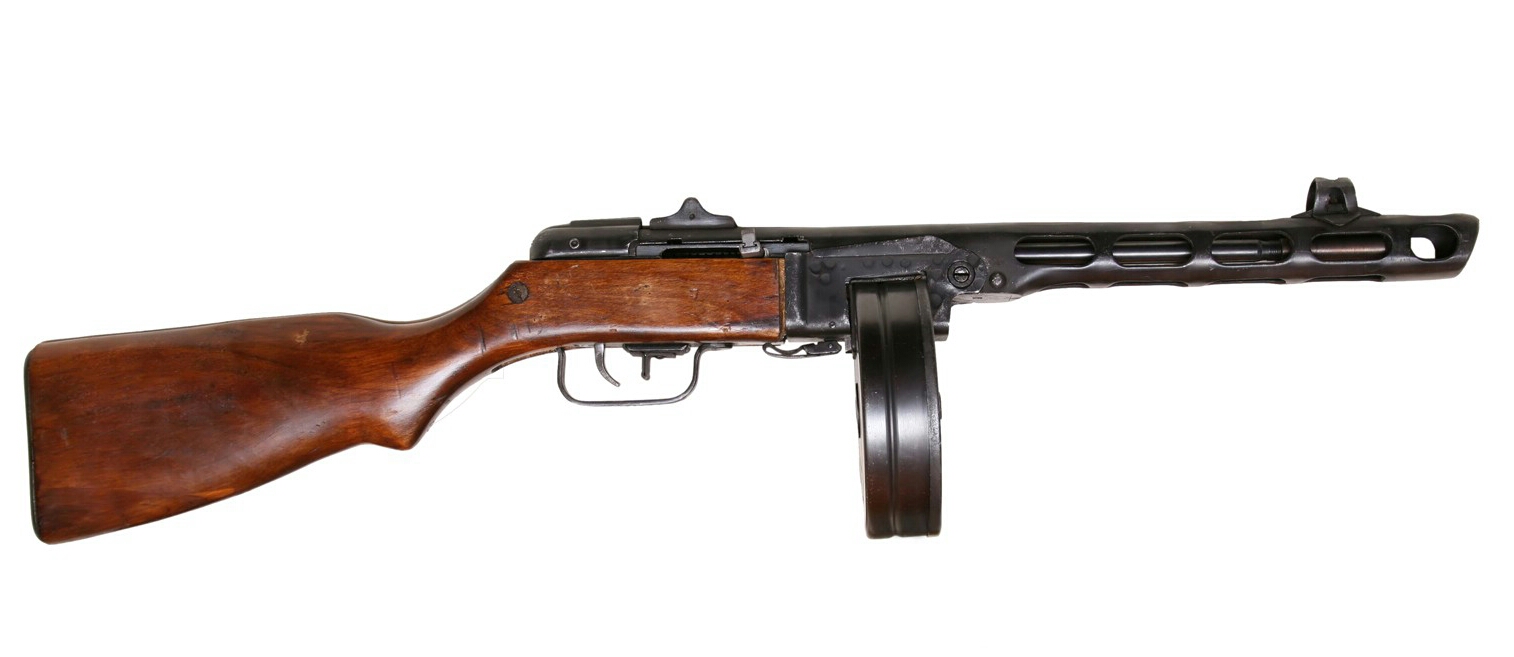
The PPSh-41 (Russian: Пистоле́т-пулемёт Шпа́гина-41, romanized: Pistolét-pulemyót Shpágina-41, lit. 'Shpagin's machine-pistol-41') is a selective-fire, open-bolt, blowback submachine gun that fires the 7.62×25mm Tokarev round. It was designed by Georgy Shpagin of the Soviet Union to be a cheaper and simplified alternative to the PPD-40.
The PPSh-41 saw extensive combat during World War II and the Korean War. It became one of the major infantry weapons of the Red Army during World War II, with about six million PPSh-41s manufactured during the period.
The firearm is made largely of stamped steel, and can be loaded with either a box or drum magazine.
The impetus for the development of the PPSh came from the Winter War (November 1939 to March 1940) between the Soviet Union and Finland, when the Finnish Army employed the Suomi KP/-31 submachine gun as a highly effective tool for close-quarter fighting in forests and built-up urban areas. The Red Army's older PPD-34 had been in mass production since 1934, but it was expensive to manufacture, both in terms of material and labor, as it used numerous milled metal parts (particularly for its receiver). The firearm-designer Georgy Shpagin wanted to reduce costs by using metal stamping for the production of the parts. In September 1940 Shpagin developed a prototype PPSh which also featured a simple gas-compensator designed to prevent the muzzle from rising during bursts; this improved shot grouping by about 70% relative to the PPD.
The new weapon was produced in a network of factories in Moscow, with high-level local Party members made directly responsible for meeting production-targets. A few hundred weapons were produced in November 1941 and another 155,000 were made during the next five months. By spring 1942, the PPSh factories were producing roughly 3,069 units a day. Soviet production figures for 1942 indicate an output of almost 1.5 million units.The PPSh-41 uses 87 components (compared to 95 for the PPD-40), and the PPSh could be manufactured with an estimated 5.6 machining hours (later revised to 7.3 hours) compared with 13.7 hours for the PPD. Barrel production was often simplified by using barrels for the 7.62mm Mosin–Nagant: the rifle barrel was cut in half and two PPSh barrels were made from it after machining the chamber for the 7.62×25mm Tokarev cartridge.
After the German Army captured large numbers of the PPSh-41 in the course of the German-Soviet War of 1941-1945, Berlin instituted a program to convert the trophy weapons to use the standard German submachine-gun cartridge – the 9×19mm Parabellum. The Wehrmacht officially adopted the converted PPSh-41 as the "MP 41(r)" (as distinct from the Schmeisser MP41, which combined the MP 40 upper receiver with the MP 28's lower receiver that was issued to Waffen-SS personnel); unconverted PPSh-41s were designated "MP 717(r)" and supplied with 7.63×25mm Mauser ammunition. German-language manuals for the use of captured PPShs were printed and distributed in the Wehrmacht. In addition to barrel replacement, converted PPSh-41s also had a magazine adapter installed, allowing them to use MP 40 magazines. The less powerful 9mm round generally reduces the cyclic rate of fire from 800 to 750 RPM. (Modern aftermarket conversion-kits based on the original Wehrmacht one also exist, using a variety of magazines, including Sten magazines.)
As standard, each PPSh-41 came with two factory-fitted drum magazines, matched to the weapon with marked serial-numbers. If drum magazines were mixed and used with different serial-numbered PPSh-41, a loose fitting could result in poor retention and failure to feed. Drum magazines were superseded by a simpler PPS-42 box-type magazine holding 35 rounds, although an improved drum magazine made from 1 mm thick steel was also introduced in 1944.
In 1943 the Red Army introduced the PPS-43, which was even more basic in its design than the PPSh-41 and had a more moderate rate of fire, but it did not replace the PPSh-41 during the war.
Hub AI
PPSh-41 AI simulator
(@PPSh-41_simulator)
PPSh-41
The PPSh-41 (Russian: Пистоле́т-пулемёт Шпа́гина-41, romanized: Pistolét-pulemyót Shpágina-41, lit. 'Shpagin's machine-pistol-41') is a selective-fire, open-bolt, blowback submachine gun that fires the 7.62×25mm Tokarev round. It was designed by Georgy Shpagin of the Soviet Union to be a cheaper and simplified alternative to the PPD-40.
The PPSh-41 saw extensive combat during World War II and the Korean War. It became one of the major infantry weapons of the Red Army during World War II, with about six million PPSh-41s manufactured during the period.
The firearm is made largely of stamped steel, and can be loaded with either a box or drum magazine.
The impetus for the development of the PPSh came from the Winter War (November 1939 to March 1940) between the Soviet Union and Finland, when the Finnish Army employed the Suomi KP/-31 submachine gun as a highly effective tool for close-quarter fighting in forests and built-up urban areas. The Red Army's older PPD-34 had been in mass production since 1934, but it was expensive to manufacture, both in terms of material and labor, as it used numerous milled metal parts (particularly for its receiver). The firearm-designer Georgy Shpagin wanted to reduce costs by using metal stamping for the production of the parts. In September 1940 Shpagin developed a prototype PPSh which also featured a simple gas-compensator designed to prevent the muzzle from rising during bursts; this improved shot grouping by about 70% relative to the PPD.
The new weapon was produced in a network of factories in Moscow, with high-level local Party members made directly responsible for meeting production-targets. A few hundred weapons were produced in November 1941 and another 155,000 were made during the next five months. By spring 1942, the PPSh factories were producing roughly 3,069 units a day. Soviet production figures for 1942 indicate an output of almost 1.5 million units.The PPSh-41 uses 87 components (compared to 95 for the PPD-40), and the PPSh could be manufactured with an estimated 5.6 machining hours (later revised to 7.3 hours) compared with 13.7 hours for the PPD. Barrel production was often simplified by using barrels for the 7.62mm Mosin–Nagant: the rifle barrel was cut in half and two PPSh barrels were made from it after machining the chamber for the 7.62×25mm Tokarev cartridge.
After the German Army captured large numbers of the PPSh-41 in the course of the German-Soviet War of 1941-1945, Berlin instituted a program to convert the trophy weapons to use the standard German submachine-gun cartridge – the 9×19mm Parabellum. The Wehrmacht officially adopted the converted PPSh-41 as the "MP 41(r)" (as distinct from the Schmeisser MP41, which combined the MP 40 upper receiver with the MP 28's lower receiver that was issued to Waffen-SS personnel); unconverted PPSh-41s were designated "MP 717(r)" and supplied with 7.63×25mm Mauser ammunition. German-language manuals for the use of captured PPShs were printed and distributed in the Wehrmacht. In addition to barrel replacement, converted PPSh-41s also had a magazine adapter installed, allowing them to use MP 40 magazines. The less powerful 9mm round generally reduces the cyclic rate of fire from 800 to 750 RPM. (Modern aftermarket conversion-kits based on the original Wehrmacht one also exist, using a variety of magazines, including Sten magazines.)
As standard, each PPSh-41 came with two factory-fitted drum magazines, matched to the weapon with marked serial-numbers. If drum magazines were mixed and used with different serial-numbered PPSh-41, a loose fitting could result in poor retention and failure to feed. Drum magazines were superseded by a simpler PPS-42 box-type magazine holding 35 rounds, although an improved drum magazine made from 1 mm thick steel was also introduced in 1944.
In 1943 the Red Army introduced the PPS-43, which was even more basic in its design than the PPSh-41 and had a more moderate rate of fire, but it did not replace the PPSh-41 during the war.