


Community hub
Recent from talks
Contribute something
Nothing was collected or created yet.
PTPRS
View on Wikipedia


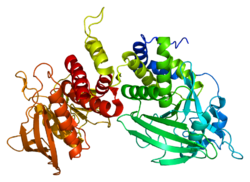
Receptor-type tyrosine-protein phosphatase S, also known as R-PTP-S, R-PTP-sigma, or PTPσ, is an enzyme that in humans is encoded by the PTPRS gene.[5][6][7]
Function
[edit]The protein encoded by this gene is a member of the protein tyrosine phosphatase (PTP) family. PTPs are known to be signaling molecules that regulate a variety of cellular processes including cell growth, differentiation, mitotic cycle, and oncogenic transformation. This PTP contains an extracellular region, a single transmembrane segment and two tandem intracytoplasmic catalytic domains (D1 and D2), and thus represents a receptor-type PTP. D1 is catalytically active, while D2 is catalytically inactive. The extracellular region of this protein is composed of multiple Ig-like and fibronectin type III-like domains. Rem2 signaling affects neuronal structure and function in part by regulation of gene expression. Molecular and Cellular NeuroscienceStudies of the similar gene in mice suggested that this PTP may be involved in cell-cell interaction, primary axonogenesis, and axon guidance during embryogenesis. This PTP has been also implicated in the molecular control of adult nerve repair. Four alternatively spliced transcript variants, which encode distinct proteins, have been reported.[7]
Clinical significance
[edit]A PTPRS protein mimetic may improve muscular and bladder control in rats with spinal cord injuries.[8][9]
Interactions
[edit]PTPRS has been shown to interact with:
- chondroitin sulphate proteoglycans,[8]
- PTPRD,[10] glial-derived and
- liprin-alpha-1.[6][11]
- NME2.[12]
References
[edit]- ^ a b c GRCh38: Ensembl release 89: ENSG00000105426 – Ensembl, May 2017
- ^ a b c GRCm38: Ensembl release 89: ENSMUSG00000013236 – Ensembl, May 2017
- ^ "Human PubMed Reference:". National Center for Biotechnology Information, U.S. National Library of Medicine.
- ^ "Mouse PubMed Reference:". National Center for Biotechnology Information, U.S. National Library of Medicine.
- ^ Wagner J, Gordon LA, Heng HH, Tremblay ML, Olsen AS (Mar 1997). "Physical mapping of receptor type protein tyrosine phosphatase sigma (PTPRS) to human chromosome 19p13.3". Genomics. 38 (1): 76–8. doi:10.1006/geno.1996.0594. PMID 8954782.
- ^ a b Pulido R, Serra-Pagès C, Tang M, Streuli M (Jan 1996). "The LAR/PTP delta/PTP sigma subfamily of transmembrane protein-tyrosine-phosphatases: multiple human LAR, PTP delta, and PTP sigma isoforms are expressed in a tissue-specific manner and associate with the LAR-interacting protein LIP.1". Proc Natl Acad Sci U S A. 92 (25): 11686–90. Bibcode:1995PNAS...9211686P. doi:10.1073/pnas.92.25.11686. PMC 40467. PMID 8524829.
- ^ a b "Entrez Gene: PTPRS protein tyrosine phosphatase, receptor type, S".
- ^ a b Lang BT, Cregg JM, DePaul MA, Tran AP, Xu K, Dyck SM, Madalena KM, Brown BP, Weng Y, Li S, Karimi-Abdolrezaee S, Busch SA, Shen Y, Silver J (2014). "Modulation of the proteoglycan receptor PTPσ promotes recovery after spinal cord injury". Nature. 518 (7539): 404–8. doi:10.1038/nature13974. PMC 4336236. PMID 25470046.
- ^ Maggie Fox (3 December 2014). "'Unprecedented': Drug May Help Heal Damaged Spine". NBC. Retrieved December 8, 2014.
- ^ Wallace MJ, Fladd C, Batt J, Rotin D (May 1998). "The second catalytic domain of protein tyrosine phosphatase delta (PTP delta) binds to and inhibits the first catalytic domain of PTP sigma". Mol. Cell. Biol. 18 (5): 2608–16. doi:10.1128/MCB.18.5.2608. PMC 110640. PMID 9566880.
- ^ Serra-Pagès C, Medley QG, Tang M, Hart A, Streuli M (Jun 1998). "Liprins, a family of LAR transmembrane protein-tyrosine phosphatase-interacting proteins". J. Biol. Chem. 273 (25): 15611–20. doi:10.1074/jbc.273.25.15611. PMID 9624153.
- ^ Hamasaki H, Fujitani M, Yamashita T (March 2016). "NME2 associates with PTPσ to transduce signals from chondroitin sulfate proteoglycans". Biochemical and Biophysical Research Communications. 471 (4): 522–7. doi:10.1016/j.bbrc.2016.02.042. PMID 26896769.
Further reading
[edit]- Adachi M, Sekiya M, Arimura Y, Takekawa M, Itoh F, Hinoda Y, Imai K, Yachi A (1992). "Protein-tyrosine phosphatase expression in pre-B cell NALM-6". Cancer Res. 52 (3): 737–40. PMID 1370651.
- Endo N, Rutledge SJ, Opas EE, Vogel R, Rodan GA, Schmidt A (1997). "Human protein tyrosine phosphatase-sigma: alternative splicing and inhibition by bisphosphonates". J. Bone Miner. Res. 11 (4): 535–43. doi:10.1002/jbmr.5650110415. PMID 8992885. S2CID 84496716.
- Norris K, Norris F, Kono DH, Vestergaard H, Pedersen O, Theofilopoulos AN, Møller NP (1997). "Expression of protein-tyrosine phosphatases in the major insulin target tissues". FEBS Lett. 415 (3): 243–8. doi:10.1016/S0014-5793(97)01133-2. PMID 9357975. S2CID 9414519.
- Wallace MJ, Fladd C, Batt J, Rotin D (1998). "The second catalytic domain of protein tyrosine phosphatase delta (PTP delta) binds to and inhibits the first catalytic domain of PTP sigma". Mol. Cell. Biol. 18 (5): 2608–16. doi:10.1128/MCB.18.5.2608. PMC 110640. PMID 9566880.
- Serra-Pagès C, Medley QG, Tang M, Hart A, Streuli M (1998). "Liprins, a family of LAR transmembrane protein-tyrosine phosphatase-interacting proteins". J. Biol. Chem. 273 (25): 15611–20. doi:10.1074/jbc.273.25.15611. PMID 9624153.
- Haworth K, Shu KK, Stokes A, Morris R, Stoker A (1998). "The expression of receptor tyrosine phosphatases is responsive to sciatic nerve crush". Mol. Cell. Neurosci. 12 (3): 93–104. doi:10.1006/mcne.1998.0707. PMID 9790732. S2CID 41195720.
- Elchebly M, Wagner J, Kennedy TE, Lanctôt C, Michaliszyn E, Itié A, Drouin J, Tremblay ML (1999). "Neuroendocrine dysplasia in mice lacking protein tyrosine phosphatase sigma". Nat. Genet. 21 (3): 330–3. doi:10.1038/6859. PMID 10080191. S2CID 19356972.
- Wallace MJ, Batt J, Fladd CA, Henderson JT, Skarnes W, Rotin D (1999). "Neuronal defects and posterior pituitary hypoplasia in mice lacking the receptor tyrosine phosphatase PTPsigma". Nat. Genet. 21 (3): 334–8. doi:10.1038/6866. PMID 10080192. S2CID 7889181.
- Suárez Pestana E, Tenev T, Gross S, Stoyanov B, Ogata M, Böhmer FD (1999). "The transmembrane protein tyrosine phosphatase RPTPsigma modulates signaling of the epidermal growth factor receptor in A431 cells". Oncogene. 18 (28): 4069–79. doi:10.1038/sj.onc.1202794. PMID 10435588.
- Blanchetot C, Tertoolen LG, Overvoorde J, den Hertog J (2003). "Intra- and intermolecular interactions between intracellular domains of receptor protein-tyrosine phosphatases". J. Biol. Chem. 277 (49): 47263–9. doi:10.1074/jbc.M205810200. PMID 12376545.
- Brandenberger R, Wei H, Zhang S, Lei S, Murage J, Fisk GJ, Li Y, Xu C, Fang R, Guegler K, Rao MS, Mandalam R, Lebkowski J, Stanton LW (2005). "Transcriptome characterization elucidates signaling networks that control human ES cell growth and differentiation". Nat. Biotechnol. 22 (6): 707–16. doi:10.1038/nbt971. PMID 15146197. S2CID 27764390.
- Rual JF, Venkatesan K, Hao T, Hirozane-Kishikawa T, Dricot A, Li N, Berriz GF, Gibbons FD, Dreze M, Ayivi-Guedehoussou N, Klitgord N, Simon C, Boxem M, Milstein S, Rosenberg J, Goldberg DS, Zhang LV, Wong SL, Franklin G, Li S, Albala JS, Lim J, Fraughton C, Llamosas E, Cevik S, Bex C, Lamesch P, Sikorski RS, Vandenhaute J, Zoghbi HY, Smolyar A, Bosak S, Sequerra R, Doucette-Stamm L, Cusick ME, Hill DE, Roth FP, Vidal M (2005). "Towards a proteome-scale map of the human protein-protein interaction network". Nature. 437 (7062): 1173–8. Bibcode:2005Natur.437.1173R. doi:10.1038/nature04209. PMID 16189514. S2CID 4427026.
- Hu YF, Zhang HL, Cai T, Harashima S, Notkins AL (2006). "The IA-2 interactome" (PDF). Diabetologia. 48 (12): 2576–81. doi:10.1007/s00125-005-0037-y. PMID 16273344. S2CID 9765497.
- Liu T, Qian WJ, Gritsenko MA, Camp DG, Monroe ME, Moore RJ, Smith RD (2006). "Human plasma N-glycoproteome analysis by immunoaffinity subtraction, hydrazide chemistry, and mass spectrometry". J. Proteome Res. 4 (6): 2070–80. doi:10.1021/pr0502065. PMC 1850943. PMID 16335952.
- Lajus S, Lang J (2006). "Splice variant 3, but not 2 of receptor protein-tyrosine phosphatase sigma can mediate stimulation of insulin-secretion by alpha-latrotoxin". J. Cell. Biochem. 98 (6): 1552–9. doi:10.1002/jcb.20871. PMID 16552719. S2CID 84223719.
- Ewing RM, Chu P, Elisma F, Li H, Taylor P, Climie S, McBroom-Cerajewski L, Robinson MD, O'Connor L, Li M, Taylor R, Dharsee M, Ho Y, Heilbut A, Moore L, Zhang S, Ornatsky O, Bukhman YV, Ethier M, Sheng Y, Vasilescu J, Abu-Farha M, Lambert JP, Duewel HS, Stewart II, Kuehl B, Hogue K, Colwill K, Gladwish K, Muskat B, Kinach R, Adams SL, Moran MF, Morin GB, Topaloglou T, Figeys D (2007). "Large-scale mapping of human protein-protein interactions by mass spectrometry". Mol. Syst. Biol. 3 (1) 89. doi:10.1038/msb4100134. PMC 1847948. PMID 17353931.
PDB gallery | |
|---|---|
|

 | This article on a gene on human chromosome 19 is a stub. You can help Wikipedia by adding missing information. |