Hubbry Logo
Transmembrane proteinTransmembrane proteinMain
Open search
Transmembrane protein
Community hub
Transmembrane protein
logo
8 pages, 0 posts
0 subscribers
Be the first to start a discussion here.
Transmembrane protein
from Wikipedia
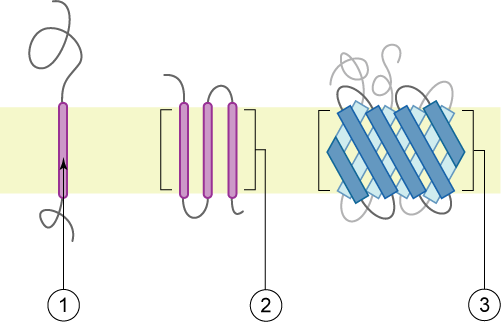
Schematic representation of transmembrane proteins: 1) a single-pass membrane protein (α-helix) 2) a multipass membrane protein (α-helix) 3) a multipass membrane protein β-sheet. The membrane is represented in light yellow.

A transmembrane protein is a type of integral membrane protein that spans the entirety of the cell membrane. Many transmembrane proteins function as gateways to permit the transport of specific substances across the membrane. They frequently undergo significant conformational changes to move a substance through the membrane. They are usually highly hydrophobic and aggregate and precipitate in water. They require detergents or nonpolar solvents for extraction, although some of them (beta-barrels) can be also extracted using denaturing agents.

The peptide sequence that spans the membrane, or the transmembrane segment, is largely hydrophobic and can be visualized using the hydropathy plot.[1] Depending on the number of transmembrane segments, transmembrane proteins can be classified as single-pass membrane proteins, or as multipass membrane proteins.[2] Some other integral membrane proteins are called monotopic, meaning that they are also permanently attached to the membrane, but do not pass through it.[3]

Types

[edit]

Classification by structure

[edit]

There are two basic types of transmembrane proteins:[4] alpha-helical and beta barrels. Alpha-helical proteins are present in the inner membranes of bacterial cells or the plasma membrane of eukaryotic cells, and sometimes in the bacterial outer membrane.[5] This is the major category of transmembrane proteins. In humans, 27% of all proteins have been estimated to be alpha-helical membrane proteins.[6] Beta-barrel proteins are so far found only in outer membranes of gram-negative bacteria, cell walls of gram-positive bacteria, outer membranes of mitochondria and chloroplasts, or can be secreted as pore-forming toxins. All beta-barrel transmembrane proteins have simplest up-and-down topology, which may reflect their common evolutionary origin and similar folding mechanism.[7]

In addition to the protein domains, there are unusual transmembrane elements formed by peptides. A typical example is gramicidin A, a peptide that forms a dimeric transmembrane β-helix.[8] This peptide is secreted by gram-positive bacteria as an antibiotic. A transmembrane polyproline-II helix has not been reported in natural proteins. Nonetheless, this structure was experimentally observed in specifically designed artificial peptides.[9]

Classification by topology

[edit]

This classification refers to the position of the protein N- and C-termini on the different sides of the lipid bilayer. Types I, II, III and IV are single-pass molecules. Type I transmembrane proteins are anchored to the lipid membrane with a stop-transfer anchor sequence and have their N-terminal domains targeted to the endoplasmic reticulum (ER) lumen during synthesis (and the extracellular space, if mature forms are located on cell membranes). Type II and III are anchored with a signal-anchor sequence, with type II being targeted to the ER lumen with its C-terminal domain, while type III have their N-terminal domains targeted to the ER lumen. Type IV is subdivided into IV-A, with their N-terminal domains targeted to the cytosol and IV-B, with an N-terminal domain targeted to the lumen.[10] The implications for the division in the four types are especially manifest at the time of translocation and ER-bound translation, when the protein has to be passed through the ER membrane in a direction dependent on the type.[citation needed]

Group I and II transmembrane proteins have opposite final topologies. Group I proteins have the N terminus on the far side and C terminus on the cytosolic side. Group II proteins have the C terminus on the far side and N terminus in the cytosol. However final topology not the only criterion for defining transmembrane protein groups, rather location of topogenic determinants and mechanism of assembly is considered in the classification[11]

3D structure

[edit]
Increase in the number of 3D structures of membrane proteins known

Membrane protein structures can be determined by X-ray crystallography, electron microscopy or NMR spectroscopy.[12] The most common tertiary structures of these proteins are transmembrane helix bundle and beta barrel. The portion of the membrane proteins that are attached to the lipid bilayer (see annular lipid shell) consist mostly of hydrophobic amino acids.[13]

Membrane proteins which have hydrophobic surfaces, are relatively flexible and are expressed at relatively low levels. This creates difficulties in obtaining enough protein and then growing crystals. Hence, despite the significant functional importance of membrane proteins, determining atomic resolution structures for these proteins is more difficult than globular proteins.[14] As of January 2013 less than 0.1% of protein structures determined were membrane proteins despite being 20–30% of the total proteome.[15] Due to this difficulty and the importance of this class of proteins methods of protein structure prediction based on hydropathy plots, the positive inside rule and other methods have been developed.[16][17][18]

Thermodynamic stability and folding

[edit]

Stability of alpha-helical transmembrane proteins

[edit]

Transmembrane alpha-helical (α-helical) proteins are unusually stable judging from thermal denaturation studies, because they do not unfold completely within the membranes (the complete unfolding would require breaking down too many α-helical H-bonds in the nonpolar media). On the other hand, these proteins easily misfold, due to non-native aggregation in membranes, transition to the molten globule states, formation of non-native disulfide bonds, or unfolding of peripheral regions and nonregular loops that are locally less stable.[19]

It is also important to properly define the unfolded state. The unfolded state of membrane proteins in detergent micelles is different from that in the thermal denaturation experiments.[citation needed] This state represents a combination of folded hydrophobic α-helices and partially unfolded segments covered by the detergent. For example, the "unfolded" bacteriorhodopsin in SDS micelles has four transmembrane α-helices folded, while the rest of the protein is situated at the micelle-water interface and can adopt different types of non-native amphiphilic structures. Free energy differences between such detergent-denatured and native states are similar to stabilities of water-soluble proteins (< 10 kcal/mol).[citation needed]

Folding of α-helical transmembrane proteins

[edit]

Refolding of α-helical transmembrane proteins in vitro is technically difficult. There are relatively few examples of the successful refolding experiments, as for bacteriorhodopsin. In vivo, all such proteins are normally folded co-translationally within the large transmembrane translocon. The translocon channel provides a highly heterogeneous environment for the nascent transmembrane α-helices. A relatively polar amphiphilic α-helix can adopt a transmembrane orientation in the translocon (although it would be at the membrane surface or unfolded in vitro), because its polar residues can face the central water-filled channel of the translocon. Such mechanism is necessary for incorporation of polar α-helices into structures of transmembrane proteins. The amphiphilic helices remain attached to the translocon until the protein is completely synthesized and folded. If the protein remains unfolded and attached to the translocon for too long, it is degraded by specific "quality control" cellular systems.[citation needed]

Stability and folding of beta-barrel transmembrane proteins

[edit]

Stability of beta barrel (β-barrel) transmembrane proteins is similar to stability of water-soluble proteins, based on chemical denaturation studies. Some of them are very stable even in chaotropic agents and high temperature. Their folding in vivo is facilitated by water-soluble chaperones, such as protein Skp. It is thought that β-barrel membrane proteins come from one ancestor even having different number of sheets which could be added or doubled during evolution. Some studies show a huge sequence conservation among different organisms and also conserved amino acids which hold the structure and help with folding.[20]

3D structures

[edit]

Light absorption-driven transporters

[edit]

Oxidoreduction-driven transporters

[edit]

Electrochemical potential-driven transporters

[edit]
  • Proton or sodium translocating F-type and V-type ATPases

P-P-bond hydrolysis-driven transporters

[edit]

Porters (uniporters, symporters, antiporters)

[edit]

Alpha-helical channels including ion channels

[edit]

Enzymes

[edit]

Proteins with single transmembrane alpha-helices

[edit]

Beta-barrels composed of a single polypeptide chain

[edit]

Note: n and S are, respectively, the number of beta-strands and the "shear number"[22] of the beta-barrel

Beta-barrels composed of several polypeptide chains

[edit]

See also

[edit]

References

[edit]
Revisions and contributorsEdit on WikipediaRead on Wikipedia
from Grokipedia
Transmembrane proteins are membrane proteins that span the entire width of the in cell membranes, featuring hydrophobic transmembrane domains embedded within the nonpolar interior of the membrane and hydrophilic domains exposed to the aqueous environments on either side. These proteins constitute approximately 20–30% of the total across all living organisms and are essential for maintaining cellular integrity and function. Structurally, transmembrane proteins are primarily organized into two major classes: α-helical bundles, which predominate in plasma and intracellular membranes and consist of 1–20 or more transmembrane α-helices typically 17–25 long, and β-barrels, which are more common in outer membranes of , mitochondria, and chloroplasts, formed by 8–24 antiparallel β-strands creating a cylindrical pore. The transmembrane domains interact dynamically with surrounding and other proteins, enabling conformational changes that are crucial for their activity, with over 1,900 unique atomic-resolution structures determined as of 2025. topology, including the number, orientation, and positioning of these segments, dictates their integration into specific cellular compartments, such as shorter helices in the endoplasmic reticulum versus longer ones in the plasma membrane. Functionally, transmembrane proteins mediate a wide array of vital processes, including the transport of ions, molecules, and metabolites across membranes to sustain homeostasis; signal transduction to detect environmental cues and facilitate intercellular communication; electron transport and energy transduction, such as in ATP synthesis; and enzymatic catalysis within the membrane. They also provide structural support, shaping cellular compartments and enabling cell adhesion. Notably, about 60% of pharmaceutical drug targets are transmembrane proteins, underscoring their biomedical significance.

Definition and Classification

Basic Definition and Characteristics

Transmembrane proteins are integral proteins that span the entire of cell membranes, with hydrophobic regions embedded within the nonpolar interior of the to facilitate their integration. These proteins are characterized by their amphipathic nature, featuring hydrophobic transmembrane domains that interact with the tails and hydrophilic domains that are exposed to the aqueous environments on both sides of the . This dual polarity ensures stable positioning within the bilayer while allowing interaction with extracellular and intracellular compartments. A key characteristic of transmembrane proteins is their role in maintaining membrane asymmetry, achieved through their oriented insertion and uneven distribution across the lipid leaflets, which contributes to the functional heterogeneity of the membrane. Transmembrane proteins exhibit evolutionary conservation across all domains of life, reflecting their fundamental importance in cellular processes; for instance, , a seven-transmembrane protein in , serves as a prototypical example due to its well-studied and light-driven proton function. In terms of composition, the transmembrane segments of these proteins typically comprise 20-30 , enriched in hydrophobic residues such as and , which promote favorable interactions with the membrane's hydrophobic core. These segments often form alpha-helices or beta-strands, leading to broader structural classifications explored elsewhere.

Structural Classifications

Transmembrane proteins are primarily classified into two structural categories based on their secondary structure motifs that span the : alpha-helical and beta-barrel proteins. Alpha-helical proteins predominate in plasma membranes across eukaryotes and prokaryotes, while beta-barrel proteins are characteristic of outer membranes in , mitochondria, and chloroplasts. These architectures reflect adaptations to distinct membrane environments and functional demands, with alpha-helices providing flexibility for diverse topologies and beta-barrels forming rigid, pore-like structures. Alpha-helical transmembrane proteins consist of one or more amphipathic alpha-helices that traverse the hydrophobic core of the membrane. Each transmembrane helix typically comprises 20-25 hydrophobic residues, sufficient to span the approximately 30 thickness of the bilayer with a rise of about 1.5 per residue. Tryptophan residues are frequently clustered at the lipid-water interface of these helices, often forming an "aromatic belt" that anchors the protein in the membrane by interacting favorably with lipid headgroups. Single-helix proteins, such as bitopic receptors, feature one such segment, whereas polytopic proteins bundle multiple helices, often 3 to 12, to form complex tertiary structures. A prominent motif is the seven-transmembrane (7TM) helix bundle found in G protein-coupled receptors (GPCRs), which arranges helices in a cylindrical fashion to create ligand-binding pockets and signaling interfaces. In contrast, beta-barrel transmembrane proteins are composed of antiparallel beta-strands that form a closed, cylindrical barrel penetrating the . These barrels typically contain 8 to 22 beta-strands, with an even number required to satisfy hydrogen bonding and enable stable membrane insertion, as odd numbers would leave unpaired edges. The strands tilt at approximately 45 degrees relative to the plane, creating a hydrophobic exterior that interacts with tails. Porins, such as those in bacterial outer membranes, exemplify this class with 16- or 18-stranded barrels that form aqueous channels for solute passage. Although rare, some transmembrane proteins exhibit hybrid architectures combining alpha-helical and beta-barrel elements, often with helical domains peripheral to the barrel core, as seen in certain bacterial outer membrane complexes. These hybrids highlight evolutionary versatility but are less common than pure forms due to folding constraints in asymmetric .

Topological Classifications

Transmembrane protein topology refers to the number, arrangement, and orientation of hydrophobic segments that span the , typically as alpha-helical bundles, determining the protein's path through the membrane and the localization of its domains relative to the intracellular and extracellular sides. This classification focuses on the overall membrane-spanning pattern, distinguishing proteins based on whether they cross the membrane once or multiple times, and their N- and C-terminal orientations. Single-pass, or bitopic, transmembrane proteins feature one transmembrane segment and are subdivided into Type I and Type II based on . Type I proteins have an extracellular or luminal and a cytoplasmic , often guided by a cleavable N-terminal that directs insertion via the in eukaryotes. In contrast, Type II proteins exhibit a cytoplasmic and an extracellular , lacking a cleavable signal but using an internal signal-anchor sequence for membrane integration. Examples include Type I proteins like the receptor, which facilitates uptake, and Type II proteins such as the , involved in clearance. Multi-pass, or polytopic, transmembrane proteins contain multiple transmembrane segments, often forming complex bundles that traverse the membrane several times, with alternating cytoplasmic and extracytoplasmic loops. These are exemplified by seven-transmembrane (7-TM) receptors, such as G-protein-coupled receptors (GPCRs), which detect extracellular signals and transduce them intracellularly through conformational changes. Polytopic topologies enable diverse functions like ion transport in proteins with 12 or more spans, such as voltage-gated channels. Orientation of transmembrane segments is governed by specific mechanisms that ensure correct topology. In bacterial inner membrane proteins, the positive-inside rule dictates that loops with higher positive charge density (from and residues) remain cytoplasmic, preventing translocation across the membrane. For eukaryotic proteins, N-terminal signal sequences or internal signal-anchors interact with the and Sec61 translocon to orient the first transmembrane segment, with subsequent spans following sequentially based on hydrophobicity and charge biases. Prediction of transmembrane topology relies on computational tools analyzing sequence features. Hydropathy plots, which graph the average hydrophobicity of windows along the protein , identify potential transmembrane segments as stretches of 20-30 hydrophobic residues. motifs, particularly distributions of charged residues flanking hydrophobic regions, further refine predictions by applying rules like positive-inside to infer orientation. These methods, often integrated in algorithms like TMHMM, achieve high accuracy for alpha-helical proteins when validated against experimental data.

Biophysical Properties

Thermodynamic Stability

The thermodynamic stability of transmembrane proteins is primarily governed by the favorable partitioning of their hydrophobic segments into the , where the free energy minimum arises from a balance of intra-protein interactions and the surrounding membrane environment. Key stabilizing factors include the , which drives the burial of nonpolar residues away from the aqueous phase into the membrane's apolar core, and van der Waals interactions that contribute to tight packing within the transmembrane domains. These forces collectively lower the free energy of the folded state relative to unfolded conformations in the bilayer. Quantitatively, the free energy of transfer (ΔG) for individual from to the bilayer interface provides insight into these contributions; for example, exhibits a ΔG of approximately -0.56 kcal/mol, reflecting its preference for the hydrophobic environment. Such values, derived from partitioning experiments, underscore how nonpolar residues accumulate negative ΔG contributions that stabilize the embedded structure. However, destabilizing forces can compromise this stability, including lipid packing defects that arise from mismatches in chain length or saturation, leading to voids or strains in the bilayer that increase the energetic cost of protein insertion. Additionally, in non-bilayer membranes, such as those with high spontaneous , imposes elastic deformation penalties that elevate the free energy of the protein-membrane complex. In comparison to soluble proteins, transmembrane proteins often display higher thermodynamic stability, attributable to the reduced solvent exposure in the , which minimizes unfavorable polar interactions in the unfolded state and enhances the ΔG of folding. This enhanced stability, with unfolding free energies frequently exceeding 10 kcal/mol, supports their functional persistence in the milieu.

Folding Mechanisms

The folding of α-helical transmembrane proteins is commonly described by the two-stage model, in which individual transmembrane helices first form and insert into the independently, driven by hydrophobic interactions, before associating via specific interhelical contacts to achieve the native tertiary . This model posits that the initial stage occurs rapidly in a -mimetic environment, where the hydrophobic core of each partitions into the bilayer core, stabilizing the secondary structure without requiring tertiary interactions. The second stage involves the packing of these preformed helices, guided by van der Waals forces, hydrogen bonding in the nonpolar membrane interior, and sometimes specific motifs like GxxxG for close helix-helix packing, leading to the functional or . In contrast, β-barrel transmembrane proteins fold through a distinct mechanism involving the sequential insertion of β-strands into the outer membrane, where alternating s between adjacent strands zipper the structure into a closed cylindrical barrel. This process begins with the translocation of the unfolded polypeptide to the periplasmic space, followed by strand-by-strand insertion perpendicular to the membrane plane, facilitated by the β-barrel assembly machinery (BAM) complex in . The BAM complex, particularly its core β-barrel subunit BamA, catalyzes the final folding by providing a template for strand registration and formation, accelerating the otherwise kinetically trapped assembly and ensuring the barrel's even number of strands (typically 8-22) forms without mispairing. Folding of both α-helical and β-barrel proteins encounters kinetic barriers during insertion, particularly at the translocon, where translocation through the aqueous channel competes with lateral gating to release segments into the . In the Sec61 translocon for α-helical proteins, slow gating kinetics—on the order of seconds—can expose hydrophobic transmembrane domains to the , increasing aggregation risk, whereas rapid gating favors efficient partitioning into the . For β-barrels, analogous barriers in the BAM complex involve substrate handoff from chaperones, where mismatched strand insertion rates create off-pathway intermediates that the complex resolves through conformational dynamics. Experimental evidence from pulse-chase studies supports these mechanisms, demonstrating that initial helix or strand insertion occurs rapidly on the millisecond timescale, reflecting the fast partitioning of hydrophobic segments, while subsequent packing into the tertiary structure proceeds more slowly over seconds due to diffusional search and specific interactions. For instance, in vivo labeling of nascent α-helical proteins like bacteriorhodopsin reveals near-complete membrane integration within 10-100 ms post-ribosome emergence, with helix association completing in 1-10 seconds, as monitored by protease protection and glycosylation assays. Similar pulse-chase approaches for β-barrel proteins, such as OmpA, show strand insertion bursts in under 1 second, with full barrel closure requiring chaperone-assisted seconds-long rearrangements. These timescales highlight how folding kinetics balance speed and fidelity, with ΔG values from thermodynamic studies underscoring the energetic favorability of the inserted states.

Membrane Interactions

Transmembrane proteins interact closely with the surrounding , where play crucial roles in stabilizing , modulating function, and influencing localization. These interactions can be broadly categorized into annular and non-annular . Annular form a dynamic shell around the protein, making non-specific contacts and rapidly exchanging with the bulk pool in the . In contrast, non-annular specifically at sites within the protein, often buried between transmembrane helices or at crevices, and exchange more slowly with the surrounding . These non-annular interactions can be highly selective, as seen in the preference for anionic at certain sites on proteins like the . Specific lipid binding sites on transmembrane proteins often accommodate cholesterol or cardiolipin, which fine-tune protein activity and stability. Cholesterol binds to hydrophobic grooves or pockets in proteins such as the β2-adrenergic receptor and Na+-K+-ATPase, influencing conformational dynamics and signaling efficiency. Similarly, cardiolipin interacts with mitochondrial proteins like the ADP/ATP carrier and , binding at multiple sites to support respiratory complex assembly and electron transport. These specific interactions highlight how lipids act as allosteric modulators, altering protein function beyond mere structural support. The boundary lipid layer around transmembrane proteins significantly impacts their mobility, with proteins diffusing 10- to 100-fold slower than free in the due to the drag from this annular shell and increased effective . This reduced diffusion coefficient, typically around 0.01–0.1 μm²/s for proteins compared to 1–10 μm²/s for , arises from the coupled motion of the protein-lipid complex, limiting lateral movement in crowded membranes. Transmembrane proteins generally prefer fluid (liquid-crystalline) phases over gel phases, as the higher disorder and mobility in fluid states facilitate insertion, folding, and function. In gel phases, proteins experience restricted mobility and potential exclusion, which can impair activity. In eukaryotic cells, many transmembrane proteins associate with lipid rafts—liquid-ordered domains enriched in cholesterol and sphingolipids—enhancing signaling and trafficking through compartmentalization. Mutations in transmembrane proteins can disrupt these lipid interactions, leading to mislocalization or dysfunction. For instance, in the cystic fibrosis transmembrane conductance regulator (CFTR), common mutations like F508del impair lipid-driven clustering into ceramide-rich platforms, reducing channel activity and contributing to disease pathology. Similarly, the S13F mutation alters CFTR's interaction with membrane lipids, affecting stability and trafficking. These defects underscore the critical role of lipid-protein interfaces in maintaining physiological function.

Functional Roles

Transport Mechanisms

Transmembrane proteins mediate the transport of ions and solutes across bilayers through two primary categories: and active mechanisms. occurs down electrochemical gradients without direct energy input, relying on concentration or electrical differences to drive movement. This includes via uniporters, which transport a single solute , and channels that form hydrophilic pores for rapid, selective passage of small molecules or ions. In contrast, moves solutes against their gradients, requiring energy; primary uses direct of ATP or other high-energy compounds, while secondary couples the uphill movement of one solute to the downhill gradient of another, such as ions. Carrier proteins in these systems, including symporters (co-transporting two solutes in the same direction) and antiporters (exchanging two solutes in opposite directions), undergo conformational changes to translocate substrates, ensuring specificity and . A key distinction exists between channel and carrier proteins in their operational modes. Channel proteins create aqueous pores that allow passive of ions or small molecules at rates up to 10^8 molecules per second when open, prioritizing speed over tight control through size and charge selectivity filters. Carrier proteins, however, bind substrates on one side of the membrane, undergo a conformational shift to expose the to the opposite side, and release the substrate, achieving higher selectivity but slower throughput, typically 10^2 to 10^4 molecules per second. This alternating access mechanism in carriers enables both passive and , while channels are generally passive and regulated by gating. Alpha-helical bundles often form the structural basis for both types, adapting to create either fixed pores or dynamic transporters. Gating mechanisms control the opening and closing of transport proteins, responding to specific stimuli to regulate flux. Voltage-gated channels sense changes via charged transmembrane segments, such as the S4 helix in potassium channels, which moves in response to to open the pore. Ligand-gated channels, like nicotinic receptors, bind extracellular ligands (e.g., neurotransmitters) that induce conformational rearrangements propagating to the transmembrane domain, opening the pathway. Mechanically gated channels, such as Piezo proteins, detect mechanical stress through lateral tension or force application, leading to force-induced deformations that widen the pore. These gating processes ensure precise temporal and spatial control of transport in cellular signaling and . Energy coupling in often follows chemiosmotic principles, where proton or gradients generated across membranes drive secondary transport. The proton motive force (ΔμH+\Delta \mu_{H^+}), comprising the proton concentration gradient (ΔpH\Delta \mathrm{pH}) and (Δψ\Delta \psi), powers symporters and antiporters in bacterial and mitochondrial systems, enabling uptake or extrusion without direct ATP use. In primary , such as in ATP-binding cassette (ABC) transporters, ATP directly fuels conformational changes for substrate translocation against gradients. This coupling maintains cellular and supports metabolic processes across diverse organisms.

Signaling and Enzymatic Functions

Transmembrane proteins play crucial roles in cellular signaling by serving as receptors that detect extracellular stimuli and initiate intracellular responses, as well as enzymes that catalyze reactions at the membrane interface. These functions enable the transduction of signals across the without net transport of molecules, relying instead on conformational changes and enzymatic modifications to . G-protein-coupled receptors (GPCRs), a major class of transmembrane signaling proteins, feature a characteristic seven-transmembrane (7TM) α-helical bundle that spans the plasma membrane, connected by three extracellular loops (ECLs) and three intracellular loops (ICLs). binding to the orthosteric site within the transmembrane helix bundle induces conformational rearrangements, such as the outward displacement of transmembrane helix 6 (TM6) by approximately 14 Å and toggling of key micro-switches like the CWxP motif in TM6 and the NPxxY motif in TM7, which propagate the signal to intracellular effectors. These changes facilitate the recruitment and activation of heterotrimeric G proteins, leading to GDP-GTP exchange on the Gα subunit and subsequent dissociation into active Gα and Gβγ components that modulate downstream pathways, including activation for cAMP production or stimulation for IP3 and DAG generation. In addition to receptor functions, certain transmembrane proteins exhibit enzymatic activity, exemplified by receptor tyrosine kinases (RTKs), which possess an extracellular ligand-binding domain, a single transmembrane , and an intracellular tyrosine kinase domain (TKD). Ligand binding, such as (EGF) to EGFR, promotes receptor dimerization or oligomerization, relieving autoinhibitory constraints on the TKD through asymmetric dimer interfaces or trans-phosphorylation of residues in the activation loop. This autophosphorylation creates docking sites for adaptor proteins containing SH2 or PTB domains, thereby initiating enzymatic cascades that phosphorylate downstream substrates. Signal transduction by these transmembrane proteins often involves allosteric regulation, where ligand-induced changes at the extracellular or orthosteric site propagate through the protein core to modulate distant intracellular interfaces, as modeled in GPCRs like the β2-adrenergic receptor where collective motions in transmembrane helices alter G-protein binding affinity. In RTKs and GPCRs, this leads to cascades, such as the Ras-Raf-MEK-ERK MAPK pathway, where receptor recruits adaptors like to stimulate Ras GTP loading, culminating in sequential kinase phosphorylations that amplify the signal and regulate , cell proliferation, and differentiation. For instance, in GPCRs, Gβγ subunits can phosphorylate Shc, linking to MAPK , while RTKs directly autophosphorylate to engage similar cascades. A prominent example is , a light-sensitive GPCR in rod photoreceptor cells, consisting of a 7TM helical bundle covalently bound to 11-cis- via a at Lys296. absorption triggers of the to all-trans-, rotating it 180° around the C11=C12 bond and initiating a cascade of intermediates, culminating in metarhodopsin II formation. This causes a 7.7 outward tilt of TM6's cytoplasmic end, breaking the ionic lock between Arg135^{3.50} and Glu247^{6.30}, which exposes a for the G-protein and activates GDP-GTP exchange to propagate the visual signal.

Structural and Supportive Roles

Transmembrane proteins play crucial roles in providing mechanical support and within cellular structures, distinct from their involvement in transport or signaling. Adhesion molecules such as are heterodimeric transmembrane receptors that mediate cell- interactions by linking the extracellular matrix to the intracellular , thereby facilitating , tissue integrity, and mechanical stability. These proteins undergo conformational changes to transmit forces bidirectionally across the membrane, ensuring robust anchorage in dynamic environments. Anchoring proteins, exemplified by single-pass transmembrane proteins like in human erythrocytes, contribute to membrane stability and shape maintenance by interacting with the underlying . , a sialoglycoprotein spanning the membrane once, associates with band 4.1 protein to connect the to the spectrin-actin network, preventing deformation under and supporting overall erythrocyte integrity. This linkage is essential for the biconcave discoid morphology of red blood cells, highlighting the supportive function of such proteins in non-adherent cell types. In addition to individual cell support, certain transmembrane proteins enable mechanical coupling between cells. , which form gap junctions, provide structural adhesion by docking hemichannels between adjacent cells, creating stable intercellular connections that distribute mechanical loads and maintain tissue cohesion. For instance, connexin 50 mediates lens fiber through its extracellular domains, promoting ordered packing and mechanical resilience in avascular tissues. Evolutionary adaptations have tailored transmembrane proteins in for survival in extreme environments, enhancing structural integrity under harsh conditions like high temperatures or . In thermophilic , these proteins exhibit increased surface charge and ion-pair formations to bolster stability against thermal denaturation, while halophilic variants incorporate acidic residues to counter ionic stresses without compromising anchoring. Such modifications underscore the of transmembrane proteins in providing foundational support for cellular architecture in extremophiles.

Examples of Structures

Alpha-Helical Transporters and Channels

Alpha-helical transporters and channels represent a major subclass of transmembrane proteins characterized by bundles of transmembrane alpha- that form selective pores or conformational pathways for or across bilayers. These structures typically consist of 6 to 12 arranged in a bundle, enabling mechanisms such as or . A classic example is , a -driven found in archaeal membranes, which features seven transmembrane alpha- enclosing a covalently bound via a to a residue on helix G. Upon absorption of , the isomerizes from all-trans to 13-cis configuration, triggering a photocycle that translocates protons from the to the , with the structure resolved at 1.55 Å resolution in PDB entry 1C3W revealing key water molecules and interactions stabilizing the helical bundle. This seven-helix motif has served as a for G-protein-coupled receptors. Aquaporins exemplify selective channels with a tetrameric assembly of monomers, each containing six transmembrane helices and two shorter half-helices that fold into an hourglass-shaped pore approximately 3 Å in diameter at its narrowest point. The conserved asparagine-proline-alanine (NPA) motifs, located at the interface of the half-helices, coordinate molecules in a single file, ensuring proton exclusion through a dual mechanism of electrostatic repulsion and disruption while permitting rapid flux up to 3 × 10^9 molecules per second per channel. The atomic structure of aquaporin-1, determined by electron crystallography, confirmed this and the of the NPA motifs in selectivity. Ion channels like the KcsA potassium channel from Streptomyces lividans illustrate highly selective cation conduction via a tetrameric arrangement of four subunits, each contributing two transmembrane helices that form a central pore with a selectivity filter. The filter comprises the conserved , where backbone carbonyl oxygens mimic aqueous hydration shells to dehydrate and coordinate K⁺ at four binding sites, achieving selectivity ratios exceeding 10,000:1 over Na⁺ due to energetic favorability for the larger K⁺ ; the at 3.2 resolution unveiled this rigid, narrow filter (radius ~1.5 ) as the basis for rapid throughput of up to 10^8 per second. Recent advances in cryo-electron microscopy have enabled high-resolution structures of mammalian transporters, such as the glucose transporter GLUT1, a 12-transmembrane helix uniporter facilitating basal glucose uptake. The crystal structure at 2.4 Å resolution (PDB: 6H7D) from 2021 reveals occluded intermediates and substrate-binding sites lined by helices 7 and 10, advancing understanding of alternating access mechanisms in human physiology. For instance, cryo-EM structures of related GLUT4 at 3.0–3.3 Å (as of 2022) highlight inhibitor-bound states that inform therapeutic targeting of glucose homeostasis.

Beta-Barrel Proteins

Beta-barrel transmembrane proteins are cylindrical structures formed by antiparallel β-strands that traverse the membrane, distinct from the helical bundles found in inner membrane proteins. These barrels typically consist of an even number of β-strands, ranging from 8 to 24, and are predominantly located in the outer membranes of Gram-negative bacteria and mitochondria. In Gram-negative bacteria, porins represent a major class of β-barrel proteins that facilitate passive diffusion of small hydrophilic molecules across the outer membrane. The outer membrane porin OmpF from Escherichia coli exemplifies this architecture, forming a trimeric assembly where each monomer comprises a 16-stranded antiparallel β-barrel with a central aqueous pore of approximately 10 Å in diameter. The structure, determined by X-ray crystallography (PDB: 2OMF), reveals short turns facing the periplasm and longer loops extending extracellularly, which contribute to the barrel's stability and selectivity for solutes up to 600 Da. This trimeric organization enhances packing density in the membrane and modulates channel function through inter-monomer interactions. Specificity in porin function is illustrated by maltoporin (LamB), a sugar-selective channel in E. coli that transports maltodextrins. Its shows an 18-stranded β-barrel with a wide extracellular vestibule narrowing to a constricted region lined by aromatic residues, enabling binding and translocation of maltooligosaccharides up to six glucose units. Resolved at 3.1 Å resolution (PDB: 1MAL), the barrel's asymmetry, with longer extracellular loops, creates a binding groove that orients substrates for efficient passage without energy input. This design contrasts with general porins like OmpF by incorporating substrate-specific motifs that exclude non-maltose molecules. Autotransporters, another family of bacterial β-barrel proteins, enable the of factors across the outer . These proteins feature a C-terminal β-barrel domain, typically 12-stranded, that inserts into the and forms a pore for translocating the N-terminal passenger domain to the . The structure of the translocator domain from NalP (PDB: 1UYN) reveals a classical β-barrel with an α-helical in the lumen, facilitating cleavage and release of the passenger domain post-translocation. This mechanism relies on the barrel's autocatalytic activity, where the passenger domain threads through the pore in a conformation before being proteolytically processed. Eukaryotic β-barrels, such as the voltage-dependent anion channel (VDAC) in the mitochondrial outer , share structural similarities but exhibit unique features. Human VDAC1 forms a 19-stranded β-barrel, an odd-numbered strand configuration rare among transmembrane proteins, with an N-terminal α-helix positioned within the pore to regulate metabolite flux. The NMR solution structure (PDB: 2K4T) highlights a barrel of about 25–30 , allowing passage of ions, , and metabolites while responding to voltage changes via conformational shifts. Similarly, the mouse VDAC1 (PDB: 3EMN) at 2.2 resolution confirms this 19-stranded fold, underscoring evolutionary conservation for mitochondrial permeability.

Single-Pass and Multi-Pass Helices

Single-pass transmembrane proteins are characterized by a single alpha-helical segment that spans the , linking extracellular and intracellular domains to mediate . The (EGFR) serves as a prototypical example, featuring an extracellular ligand-binding domain that recognizes growth factors like EGF, a single transmembrane helix (residues 622-644), and an adjacent juxtamembrane region that interacts with the intracellular kinase domain to propagate signals. Structural studies reveal that this transmembrane helix adopts an alpha-helical conformation within the , with the juxtamembrane segment transitioning to an unstructured or partially helical state that facilitates dimerization and activation upon ligand binding. In contrast, multi-pass transmembrane proteins incorporate multiple alpha-helices that traverse the membrane multiple times, often assembling into bundles to form enclosed functional spaces. G protein-coupled receptors (GPCRs) represent another key class of multi-pass proteins, typically with seven transmembrane alpha-helices arranged in a barrel-like structure. The illustrates this organization, with its helices packing tightly to form a central ligand-binding pocket that accommodates catecholamine agonists, triggering conformational changes for coupling. The (PDB 2RH1) highlights the helix packing, where transmembrane helices II, III, VI, and VII converge to stabilize the orthosteric site, as seen with the antagonist carazolol. A common feature in both single- and multi-pass proteins is the use of dimerization motifs to drive helix-helix associations across the . The GxxxG motif, consisting of two glycines separated by three residues, promotes close interhelical packing by allowing flexibility and van der Waals contacts between small side chains, as observed in EGFR transmembrane dimers. This motif stabilizes oligomeric states critical for assembly and function.

and Study Methods

Biosynthetic Pathways

The biosynthesis of transmembrane proteins primarily occurs through coordinated cellular pathways that ensure proper synthesis, targeting, and insertion into bilayers, preventing aggregation and misfolding. In most cases, insertion is co-translational, where nascent polypeptides are threaded directly into the as they emerge from the , guided by hydrophobic transmembrane segments that serve as topological signals for orientation. Co-translational insertion in eukaryotes relies on the Sec61 translocon complex in the (ER) , which forms a protein-conducting channel that interacts directly with the . The (SRP) first binds the emerging hydrophobic signal sequence of the nascent chain, targeting the ribosome-nascent chain complex to the Sec61 channel; upon docking, the channel opens laterally to partition transmembrane helices into the based on their hydrophobicity, establishing the protein's . In , the analogous SecYEG translocon in the inner (cytoplasmic) facilitates similar co-translational insertion, with the SRP and FtsY receptor delivering the complex to SecYEG, where SecA ATPase provides energy for translocation and the lateral gate allows hydrophobic segments to enter the . This process ensures efficient integration of multi-spanning proteins like ion channels and receptors, with the translocon's dynamic gating preventing premature folding in the cytosol. Post-translational pathways, though less common for transmembrane proteins, are crucial in for inserting certain folded proteins across or into . The twin-arginine translocation (Tat) system specifically handles fully folded substrates bearing twin-arginine s, using the TatABC complex to span the inner ; TatC recognizes and orients the in a transmembrane configuration, while TatA forms dynamic pores driven by the proton-motive force to translocate the folded domain without unfolding. This pathway is essential for proteins requiring cofactors or disulfide bonds for folding prior to export, such as some respiratory enzymes with transmembrane domains, distinguishing it from the Sec pathway by its independence from ribosomes. Chaperones play vital roles in these pathways by shielding nascent or translocated chains from aggregation. In , the ribosome-associated trigger factor acts co-translationally in the , binding near the ribosomal exit tunnel to stabilize hydrophobic transmembrane segments of nascent inner proteins and facilitate their handoff to the SecYEG translocon or other insertases. For periplasmic delivery of outer proteins, the soluble chaperone Skp forms a cage-like structure around unfolded precursors post-Sec translocation, preventing misfolding during transit across the and aiding insertion into the outer via the Bam complex. These chaperones ensure sequential protection, with trigger factor dominating early co-translational stages and Skp supporting later post-translocational steps. Quality control mechanisms degrade misfolded transmembrane proteins to maintain . In eukaryotes, ER-associated degradation (ERAD) identifies aberrant proteins via chaperones like BiP and (e.g., Yos9), which recognize exposed hydrophobic regions or unglycosylated sites; misfolded chains are retrotranslocated through the ER by channels such as Derlin or Sec61, ubiquitinated by E3 ligases (e.g., Hrd1), and extracted by the Cdc48 for proteasomal degradation in the . This process is selective for transmembrane proteins with insertion defects, preventing ER stress and accumulation of toxic aggregates.

Experimental Techniques

Experimental techniques for studying transmembrane proteins encompass a range of biophysical, biochemical, and functional methods that address the challenges posed by their hydrophobic nature and membrane-embedded domains. These approaches enable the determination of atomic structures, assessment of dynamic behaviors, and evaluation of and signaling functions, often requiring specialized to mimic native environments. Biophysical methods like have been pivotal in resolving high-resolution structures of transmembrane proteins, despite historical difficulties in . Membrane proteins are typically extracted from bilayers using mild detergents such as n-dodecyl-β-D-maltoside (DDM), which form micelles around hydrophobic transmembrane segments to maintain and prevent aggregation during purification. This solubilization step is crucial, as it allows for the formation of homogeneous protein-detergent complexes suitable for trials, often employing lipidic cubic phase or bicelle methods to promote ordered . Seminal work has demonstrated that such techniques can yield structures at resolutions around 3 Å, revealing key architectural features like alpha-helical bundles in transporters. Recent advances as of 2025 include improved solubilization and stabilization techniques, such as novel detergents and nanobody stabilizers, enhancing the yield and quality of membrane protein preparations for structural studies. Nuclear magnetic resonance (NMR) complements by providing insights into the dynamics and conformational flexibility of transmembrane proteins in near-native environments. Solution NMR is particularly effective for smaller proteins or peptides, using micelles or nanodiscs to solubilize the transmembrane domains, while solid-state NMR excels for larger complexes, capturing atomic-level details of orientations and interactions without . For instance, solid-state NMR has elucidated the motional averaging in membrane-embedded , highlighting how dynamics influence function in channels and receptors. Cryo-electron microscopy (cryo-EM), particularly single-particle analysis, has revolutionized the field by enabling structures of large transmembrane complexes at near-atomic resolution without crystals. Advances in direct electron detectors and phase plates have pushed resolutions below 3 Å routinely, with some membrane protein structures achieving ~2 Å by the 2020s, as seen in G-protein-coupled receptors (GPCRs) and ion channels embedded in lipid nanodiscs. As of 2025, integration of with cryo-EM has further improved resolutions better than 2 Å for challenging membrane proteins, facilitating high-resolution modeling. This method has revealed conformational states in transporters like the ATP-binding cassette family, providing snapshots of functional cycles. Functional assays directly probe the physiological roles of transmembrane proteins, with patch-clamp electrophysiology serving as the gold standard for ion channels. This technique isolates membrane patches to measure single-channel currents, quantifying conductance, selectivity, and gating kinetics in response to voltage or ligands, as exemplified in studies of voltage-gated sodium channels. For transporters, flux assays assess substrate translocation rates, often using radiolabeled or fluorescent analogs in reconstituted liposomes or cell-based systems to determine kinetic parameters like . Biochemical methods such as chemical cross-linking and map intra- and inter-protein interactions within transmembrane domains. Cross-linking (XL-MS) uses bifunctional reagents to covalently link proximal residues, followed by MS analysis to identify distance constraints, particularly useful for hydrophobic regions with photoreactive linkers targeting membrane-embedded sites. introduces targeted amino acid substitutions to disrupt specific interactions, revealing functional residues in helix-helix packing, as demonstrated in transmembrane domains. These techniques have illuminated oligomerization interfaces in beta-barrel proteins.

Computational Modeling

Computational modeling of transmembrane proteins relies on algorithms and simulations to predict their , , and dynamics within environments, addressing challenges posed by their hydrophobic nature and membrane insertion. One foundational tool is TMHMM, a hidden Markov model-based algorithm that predicts transmembrane helices and overall protein from amino acid sequences. Developed in 2001, TMHMM achieves high accuracy, correctly identifying 97-98% of transmembrane helices in benchmark datasets by modeling sequence states such as cytoplasmic, non-cytoplasmic, and helical regions. This method has become widely adopted for initial topology screening, outperforming earlier statistical approaches in handling complete genomes. Advances in have revolutionized structure prediction for transmembrane proteins, with AlphaFold2 and its successor AlphaFold3 enabling high-fidelity models that capture membrane topology. Released in 2020, AlphaFold2 demonstrates robust performance on alpha-helical transmembrane proteins, generating structures with accurate orientations and insertions without specific membrane adaptations, as validated against experimental data. AlphaFold3, introduced in 2024, further extends this to multimers and ligand-bound states, enhancing predictions for complex membrane assemblies with high accuracy. Methods to refine contact predictions, such as incorporating structural features, have improved precision for alpha-helical transmembrane contacts. These tools have dramatically increased structural coverage of the human , filling gaps in experimental databases. Molecular dynamics (MD) simulations provide insights into the dynamic behavior of transmembrane proteins embedded in bilayers, using force fields optimized for biomolecular interactions. The CHARMM36 force field, parameterized for proteins and , is extensively used to model -protein systems, accurately reproducing thickness, area per , and protein conformational changes. Simulations typically involve equilibration phases lasting 10-100 ns to stabilize the protein- interface, followed by production runs extending to microseconds for capturing events like permeation or conformational transitions. Tools like CHARMM-GUI facilitate system setup, enabling realistic simulations of diverse compositions around transmembrane proteins. Recent integration of AI in de novo design has enabled the creation of novel transmembrane proteins with specified functions, bridging prediction and engineering. RoseTTAFold-based methods, such as RFdiffusion from 2023, generate custom topologies for alpha-helical bundles and beta-barrels by diffusing protein backbones in , achieving experimental success rates over 20% for membrane-inserting designs that fold and function . This approach outperforms traditional physics-based design by incorporating evolutionary priors and has been applied to engineer binders for , demonstrating programmable regulation of membrane signaling.

References

Add your contribution
Related Hubs
User Avatar
No comments yet.