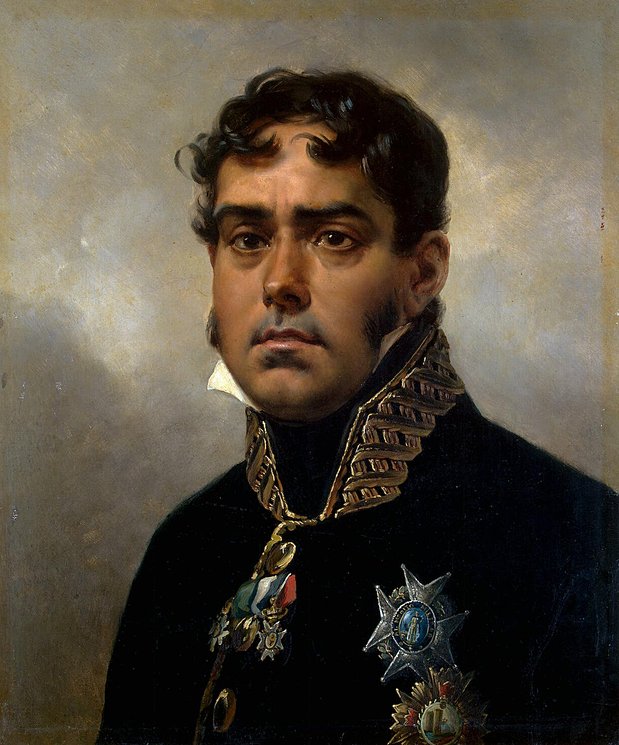
Pablo Morillo
Pablo Morillo
Main page
1580747

Pablo Morillo

logo
Community Hub0 subscribers
Read side by side
from Wikipedia

Pablo Morillo y Morillo, Count of Cartagena and Marquess of La Puerta, a.k.a. El Pacificador (The Pacifier) (5 May 1775 – 27 July 1837) was a Spanish military officer who fought in the Napoleonic Wars and in the Spanish American Independence Wars. He fought against French forces in the Peninsular War, where he gained fame and rose to the rank of Field Marshall for his valiant actions.[1] After the restoration of the Spanish Monarchy, Morillo, then regarded as one of the Spanish Army's most prestigious officers,[2] was named by King Ferdinand VII as commander-in-chief of the Expeditionary Army of Costa Firme with the goal to restore absolutism in Spain's possessions in the Americas.[3]

Key Information

Born to a peasant family in Fuentesecas, Spain, at the age of 16 he joined the Spanish Navy as part of the Spanish Marine Infantry, where fought in the Battle of Cape St. Vincent and the Battle of Trafalgar; both times he would be taken prisoner. After the outbreak of the Peninsular War, Morillo left the Spanish Navy and joined the Spanish Army and fought at the Battle of Bailen under the command of General Castaños; he would also be present at the Battle of Vitoria. He rose through the ranks quickly during the war. His actions at the Battle of Puente Sanpayo won him fame, as he commanded an army that defeated Marshal Ney and forced the French army to evacuate Galicia.[2]

After the end of the war, in 1814, Morillo was named Captain General of Venezuela and given command of an Expeditionary Army to defeat the rebellions in New Granada and Venezuela. This expeditionary force of 60 ships and 10,000 men left Spain in early 1815, arriving in Venezuela in the spring of 1815. Morillo led a successful campaign to reconquer New Granada. His victory at the Siege of Cartagena earned him the title of Count of Cartagena. He successfully reconquered New Granada in 1816 and ordered the execution of various independence leaders as well as the confiscation of their assets.

In 1817, he returned to Venezuela, where Simon Bolivar had begun a new campaign to liberate Venezuela from Spanish rule. He fought Bolivar to a stalemate, then he managed to best him at the Third Battle of La Puerta in 1818, where he was wounded and successfully defended the capital, Caracas, from Boilvar's forces. This earned him the title of Marquess of La Puerta. After the loss of New Granada in 1819, the war shifted, and in 1820 Morillo signed an armistice with Bolivar and later also signed the treaty on "War Regularization." After repeated requests for retirement, Morillo was finally given royal approval and returned to Spain in 1821.[1] After his service in South America he was appointed Captain General of New Castille in May 1821, a position from which he resigned the following year. In 1832 he was appointed captain general of Galicia, a position he left for health reasons in 1835. He died in the French city of Baregés, where he had gone to take medicinal baths, on July 27, 1837.[2]

Early career

[edit]

In 1791, he enlisted in the Real Cuerpo de Infantería de Marina (Spanish Royal Marine Corps) and during the War of the First Coalition participated in the landing operation on San Pietro Island in 1793, as part of the campaign that repelled the French expedition to Sardinia[4] and later that year was wounded at the Siege of Toulon.[4]

During the War of the Pyrenees, he took part in the Siege of Roses (1794–1795).[4]

During the Anglo-Spanish War (1796–1808), Morillo saw action at the Battle of Cape St. Vincent (1797), on board the San Isidro, which was captured and he was taken prisoner.[4] The following October he was promoted to sergeant and sent to Cadiz, where he took part in the defense of the city following the British assault and blockade.[4]

At the Battle of Trafalgar (October 1805), he was wounded while serving on board the San Ildefonso, which was captured. Morillo then spent the following three years at the barracks at Cadiz awaiting an assignment on one of the few Spanish ships that survived the defeat.[4]

Peninsular War

[edit]

With the outbreak of the War, Morillo left the Spanish Navy to enlist in the Llerena Voluntary Corps, in which, given his military experience, he was made a sub-lieutenant. In June 1808, he saw action at the Battle of Bailen[4] and, later that year, saw action at Elvas, Almaraz and Calzada de Oropesa.[4] He was promoted to lieutenant that December.[4] The following January he was promoted to captain and sent to Vigo, in Galicia, where the commander of the French garrison, besieged by guerrilleros, refused to capitulate to civilians and demanded the presence of a high-ranking officer.[4]

Morillo's rank was not accepted, but as the only officer present, the besiegers appointed him their colonel, and he was thus able to negotiate the terms of capitulation.[4] Regarding this incident, Oman (1903), citing various sources, offers a different version of the events at Vigo.[5][note 1]

Following the capitulation of Vigo, Marshal Ney occupied Santiago de Compostela, and headed towards Vigo. Morillo's troops intercepted the French force, and at the Battle of Puente Sanpayo, forced it to retreat.[4]

Spanish American war of independence

[edit]
An engraving made in 1814, with caption "Field Marshall Pablo Morillo of the Royal Armies and Commander-in-chief of the expreditionary troops destined for Montevideo"

Once the war ended and the Spanish monarchy was restored, on August 14, 1814, King Ferdinand VII of Spain appointed Field Marshall Morillo as Commander of the Expeditionary Army of the Americas with the purpose of quashing the rebellion and restoring order in the Viceroyalty of Rio de la Plata. This expeditionary force would be recruited and organized in the port city Cadiz, a large effort was expended to acquire a large number of troops and amount of material that would keep them well supplied, despite this however morale was low and the expedition was unpopular amongst the troops due to the long journey, tropical diseases, and the nature of warfare being conducted in Spanish America. As a result of this sentiment by December 1814 all troops bound for the Americas were restricted to their barracks and heavily monitored to prevent desertion.[6]

On February 17, 1815, Morillo aboard of the ship of the line San Pedro Alcántara set sail from Cadiz bound for Montevideo with a fleet of 18 warships and 42 cargo ships along with some 10,400 troops with the majority of these troops being veterans of the Peninsular War. Unknown to his troops in November 1814 Morillo had been secretly informed that his destination would be changed, the new orders from the Spanish Government were to sail to Costa Firme to put an end to the rebellion in New Granada and Venezuela, with this new mission the King named him Captain General of Venezuela in order to have all of the legal authority in order to reconquest that province.[1] Morillo did not inform his troops of this decision until February 25, 1815, with the expedition well underway at sea which caused his troops to express further discontent as they had heard about how the war in Venezuela was a war to the death, Morillo would also be promoted to Lieutenant General during this journey.[6] On 6 April the Expedition disembarked in Carupano and Isla Margarita off the coast of Venezuela, with the mission to pacify the revolts against the Spanish monarchy in the American colonies. Later, while heading to Cumaná, the San Pedro Alcántara exploded and sank between Coche and Cubagua on April 25. The loss of a thousand crew members and a million pesos that the ship was carrying meant that Morillo quickly traveled to the mainland and left a small garrison in Pampatar. He travelled to La Guaira, Caracas, Puerto Cabello, Santa Marta and Cartagena de Indias (United Provinces of New Granada) in a military campaign to fight Simon Bolívar's revolutionary armies.

Reconquest of New Granada

[edit]
Pablo Morillo (c. 1815), Colombian National Museum

On 22 August 1815, Morillo put the walled city of Cartagena under siege for 105 days,[7] preventing any supplies from going in until 6 December that year, when the Spanish Royal Army entered the city. In a letter written to the Viceroy of Peru José Fernando de Abascal y Sousa dated December 7, Morillo informed the viceroy of the victory with minimal damage done to its fortifications and the capture of a large amount of artillery pieces and ample amounts of gunpowder he also described the level of starvation within the city where estimated that some 2000 Cartagenians where suffering from starvation.[8]

The victory over the republicans in Cartagena led to the King granting Morillo the title Count of Cartagena. With control over Cartagena, Morillo continued with the Reconquest of New Granada marching south from Cartagena into the interior in tandem with Brigadier Juan de Samano's troops marching north from the Royalist strongholds of Quito and Pasto along with Colonel Sebastián de la Calzada's troops marching west from Venezuela. This campaign would culminate with the fall of the capital, Santa Fe, when his second-in-command General Miguel de la Torre assaulted the practically undefended city on May 6, 1816,[9] Morillo himself entered the city on May 26.[1]

Upon entering the capital an amnesty which had been granted by Brigadier de la Torre was revoked, and Morillo began a Reign of Terror in the city.[1] The various leaders and intellectuals who had participated in the Juntas of 1810 and that were part of the Neogranadine independence movement were arrested and tried before a consejo de guerra which judged the accused of treason and rebellion, this resulted in the execution of more than a hundred notable Republican officials with many being executed in the main plaza of Santa Fe such as Camilo Torres Tenorio, Francisco Jose de Caldas, and Jorge Tadeo Lozano as well as countless others.

War in Venezuela

[edit]

He then returned to Venezuela to continue the fight against revolutionaries, where Simón Bolívar had just returned from his exile in Haiti in a renewed effort to liberate Venezuela from Spanish rule. The Venezuelan patriots were able to capture the city of Angostura and made it their capital establishing the Third Republic of Venezuela.

He fought Bolivar forces to a stalemate, then he managed to best him at the Third Battle of La Puerta in 1818, where he was wounded and successfully defended the capital, Caracas, from Boilvar's attack. This earned him the title of Marquess of La Puerta. After the loss of New Granada in 1819, the war shifted, and in 1820 Morillo signed an armistice with Bolivar and later also signed the treaty on "War Regularization."

In June 1820, Morillo, under Royal mandate, ordered that everyone in the colonies obey the Cadiz Constitution and sent delegates to negotiate with Bolivar and his followers. Bolivar and Morillo later met in the Venezuelan town of Santa Ana and signed a six-months' armistice followed by a second one named "War Regularization".

Post-war career

[edit]

Morillo returned to Spain, was named General Captain of New Castile, and supported the Liberal Constitution during the Liberal Triennium. He prevented a coup against the Constitution in 1822, and fought in 1823 the French invasion under Louis-Antoine, Duke of Angoulême in the north of Spain, where he was defeated.

When King Ferdinand VII restored the absolute regime in 1823, Morillo went to France. A few years later, he returned to Spain and participated in some military operations during the Carlist Wars. He felt ill and went back to France where he died on 27 July 1837, in Barèges.

See also

[edit]

Notes

[edit]

References

[edit]

Bibliography

[edit]
[edit]
Revisions and contributorsEdit on WikipediaRead on Wikipedia
from Grokipedia
Pablo Morillo y Morillo, 1st Count of Cartagena (5 May 1775 – 27 July 1837), was a Spanish general of peasant origins who advanced through the ranks of the Marine Infantry to lead royalist campaigns against French invaders in the Peninsular War and later spearhead the reconquest of northern South American territories during the independence revolts.[1][2] Morillo's military career began at age 16 in the Spanish Navy, where he participated in naval engagements before transferring to infantry roles amid the Napoleonic invasions; his valor in battles such as those in the Peninsular War earned rapid promotions to colonel by 1814.[3] In 1815, King Ferdinand VII appointed the 40-year-old lieutenant colonel to command a 10,000-man expeditionary force—the largest dispatched to the Americas—as Captain General of Venezuela and "Pacificador de América," tasking him with crushing separatist insurgencies in New Granada and Venezuela through decisive action and exemplary punishments.[4] His forces besieged and captured key strongholds like Cartagena de Indias after 105 days of resistance in 1815, followed by occupations of Bogotá and other cities, temporarily restoring Spanish control via scorched-earth tactics, mass executions of rebel leaders, and forced loyalty oaths that quelled uprisings but provoked widespread resentment.[5] Despite these tactical victories, Morillo faced mounting guerrilla warfare, logistical strains, and shifting alliances, culminating in a 1820 armistice with Simón Bolívar that allowed patriot forces to regroup; recalled amid Spain's own liberal revolution, he later supported the Trienio Liberal constitution and commanded against absolutist coups before dying in exile.[2] His campaigns highlighted the limits of metropolitan military projection against entrenched colonial dissent, contributing to Spain's eventual loss of empire, though contemporary accounts credit his strategic acumen and discipline for prolonging royalist holdouts amid what he viewed as anarchic rebellion.[3]

Early Life and Entry into Military Service

Family Origins and Initial Enlistment

Pablo Morillo y Morillo was born on 5 May 1775 in Fuentesecas, a small rural village in the province of Zamora, in the Kingdom of Spain's Castile and León region, to a family of peasants engaged in subsistence agriculture.[6] His humble origins provided no access to formal education or noble patronage, reflecting the socioeconomic constraints typical of rural Castilian families during the late Ancien Régime, where military service offered one pathway for social mobility to those without resources.[7] At age 16, Morillo enlisted in 1791 as a soldado (common infantryman) in the Real Cuerpo de Marina, Spain's Royal Marine Corps, an elite naval infantry unit under the Ministry of the Navy responsible for shipboard combat and amphibious operations. This initial service marked his entry into professional soldiery amid Spain's involvement in the French Revolutionary Wars, where recruits from modest backgrounds like his often filled the ranks through voluntary enlistment driven by economic necessity or patriotic incentives.[8] His rapid progression from enlisted man underscores the meritocratic elements within Spanish military structures of the era, though constrained by the era's high casualty rates and limited officer paths for non-nobles.[7]

Service in the French Revolutionary Wars

Morillo enlisted in the Real Cuerpo de Infantería de Marina (Royal Marine Infantry Corps) in 1791 at the age of 13.[9] During the French Revolutionary Wars (1792–1802), he served in naval battalions as an enlisted marine infantryman, participating in Spain's coalitions against revolutionary France, including the War of the Pyrenees (1793–1795) and subsequent naval confrontations amid shifting alliances.[3] His roles involved coastal defense and amphibious operations, where marine units supported land campaigns like the failed Spanish invasion of Roussillon and the defense against French counteroffensives that culminated in the Treaty of Basel on 22 July 1795.[10] Morillo advanced to corporal and sergeant, gaining a reputation for bravery in these engagements despite the overall Spanish setbacks, including the loss of dominance in the Mediterranean following defeats in the Anglo-Spanish War from 1796 onward.[10] By the wars' end, his experience as a non-commissioned officer in disciplined marine formations had honed his tactical acumen, though detailed personal exploits from this era remain sparsely documented compared to his later commands.[9]

Campaigns in the Peninsular War

Key Battles and Rise to Prominence

Morillo's military prominence in the Peninsular War began shortly after the French invasion of Spain in 1808, when he transitioned from naval service to the army and participated in the Battle of Bailén on July 16–19, 1808, contributing to the decisive Spanish victory over General Pierre Dupont's forces that forced the surrender of 17,000 French troops.[4] This early success highlighted his leadership, leading to his rapid advancement to colonel.[11] His defining moment came at the Battle of Ponte Sampaio from June 7 to 9, 1809, where, commanding approximately 6,000 Spanish irregulars and militia in Galicia, Morillo outmaneuvered and defeated Marshal Michel Ney's 12,000-strong French corps, inflicting heavy casualties and compelling the French to abandon the region entirely. The victory, achieved through ambushes and exploitation of terrain despite numerical inferiority, liberated Galicia and earned Morillo promotion to brigadier general, marking his rise from obscurity to national recognition as a capable guerrilla leader against Napoleonic occupation.[4] Subsequent operations in northern Spain included participation in the recapture of Burgos in 1812 and engagements against Marshal Géraud Duroc's forces, further solidifying his reputation for tenacity in irregular warfare.[12] By 1813, as a major general, Morillo led a Spanish division of about 4,500 men under Sir Rowland Hill's corps during the Battle of Vitoria on June 21, 1813, advancing on the French right flank alongside British and Portuguese units to contribute to the rout of Joseph Bonaparte's 60,000-man army, which lost 8,000 killed or wounded and vast supplies in the Allies' largest victory of the campaign.[13] These actions propelled his meteoric ascent to field marshal by war's end in 1814, positioning him as one of Spain's most trusted commanders for future expeditions.[4]

Contributions to Spanish Resistance Against French Occupation

Upon the outbreak of the Peninsular War in May 1808 following the French invasion and abdication of the Spanish Bourbons, Morillo transitioned from naval service to the army, participating in the Battle of Bailén from 16 to 19 July 1808. Under General Castaños, he contributed to the Spanish victory that encircled and forced the surrender of General Dupont's 20,000-man corps, resulting in over 17,000 French prisoners and marking the first major open-field defeat of Napoleonic forces in Europe.[11] This engagement elevated Morillo from enlisted marine to officer at age 30, recognizing his demonstrated leadership and loyalty amid the collapse of regular Spanish units.[11] Relocating to northern Spain, Morillo organized guerrilla operations in Cantabria, coordinating regular troops with local militias to harass French supply lines and garrisons during the French consolidation of Old Castile and Aragon in late 1808. His irregular tactics disrupted enemy foraging and communications, complementing broader resistance efforts that tied down thousands of French troops needed elsewhere. By early 1809, promoted to colonel, Morillo led Galician forces in pursuing Marshal Soult's retreating army after its failed invasion of Portugal.[12] Morillo's pivotal contribution came at the Battle of Puente Sanpayo (Ponte Sampaio) from 7 to 9 June 1809, where his command of approximately 10,000 Spanish regulars and militia intercepted Soult's 10,000-man corps withdrawing from Galicia toward Orense. Despite inferior artillery, Morillo's forces exploited the narrow bridge and terrain, inflicting around 660 French casualties while suffering 110, compelling Soult's evacuation of the region and preventing French reoccupation of northwestern Spain.[14] This victory, achieved through bold maneuvering and integration of local knowledge, earned Morillo rapid promotions, culminating in field marshal rank by war's end in 1814 for sustained valor against superior French numbers.[11] His efforts in these northern campaigns bolstered Spanish morale and logistics for allied advances, contributing to the eventual French expulsion.[4]

Expedition to Spanish America

Assembly of the 1815 Expeditionary Force

Following Ferdinand VII's restoration to the Spanish throne in 1814, the government initiated preparations for a large-scale military expedition to suppress independence insurgencies in the Americas, prioritizing the northern regions of Tierra Firme. Pablo Morillo, a field marshal distinguished in the Peninsular War, was appointed commander on August 24, 1814, and promoted to lieutenant general, with explicit orders to restore royal authority through pacification and, if necessary, severe measures against rebels.[4][11] Assembly occurred primarily in Cádiz during late 1814 and early 1815, drawing on demobilized veterans from the Napoleonic campaigns, supplemented by fresh recruits to form a professional force of approximately 10,000 soldiers, including infantry battalions, artillery detachments, and limited cavalry elements adapted for overseas service. The expedition benefited from the availability of seasoned troops freed by the war's end, though preparations faced internal political frictions between absolutist and liberal factions within the army. Logistics emphasized ample supplies, munitions, and funding from the royal treasury to sustain extended operations.[4][11][7] The naval escort comprised 60 vessels, with 18 warships providing convoy protection and 42 transports for personnel and equipment, commanded by Rear Admiral Juan de los Pozos y Uriarte. Originally intended for the Río de la Plata, the fleet's orders were altered en route to target Venezuela and New Granada, a decision Ferdinand VII confirmed publicly on May 9, 1815. On February 17, 1815, the armada departed Cádiz, with Morillo aboard the ship-of-the-line San Pedro Alcántara, marking the largest Spanish transatlantic deployment since the early colonial era.[11][15]

Siege and Reconquest of Cartagena and New Granada

In mid-1815, following the arrival of his expeditionary force in Venezuela, Pablo Morillo directed operations toward Cartagena de Indias, a fortified stronghold in New Granada held by patriot forces. Departing Puerto Cabello on July 12, 1815, Morillo's fleet sailed to Santa Marta before advancing southward, disembarking troops north of Cartagena on August 19.[2] He established headquarters on La Torecilla hill and initiated the siege on August 22 (or mid-August by some accounts), deploying artillery and blocking supply lines to starve the defenders.[16][5] The siege lasted 105 days, with Morillo commanding approximately 6,000-7,000 troops against a garrison of about 4,000 under General Manuel del Castillo y Rada, bolstered by civilian irregulars. Spanish forces encircled the city in an arc, utilizing naval blockade and land batteries to bombard fortifications like the Castillo de San Fernando de Bocachica, while patriot sorties and internal divisions hampered resistance. Disease, famine, and ammunition shortages decimated the defenders, leading to Castillo's surrender on December 6, 1815; terms included amnesty for most combatants but execution of key leaders deemed responsible for prior atrocities against royalists.[5][17][18] With Cartagena secured as a base, Morillo launched the reconquest of New Granada in early 1816, dividing his army into columns to advance inland. Royalist forces, reinforced by local loyalists, swiftly subdued fragmented patriot remnants weakened by the "Guerra a Muerte" civil strife of 1813-1814. Key victories included the capture of Santa Fe de Bogotá on May 6, 1816, after minimal resistance, and the subjugation of Popayán and other highland centers by summer, restoring Spanish control over most of the viceroyalty by mid-1816 with relatively few pitched battles.[18][19] Morillo's strategy emphasized rapid maneuver and psychological warfare, including proclamations offering clemency to induce defections, though subsequent reprisals against independence leaders—such as the execution of nine patriots on February 24, 1816—underscored the campaign's severity.[2][5]

Operations in Venezuela and Negotiations

Military Engagements Against Independence Forces

Upon landing in Venezuela on April 5, 1815, with an expeditionary force of about 10,000 veteran troops, Morillo rapidly engaged scattered patriot detachments along the central coast, leveraging superior discipline and artillery to secure royalist control over key ports like Puerto Cabello and La Guaira without major pitched battles.[20] By May 11, 1815, his forces entered Caracas, where local authorities capitulated amid the collapse of patriot resistance in the region, marking the effective reconquest of the Venezuelan heartland.[20] Morillo then coordinated with royalist commander Francisco Tomás Morales to suppress independence forces in eastern Venezuela, dispatching detachments that dispersed patriot units under Juan Bautista Arismendi and Santiago Mariño operating from Margarita Island and Cumana.[2] These operations, involving amphibious landings and rapid maneuvers, culminated in the royalist reoccupation of Cumana by late April 1815 and the neutralization of rebel concentrations by mid-year, forcing many patriots into guerrilla retreats or exile. In July 1815, prior to shifting primary efforts to the siege of Cartagena in New Granada, Morillo reinforced Morales's campaign against remaining patriot holdouts in Barcelona and the Orinoco delta, achieving tactical victories that fragmented independence leadership and restored Spanish administrative control over most settled areas of Venezuela by year's end.[2] These engagements, characterized by royalist exploitation of numerical superiority (often 2:1 or greater against irregular patriot bands) and supply interdiction, resulted in the capture or execution of several mid-level rebel commanders, though llanero cavalry under José Antonio Páez evaded decisive defeat in the plains.[3] Returning from New Granada in 1816, Morillo oversaw renewed offensives against resurgent patriot activity, including operations to contain Páez's llaneros in Apure and Barinas provinces, where royalist columns inflicted heavy casualties in skirmishes but struggled against mobile guerrilla tactics amid harsh terrain and disease.[21] By 1817, these efforts had stabilized royalist dominance in urban and coastal zones, though persistent low-intensity conflicts drained resources and foreshadowed the armistice phase.[2]

Armistice with Simón Bolívar and Withdrawal

In 1820, amid mounting royalist setbacks in Venezuela and the destabilizing effects of Rafael Riego's liberal pronunciamiento in Spain earlier that year, which undermined Ferdinand VII's absolute authority and troop morale, Pablo Morillo initiated negotiations with Simón Bolívar to suspend hostilities.[2] Bolívar, operating from Trujillo, proposed terms on October 26, prompting Morillo to agree to an armistice that moderated the brutal "war to the death" practices initiated by Bolívar's 1813 decree.[2] The Armistice of Trujillo was formally signed on November 25, 1820, establishing a six-month ceasefire, facilitating prisoner exchanges (including the release of sick and wounded captives), and committing both sides to a convention regulating warfare to align with European norms, thereby granting patriot forces formal belligerent status and halting summary executions.[22][23] On November 27, Morillo and Bolívar met personally at Santa Ana de Trujillo to ratify the accords, exchanging symbolic gestures of respect amid mutual exhaustion from prolonged conflict; this encounter, later commemorated as the "Embrace of Trujillo," underscored the armistice's aim to humanize the war but did not resolve underlying independence demands.[24] The agreement enabled Bolívar to consolidate forces and import arms via British merchants, while Morillo used the respite to evacuate non-combatants and reorganize loyalist units, though it exposed royalist vulnerabilities as patriot recruitment surged.[25] Despite these provisions, the truce proved temporary, with skirmishes persisting and full-scale fighting resuming by mid-1821 after Spanish commissioners failed to offer concessions on autonomy. Disillusioned by logistical strains, disease-ravaged troops (with estimates of over 20,000 expeditionary losses since 1815), and Spain's internal turmoil, Morillo repeatedly petitioned Ferdinand VII for relief from command, citing the campaign's futility without reinforcements.[4] Royal approval arrived in late 1820, prompting him to transfer authority to Lieutenant General Miguel de la Torre on December 17, 1820, before sailing from La Guaira for Spain, marking the effective withdrawal of his direct leadership from the American theater.[26] This handover left royalists fragmented, contributing to defeats like Carabobo in June 1821, as la Torre lacked Morillo's tactical acumen and faced unified patriot offensives bolstered by the armistice's interlude.[4]

Return to Spain and Post-War Activities

Support for the Liberal Trienio and Political Involvement

Upon returning to Spain in late 1820 after negotiating the armistice with Simón Bolívar, Pablo Morillo received noble titles including Conde de Cartagena and Marqués de la Puerta, and was appointed Captain General of New Castile (Castilla la Nueva).[11] This position placed him in a key administrative and military role amid the political upheaval of the Trienio Liberal (1820–1823), a period initiated by Rafael del Riego's mutiny in January 1820 that compelled King Ferdinand VII to restore the Constitution of 1812 on March 7, 1820.[27] Morillo aligned with the liberal constitutional regime, supporting its efforts to implement parliamentary governance and curb absolutist resurgence.[11] His prior instructions from the Cortes-influenced government in Spain to negotiate with American independence leaders on constitutional terms—evident in the November 1820 armistice offering regularization based on the 1812 charter—reflected this orientation, marking a shift from reconquest to conditional reconciliation.[11] As Captain General, he assumed responsibilities in a moderate liberal faction (moderados) that sought to stabilize the regime against radical exaltado elements while defending against royalist plots, contributing to the consolidation of liberal authority in central Spain.[28] In 1823, as French forces under Louis-Antoine, Duke of Angoulême, invaded to enforce the Congress of Verona's mandate and restore Ferdinand VII's absolute monarchy—entering Spain on April 7 and capturing key cities by May—Morillo commanded liberal troops in northern Spain against the intervention. His forces engaged but ultimately retreated before the superior coalition, leading to the regime's collapse by October 1823; Morillo then withdrew to France to avoid persecution under the restored absolutism. This involvement underscored his commitment to constitutionalism over unconditional royal loyalty during the Trienio, though it ended in exile rather than sustained political office.[11]

Participation in the First Carlist War

Upon the death of Ferdinand VII on September 29, 1833, which precipitated the First Carlist War through disputes over succession, Morillo, who had been in exile following the absolutist restoration, returned to Spain and aligned himself with the regency of Maria Christina in support of Isabella II against the Carlist pretender Don Carlos.[29] His prior experience in counterinsurgency campaigns, including against South American independence forces, positioned him to assume military commands aimed at suppressing early Carlist uprisings, particularly in northern and eastern regions where traditionalist sentiments were strong.[30] Morillo's efforts focused on organizing loyalist forces and conducting initial defensive operations to secure government control amid the fragmented outbreaks of Carlist rebellion that began in October 1833.[31] By 1836, at age 61, Morillo's declining health—exacerbated by decades of campaigning—limited his active field role, leading to his effective retirement from command, though he remained symbolically committed to the isabelino cause against Carlist absolutism.[32] He departed Spain for France, where he died on July 27, 1837, in Barèges, before the war's major escalations in the Basque Country and Catalonia.[29] His brief involvement underscored a continuity of loyalty to the Bourbon dynasty's designated heir, despite his earlier liberal affiliations during the Trienio Constitucional (1820–1823), reflecting pragmatic adaptation to the regency's constitutionalist framework against Carlist traditionalism.[31]

Controversies, Assessments, and Legacy

Criticisms of Harsh Measures and Executions

Morillo's reconquest of New Granada in May 1816 involved the establishment of military tribunals that sentenced numerous independence leaders to death, prompting accusations of implementing a reign of terror in Bogotá (Santafé de Bogotá).[33] Prominent figures such as Camilo Torres Tenorio, president of the short-lived United Provinces of New Granada, along with Manuel Rodríguez Torices and Pedro Felipe Valencia, were subjected to rapid trials and executed by firing squad on October 5, 1816, following Morillo's orders to suppress residual rebel activity.[34] These actions were criticized by contemporaries and later historians aligned with independence narratives as disproportionate retribution against intellectuals and political figures, rather than strictly military threats.[11] Further condemnation arose from the execution of Francisco José de Caldas, a renowned Colombian scientist and cartographer, on October 28, 1816, despite pleas for clemency highlighting his non-combatant status and contributions to exact sciences.[35] British traveler and observer Michael Quin described the killing as "wanton cruelty," arguing it deprived humanity of valuable knowledge in mathematics and philosophy, while Venezuelan historical memory has enshrined Morillo as a tyrant for targeting such civilians alongside political leaders like Torres.[35][11] Critics, including pro-independence chroniclers, contended that these summary executions—totaling dozens of patriots via councils of war—exceeded military necessity, fostering resentment that undermined long-term pacification efforts.[3] In Venezuela, Morillo's subsequent operations from 1816 to 1818 extended similar punitive measures, including asset confiscations and executions of captured insurgents, which royalist accounts justified as countermeasures to Simón Bolívar's 1813 Decree of War to the Death—a policy mandating the extermination of Spaniards and Canarians found in rebel-held areas, resulting in hundreds of civilian deaths. Nonetheless, independence sympathizers decried Morillo's reciprocity as mirroring the very brutality he aimed to suppress, with policies like declaring rebels pirates and authorizing immediate hangings for armed resisters amplifying perceptions of excessive severity.[36][3] Such criticisms persist in regional historiography, where Morillo's methods are often contrasted with his initial proclamations of clemency, revealing a strategic shift toward deterrence amid ongoing guerrilla warfare.[11]

Evaluations of Strategic Successes and Loyalty to the Crown

Morillo's military campaigns from 1815 to 1816 demonstrated notable operational successes, including the prolonged siege and capture of Cartagena de Indias, which lasted 105 days and culminated in the city's surrender on February 6, 1816, restoring Spanish control over key coastal fortifications in New Granada.[18] This victory, achieved with an expeditionary force of approximately 10,000 to 12,000 troops dispatched by Ferdinand VII, enabled subsequent advances that reconquered Bogotá by June 1816 and much of New Granada, effectively dismantling patriot resistance in the viceroyalty within months.[11] Historians have credited these outcomes to Morillo's logistical planning and disciplined use of combined arms, contrasting with the disorganized patriot forces, though sustained control proved elusive due to guerrilla tactics and terrain challenges.[3] In Venezuela, Morillo extended operations against Simón Bolívar's remnants, securing provisional royalist dominance by early 1817 through coordinated offensives that neutralized urban centers and llanero irregulars temporarily.[21] These achievements earned him the title Conde de Cartagena from Ferdinand VII, reflecting crown recognition of his role in reestablishing authority amid prior independence gains.[11] However, strategic evaluations highlight limitations: despite tactical victories, Morillo's forces faced attrition from disease, desertions, and supply shortages, preventing a decisive eradication of independence movements; by 1819, patriot counteroffensives under Bolívar eroded these gains, underscoring how initial reconquests failed to address underlying colonial grievances or secure long-term loyalty.[37] Morillo's adherence to crown directives affirmed his loyalty to Ferdinand VII, as evidenced by his appointment as Pacificador de Tierra Firme and implementation of policies aimed at restoring monarchical order, including amnesties intertwined with punitive measures against insurgents.[3] The 1820 armistice with Bolívar, signed on November 25 following Spain's Riego pronunciamiento, was executed under explicit instructions from Madrid to seek regularization amid domestic liberal pressures, prioritizing preservation of remaining holdings over unconditional victory; critics within royalist circles viewed it as overly conciliatory, yet it aligned with Ferdinand's shifting imperatives to avoid total collapse.[38] Overall assessments portray Morillo as a capable executor of absolutist aims, whose loyalty persisted despite strategic setbacks, with his return to Spain in 1821 reinforcing commitments to the regime rather than defection.[11]

References

User Avatar
No comments yet.