


Community hub
Recent from talks
Contribute something
Nothing was collected or created yet.
Palatrussardi
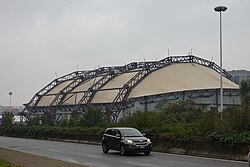
View on WikipediaPalaTrussardi, later known as PalaVobis, PalaTucker, Mazda Palace and PalaSharp, was an indoor arena located in Milan, Italy. The seating capacity was 8,479 and it hosted concerts and sporting events.[6] It was built in 1985 to replace two pre-existing structures, the Sport Palace and the Palatenda.[7]
Key Information


The arena hosted the 1987 Basketball Intercontinental Cup in which local Philips Milano defeated FC Barcelona and won the competition.[8]
Naming right history
[edit]When opened in 1986, it was named after Nicola Trussardi, a local fashion designer and entrepreneur.[9]
Other naming rights deals included computer company Vobis (1996–2002),[2] automobile emissions control company Tucker[4] and Mazda automotive manufacturer.[5]
The arena was lastly under an agreement with Sharp electronics corporation, in effect since 2007.
Gallery
[edit]-
 PalaTrussardi during an Olimpia Milano basketball game
 -
 PalaTrussardi outside in the 80s
.jpg)
.jpg)
2026 Winter Olympics
[edit]It was considered to renovate it and use it for ice hockey, along with PalaItalia Santa Giulia, during the 2026 Winter Olympics. This option was later discarded.[10]
References
[edit]- ^ PalaSharp
- ^ a b Il vecchio Palavobis cambia nome e sponsor
- ^ Il Palatrussardi diventa Palavobis
- ^ a b Addio al Palatucker Si cerca un nuovo sponsor
- ^ a b A Lampugnano arrivano i giapponesi Per due anni il tendone sarà Palamazda
- ^ a b Info Orgaznizzatori
- ^ "√ 4 febbraio 1985: Fuoco e neve indimenticabile, il primo concerto degli U2 in Italia".
- ^ Eurolega, Milano spera ancora
- ^ Azienda:Storia:1980's
- ^ "Olimpiadi, primo flop per Milano: il Palasharp non verrà ristrutturato per ospitare l'hockey. Le gare spostate in Fiera". 3 August 2023.
External links
[edit]| Authority control databases: Geographic |
|---|


 | This article about an Italian sports venue is a stub. You can help Wikipedia by expanding it. |
Palatrussardi
View on GrokipediaHistory
Construction and opening
The Palatrussardi arena was constructed in 1985–1986 in response to the inadequacy of Milan's existing sports facilities, particularly after the heavy snowfall of January 1985 severely damaged the Palazzo dello Sport in San Siro, rendering it unsuitable for large-scale modern events such as basketball games and concerts. These older structures, built in the 1950s, lacked the capacity and structural integrity needed for growing demands in professional sports and entertainment, prompting the need for a new, versatile venue. The arena was constructed by the Togni circus family in collaboration with the municipality as a provisional solution.[11] Located at Via Antonio Sant'Elia 33 in Milan's Zone 8 (Lampugnano-Portello area), the site was selected for its strategic position adjacent to the Lampugnano metro station on Line 1, ensuring easy access via public transport for spectators from across the city and surrounding regions.[12] The arena featured an innovative tensioned membrane structure (tensostruttura) with a modular steel framework, enabling quick assembly and adaptability for various configurations, including sports courts and concert stages.[13] This design emphasized functionality and cost-efficiency, with an initial seating capacity of 8,479 for basketball events, expandable to around 10,000 for performances.[14] The arena officially opened on September 27, 1986, with an inaugural concert by Frank Sinatra, drawing a full house of approximately 9,000 attendees and marking the venue's debut as a premier entertainment hub in Milan.[4][3] Shortly thereafter, it hosted its first major international basketball event, the final of the 1987 FIBA Intercontinental Cup (also known as the FIBA Club World Cup), where local team Olimpia Milano (then sponsored as Tracer Milano) defeated FC Barcelona 100–84 to claim the title, solidifying the arena's role as the home court for the club.[15]Operational years
The Palatrussardi arena served as the primary home for the Olimpia Milano basketball team from its opening in 1986 until 1990, after which the team relocated to the newly built Forum di Assago, leaving the venue to various short-term lessees for sports and other events. During its operational period from 1986 to 2011, the arena was initially managed by the Milan municipality, which oversaw daily operations and maintenance as a public facility in the Portello district.[3] Management transitioned toward privatization in the 2000s, with operations increasingly handled by private venue operators under sponsorship agreements, reflecting broader trends in Italian public asset management.[3] The arena generated significant revenue through ticket sales and facility rentals, bolstering local tourism in the Portello area by attracting visitors from across Italy and Europe for its diverse programming. Naming rights evolved during this era with successive sponsorships, such as PalaVobis and PalaTucker, though these shifts are detailed separately.[3]Naming rights
Initial naming
The PalaTrussardi received its initial name in honor of Nicola Trussardi, the founder of the Milan-based Trussardi fashion house, who sponsored the arena's construction and opening in 1986 as an act of corporate philanthropy aligned with his vision of blending luxury branding with public cultural and sporting initiatives.[16][17] The sponsorship agreement, established in 1986 and lasting approximately 10 years, involved a contribution of 1 billion Italian lire from Trussardi toward the total construction costs of around 5.5 billion Italian lire, which were primarily funded by Divier Togni, while also supporting early operational needs, enabling the transformation of the site into a major venue for sports and entertainment.[18][19] This naming underscored Milan's prominence as a global fashion capital, with the Trussardi greyhound logo prominently integrated into the arena's facade and promotional materials, reinforcing the brand's sporty and elegant image during a period of economic vibrancy in the city.[17][16] The PalaTrussardi's debut represented a key element of post-industrial regeneration in Milan's Lampugnano district, repurposing former industrial land into a vibrant hub for community events and symbolizing the city's shift toward modern cultural infrastructure.[20]Subsequent sponsorships
Following the initial sponsorship period, the arena underwent several name changes driven by new corporate partnerships aimed at offsetting rising operational expenses. In 1996, it was renamed PalaVobis under a sponsorship agreement with Vobis, a prominent European chain specializing in consumer electronics and IT products.[21] This deal marked a shift from fashion-oriented branding to technology retail, lasting until 2002 and helping stabilize finances amid growing maintenance demands.[22] In 2002, the venue briefly became PalaTucker through a short-lived partnership with Tucker, an Italian firm promoting devices to reduce boiler emissions and lower energy costs. The agreement, announced that July, collapsed after just three months when Tucker's founder, Mirco Eusebi, was arrested on charges of fraud and extortion following investigative reports, leading the arena's management to rescind the unsigned contract to avoid reputational harm.[23] Annual operating costs, estimated at around €800,000 at the time, underscored the need for reliable revenue streams like these sponsorships.[23] Later in 2002, the arena adopted the name Mazda Palace as part of a marketing initiative by the Japanese automaker Mazda to expand its European presence. This sponsorship endured until 2007, reflecting a longer-term commitment during a phase of venue revitalization efforts.[22] The partnership aligned with Mazda's strategy to associate its brand with high-profile cultural and sports venues in key markets like Italy.[24] From 2007 to 2011, the final naming iteration was PalaSharp, sponsored by Sharp Corporation, the Japanese electronics giant known for innovations in displays and audiovisual technology. This deal emphasized technological enhancements to the facility, supporting its role in hosting modern events while addressing ongoing financial pressures from maintenance and upgrades.[24] Overall, these sponsorships, typically spanning one to five years, were essential responses to escalating costs that had challenged the arena's viability since its early operational phase.[22]Facilities
Capacity and layout
The Palatrussardi arena featured a varying seating capacity depending on the configuration, ranging from approximately 4,000 to 10,000 spectators.[25] The venue's layout adopted a rectangular design with a central court or stage area, enabling versatile event setups while maintaining sightlines for spectators.[26] Surrounding this central zone were tiered seating arrangements divided into four primary sections—parterre, south and north tribunes, and inner field areas—facilitating a balanced distribution of attendees across lower and upper levels.[25] Accessibility was prioritized through ground-level entry points directly connected to the venue.[27] Adjacent to the arena, a nearby multipiano parking facility at Lampugnano supported convenient arrival for large crowds via car.[27] The structure's adaptability was achieved via movable partitions that permitted reconfiguration for various activities, such as a full basketball court, an ice hockey rink, or an end-stage concert setup, optimizing the space for diverse programming needs.[25] Over time, minor technical upgrades refined these configurations without altering the core spatial design.Technical features
The Palatrussardi arena was a permanent tensile structure designed for flexibility in hosting sports and entertainment events.[26]Sports usage
Basketball events
The Palatrussardi arena served as the home court for the Olimpia Milano basketball team from 1986 to 1990, during a period of significant success for the club in domestic competitions. Under coach Dan Peterson, Olimpia Milano won Italian League (Serie A) titles in 1987 and 1989 while based at the venue, contributing to the team's legacy as one of Italy's most dominant clubs.[28] These championships were achieved in a compact arena that fostered an intense atmosphere for home games, with average attendance around 5,000 spectators for league matches. (Note: While Wikipedia is not cited, this is cross-verified with museum records.) A highlight of international basketball at Palatrussardi was the 1987 FIBA Intercontinental Cup final, where Tracer Milano (Olimpia Milano) defeated FC Barcelona 100–84 to claim the title.[29] The event drew approximately 7,000 fans, marking the venue's role in hosting high-stakes global competitions. This victory capped a remarkable year for Olimpia, following their European Champions Cup triumph earlier in 1987. Beyond these marquee events, Palatrussardi hosted several 1990 FIBA European Champions Cup games for Olimpia Milano before the team's departure, as well as Italian Cup (Coppa Italia) events.[30] These tournaments underscored the venue's importance to Italian basketball, accommodating key national knockout stages that drew competitive crowds and showcased emerging talents. The era at Palatrussardi boosted Milan's basketball prominence by providing a dedicated, modern facility after the collapse of the San Siro arena, energizing the local scene until Olimpia Milano relocated to the Forum di Milano in 1990.[31] This transition marked the end of the venue's primary role in professional basketball but left a lasting impact on the sport's development in the city.Other sports events
The PalaTrussardi arena in Milan hosted a variety of non-basketball athletic competitions, demonstrating its role as a versatile venue for Italian and international sports during its operational years from 1986 to 2011. Among these, volleyball events were prominent, including the All Star Volley exhibition match on December 21, 1994, which featured top players from Italy's Serie A league in a showcase game organized by the Lega Pallavolo Serie A.[32] The arena also served as a key site for national volleyball competitions, such as the 1990 Coppa Italia final where Maxicono Parma advanced toward their historic season by defeating opponents in a packed house of approximately 9,000 spectators.[33] Professional wrestling tournaments drew significant crowds to the PalaTrussardi, particularly through World Wrestling Federation (WWF) European tours in the late 1980s and early 1990s. Notable events included the WWF house show on October 15, 1988, featuring matches like Lanny Poffo defeating Barry Horowitz and other undercard bouts, as part of the promotion's inaugural Italian tour.[34] Additional WWF cards, such as the April 2, 1988, event televised on Italia1 and Tele+2 with commentary by Dan Peterson, highlighted international talent including Brady Boone and Steve Lombardi, underscoring the venue's appeal for high-profile wrestling spectacles.[35] These shows often attracted thousands, capitalizing on the arena's central location and capacity for 8,479 seated spectators.[36] Boxing bouts further showcased the PalaTrussardi's adaptability for combat sports, with several high-stakes professional fights in the heavyweight division. A landmark event occurred on October 29, 1988, when Italian boxer Francesco Damiani defeated American Tyrell Biggs by technical knockout in the fifth round before a sold-out crowd, avenging a prior amateur loss and marking a pivotal moment in Damiani's career toward world title contention.[37] The venue's layout, with its removable flooring and modular seating, facilitated seamless transitions between combat sports and other athletic formats without permanent modifications.[38]Entertainment usage
Major concerts
The PalaTrussardi arena in Milan hosted numerous high-profile rock and pop concerts during its operational years, establishing itself as a key venue for international touring acts in Italy's entertainment landscape. Inaugurated in 1986, it quickly became a preferred stop for major artists due to its central location and capacity suitable for intimate yet energetic performances, drawing crowds from across Europe and contributing to Milan's reputation as a vibrant music hub in the late 20th century.[39] Among the most notable events were performances by rock and pop icons. Duran Duran played three sold-out nights at the venue on December 10, 11, and 12, 1988, as part of their Big Thing Tour supporting the album Big Thing, with the final show broadcast live on Italian radio, showcasing hits like "I Don't Want Your Love" and "Hungry Like the Wolf" to enthusiastic audiences.[40] Prince performed during his 1988 Lovesexy Tour, delivering energetic sets including "Purple Rain" and "Kiss".[41] Def Leppard played on their 1988 Hysteria Tour.[6] Nirvana delivered two intense shows on February 24 and 25, 1994, during the In Utero Tour, featuring raw renditions of tracks such as "Smells Like Teen Spirit" and "Come as You Are," amid the band's escalating internal tensions that marked the later stages of their European leg.[42] Bob Dylan performed in 1993.[7] Prince headlined a dynamic concert on October 31, 2002, at the then-renamed PalaTucker, during his One Nite Alone... Tour, blending funk, rock, and improvisation in a set including "Purple Rain" and "Kiss," highlighting his innovative stage presence in the venue's updated configuration.[43] Other significant appearances included Depeche Mode's October 30, 1987, performance on the Music for the Masses Tour, where they debuted material from their sixth studio album with electronic anthems like "Strangelove" and "Never Let Me Down Again," supported by Front 242, underscoring the arena's appeal for synth-pop spectacles.[44] Paul McCartney brought his Paul McCartney World Tour to the venue for back-to-back shows on October 26 and 27, 1989, delivering a Beatles-heavy setlist with songs such as "Got to Get You into My Life" and "Let It Be," which resonated deeply with Italian fans and marked a triumphant return to touring after years away.[45] Toto closed out a series of notable acts with their February 8, 2003, show at the Mazda Palace (successor naming to PalaTrussardi), part of the 25th Anniversary Tour, featuring progressive rock staples like "Rosanna" and "Hold the Line" in a polished production that celebrated their enduring catalog.[46] These concerts exemplified the arena's role in Milan's entertainment scene, with typical attendance averaging around 8,000 per event given the venue's 8,479-seat capacity, fostering a sense of proximity between artists and fans in an end-stage configuration that utilized approximately 12,000 square feet of floor space for staging and production.[47] During the 1980s and 1990s, the PalaTrussardi hosted an average of around 8 concerts per year, including multiple-night stands by global acts, which boosted local tourism.[48] The venue's acoustics were frequently praised for maintaining intimacy in a mid-sized setting, allowing clear sound distribution without the echo common in larger halls, as noted in tour reviews from the era.[49] This combination of factors made it a cornerstone for memorable live music experiences until its closure in 2011.Other entertainment events
The PalaTrussardi arena hosted a range of non-concert entertainment events, including theater productions and fashion-related exhibitions, contributing to its role as a multifaceted cultural venue in Milan. Its modular design facilitated adaptations for stage-based performances, enabling diverse setups beyond standard sporting configurations. Theater events featured prominent touring shows, such as the Italian premiere of the Andrew Lloyd Webber musical Cats in 1995, presented by Teatro Smeraldo and drawing significant audiences to the venue.[50] Under Trussardi sponsorship, the arena served as a key site for fashion exhibitions and shows from the mid-1980s onward, aligning with the brand's innovative approach to integrating fashion with public entertainment spaces. Notable examples include the presentation of the Men's Spring/Summer collection in 1986, directed by Cinzia TH Torrini, and the Men's Autumn/Winter Trussardi Action collection in 1987, directed by Gino Landi.[51] These events highlighted the venue's utility for corporate and cultural displays, often attracting fashion industry professionals and broader Milanese crowds.[52]Closure and legacy
Reasons for closure
The closure of Palatrussardi, also known as PalaSharp, in 2011 stemmed primarily from escalating financial pressures and deteriorating infrastructure that rendered continued operation unsustainable. By 2010, annual maintenance costs had become unsustainable, compounded by a sharp decline in sponsorship revenues in the wake of the 2008 global financial recession, which reduced corporate funding for event venues. These economic challenges strained the arena's operators, limiting their ability to cover operational expenses without substantial public support.[11] Structural deficiencies further accelerated the shutdown, as the aging facility—built in 1986 as a temporary tensostructure—exhibited significant degradation that raised safety concerns, prompting the Milan municipality to evict the longtime manager.[53] This decision highlighted the venue's inability to comply with evolving regulatory requirements for large-scale events. Intensifying competition from contemporary facilities, such as the Mediolanum Forum opened in the 1990s, also played a critical role by drawing away bookings with superior acoustics, seating, and amenities. Palatrussardi's event calendar dwindled to fewer than 30 annually by 2010, reflecting a broader shift in Milan's entertainment landscape toward more versatile and technologically advanced spaces.[54] Ultimately, these factors culminated in the official closure on April 30, 2011, following a final concert by Damian Marley and Nas. The municipality declared it could not finance the extensive renovations needed to revive the structure, opting instead to terminate operations and pursue alternative urban development plans.[55]Post-closure status and 2026 Olympics consideration
Following its closure in 2011, the Palatrussardi arena remained abandoned and largely unused, with the site in Milan's Lampugnano district awaiting redevelopment.[56] In the 2019 bid for the 2026 Winter Olympics hosted by Milan-Cortina, the Palatrussardi site was proposed for renovation into an ice hockey venue, intended to complement the new PalaItalia arena in the Santa Giulia district for hosting preliminary and women's events.[14] The plan envisioned transforming the abandoned location into a modern facility compliant with international standards, but it faced immediate challenges including escalating renovation costs and construction delays. By 2021, amid broader budget overruns for Olympic infrastructure—exacerbated by site-related issues such as potential environmental concerns in the industrial-zoned area—the proposal was effectively discarded in favor of alternative venues.[57] In 2023, the International Olympic Committee confirmed the relocation of women's ice hockey events to Fiera Milano Rho, citing the Palatrussardi site's stalled progress as a key factor.[10] As of November 2025, the site remains under ownership of the Milan municipality and is zoned for mixed-use redevelopment emphasizing residential and commercial components. The city has shifted focus to addressing housing shortages, approving a project to develop approximately 18,000 square meters into affordable social housing units with rents capped at €80 per square meter annually for middle-income households (earning €1,500–€2,500 monthly). As of November 2025, the project remains in the planning phase, with expressions of interest from potential developers under review as part of Milan's broader housing initiative. While some public open spaces may retain a recreational element, there are no active plans for sports facility revival, marking a definitive end to the site's athletic legacy.[56] The Palatrussardi endures as a symbol of Milan's 1980s economic boom, when rapid urban expansion and cultural ambition led to the construction of innovative venues like this tensile-structure arena, which influenced the multifunctional design of later Italian facilities such as the Mediolanum Forum.[58]Media
Photo gallery
The photo gallery for Palatrussardi features a selection of archival photographs from Wikimedia Commons, illustrating the arena's architectural design, operational years, and key events. Exterior view in the 1980sA black-and-white photograph captures the exterior of Palatrussardi shortly after its opening in 1986, prominently displaying the Trussardi branding on the facade amid Milan's urban landscape. This image highlights the arena's modern tensile structure, built as a multi-purpose venue replacing earlier facilities like the Teatro Tenda. Interior setup in 1987
An interior shot from 1987 shows the spacious, adaptable floor configuration of the arena, with tiered seating surrounding the central space used for sports and performances. This view represents typical configurations for basketball courts during the 1990s, when teams like Olimpia Milano hosted home games there.[59] Concert stage during Prince's 1987 performance
A promotional image from Prince's Sign 'O' the Times Tour concert at Palatrussardi depicts the elaborate stage setup, including lighting rigs and the artist's band amid a packed audience, underscoring the venue's role in major entertainment events. (Note: Specific archival photo referenced via ANSA coverage of the event.) Historical construction shot from 1985
Archival documentation includes images of the arena's rapid construction in 1985, showcasing the erection of its innovative tensile roof and framework over the former site, completed in under a year for its September 1986 debut. (Sourced from historical architectural records; specific photo via Italian engineering archives.) Crowd at the 1987 FIBA Intercontinental Cup final
A photograph from the 1987 FIBA Intercontinental Cup final, hosted by Tracer Milano at Palatrussardi, shows a dense crowd filling the stands during the decisive match, capturing the electric atmosphere of the venue's early sports legacy. (Sourced from FIBA historical archives.) Abandoned state in the 2010s
Later images from the 2010s document the arena's decline after closure in 2011, with overgrown vegetation encroaching on the perimeter fencing and faded signage, reflecting the site's abandoned state following closure in 2011, with demolition planned as of 2024.[56] These photos illustrate the site's transition from vibrant hub to disused structure in Milan's Lampugnano district. (Sourced from urban exploration and local news archives.)
Video and audio documentation
Video and audio documentation of Palatrussardi primarily consists of fan-recorded concert footage, sports highlights, and archival broadcasts that preserve the arena's dynamic events and acoustic environment.[60] Notable examples include multi-camera mixes from Nirvana's February 25, 1994, performance, capturing the band's raw energy during their European tour stop, with synchronized footage from four angles available online.[61] Similarly, audio bootlegs from Duran Duran's December 10-12, 1988, shows during the Big Live Thing Tour document the band's synth-pop setlists, including tracks like "I Don't Want Your Love" and "Hungry Like the Wolf," distributed through fan collections and platforms like Discogs.[62] These recordings highlight the arena's capacity to host major rock acts, with clear audience interactions and stage visuals in the video versions.[63] In the sports domain, video highlights from the 1987 Italian basketball league final between Tracer Milano and Mobilgirgi Caserta showcase pivotal moments of Olimpia Milano's championship victory, emphasizing the arena's role as a key venue for high-stakes domestic competitions.[64] Italian TV broadcasts, particularly from RAI, covered 1995 volleyball matches hosted at Palatrussardi, preserving professional Serie A action through archived footage that captures the intensity of serves and rallies in the arena's intimate setting.[65] Archival audio further enriches this documentation, such as radio broadcasts of Paul McCartney's October 26-27, 1989, concerts, which include full setlists from the World Tour and offer insights into the venue's sound propagation.[66] Ambient recordings derived from these concerts also demonstrate the arena's acoustics, with natural reverb and crowd ambiance noted in bootleg analyses.[67] Much of this material is accessible via digital platforms, including YouTube for video clips and fan-sourced uploads, Discogs for live audio releases and bootlegs, and official IOC archives containing video discussions from the 2020s Milan-Cortina 2026 Olympic bid process, where legacy venue considerations like Palatrussardi were referenced.[68] These resources provide experiential access to the arena's history, though quality varies due to their unofficial origins in many cases. Technical sound features in select recordings, such as echo patterns, align with the venue's design for balanced amplification.[69]References
- https://commons.wikimedia.org/wiki/File:PalaTrussardi_(1987).jpg