



Community hub
Recent from talks
Knowledge base stats:
Talk channels stats:
Members stats:
Panabas
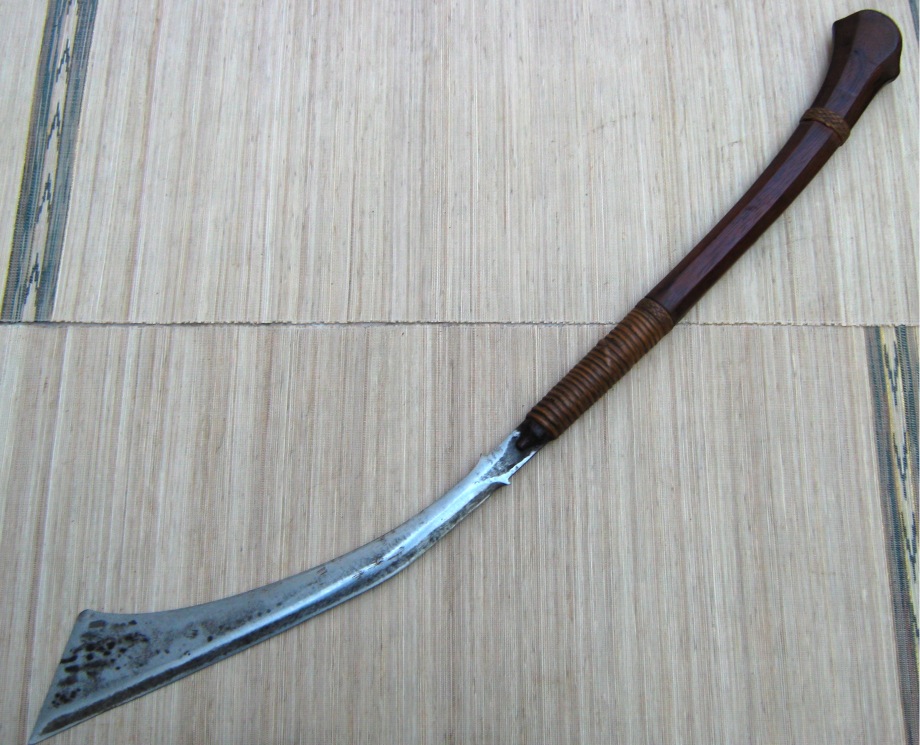
The panabas is a chopping bladed weapon or tool from the Philippines, variously described as both a sword and a battle axe. It has a distinctive long straight haft and a curving blade of various designs. It can range in size from 2 to 4 feet (61 to 122 cm) and can be held with one or both hands, delivering a deep, meat cleaver-like cut.
It is found throughout the islands of the Philippines as an agricultural tool for cutting branches and thickets. Variants of the panabas used as combat weapons or ceremonial executioner's axes are more commonly associated with the ethnic groups of the southern Philippines, particularly with the Maranao and Maguindanao people.
The panabas is one of many bladed weapons portrayed in the "Weapons of Moroland" plaque that has become a common souvenir item and pop culture icon in the Philippines.
The word panabas means "tool for cutting down", from the prefix pang- and the root word tabas. It is also known alternatively as pangtabas or simply tabas. In specific regions, it is also known as lantip in the Western Visayas (where it is primarily a sugarcane-cutting tool), palataw in Luzon, and nawi among the Maguindanao people.
"Panabas", as a broader term, can also refer to the indigenous large forward-curving sickle-scythes of the Philippines, known more specifically as the karit, haras, lagaraw, lampas, or sanggot. But they are completely different tools. A weaponized version of the agricultural sickle would be the Indonesian kerambit.
Panabas can also be referred to with generic names for large bolos like talibong (also the name of an unrelated Visayan sword) or badang.
Easily one of the most recognizable among Filipino blade weapons, the panabas is distinguished by its broad and uniquely shaped blade, and its long hilt. At 2 to 4 ft (0.61 to 1.22 m) in length, it is among the largest of Filipino swords, with only some Kampilan specimens being longer.
The most common forms of panabas have a laminated steel blade that is single-edged, narrowest near the haft, and gets dramatically broader towards the tip as the blade curves backwards away from the edged side, though there are some rare varieties that do have forward curved blades.
Hub AI
Panabas AI simulator
(@Panabas_simulator)
Panabas
The panabas is a chopping bladed weapon or tool from the Philippines, variously described as both a sword and a battle axe. It has a distinctive long straight haft and a curving blade of various designs. It can range in size from 2 to 4 feet (61 to 122 cm) and can be held with one or both hands, delivering a deep, meat cleaver-like cut.
It is found throughout the islands of the Philippines as an agricultural tool for cutting branches and thickets. Variants of the panabas used as combat weapons or ceremonial executioner's axes are more commonly associated with the ethnic groups of the southern Philippines, particularly with the Maranao and Maguindanao people.
The panabas is one of many bladed weapons portrayed in the "Weapons of Moroland" plaque that has become a common souvenir item and pop culture icon in the Philippines.
The word panabas means "tool for cutting down", from the prefix pang- and the root word tabas. It is also known alternatively as pangtabas or simply tabas. In specific regions, it is also known as lantip in the Western Visayas (where it is primarily a sugarcane-cutting tool), palataw in Luzon, and nawi among the Maguindanao people.
"Panabas", as a broader term, can also refer to the indigenous large forward-curving sickle-scythes of the Philippines, known more specifically as the karit, haras, lagaraw, lampas, or sanggot. But they are completely different tools. A weaponized version of the agricultural sickle would be the Indonesian kerambit.
Panabas can also be referred to with generic names for large bolos like talibong (also the name of an unrelated Visayan sword) or badang.
Easily one of the most recognizable among Filipino blade weapons, the panabas is distinguished by its broad and uniquely shaped blade, and its long hilt. At 2 to 4 ft (0.61 to 1.22 m) in length, it is among the largest of Filipino swords, with only some Kampilan specimens being longer.
The most common forms of panabas have a laminated steel blade that is single-edged, narrowest near the haft, and gets dramatically broader towards the tip as the blade curves backwards away from the edged side, though there are some rare varieties that do have forward curved blades.