Hubbry Logo
search
logo
Panabas
Panabas
current hub
1241203

Panabas

logo
Community Hub0 Subscribers
Read side by side
from Wikipedia

The panabas is a chopping bladed weapon or tool from the Philippines, variously described as both a sword and a battle axe.[1][2][3] It has a distinctive long straight haft and a curving blade of various designs. It can range in size from 2 to 4 feet (61 to 122 cm) and can be held with one or both hands, delivering a deep, meat cleaver-like cut.[4][5]

Key Information

It is found throughout the islands of the Philippines as an agricultural tool for cutting branches and thickets. Variants of the panabas used as combat weapons or ceremonial executioner's axes are more commonly associated with the ethnic groups of the southern Philippines, particularly with the Maranao and Maguindanao people.[6]

The panabas is one of many bladed weapons portrayed in the "Weapons of Moroland" plaque that has become a common souvenir item and pop culture icon in the Philippines.

Names

[edit]

The word panabas means "tool for cutting down", from the prefix pang- and the root word tabas. It is also known alternatively as pangtabas or simply tabas. In specific regions, it is also known as lantip in the Western Visayas (where it is primarily a sugarcane-cutting tool),[7] palataw in Luzon,[8] and nawi among the Maguindanao people.[9]

"Panabas", as a broader term, can also refer to the indigenous large forward-curving sickle-scythes of the Philippines, known more specifically as the karit, haras, lagaraw, lampas, or sanggot. But they are completely different tools. A weaponized version of the agricultural sickle would be the Indonesian kerambit.

Panabas can also be referred to with generic names for large bolos like talibong (also the name of an unrelated Visayan sword) or badang.

Appearance

[edit]
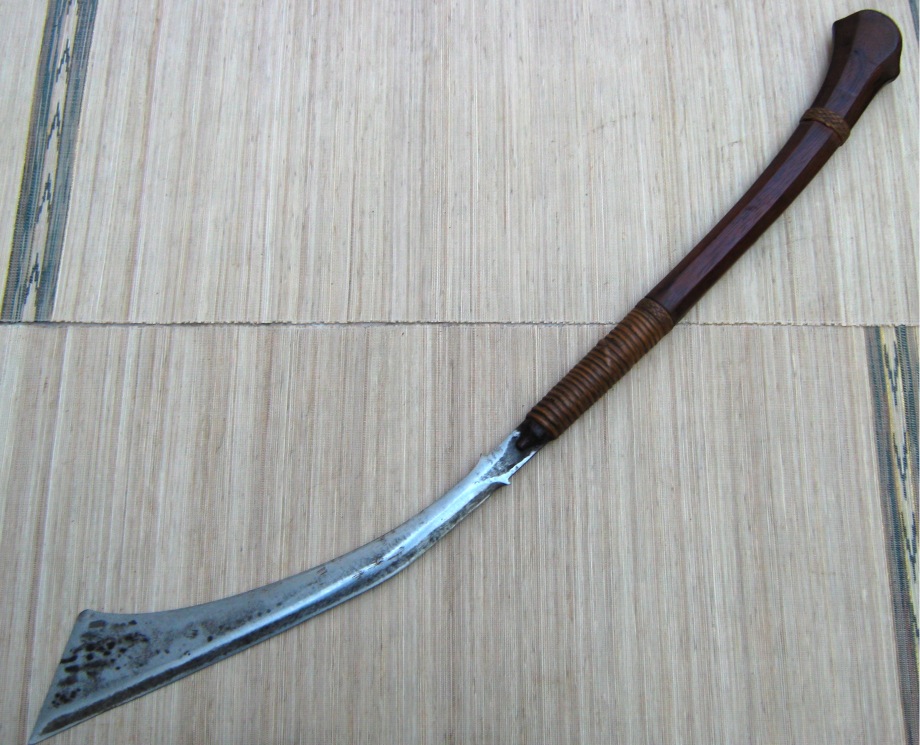
A Lumad panabas. Overall length of this example is 62 cm (24 in).
Bagobo (2) and Maranao (3) panabas with decorative spikes, labeled as "talibong" and primarily used for agricultural work. The top and bottom swords (1 and 4) are Maranao kampilan swords which can reach similar large sizes. (c. 1926)

Easily one of the most recognizable among Filipino blade weapons, the panabas is distinguished by its broad and uniquely shaped blade, and its long hilt. At 2 to 4 ft (0.61 to 1.22 m) in length, it is among the largest of Filipino swords, with only some Kampilan specimens being longer.

Blade

[edit]
Four types of Maguindanao panabas (1 to 5), labeled as "tabas" and "talibong". 1, 3, and 4 are all ceremonially used for execution by beheading. 2 and 5 have S-shaped blades. The topmost sword (6) is a Visayan talibong. (c. 1926)

The most common forms of panabas have a laminated steel blade that is single-edged, narrowest near the haft, and gets dramatically broader towards the tip as the blade curves backwards away from the edged side, though there are some rare varieties that do have forward curved blades.[10][11]

Because the panabas is primarily used in a chopping rather than thrusting motion, the shape of the actual tip varies greatly, with some specimens coming to a blunt tip, some pointed in the manner of other Filipino swords such as the Dahong Palay, and some taking on a square or diamond shape, with the furthest tip of the diamond, on the tip of the edge. There are rare panabas specimens that have an S-shaped blade sharpened partially along the backside, such that the specimen is double edged at the tip.[5]

While design work on the panabas's blade is relatively rare, among the most common examples of decorative design elements take the form of decorative piercings/serrations along a small section on the furthest end of the spine,[10] and/or a talismanic 'X' along the spine.[5]

Observed cross-sectionally, the blade is also thicker at its base, with a typical example being about 2 cm (0.79 in) thick - so designed in order to withstand the massive forces that the panabas both deals out and absorbs with every blow.[5]

Haft

[edit]

The panabas' haft, made of hardwood such as narra and often wrapped in braided rattan, is perhaps the longest among Filipino swords, both in terms of overall length, and in terms of proportion relative to the blade. The hafts of some specimens are wrapped in metal bands rather than rattan.[4][5] The haft has no guards.[12]

Scabbard

[edit]

Panabas scabbards were made of plain wood and are now extremely rare - according to accounts, largely because warriors would frequently discard them prior to a battle. Such scabbards invariably consist of two pieces of wood which are taken apart to remove the sword, as opposed to the sheath-type scabbards used by most other swords. The weapons are also said to have been carried into battle wrapped in cloth and slung across the back.[5]

Usage

[edit]

Weapon

[edit]

While the panabas is now rare and there are thus no contemporary cases of its use in battle, stories from and prior to the American colonial era describe it as being used for mop-up operations. It is said that warriors wielding panabas would form a rear guard and, following in the steps of warriors in front, use the panabas to quickly dispatch any survivors.[5]

Execution tool

[edit]
A very large ceremonial Yakan panabas

Because of its effectiveness at chopping through meat, panabas was known favored for use in executions. As such, the panabas also came to symbolize a datu's power - a demonstration of his ability to control violence.[5]

Domestic use

[edit]

The function of the panabas is that of a large cleaver, and this shapes the domestic use of the panabas as much as it shapes the martial use. The noted use of the panabas as an execution tool sprang from its initial domestic use for cleaving meat and fish, easily chopping through the large tuna that are caught in the seas of the Southern Philippines. However, its main domestic use is that of clearing dense vegetation.[5]

See also

[edit]

References

[edit]
[edit]
Revisions and contributorsEdit on WikipediaRead on Wikipedia
from Grokipedia
The panabas is a large, forward-curving chopping weapon, classified as both a sword and battle axe, originating from the Moro people of Mindanao in the southern Philippines.[1] It consists of a single-edged, laminated steel blade designed for powerful cleaving strikes, typically measuring 60–120 cm (24–48 in) in overall length, with the blade widening toward the tip and sometimes featuring tooth-like notches or decorative file work near the edge.[1][2] The hilt is long and ergonomic, crafted from hardwood and often bound with braided rattan or metal for a secure two-handed grip, enabling its use in delivering devastating blows.[1][3] Historically, the panabas emerged in the 18th–19th centuries among Moro ethnic groups, such as the Magindanao and Maranao, as a tool for warfare, agricultural clearing, and executions during tribal conflicts.[3][2] Moro warriors wielded it to follow assault lines and dispatch wounded foes, contributing to its fearsome reputation in battles against Spanish and later American colonial forces.[1] Beyond combat, it served as an executioner's blade for beheadings, symbolizing the authority and prestige of chieftains (datus) who controlled such instruments of justice and violence.[1] Scabbards were rarely used, with the weapon often carried wrapped in cloth across the back or discarded before engagement to reduce weight.[1] In Moro culture, the panabas embodied martial prowess and social status, with ornate examples reserved for leaders and incorporating talismanic motifs for spiritual protection.[1] Today, surviving specimens from the late 19th to early 20th centuries are preserved in museums, highlighting their role in Philippine ethnographic history and Filipino martial arts traditions like Arnis and Eskrima, where replicas are used for training.[3][2] Variants, such as the "S"-shaped blade or regionally named forms like tabas or nawi, reflect adaptations across Mindanao communities.[1]

History and Origins

Etymology and Regional Names

The term "panabas" derives from the Visayan language, specifically a contraction of "pang-tabas," where "pang-" is a prefix indicating purpose or tool, and "tabas" means "to cut down" or "to chop," reflecting the implement's function as both a utilitarian chopping tool and a combat weapon.[4] This etymology underscores its origins in the agricultural practices of pre-colonial Philippine societies, where such tools were essential for clearing vegetation. Across regions, the panabas is known by various synonyms that highlight local linguistic and cultural adaptations. In Western Visayas, it is called "lantip," emphasizing its role in farming tasks; in Luzon, particularly among northern groups, it appears as "palataw" or simply "tabas"; and among the Maguindanao people of Mindanao, it is referred to as "nawi." Broader associations exist with sickle-like tools such as "karit" and "haras" in northern Luzon, illustrating the weapon's overlap with everyday implements.[5][6] The linguistic roots of "panabas" trace back to Austronesian languages prevalent in the pre-colonial Philippines, with Visayan dialects forming a key branch that evolved among central island communities. First documented mentions of the panabas appear in 19th-century Spanish colonial accounts describing Moro weaponry in southern Philippines, often in the context of resistance against colonial forces.[1] It holds particular significance among Moro ethnic groups, including the Maranao and Maguindanao.

Development in Philippine Martial Culture

The panabas emerged in the 18th–19th centuries among Moro groups in Mindanao, evolving from agricultural tools used for harvesting and butchering into a specialized combat weapon amid Spanish colonial resistance and the spread of Islam through maritime trade networks connecting the archipelago to Southeast Asia.[7][3] The establishment of sultanates, such as Sulu in 1450 and Maguindanao in the early 16th century, facilitated this cultural integration, with Tausug and other preachers promoting Islamic practices that intertwined with local warfare traditions.[7] Influenced by Malay forging techniques transmitted via these trade routes and broader Austronesian migration patterns that introduced early metallurgical knowledge to the region, the panabas was adapted for warfare during the colonial era.[8] Its adoption peaked during Spanish colonial resistance from the 16th to 19th centuries, particularly in the Moro Wars, where it served Moro warriors in raids against Spanish forces, as evidenced by accounts of battles like the 1599 offensive involving thousands of fighters.[7][9] Usage continued into the early 20th century amid American colonial operations, including mop-up actions in the Moro Rebellion of 1902–1913.[10][7] Preserved examples from Mindanao, including specimens at institutions like the Aga Khan Museum in Marawi, reflect the weapon's adaptation for combat among Meranaw and Maguindanao communities—where it was also known regionally as "nawi."[10][5] By the mid-20th century, the panabas declined in practical use due to the widespread adoption of firearms introduced during colonial eras, though it persisted as a cultural symbol in artifacts such as the "Weapons of Moroland" plaque curated at the Philippine National Museum in the 1960s.[10][11]

Design and Construction

Blade Features

The Panabas blade features a single-edged design with a pronounced forward-curving profile, optimized for powerful chopping motions. It is narrowest near the hilt for maneuverability and broadens dramatically toward the tip, creating a wide, axe-like cutting surface that maximizes leverage and impact. This configuration, often described as a hybrid between a sword and a battle axe, allows for effective momentum in swings while maintaining balance for two-handed use with a long haft.[12][8] Overall lengths typically range from 2 to 4 feet (61–122 cm), with blade lengths of 38–61 cm (15–24 in), though museum specimens exhibit variation. Weight distribution emphasizes heaviness, averaging 2–3 pounds (0.9–1.4 kg), concentrated toward the tip for enhanced cutting power, complemented by a thickened spine that bolsters durability against impacts such as bone or light armor. Tip shapes vary by purpose and region: blunt forms for agricultural chopping, pointed or squared ends for combat penetration, and rare S-shaped profiles in ceremonial variants among Moro artisans.[3][13][14][15] Blades are often constructed from laminated steel, sometimes using pattern welding techniques to create resilient edges, though many examples are simpler forgings without distinctive patterns. These techniques, rooted in pre-colonial Malay metallurgical traditions and adapted using local iron sources, ensure a strong core with a hardened edge capable of withstanding repeated use.[12][16][17]

Haft and Grip

The haft of the Panabas is typically constructed from dense hardwoods such as kamagong (Mabolo ebony), valued for its strength and resistance to wear during intense chopping actions.[18] These materials ensure the handle can endure the physical demands of both agricultural labor and combat, with examples often featuring plain or minimally carved wood to prioritize functionality over ornamentation.[19] Haft lengths vary by purpose and regional style, commonly measuring 30 to 41 cm to support a two-handed grip that facilitates powerful swings while maintaining user distance from the target.[3][20] The grip lacks a crossguard or pommel, instead relying on rattan or cordage wrapping—often in braided patterns—for a secure, non-slip hold amid vigorous use, sometimes reinforced at the base with metal ferrules.[3][21] The blade is attached via a full tang inserted into the haft, commonly formed by binding two wooden halves around it with cord or leather for stability, or occasionally using resin and pins to secure the socketed base.[21] This method positions the center of gravity near the blade's base, optimizing balance for the Panabas's broadening tip and enabling effective chopping strikes.[21] The scabbard for the panabas, a utilitarian protective covering for the blade, was typically constructed from two pieces of plain hardwood, such as coconut or bamboo, bound together with fiber ties like rattan to form a simple slot for blade insertion.[1][22] This breakaway design allowed for rapid deployment, as the bindings could be severed during the initial draw, enabling the wielder to strike in one fluid motion without hindrance from the sheath.[22] Measuring slightly longer than the blade itself, the scabbard featured a plain finish devoid of elaborate decoration, prioritizing practicality for quick access over aesthetic appeal.[1] Due to its functional role, the panabas scabbard was notably rare even in historical collections, as Moro warriors often discarded it prior to combat to minimize weight and encumbrance during battle.[1] Unlike the ornate scabbards of the kampilan, which incorporated intricate carvings and metal fittings, panabas sheaths avoided such embellishments to maintain simplicity and speed in use.[23] In elite versions, occasional brass or copper fittings reinforced the structure, while leather slings were sometimes added for carrying during transit.[13] In non-combat, domestic contexts, the panabas—functioning as an agricultural tool—might be wrapped in cloth for storage and transport, though such coverings were not considered integral to the weapon's core identity or ritual significance.[1] This approach ensured compatibility with the hardwood haft, allowing secure bundling without specialized accessories.[3]

Practical and Combat Uses

Agricultural and Domestic Applications

The panabas primarily served as an agricultural tool in rural Mindanao, particularly among the Meranaw people, where its broad, forward-curving blade and extended haft enabled efficient clearing of dense vegetation such as grasslands, vines, and thickets during harvesting seasons.[10] The long handle, often measuring up to twice the blade's length, allowed users to maintain a safe distance while delivering powerful swinging arcs to cut through tough plant material like banana trees or coconut fronds without risking close contact.[5] This design facilitated labor-intensive tasks in iron-scarce regions, where the tool's durability and low maintenance made it a cost-effective alternative to imported machinery.[10] In domestic settings, the panabas was employed for butchering large livestock, such as goats and cows in ritual preparations, as well as game and sizable fish like tuna, leveraging its heavy blade for quick, deep cuts that efficiently dismembered carcasses without requiring finer precision instruments.[10] Its multifunctional nature extended to food preparation in remote households, combining chopping and cleaving roles that streamlined daily chores in agrarian communities.[5] Originating from pre-colonial sickles known as karit, the panabas evolved as a utilitarian implement in Philippine material culture, with continuous use documented in Mindanao farming practices into the 2010s through ethnographic accounts.[24] Similar chopping tools, such as the tabas, have been used historically in Visayan agriculture for field clearing.[6] The chopping motion employed in these tasks bore resemblance to later adaptations in combat swings, highlighting the tool's inherent versatility.[10]

Role in Warfare

The Panabas served as a formidable chopping weapon in the arsenal of Moro warriors, especially among the Maranao of Mindanao, during the extended Spanish-Moro Wars from 1578 to 1898. Led by datus, Maranao forces utilized the panabas in guerrilla-style engagements and defensive stands against Spanish conquistadors, leveraging its heavy, curved blade for devastating close-quarters strikes against unarmored infantry. Its design allowed for powerful impacts that could hook and shatter wooden shields or sever limbs, drawing parallels in function to ancient curved weapons like the Dacian falx, though adapted to the tropical terrain of Philippine jungles. In combat, the panabas was primarily employed in two-handed techniques, with warriors delivering overhead swings to decapitate or dismember opponents during charges or mop-up phases after initial volleys from ranged weapons like the kampilan or kris. This approach proved particularly effective in dense jungle skirmishes, where the weapon's extended reach—often 60 to 120 centimeters overall—enabled warriors to outdistance shorter blades while maintaining momentum for cleaving blows against fallen or isolated foes. Such tactics were integral to Maranao resistance during Spanish assaults in the 19th century.[1] The panabas's battlefield utility waned with the widespread adoption of firearms by colonial forces in the late 19th and early 20th centuries, rendering its melee-focused role obsolete in large-scale confrontations during the American Moro campaigns after 1900. Consequently, it transitioned from a primary combat tool to a symbol of warrior status, carried by bodyguards or used in ritual contexts rather than frontline warfare.[1]

Use as an Execution Implement

The panabas was particularly favored by Moro datus as an execution implement, especially for beheadings, due to its broad, heavy blade that enabled clean, powerful cuts through neck vertebrae and dense tissue. This design, derived from its agricultural role in chopping through thick meat and bone, made it highly effective for severing heads to enforce traditional laws.[1][25] The weapon's chopping mechanics paralleled those used in warfare, allowing for decisive, cleaving strikes against opponents.[1] In Moro society, executions with the panabas carried ritual significance, often conducted publicly in village squares to affirm the datu's authority and deter crime through spectacle.[1] The implement's imposing size—typically ranging from 2 to 4 feet in length—amplified the executor's perceived power, transforming the act into a symbolic display of governance and control over violence. Such practices were prominent in 18th- and 19th-century Maguindanao courts, where the panabas served as both a practical tool and an emblem of judicial prestige.[25] By the early 20th century, the adoption of colonial legal systems under American administration phased out these traditional executions, leading to the decline of the panabas in official punitive roles, though its legacy endures in Moro oral traditions.

Cultural and Symbolic Role

Significance in Moro Society

In Moro society, the panabas served as a prominent status symbol, particularly among datus and elite warriors, signifying rank and authority through its association with the control of violence and execution. Owned and wielded by chieftains and their bodyguards, it embodied a ruler's prestige and power, often displayed in court settings to reinforce hierarchical structures within Maranao and other Moro communities.[10] The panabas held ceremonial significance in Moro rituals and gatherings, where it was featured in displays symbolizing communal strength and historical resistance against colonial incursions, as part of the broader "Weapons of Moroland" iconography representing Moro autonomy. In events such as peace pacts and traditional ceremonies, it underscored themes of unity and deterrence, integral to Moro cultural expressions in Mindanao. Its ties to execution authority further highlighted a datu's role in upholding justice and order.[10][11] Primarily associated with male warriors in Moro society, the panabas reinforced gender roles centered on martial prowess and protection, reflecting the fusion of Islamic influences with indigenous Malay traditions in shaping Mindanao identity. It appeared in communal rituals involving executions and butchering, preserving values of honor and resilience.[10] Preservation efforts for the panabas and related Moro traditions include registration under the Philippine Registry of Cultural Property (PRECUP) and maintenance in institutions such as the Aga Khan Museum at Mindanao State University in Marawi, which houses panabas artifacts alongside other Meranaw weapons to support community-driven transmission of cultural heritage. The UNESCO inscription of the Darangen epic of the Maranao people as intangible cultural heritage in 2018 recognizes broader Maranao oral traditions and pre-colonial autonomy, complementing these safeguarding initiatives.[26][10]

Modern Interpretations and Reproductions

In contemporary times, the panabas continues to be reproduced by Filipino bladesmiths employing traditional forging techniques, primarily for use in Filipino Martial Arts (FMA) training such as Kali and Eskrima, as well as for collectors of historical weaponry. These modern replicas often feature high-carbon steel blades mimicking the original curved, chopping design, with lengths ranging from 35 to 36 inches for practical handling in drills and demonstrations. Notable examples include the panabas crafted by Blade Culture International (BCI) under bladesmith Hernando De Guzman, which emphasizes authenticity in balance and edge geometry for both training and display purposes. Pricing for such reproductions as of 2025 typically falls between $200 and $500, depending on materials and craftsmanship, making them accessible to martial arts practitioners and enthusiasts.[27][5] The panabas has gained visibility in popular culture through its inclusion in media representations of Philippine heritage and weaponry. It appears as a ceremonial execution tool wielded by antagonists in the indie video game Break In and Steal Thingz, highlighting its historical role in Moro warfare. Additionally, the weapon was featured in Season 4 of the television series Forged in Fire, where bladesmiths competed to recreate a functional panabas as the "ultimate battle axe," drawing attention to its chopping prowess and cultural significance. The panabas also forms part of the iconic "Weapons of Moroland" plaque, a popular souvenir that symbolizes Moro martial traditions and has permeated Philippine pop culture as a motif in art and memorabilia.[28][29] Legally, the panabas faces no domestic restrictions in the Philippines when used as a tool or in cultural contexts, though export of replicas or antiques may require clearance from the National Museum or Bureau of Customs to prevent illicit trade in cultural heritage items. Following the 2014 Comprehensive Agreement on the Bangsamoro, there has been increased interest in historical reenactments and cultural demonstrations featuring traditional Moro weapons like the panabas, as part of broader efforts to preserve and revive indigenous practices amid post-conflict normalization.[30][31]

References

User Avatar
No comments yet.