


Community hub
Recent from talks
Contribute something
Nothing was collected or created yet.
Karambit
View on Wikipedia
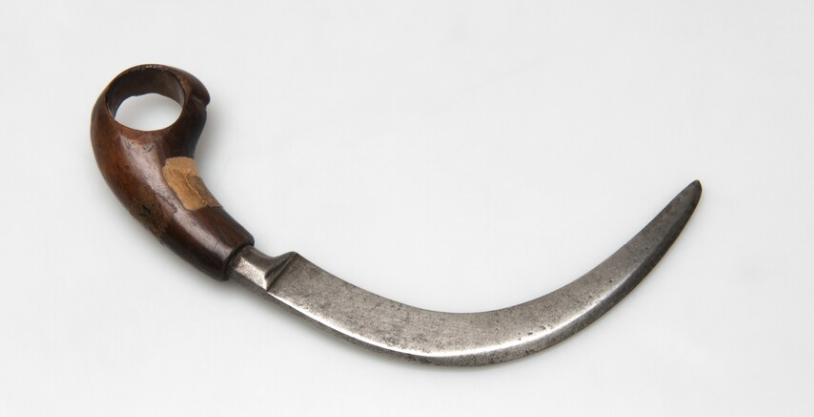
The karambit or kerambit (as used in Indonesian), kurambik or karambiak (both from the Minangkabau language) is a small curved knife resembling a claw.
Key Information


Origin
[edit]
The karambit is believed to have originally been weaponized among the Minangkabau people of West Sumatra[1] where, according to folklore, it was inspired by the claws of a tiger.
As it was weaponised, the blade became more curved to maximise cutting potential.
Through Indonesia's trade network and close contact with neighbouring countries, the weaponization of the karambit was eventually dispersed through what are now Malaysia, the Philippines, Thailand, Cambodia, Laos, and Myanmar.[2][3]
European accounts tell that soldiers in Indonesia were armed with a kris at their waist or back and a spear in their hands, while the karambit was used as a last resort when the fighter's other weapons were lost in battle.
The renowned Bugis warriors of Sulawesi were famous for their embrace of the karambit.
Technique
[edit].jpg)
.jpg)
As a tool
[edit]The karambit was originally an agricultural implement designed to rake roots, gather threshing and plant rice in most of island Southeast Asia.
It's a smaller variant of the Southeast Asian sickles (Indonesian celurit, arit, or sabit; Filipino garab and karit; and Malaysian sabit).
It still possesses many efficient uses for the modern laborer, allowing use of the blade for utility work, with the finger ring eliminating the need to put the knife down between operations, if use of the fingers to manipulate the object to be worked on is required (such as the action of cutting and opening a shipping box, or removing plastic wrap from shipments, in two very basic examples).
The finger ring also provides an added degree of protection against dropping the knife during use, which is particularly essential in work environments that include heavy machinery, into which dropping a handheld, metal tool of any kind can cause massive damage to the equipment and those around it, especially if the tool is ejected at high velocity from rotating components.
As a weapon
[edit]The karambit is held with the blade pointing downward from the bottom of the fist, usually curving forwards.
While it is primarily used in a slashing or hooking motion, karambit with a finger ring are also used in a punching motion, hitting the opponent with the finger ring.
Some karambit are designed to be used in a hammering motion. This flexibility of striking methods is what makes it useful in self-defense situations.
The finger guard makes it difficult to disarm and allows the knife to be maneuvered in the fingers without losing one's grip.[4]
The short Filipino karambit has found some favor in the West because such proponents allege the biomechanics of the weapon allow for more powerful cutting strokes and painful "ripping" wounds, and because its usability is hypothesized as more intuitive, but more difficult to master than a classic knife.[citation needed]
In martial arts
[edit]The karambit is one of the weapons commonly used in pencak silat and Filipino martial arts.[4][5]
Variations
[edit]_with_Sheath_MET_36.25.823ab_002june2014.jpg)
_with_Sheath_MET_36.25.869ab_005july2014.jpg)
_with_Sheath_MET_36.25.873ab_002july2014.jpg)
There are many regional variants of karambit. The length of the blade, for example, could vary from one village or blacksmith to another. Some have no finger guard and some feature two blades, one on each side of the handle.
Traditional types include:
- Kuku Bima: Bhima's claw from West Java
- Kuku Hanuman: Hanuman's claw from West Java
- Kuku Macan: tiger's claw, endemic to Sumatra, Central Java and Madura
- Kerambit Sumbawa: larger, sturdier kerambit made specially for battle. From the Sumba Islands
- Kerambit Lombok: larger, sturdier kerambit made specially for battle. From Lombok
- Lawi Ayam: chicken's claw, created by the Minang community
Superficially, the karambit resembles the jambiyah, although there is no connection.
The jambiyah was always designed as a weapon and serves as a status marker, often made by skilled artisans and jewelers using precious stones and metals, whereas the karambit was and still remains an unadorned farmer's implement and utility knife.[4]
Modern forms
[edit]The modern Western interpretation of the karambit is far removed from the original agricultural tool.
They may have folding blades, are finished to a high standard, made from expensive materials as opposed to being rudimentary and makeshift and are generally larger to accommodate larger hands giving it pure shape.[6]
Additionally, modern karambit may have spikes or spurs on the front or rear ricasso, which may be intended for gripping clothing or horse tack, tearing flesh or for injecting a poison, such as the upas.[7]
See also
[edit]
References
[edit]- ^ Agus Mulyana (2010). "KERAMBIT: Senjata Genggam Khas Minangkabau". Sumedang Online. Archived from the original on 28 January 2015. Retrieved 9 October 2014.
- ^ Proyek Pembinaan Permuseuman Jakarta (Indonesia). Koleksi pilihan museum-museum negeri propinsi. Proyek Pembinaan Permuseuman Jakarta: 1989. 65 pages
- ^ D. Christo (2014). "Karambit FAQ". Karambit.com.
- ^ a b c Tarani, Steve (2002). Karambit: Exotic Weapon of the Indonesian Archipelago. Unique Publications. pp. 15–22. ISBN 978-0-86568-206-1.
- ^ Farrer, D. S. (5 June 2009). Shadows of the Prophet: Martial Arts and Sufi Mysticism. Springer Science & Business Media. p. 91. ISBN 978-1-4020-9356-2.
- ^ Emerson, Ernest (February 2004). "The Battle Blade". Black Belt Magazine. 42 (2). Los Angeles, California: Active Interest Media, Inc.: 80–85. ISSN 0277-3066. Retrieved 3 March 2015.
- ^ Sheikh Shamsuddin. The Malay art of self-defense: silat seni gayong. North Atlantic Books, 2005 ISBN 1-55643-562-2, ISBN 978-1-55643-562-1. 247 pages. pp234
External links
[edit] Media related to Karambit at Wikimedia Commons

Indonesian traditional weapons, armors, and premodern gunpowder-based weapons | ||||||||||||||||||||
|---|---|---|---|---|---|---|---|---|---|---|---|---|---|---|---|---|---|---|---|---|
|    | |||||||||||||||||||
|
| ||||||||||||||||||||
| ||||||||||||||||||||

Karambit
View on GrokipediaHistory
Origins in Southeast Asia
The karambit emerged in the 11th century among the Minangkabau people of West Sumatra, Indonesia, where it originated as an agricultural implement for raking roots, harvesting crops, and planting rice in the region's rice paddies and forests.[8] According to Minangkabau folklore, its distinctive curved blade was inspired by the claws of tigers that inhabited the Sumatran jungles, allowing farmers to emulate the animal's natural hooking motion for efficient fieldwork.[9] This design reflected the agrarian lifestyle of the Minangkabau, an ethnic group known for their matrilineal society and reliance on wet-rice cultivation in the highlands of West Sumatra.[1] The etymology of "karambit" traces to the Minangkabau language, derived from terms such as kurambik or karambiak.[10] Early examples, often forged from simple iron or steel with handles of wood or buffalo horn, were compact and concealable, suited to the needs of rural communities navigating dense terrain and wildlife threats.[7] Through ancient trade routes, migration patterns, and cultural exchanges across the Indonesian archipelago and beyond, the karambit disseminated to neighboring regions, reaching the Malay Peninsula and the Philippines, where it adapted to local variants while retaining its core sickle-like utility.[3] In these areas, seafaring merchants and warriors carried the tool, integrating it into broader Southeast Asian networks that connected Sumatra with mainland and island societies.[1]Cultural and Historical Significance
In Minangkabau mythology, the karambit's distinctive curved blade is believed to emulate the tiger's claw, embodying symbols of ferocity, strength, and protective power drawn from the natural world that inspired the community's philosophical tenet "alam takambang jadi guru" (nature becomes the teacher).[11] This folklore underscores the weapon's role not merely as a tool but as a cultural emblem linking human resilience to the predatory prowess of Sumatran tigers.[12] Historically, the karambit played a vital role in 19th-century colonial resistances, notably the Padri War (1803–1838), where Minangkabau farmers carried it as an everyday utility that doubled as a defensive arm when confronting Dutch forces and internal reformers.[13] These agrarian fighters, embodying adat traditions against imposed changes, elevated the karambit from farm implement to emblem of defiance and cultural preservation. Within pencak silat communities, the karambit fosters regional identity as a pusaka, or sacred heirloom blade, meticulously passed through generations to convey lineage, martial legacy, and spiritual guardianship.[14] Such status reinforces its enduring place in Minangkabau social fabric, where it transcends utility to represent ancestral wisdom and communal pride.Design and Features
Anatomy and Ergonomics
The karambit is distinguished by its curved hawkbill-style blade, which typically measures 3 to 6 inches in length and features a single-edged belly optimized for hooking, ripping, and slashing actions. This blade geometry mimics a claw, with the curve facilitating close-range maneuvers while maintaining a compact profile for concealability and control. The reinforced spine along the blade's back enhances structural integrity during use, and the choil—the unsharpened area near the handle junction—allows for precise pinching grips when performing fine cuts.[15][16] At the handle's base, the karambit incorporates a prominent finger ring, which serves as a retention mechanism to secure the weapon during dynamic movements and enables an inverted grip where the pinky or ring finger loops through for enhanced stability. This ring, often integrated seamlessly into the handle design, prevents slippage in high-stress scenarios and supports rotational techniques without compromising control. Optional finger grooves along the handle's sides may be present in some variants, providing additional tactile feedback for thumb and index finger placement to improve precision.[15][17] Ergonomically, the karambit's design promotes natural wrist alignment, allowing fluid, intuitive motions in close-quarters handling that align with human anatomy for reduced strain and increased efficiency. The balanced weight distribution, averaging 4 to 8 ounces, centers mass near the hand for agile manipulation without fatigue, making it suitable for prolonged engagement while the finger ring reinforces grip security to counter torque forces. These human-factor elements underscore the karambit's evolution from agricultural origins to a tool emphasizing retention and biomechanical harmony.[15][17][18]Materials and Manufacturing
Traditional karambit blades are typically crafted from high-carbon steel to ensure durability and edge retention.[19] This folding and hammering process, rooted in Southeast Asian metallurgical traditions, creates a laminated structure that resists breakage while allowing for a razor-sharp curve.[20] The manufacturing begins with pandai besi, or traditional bladesmiths, who hand-hammer the steel over coal fires to shape the distinctive hooked form, followed by quenching and tempering to balance hardness and flexibility for reliable performance in use.[20] These artisans rely on manual tools and inherited knowledge, avoiding modern machinery to preserve the blade's authenticity and functional integrity, with the process often taking several days to complete a single piece.[21] Handles are commonly constructed from natural materials such as wood, buffalo horn, or bone, selected for their ergonomic fit and availability in the region, and frequently wrapped with rattan or cordage to improve grip and prevent slippage during handling.[21] Buffalo horn, in particular, provides a lightweight yet sturdy option that can be carved to accommodate the finger ring, enhancing control without adding excess weight.[22] The sheath, known as sarung, is traditionally made from wood or leather, carved or stitched to snugly encase the blade and facilitate secure belt carry, often with a simple loop or slot for easy access while maintaining the weapon's concealability.[23] Wooden sarung are shaped to follow the blade's curve, ensuring protection during transport, and may be decorated minimally to reflect cultural motifs without compromising utility.[21]Traditional Uses
As an Agricultural Tool
The karambit originated as a practical agricultural implement among the Minangkabau people of West Sumatra, Indonesia, where its curved blade design was tailored for the demands of rice farming and related rural labor. Farmers utilized the hook-like edge to grasp and sever rice stems during harvest, enabling efficient collection of sheaves while minimizing damage to surrounding plants in dense paddies. This functionality stemmed from the blade's anatomy, which allowed for a pulling motion to bundle crops effectively.[24] Beyond harvesting, the karambit's curve proved ideal for weeding, as it could hook weed roots or stems close to the ground and extract them with a single motion, reducing the need for repetitive digging in muddy terrain. It also supported processing tasks essential to agrarian life, including gutting fish caught in irrigation channels, skinning small game or livestock, and pruning overgrowth in wet rice fields to maintain crop health. In Minangkabau culture, it also held symbolic value akin to a tiger's claw, and similar tools were used in neighboring regions for comparable agrarian tasks.[24][1] These applications highlighted its role as a multifunctional tool suited to the humid, labor-intensive conditions of Southeast Asian agriculture.[25] In the 19th century, Minangkabau farmers carried the karambit as a portable everyday item, often sheathed at the waist for quick access during extended fieldwork. Its lightweight construction and compact form made it indispensable for on-the-go tasks, from dawn patrols of fields to evening preparations of produce.[26] Compared to straight-edged tools like sickles or knives, the karambit's hooked profile offered superior leverage for uprooting stubborn plants or roots, distributing force across the curve to lessen hand strain during prolonged use. This mechanical advantage enhanced productivity in root-heavy crops and weedy environments, underscoring its evolution from a simple sickle variant to a specialized farming aid.[3]As a Defensive Weapon
The karambit serves as an effective defensive weapon in close-range self-defense scenarios, primarily through slashing and hooking techniques that exploit its curved blade to disarm or control opponents. The blade's inward arc facilitates hooking and controlling an attacker's weapon or limb, allowing the defender to redirect incoming strikes or immobilize the aggressor while positioning for counterattacks to vulnerable areas like the throat or tendons. This design emphasizes ripping and tearing motions over straight thrusts, making it suited for grappling distances where linear weapons falter.[27][28] Historically, during the colonial era in Southeast Asia, the karambit was used in ambushes and street fights as a concealed backup to longer blades like the golok or parang, enabling quick deployment by farmers and villagers against armed intruders or oppressors. Its compact size and ergonomic ring allowed for discreet carry in sheaths hidden under clothing or in belts, providing a last-resort option in asymmetric conflicts where larger weapons were impractical. With European colonization, its use spread to regions like the Philippines and Thailand, where it was employed in close-quarters self-defense during conflicts.[18][29] Defensive tactics often involve an inverted grip, where the blade points downward from the pinky side, secured by the index finger through the handle ring; this orientation permits shielding vital areas such as the neck and midsection with the forearm while executing hooking pulls to unbalance the opponent and expose them to slashes. The grip enhances retention during physical struggles, reducing the risk of disarmament and allowing fluid transitions between blocking and striking in confined spaces.[30] Despite these advantages, the karambit's short blade length—typically 3 to 5 inches—restricts its reach to intimate one-on-one encounters, limiting utility against multiple foes or in open-field battles where distance management is key. It excels in urban or indoor self-defense but requires superior footwork and awareness to compensate for its inability to engage at arm's extension beyond grappling range.[28]Role in Martial Arts
Integration in Pencak Silat
The karambit was adopted into pencak silat, particularly in styles like Harimau (tiger) and Cimande, where its curved blade design allowed practitioners to mimic the slashing and hooking strikes of animal claws, especially the tiger in Harimau variants.[31] This integration reflected the art's emphasis on naturalistic movements drawn from local wildlife, transforming the tool's agricultural origins into a core element of defensive combat training.[29] Within pencak silat, the karambit features prominently in juru (pre-arranged forms) and randai (controlled sparring), where it is wielded to complement the body's low, flowing postures and evasive footwork, promoting seamless transitions between strikes and grapples.[9] The weapon's ergonomic ring enables secure retention during dynamic sequences, ensuring that movements remain fluid and integrated with the practitioner's overall biomechanics.[29] Variations in karambit usage appear across regional styles; for instance, Silek Minangkabau from West Sumatra often employs paired karambits to achieve symmetrical offense and defense, balancing attacks from both sides while maintaining the art's characteristic agility.[31] The doctrinal role of pencak silat techniques, including those with the karambit, has been preserved through guru-murid (teacher-student) lineages, a traditional oral and demonstrative transmission system prevalent in Indonesia and Malaysia, where knowledge is passed directly from masters to apprentices in intimate, hierarchical settings to uphold stylistic authenticity.[32]Role in Filipino Martial Arts
The karambit has influenced Filipino martial arts such as Kali and Arnis (also known as Eskrima), where it is incorporated into close-quarters techniques emphasizing fluid weapon transitions and disarms. In these systems, the karambit's curve facilitates trapping and redirecting opponents' limbs, integrating with stick and empty-hand flows. Variations adapted for Filipino contexts often feature shorter blades suited to urban self-defense.[6]Specific Techniques and Training
The karambit is wielded using specific grip variations to optimize retention and maneuverability in pencak silat. The standard ring hold positions the index finger through the finger ring at the base of the handle, ensuring secure retention during intense exchanges and allowing for quick transitions between offense and defense. This grip leverages the ergonomic curve of the handle to mimic a natural fist, enhancing control in close-range engagements.[33] In the reverse grip, also called the hammer or ice pick grip, the blade aligns along the back of the forearm with the ring securing the index finger, facilitating slashing arcs and hooking pulls that exploit the weapon's curved edge for trapping limbs or drawing blood.[34] Core techniques emphasize the integration of langkah footwork with potong cuts to create fluid, deceptive attacks. Langkah involves triangular or circular stepping patterns that maintain balance and distance while circling opponents, often drawing from animal-inspired movements for unpredictability. Potong techniques include upward hooks targeting tendons in the limbs, such as the Achilles or hamstrings, to immobilize foes rapidly; these cuts exploit the karambit's hook to slice deeply while pulling the target off-balance.[35] Training follows a structured progression to build proficiency and safety. Beginners start with solo drills on wooden dummies, which replicate human anatomy to practice precise strikes and footwork combinations without risk. As skills advance, partner drills incorporate padded or blunted training karambits made from materials like polypropylene, allowing practitioners to simulate combat flows and develop timing against resisting opponents. Emphasis is placed on sensitivity training methods that heighten tactile awareness through controlled contact, enabling instinctive responses to an adversary's movements.[36][37][38] Safety protocols are integral, particularly given the karambit's hooked edge, which can cause severe lacerations. Controlled sparring uses protective gear and blunted weapons, with strict rules limiting force to prevent injuries; instructors monitor sessions to enforce distance and technique corrections, progressing only when foundational control is mastered.[39]Variations
Regional and Traditional Forms
The karambit exhibits notable regional variations across Southeast Asia, reflecting local cultural, functional, and martial needs among ethnic groups. In Indonesia, the Jawa variant, associated with Java including Sundanese regions in West Java, often features a tinier blade suited for agile close-quarters combat in historical warfare, distinguishing it from larger designs elsewhere. This adaptation emphasized speed and precision for battlefield use, as seen in traditional silat practices.[40][31] In Malaysia, the kerambit adopted regional adaptations for personal defense in urban and rural settings. These versions frequently incorporate engraved motifs inspired by local flora and Islamic patterns, enhancing their aesthetic and symbolic value in everyday and ceremonial contexts.[9] Filipino adaptations of the karambit evolved the weapon's role in archipelago martial traditions beyond its Indonesian origins. Historical accounts note variations in length, with some Filipino forms extending longer or shorter than standard Indonesian models to align with stick-fighting dynamics in kali (also known as escrima or arnis).[41][3] Other Indonesian variants include the larger, sturdier kerambit from Sumbawa and Lombok, designed specifically for battle. Traditional evolutions of the karambit in the 20th century, particularly post-independence in Indonesia and Malaysia, involved refinements to balance form and function while preserving heirloom (pusaka) status. Artisans retained intricate engravings—often damascene patterns symbolizing protection and ancestry—on blades and handles, adapting to modern materials without altering core ergonomic designs. These changes ensured cultural continuity amid national identity movements, as documented in regional heritage collections.[7][3]Modern and Tactical Adaptations
In the 20th and 21st centuries, the karambit evolved from its traditional roots into tactical tools optimized for military, law enforcement, and civilian self-defense applications, with manufacturers emphasizing portability, durability, and rapid deployment. Cold Steel introduced folding karambit designs in the 1990s, such as the Steel Tiger and Tiger Claw series, which utilize AUS-8A stainless steel blades for corrosion resistance and edge retention, paired with Zytel polymer handles and stainless steel pocket clips for secure, low-profile everyday carry.[42] These adaptations retain the curved blade's hooking capability while incorporating modern locking mechanisms like Tri-Ad locks to prevent accidental closure during use.[43] Military adoption of karambit-derived designs gained traction post-Vietnam War, as U.S. special forces sought to incorporate Southeast Asian close-quarters combat (CQC) techniques influenced by encounters with regional weapons. Emerson Knives' Combat Karambit, introduced in the late 1990s, became a staple for elite units, featuring a chisel-ground 154CM steel blade and an ergonomic G-10 handle that facilitates forward or reverse grips in high-stress scenarios, with its "wave" opener allowing one-handed deployment from a pocket.[44] Former Navy SEAL Phillip Koontz, who integrated karambit training into special operations curricula, credits the blade's finger ring for enhancing retention during dynamic CQC engagements. Collectible and training variants emerged to support safe skill development, often constructed from non-lethal materials like Santoprene rubber or aircraft-grade aluminum to mimic weight and balance without causing harm. Cold Steel's rubber Karambit Trainer, for instance, replicates the 4-inch blade profile for realistic disarming drills and solo practice.[45] Aluminum models from producers like Rising Phoenix provide durable alternatives weighing around 2-3 ounces, ideal for repeated impacts in martial arts sessions.[46] Contemporary innovations further refined the karambit for urban tactical use, including assisted-opening mechanisms that propel the blade via spring tension for swift access, as in the Delta Defender's liner-lock system. Ergonomic polymer handles, often textured G-10 or Zytel composites, enhance grip security and reduce fatigue during prolonged carry, distinguishing these from fixed-blade traditional forms by prioritizing concealability and versatility.[47]Modern Relevance
Legal Status and Regulations
The legal status of the karambit varies significantly by jurisdiction, often depending on its classification as a curved dagger, fixed-blade knife, or cultural artifact, which influences ownership, carry, and transport regulations. In the United States, regulations are primarily handled at the state level, with no uniform federal prohibition on ownership. In California, the karambit is typically classified as a "dirk or dagger" under Penal Code § 21510 if it features a fixed blade capable of stabbing, making concealed carry unlawful regardless of blade length, a restriction rooted in early 20th-century laws updated from the original 1917 Penal Code provisions.[48] Ownership and open carry in a sheath are permitted for fixed-blade karambits, but folding variants must remain closed during transport to avoid reclassification.[49] In contrast, many other states allow ownership and concealed carry of karambits with blade lengths under 3 inches, treating them as utility knives, though states like New York prohibit them outright if designed for offensive use.[50] Local ordinances may impose additional restrictions, such as bans in urban areas. As of 2025, US state laws remain varied with no federal changes. In Indonesia, where the karambit originated as a traditional agricultural and defensive tool, ownership and domestic possession are generally permitted as a cultural artifact without specific prohibitions.[51] However, export is restricted under heritage protection laws, requiring approval from the Ministry of Education, Culture, Research, and Technology for items deemed national cultural assets, a policy strengthened in the 2000s to preserve traditional weaponry like the keris and similar edged tools.[52] Unauthorized export can result in seizure and fines. European Union member states exhibit diverse approaches. In the United Kingdom, karambits are classified as offensive weapons, prohibiting public possession, sale, and import under the Offensive Weapons Act 2019 and related laws, particularly due to the finger ring resembling a knuckle-duster; private ownership may be permitted if not used offensively.[53] Even non-functional replicas may be seized at borders. In Germany, under the Waffengesetz (Weapons Act), karambits are not explicitly prohibited and can be owned; however, public carry is restricted under §42a without a legitimate reason (e.g., collection, utility), and folding versions must require two-handed operation to avoid one-hand knife bans, with further limits in weapon-free zones such as public events.[54] Internationally, shipping karambits faces scrutiny due to aviation and customs rules. The U.S. Transportation Security Administration (TSA) prohibits all knives, including karambits, in carry-on luggage but allows them in checked baggage if sheathed and not classified as prohibited weapons like switchblades.[55] Customs authorities in various countries may seize curved blades upon import if deemed offensive weapons; for instance, Australian Border Force bans karambits outright as prohibited edged tools.[56] U.S. Customs and Border Protection similarly restricts spring-loaded or automatic karambits, often leading to confiscation during international transit.[57]Depictions in Popular Culture
The karambit has gained significant visibility in action cinema through its depiction as a formidable close-combat weapon. In the 2014 Indonesian film The Raid 2, a pivotal fight scene features the protagonist Rama engaging in a brutal karambit duel against the assassin known as The Assassin (Cecep Arif Rahman), demonstrating the blade's slashing and hooking capabilities in pencak silat choreography.[58] Likewise, in John Wick: Chapter 3 – Parabellum (2019), the twin Shinobi assassins employ dual karambits during their ambush on the titular character, portraying the knife as a swift, curved tool for disarming and lethal strikes in high-stakes tactical scenarios.[59] Video games have further popularized the karambit as a stylish and functional melee option, often integrated into stealth and combat mechanics. It appears as a premium knife skin in Counter-Strike: Global Offensive (introduced in the 2013 Arms Deal update), where players equip it for executions, with customizable patterns like Fade and Doppler enhancing its appeal as a status symbol among the game's competitive community; karambit skins persist in Counter-Strike 2 following the 2023 transition. The weapon's ergonomic ring and claw-like curve make it a favored choice for immersive gameplay, influencing player preferences in multiplayer titles. Beyond media, the karambit's exotic design has inspired merchandise trends, particularly in cosplay and survival gear since the 2010s social media surge. Replicas, often crafted from safe materials like plastic or rubber for conventions, allow fans to recreate film and game aesthetics, while trainer versions in stainless steel or titanium serve as collectibles for enthusiasts exploring tactical adaptations.[3] This commercialization has boosted its cultural footprint, turning the traditional tool into a symbol of edgy, martial-inspired fashion.References
- https://en.wiktionary.org/wiki/karambit