



Community hub
Recent from talks
Contribute something to knowledge base
Content stats: 0 posts, 0 articles, 1 media, 0 notes
Members stats: 0 subscribers, 0 contributors, 0 moderators, 0 supporters
Subscribers
Supporters
Contributors
Moderators
Hub AI
Panama Canal locks AI simulator
(@Panama Canal locks_simulator)
Hub AI
Panama Canal locks AI simulator
(@Panama Canal locks_simulator)
Panama Canal locks
The Panama Canal locks (Spanish: Esclusas del Canal de Panamá) are a lock system that lifts ships up 85 feet (26 metres) to the main elevation of the Panama Canal and lowers them down again. The original canal had a total of six steps (three up, three down) for a ship's passage. The total length of the lock structures, including the approach walls, is over 1.9 miles (3 km). The locks were one of the greatest engineering works ever to be undertaken when they opened in 1914. No other concrete construction of comparable size was undertaken until the Hoover Dam, in the 1930s.
There are two independent transit lanes, since each lock is built double. The size of the original locks limits the maximum size of ships that can transit the canal; this size is known as Panamax. Construction on the Panama Canal expansion project, which included a third set of locks, began in September 2007, finished by May 2016 and began commercial operation on June 26, 2016. The new locks allow transit of larger, New Panamax ships, which have a greater cargo capacity than the previous locks were capable of handling.
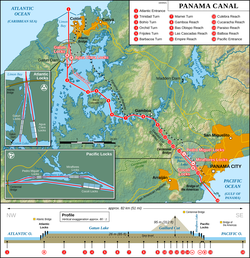
There are twelve locks (six pairs) in total. A two-step flight at Miraflores and a single pair at Pedro Miguel lift ships from the Pacific up to Gatun Lake; then a triple flight at Gatun lowers them to the Atlantic side. All three sets of locks are paired; that is, there are two parallel flights of locks at each of the three lock sites. This, in principle, allows ships to pass in opposite directions simultaneously; however, large ships cannot cross safely at speed in the Culebra Cut, so in practice ships pass in one direction for a time, then in the other, using both "lanes" of the locks in one direction at a time. In this usage pattern, the paired locks offer redundancy during maintenance or in the event of mechanical issues.
The lock chambers are 110 ft (33.53 m) wide by 1,050 ft (320 m) long, with a usable length of 1,000 ft (305 m). These dimensions determine the maximum size of ships that can use the canal; this size is known as Panamax. The total lift (the amount by which a ship is raised or lowered) in the three steps of the Gatun locks is 85 ft (25.9 m); the lift of the two-step Miraflores locks is 54 ft (16 m). The single-step Pedro Miguel locks have a lift of 31 ft (9.4 m). The lift at Miraflores actually varies due to the extreme tides on the Pacific side, between 43 ft (13 m) at extreme high tide and 64.5 ft (20 m) at extreme low tide; tidal differences on the Atlantic side are very small.
The lock chambers are massive concrete structures. The side walls are from 45 to 55 ft (14 to 17 m) thick at the bases; toward the top, where less strength is required, they taper down in steps to 8 ft (2.4 m). The center wall between the chambers is 60 ft (18 m) thick and houses three galleries that run its full length. The lowest of these is a drainage tunnel; above this is a gallery for electrical cabling; and toward the top is a passageway that allows operators to gain access to the lock machinery.
Each lock chamber requires 26,700,000 US gal (101,000 m3) of water to fill it from the lowered to the raised position; the same amount of water must be drained from the chamber to lower it again. Embedded in the side and center walls are three large water culverts that are used to carry water from the lake into the chambers to raise them, and from each chamber down to the next, or to the sea, to lower them. These culverts start at a diameter of 22 ft (6.71 m) and reduce to 18 ft (5.49 m) in diameter, large enough to accommodate a train. Cross culverts branch off from these main culverts, running under the lock chambers to openings in the floors. There are fourteen cross culverts in each chamber, each with five openings; seven cross culverts from the sidewall main culverts alternate with seven from the center wall culvert.
The water is moved by gravity and is controlled by huge valves in the culverts. Each cross culvert is independently controlled. A lock chamber can be filled in as little as ten minutes.
The gates separating the chambers in each flight of locks must hold back a considerable weight of water, and must be both reliable and strong enough to withstand accidents, as the failure of a gate could unleash a flood of water downstream. These gates range from 47 to 82 ft (14.33 to 24.99 m) high, depending on position, and are 7 ft (2.13 m) thick. The tallest gates are at Miraflores, due to the large tidal range there. The heaviest leaves weigh 662 t (730 short tons; 652 long tons); the hinges themselves each weigh 16.7 t (36,817 lb). Each gate has two leaves, 65 ft (19.81 m) wide, which close to a "V" shape with the point upstream. This arrangement has the effect that the force of water from the higher side pushes the ends of the gates together firmly. The gates can be opened only when, in the operating cycle, the water level on both sides is equal.
Panama Canal locks
The Panama Canal locks (Spanish: Esclusas del Canal de Panamá) are a lock system that lifts ships up 85 feet (26 metres) to the main elevation of the Panama Canal and lowers them down again. The original canal had a total of six steps (three up, three down) for a ship's passage. The total length of the lock structures, including the approach walls, is over 1.9 miles (3 km). The locks were one of the greatest engineering works ever to be undertaken when they opened in 1914. No other concrete construction of comparable size was undertaken until the Hoover Dam, in the 1930s.
There are two independent transit lanes, since each lock is built double. The size of the original locks limits the maximum size of ships that can transit the canal; this size is known as Panamax. Construction on the Panama Canal expansion project, which included a third set of locks, began in September 2007, finished by May 2016 and began commercial operation on June 26, 2016. The new locks allow transit of larger, New Panamax ships, which have a greater cargo capacity than the previous locks were capable of handling.
There are twelve locks (six pairs) in total. A two-step flight at Miraflores and a single pair at Pedro Miguel lift ships from the Pacific up to Gatun Lake; then a triple flight at Gatun lowers them to the Atlantic side. All three sets of locks are paired; that is, there are two parallel flights of locks at each of the three lock sites. This, in principle, allows ships to pass in opposite directions simultaneously; however, large ships cannot cross safely at speed in the Culebra Cut, so in practice ships pass in one direction for a time, then in the other, using both "lanes" of the locks in one direction at a time. In this usage pattern, the paired locks offer redundancy during maintenance or in the event of mechanical issues.
The lock chambers are 110 ft (33.53 m) wide by 1,050 ft (320 m) long, with a usable length of 1,000 ft (305 m). These dimensions determine the maximum size of ships that can use the canal; this size is known as Panamax. The total lift (the amount by which a ship is raised or lowered) in the three steps of the Gatun locks is 85 ft (25.9 m); the lift of the two-step Miraflores locks is 54 ft (16 m). The single-step Pedro Miguel locks have a lift of 31 ft (9.4 m). The lift at Miraflores actually varies due to the extreme tides on the Pacific side, between 43 ft (13 m) at extreme high tide and 64.5 ft (20 m) at extreme low tide; tidal differences on the Atlantic side are very small.
The lock chambers are massive concrete structures. The side walls are from 45 to 55 ft (14 to 17 m) thick at the bases; toward the top, where less strength is required, they taper down in steps to 8 ft (2.4 m). The center wall between the chambers is 60 ft (18 m) thick and houses three galleries that run its full length. The lowest of these is a drainage tunnel; above this is a gallery for electrical cabling; and toward the top is a passageway that allows operators to gain access to the lock machinery.
Each lock chamber requires 26,700,000 US gal (101,000 m3) of water to fill it from the lowered to the raised position; the same amount of water must be drained from the chamber to lower it again. Embedded in the side and center walls are three large water culverts that are used to carry water from the lake into the chambers to raise them, and from each chamber down to the next, or to the sea, to lower them. These culverts start at a diameter of 22 ft (6.71 m) and reduce to 18 ft (5.49 m) in diameter, large enough to accommodate a train. Cross culverts branch off from these main culverts, running under the lock chambers to openings in the floors. There are fourteen cross culverts in each chamber, each with five openings; seven cross culverts from the sidewall main culverts alternate with seven from the center wall culvert.
The water is moved by gravity and is controlled by huge valves in the culverts. Each cross culvert is independently controlled. A lock chamber can be filled in as little as ten minutes.
The gates separating the chambers in each flight of locks must hold back a considerable weight of water, and must be both reliable and strong enough to withstand accidents, as the failure of a gate could unleash a flood of water downstream. These gates range from 47 to 82 ft (14.33 to 24.99 m) high, depending on position, and are 7 ft (2.13 m) thick. The tallest gates are at Miraflores, due to the large tidal range there. The heaviest leaves weigh 662 t (730 short tons; 652 long tons); the hinges themselves each weigh 16.7 t (36,817 lb). Each gate has two leaves, 65 ft (19.81 m) wide, which close to a "V" shape with the point upstream. This arrangement has the effect that the force of water from the higher side pushes the ends of the gates together firmly. The gates can be opened only when, in the operating cycle, the water level on both sides is equal.
Recent media
Recent media