Hubbry Logo
PantelegraphPantelegraphMain
Open search
Pantelegraph
Community hub
Pantelegraph
logo
8 pages, 0 posts
0 subscribers
Be the first to start a discussion here.
Pantelegraph
Pantelegraph
from Wikipedia
Pantelegraph
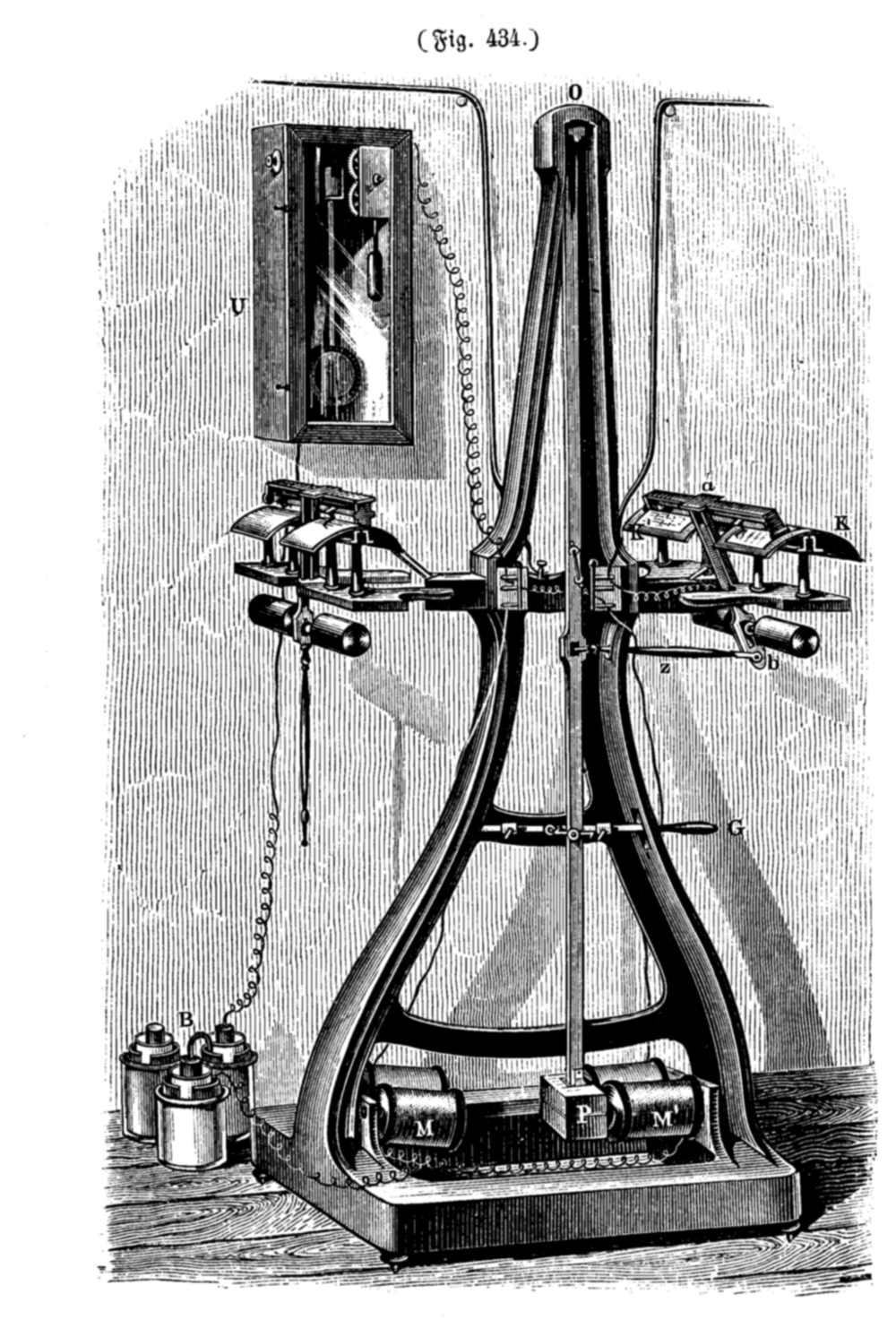
Caselli's pantelegraph mechanism

The pantelegraph (Italian: pantelegrafo; French: pantélégraphe) was an early form of facsimile machine transmitting over normal telegraph lines developed by Giovanni Caselli, used commercially in the 1860s, that was the first such device to enter practical service. It could transmit handwriting, signatures, or drawings within an area of up to 150 mm × 100 mm (5.9 in × 3.9 in).

Description

[edit]

The pantelegraph used a regulating clock with a pendulum which made and broke the current for magnetizing its regulators, and ensured that the transmitter's scanning stylus and the receiver's writing stylus remained in step. To provide a time base, a large pendulum was used weighing 8 kg (18 lb), mounted on a frame 2 m (6 ft 7 in) high. Two messages were written with insulating ink on two fixed metal plates; one plate was scanned as the pendulum moved to the right and the other as the pendulum moved to the left, so that two messages could be transmitted per cycle.[1] The receiving apparatus reproduced the transmitted image by means of paper impregnated with potassium ferricyanide, which darkened when an electric current passed through it from the synchronized stylus. In operation the pantelegraph was relatively slow; a sheet of paper 111 mm × 27 mm (4.4 in × 1.1 in), with about 25 handwritten words, took 108 seconds to transmit.[2]

The most common use of the pantelegraph was for signature verification in banking transactions.

History

[edit]
Pantélégraph by Giovanni Caselli, 1933 replica exhibited at the Museo nazionale della scienza e della tecnologia Leonardo da Vinci, Milan.
Detail of the Pantélégraph by Giovanni Caselli, 1933 replica, Museo nazionale della scienza e della tecnologia Leonardo da Vinci, Milan.

While employed teaching physics at the University of Florence, Giovanni Caselli devoted much time to research into the telegraphic transmission of images. The major problem of the time was to get perfect synchronization between the transmitting and receiving parts so they would work together correctly. Caselli developed an electrochemical technology with a "synchronizing apparatus" (regulating clock) to make the sending and receiving mechanisms work together that was far superior to any technology Bain or Bakewell had.[3]

By 1856, he had made sufficient progress for Leopold II, Grand Duke of Tuscany to take an interest in his work, and the following year he travelled to Paris where he was assisted by the engineer Paul-Gustave Froment, to whom he had been recommended by Léon Foucault, to construct the first pantelegraph. In 1858, Caselli's improved version was demonstrated by French physicist Alexandre-Edmond Becquerel at the French Academy of Sciences in Paris.[1]

On 10 May 1860 Napoleon III visited Froment's workshop to observe a demonstration of the device, and was so enthused by the device that he secured access for Caselli to the telegraph lines he needed to further his work, from Froment's workshops to the Paris Observatory. In November 1860 a telegraph line between Paris and Amiens was allotted to Caselli which enabled a true long-distance experiment, which was a complete success, with the signature of the composer Gioacchino Rossini as the image sent and received, over a distance of 140 km (87 mi).[1] The composer wrote a piece, allegretto ‘del pantelegrafo’, for piano, marking the event.

The first "pantelegram" was sent from Lyon to Paris on 10 February 1862. The Corps législatif later ordered the installation of the pantelegraph on the railway line between the two cities, and from February 1863 the public was able to use it. French law was enacted in 1864 for the pantelegraph facsimile system to be officially accepted. The next year in 1865 the operations started with the Paris to Lyon line and extended to Marseille in 1867.[4]

Russian Tsar Alexander II installed an experimental service between his palaces in Saint Petersburg and Moscow between 1864 and 1865.[1][4][5] In 1867 the Director of Telegraphs of France, de Vougy, had a second line set up from Lyon to Marseille; the transmission cost was 20 centimes per square centimetre of image, and the service was operated until 1870.[6]

Surviving machines

[edit]

There are few remaining examples of the original pantelegraph. A formidable display of the pantelegraph was mounted in 1961 at the Musée National des Techniques, when a centennial celebration of the device was performed between Paris and Marseille. Again in 1982 their reliability was displayed; at the Postal Museum in Riquewihr, two pantelegraphs were used for six hours a day, for several months, performing without error.

An original specimen is also kept on display at the Istituto Della Porta in Naples.[7]

One pantelegraph is in Munich (German Museum); it was (as of 2007) never displayed.[8]

Another specimen is displayed at the A.S. Popov Central Museum of Communications in St Petersburg, Russia.[9]

Literature

[edit]
  • Zons, Julia (2015). Casellis Pantelegraph: Geschichte eines vergessenen Mediums (PhD). Universität Konstanz. ISBN 978-3-8394-3116-0. 31792.

Footnotes

[edit]

References

[edit]
[edit]
Revisions and contributorsEdit on WikipediaRead on Wikipedia
from Grokipedia
The pantelegraph was an early electromechanical device invented by Italian Giovanni Caselli in the mid-19th century, designed to transmit images, , drawings, and signatures over telegraph lines by scanning and reproducing them at a remote location. It operated using a synchronized system of a and clock to ensure precise line-by-line scanning at both the transmitter and receiver, where a traced conductive and non-conductive areas of an image prepared on with insulating , sending electrical signals via telegraph wires to mark sensitized paper—typically coated with —at the receiving end. Capable of handling documents up to 15 cm by 10 cm, it represented the first practical system for over distance, predating modern fax machines by nearly a century. Caselli, born in 1815 in , , and ordained as a Catholic in , developed the pantelegraph while teaching physics at the , building on earlier concepts like Scottish inventor Alexander Bain's 1843 electrochemical telegraph. He refined the device in around 1858 with assistance from instrument maker Paul-Gustave Froment, leading to a successful demonstration in 1860 before , where he transmitted the signature of composer over approximately 130 km from to . Further tests in the early 1860s extended transmissions up to 800 km, from to , showcasing its reliability for long-distance use. Commercial deployment began in in 1865 with a line between and , expanding to by 1867 after official acceptance by the French government in 1864; it integrated into the national telegraph network and was used primarily for secure banking transactions, such as verifying signatures on checks and contracts to prevent fraud. By the late 1860s, similar systems operated briefly in other countries, including , , and , though adoption was limited by the need for dedicated lines and competition from faster telegraph alternatives. The service declined in the 1870s due to technical limitations and the rise of the , but Caselli's invention laid foundational principles for later scanning and transmission technologies, influencing the evolution of and early photocopying devices.

Overview and Description

Invention and Basic Concept

The pantelegraph was the first commercially viable facsimile machine, designed to transmit handwriting, signatures, and drawings over telegraph lines. Invented by Giovanni Caselli, an Italian priest and physicist born in in 1815 who had a lifelong devotion to physics and early studies in and , the device addressed key limitations in prior telegraph systems by enabling the reproduction of visual content at a distance. Caselli developed the pantelegraph with assistance from French instrument maker Paul-Gustave Froment, refining concepts from earlier inventors like Alexander Bain to overcome synchronization challenges in image transmission. At its core, the pantelegraph operated on the principle of synchronized scanning, using isochronously vibrating pendulums at both the sending and receiving ends to ensure precise line-by-line reproduction of images. This mechanical harmony allowed a to trace the original document on the transmitter while a corresponding on the receiver recreated the image in real time, marking a foundational advance in electromechanical technology. The device accommodated sheets up to 150 mm × 100 mm, though the standard transmission area was limited to 111 mm × 27 mm, sufficient for documents containing about 25 words. On the receiving end, impressions were captured on paper coated with , which darkened upon exposure to , producing a visible copy of the transmitted content.

Technical Specifications

The Pantelegraph machine featured sender and receiver units equipped with mechanisms for scanning and marking, mounted on a frame approximately 2 meters high, with overall dimensions of 84 inches in height, 36 inches in width, and 10 inches in depth. A , approximately 6 feet long and weighted with 12 pounds of iron and lead, drove the scanning process, regulated by a clock mechanism to ensure precise timing. The system utilized curved segmental tin tables with a 5-inch radius for holding documents, allowing for the transmission of images up to about 111 mm × 27 mm in size. Synchronization between sender and receiver was achieved through dual pendulums vibrating at the same , with a regulator pendulum oscillating twice per cycle of the main pendulum to align line-by-line scanning. This setup enabled the transmission of two messages per pendulum cycle, one scanned during the rightward swing and the other during the leftward swing, using insulating on silvered metal plates at the sender to modulate electrical conductivity. A full sheet of 111 mm × 27 mm, typically containing around 25 handwritten words or a , required 108 seconds to transmit over telegraph lines. In 1867 France, transmission costs were set at 20 centimes per square centimeter, in addition to expenses for the metallic sheets used, with overall operational costs linked to standard telegraph line usage rates. The receiver produced output as blue impressions on paper impregnated with , which darkened upon exposure to , rendering clear reproductions suitable for verifying signatures and simple black-and-white line drawings but limited to monochromatic without shading or color.

Development and History

Early Prototypes and Demonstrations

Giovanni Caselli, an Italian physicist and inventor, developed the initial prototype of the pantelegraph in Florence, Italy, in 1856. This early version integrated with an electrochemical scanning mechanism to transmit simple images and handwriting over wire lines. The prototype's progress impressed Leopold II, Grand Duke of , who observed a demonstration and provided support for further experimentation, recognizing its potential to extend telegraph capabilities beyond text. By 1858, Caselli had relocated to Paris, where he collaborated with engineer Paul-Gustave Froment to refine the device mechanically, addressing initial unreliability in transmission speed and distance. An improved prototype was demonstrated at the French Academy of Sciences by physicist Alexandre-Edmond Becquerel, showcasing the successful transmission of basic images over telegraph lines. Key innovations included the use of synchronized pendulums to maintain alignment between the transmitting and receiving styluses, ensuring precise scanning and reconstruction of the original document. Froment's refinements, such as enhanced regulators and clock mechanisms, resolved synchronization issues that had plagued earlier short-range tests. In 1860, with endorsement from , who had witnessed a private demonstration, long-distance tests were conducted over standard telegraph infrastructure. A notable trial transmitted an autographed note from composer Gioacchino Rossini from to , covering 140 km, in just a few minutes, validating the system's viability for extended ranges. Further tests in the early extended transmissions up to 800 km, from to . These demonstrations highlighted the pantelegraph's ability to overcome prior limitations in signal fidelity over distance, paving the way for broader evaluation.

Commercial Implementation

The first pantelegram was transmitted from to on February 10, 1862. This early deployment was facilitated by the French government's interest following successful prototypes, leading to legislative authorization in 1863 for an official line between and to handle private dispatches and drawings. Commercial service began on the Paris-Lyon line in 1865. Expansion accelerated between 1863 and 1867, with the network connecting and by 1865 and extended to in 1867, establishing multiple stations at its peak for reliable transmission across key urban centers. In 1864, French law formally recognized the Pantelegraph for secure document transmission, particularly validating signatures on official and financial papers, which solidified its role in governmental operations. Internationally, adoption included trials in from 1864 to 1865, where Tsar Alexander II ordered an experimental line between St. Petersburg and for testing image reproduction over telegraph wires. Brief implementations occurred in and during the mid-1860s, limited to short-distance demonstrations without widespread networks. The system's rollout was subsidized by governments to support banking and official communications, emphasizing its utility for authenticating documents remotely. However, by the late , high operational costs and competition from faster telegraphs led to its decline, with French services ceasing in 1870.

Operation and Applications

Mechanism of Transmission

The Pantelegraph's transmission mechanism began with the preparation of the original document on a sheet of . The sender inscribed the image, such as or drawings, using non-conductive , typically a varnish-like substance that insulated the underlying metal. This setup ensured that the tin foil remained electrically conductive in areas without ink, while the inked lines disrupted conductivity. At the transmitting end, a mounted on a arm scanned the tin sheet line by line. The , weighing approximately 18 pounds and housed in a 6-foot cast-iron frame, swung in a precise arc driven by a regulating clock to maintain isochronous motion. As the lightly touched the surface, it completed an electrical circuit through the conductive tin in blank areas, generating a continuous current; over the non-conductive , the circuit broke, producing interruptions in the signal. These variations—pulses of current on and off—encoded the image data, with one full pendulum cycle (forward and return swing) scanning two lines to optimize efficiency. A screw mechanism advanced the sheet longitudinally between swings, ensuring complete coverage without overlap. The electrical pulses were transmitted over standard telegraph wires to the receiving station, where an identical pendulum setup mirrored the sender's motion for synchronization. This parallel operation relied on the pendulums' precise timing to align the receiving stylus exactly with the transmitted signals; any desynchronization could distort the image, necessitating retransmission of the entire document. At the receiver, the stylus moved across specially prepared paper impregnated with potassium ferricyanide and moistened with an iron salt solution, forming an electrolyte. When current flowed—corresponding to blank areas on the original—the chemical reaction produced Prussian blue marks, darkening the paper and creating a negative reproduction where lines appeared as light areas against a darkened background. A complete transmission cycle for a standard sheet (approximately 111 mm by 27 mm) took 108 seconds, encompassing the full scanning, signaling, and recording process. The system's dependence on uninterrupted timing and wire integrity meant that line noise or mechanical drift often required manual restarts, underscoring the mechanical precision essential to its function.

Practical Uses and Limitations

The Pantelegraph found its primary applications in the banking sector, where it was employed to transmit handwritten signatures for verification, thereby helping to prevent in long-distance financial transactions. This capability allowed banks to confirm the authenticity of signatures on documents like and deposits without physical transport, marking an early use of visual in secure commerce. Secondary uses included the transmission of maps, legal contracts, and simple black-and-white illustrations, though these were constrained by the device's format, typically limited to about 25 words or equivalent content on a small sheet measuring 111 mm by 27 mm. The system's line-scanning mechanism, which briefly referenced its synchronization-dependent operation, enabled these reproductions but restricted it to basic textual and linear graphics. Despite its innovations, the Pantelegraph faced significant limitations that confined it to niche roles. Transmission speed was notably slow, requiring approximately 108 seconds to scan and send a standard small sheet, making it impractical for high-volume or time-sensitive exchanges. Operational costs were prohibitively high, priced at 20 centimes per square centimeter of transmitted image, which often amounted to at least 6 francs per message and deterred widespread adoption. Additionally, vulnerability to telegraph line noise frequently caused distortions in the received images, compromising accuracy for detailed content. User constraints further hampered usability, as the device demanded skilled operators to manually prepare documents, synchronize pendulums, and interpret outputs, limiting accessibility to trained telegraph personnel. It was unsuitable for photographs or complex images, relying solely on black-and-white line scanning that could not capture or intricate visuals effectively. These factors contributed to its decline, as competition from faster automatic printing telegraphs and the emerging reduced demand by the 1870s; the service operated commercially in from 1865 to 1870 before ceasing.

Legacy and Preservation

Influence on Later Technologies

The Pantelegraph, developed by Giovanni Caselli in the 1860s, served as the first practical device capable of transmitting images over telegraph wires, establishing a foundational proof-of-concept for long-distance that directly influenced the evolution of 20th-century machines. Unlike earlier experimental systems, its commercial deployment between and demonstrated reliable transmission of handwriting and signatures, paving the way for standardized technologies that became ubiquitous in business and by the mid-20th century. This success highlighted the viability of scanning and reproducing documents electrically, inspiring subsequent innovations in image transfer protocols. A key contribution of the Pantelegraph was its pendulum-based mechanism, which ensured precise alignment between the transmitting and receiving scanners—a model that advanced early scanning techniques and addressed limitations in prior devices. Building on Alexander Bain's 1843 chemical telegraph, which lacked effective and was limited to short-range or low-fidelity transmissions, Caselli's design improved resolution and distance capability, transmitting clear images up to 800 kilometers. It also surpassed Frederick Bakewell's 1858 image telegraph, which operated only over short distances without commercial scalability, by integrating robust for sustained operational use. These enhancements influenced later inventors, including Gray's 1888 , which adapted similar principles for handwriting replication over wires, bridging mechanical scanning to more automated systems. The Pantelegraph's broader impact extended to secure document verification in , where it enabled banks to remotely authenticate signatures and contracts over telegraph lines, marking an early application of imaging technology in . Conceptually, it laid the groundwork for document imaging in , facilitating the transition to wireless facsimile (radiofax) in the early and serving as a direct ancestor to the analog fax standards introduced in 1968 by the , which standardized six-minute page transmissions at 96 lines per inch resolution. Historians recognize the Pantelegraph as a pivotal milestone in imaging technology, underscoring its role in evolving from rudimentary to modern digital scanning.

Surviving Artifacts

Few original Pantelegraph machines survive today, with estimates suggesting fewer than ten known examples worldwide, most of which are non-functional due to their age and the fragility of 19th-century mechanical components. These artifacts are invaluable for studying early electromechanical technology and the integration of with image transmission. While no operational Pantelegraph networks exist, preserved units offer insights into the device's pendulum-driven and stylus-based scanning mechanisms. In , an original Pantelegraph is housed at the in , where it has been maintained as part of the museum's collection of historical communication devices. This specimen was demonstrated in working condition during a 1961 centennial exhibition, successfully transmitting images over a recreated line between and to commemorate the device's early trials. Further restorations allowed it to operate reliably for public viewings in 1982 at the Postal Museum in , highlighting the durability of its core electromechanical elements despite over a century of disuse. Italy preserves key examples, reflecting Giovanni Caselli's national origins and the device's brief commercial use there. An original unit is on display at the Istituto Tecnico Statale "G.B. della Porta" in , showcasing Caselli's authentic design with its characteristic ink-foil and pendulum system. Another specimen, a 1933 replica, resides at the Museo Nazionale della Scienza e della Tecnologia "" in , where it serves as a centerpiece for exhibits on early and image reproduction technologies. These Italian artifacts emphasize the Pantelegraph's role in 19th-century European innovation, though they remain largely static displays rather than functional pieces. A German example is held in the collection of the in , acquired as part of its extensive holdings on the and . This over-400-kilogram machine, standing two meters tall with an 8-kilogram iron , includes 1860s-era accessories but remains in poor condition and has never been publicly exhibited due to the need for extensive restoration. Conservation efforts have focused on its electromagnets and components, underscoring the challenges of preserving such intricate, telegraph-integrated devices. In , a Pantelegraph from the 1864 trials between St. Petersburg and is preserved at the A.S. Popov Central Museum of Communications in St. Petersburg, illustrating the device's experimental adoption beyond . These surviving artifacts, primarily from , , , and —countries where the Pantelegraph saw early commercial or trial implementation—collectively represent the limited physical legacy of a pioneering but short-lived .

References

Add your contribution
Related Hubs
User Avatar
No comments yet.