Hubbry Logo
1860s1860sMain
Open search
1860s
Community hub
1860s
logo
8 pages, 0 posts
0 subscribers
Be the first to start a discussion here.
1860s
1860s
from Wikipedia
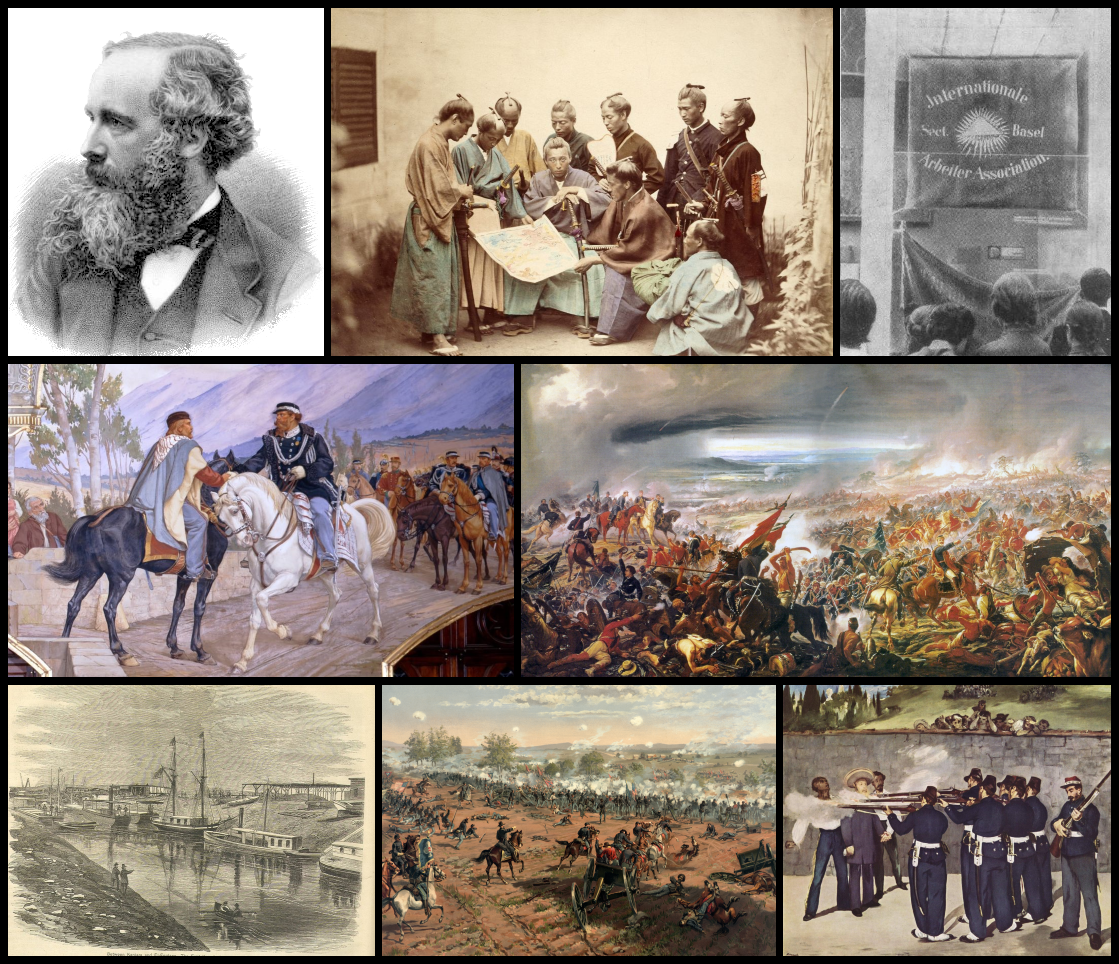
From top left, clockwise: Scottish physicist James Clerk Maxwell formulates the classical theory of electromagnetic radiation, bringing together for the first time electricity, magnetism, and light as different manifestations of the same phenomenon; the Meiji Restoration leads to enormous changes in Japan's political and social structure; the International Workingmen's Association is formed in 1864, aimed at uniting a variety of different left-wing socialist, communist and anarchist groups; the Battle of Avay, fought in 1868 during the Paraguayan War, the bloodiest inter-state war in Latin America's history; execution in 1867 of Maximilian I of Mexico, ruler of the Second Mexican Empire, established during the Second French intervention in Mexico; the Battle of Gettysburg, the turning point of the American Civil War, fought in the United States from 1861 to 1865, between the North (the Union) and the South (the Confederacy) as a result of the long-standing controversy over the enslavement of black people; the Suez Canal is inaugurated in 1869; Victor Emmanuel meets Garibaldi near Teano in 1860, at the end of the Expedition of the Thousand.

The 1860s (pronounced "eighteen-sixties") was a decade of the Gregorian calendar that began on January 1, 1860 and ended on December 31, 1869.

The decade was noted for featuring numerous major societal shifts in the Americas. In North America, the election of Free Soiler Abraham Lincoln to the presidency in 1860 in the United States led to the secession of eleven southern states as the Confederate States of America (CSA). The resulting American Civil War (1861–1865) would be among the first industrial wars, featuring advanced technology such as steel warships and machine guns. The victory of the Union and subsequent abolition of slavery would contribute to the decline of the global slave trade. Conflict in Mexico ensued after the French Empire installed Maximilian I as Emperor of Mexico; former President Benito Suarez would regain his position in 1867 after a power struggle.

In South America, the Triple Alliance of the Empire of Brazil, Argentina and Uruguay in the Paraguayan War (1864–1870) would be among the bloodiest conflicts in the continent's history, leading to the death of almost 60% of the Paraguayan population.

In Europe, the formation of the union of Austria-Hungary in 1867 and the ongoing campaign to unify Italy by Victor Emmanuel II of Sardinia-Piedmont would affect the European balance of power. The United Kingdom would continue engaging in a series of conflicts known as the New Zealand Wars with the indigenous Māori, with the New Zealand land confiscations beginning in 1863.

In Asia, the Meiji Restoration of 1868 would begin the process of transforming Japan into a global imperial power. The Qing Dynasty of China would experience decline following its defeat to the British in 1860 in the Second Opium War. In 1864, the Russian Empire would embark upon the Circassian genocide in the Caucasus, leading to the deaths or expulsion of at least 75% of the Circassian people.

The last living person from this decade was Nellie Spencer, who died in 1982.

Politics and wars

[edit]
Emperor Maximilian being executed (1867), marking the end of the Second Mexican Empire

Wars

[edit]

Internal conflicts

[edit]
American Civil War: Battle of Antietam by Thure de Thulstrup

Prominent political events

[edit]
Political map of the world in 1860

Assassinations and attempts

[edit]

Prominent assassinations, targeted killings, and assassination attempts include:

Year Date Name Position Culprits Country Description Image
1860 March 24 Ii Naosuke Tairō of the Tokugawa Shogunate 17 young samurai loyalists Japan While Naosuke was at staying at the Edo Castle a group of 17 loyalist ambushed and was decapitated.
1861 October 23 Jorge Córdova president of Bolivia Colonel Plácido Yáñez Bolivia Jorge was captured by Colonel Plácido Yáñez and executed along with 50 other prisoners.
1862 January 11 José Santos Guardiola President of Honduras unknown presidential guard Honduras Jose was sleeping with his wife Ana Arbizú y Flores when an unknown assassin shot him and fled.
1863 May 12 Radama II King of Madagascar Men led by Rainivoninahitriniony Madagascar Radama's absolutism in pursuing dramatic reforms in disregard of the advice of his ministers ultimately turned them against him. In a coup led by his prime minister, Rainivoninahitriniony, Radama II was strangled on May 12, 1863.
1863 October 30 Serizawa Kamo chief of Shinsen-gumi likely Hijikata, Okita, Yamanami Keisuke, Inoue, Harada or Tōdō and Saitō Japan While sleeping with a woman named Oume he was assassinated by an unknown assassin.
1865 March 27 Manuel Isidoro Belzu Humérez President of Bolivia A group of men led by Mariano Melgarejo Bolivia When Belzu entered the Palacio Quemado for a meeting with Mariano Melgarejo he was ambushed by Melgarejo and a group of men who murdered him.
1865 April 14 Abraham Lincoln President of America John Wilkes Booth United States of America On the night of April 14 of 1865, John Wilkes Booth sneaked into Ford's Theatre and assassinated the President whilst he watched Our America Cousin. Image of Lincoln being shot by Booth while sitting in a theater booth.
1868 February 19 Venancio Flores and Bernardo Prudencio Berro President of Uruguay Group of unknown assassins Uruguay Four days after stepping down as President, Flores and Berro were murdered by a group of unidentified assassins in Montevideo.
1868 April 7 Thomas D'Arcy McGee Member of the Canadian Parliament for Montreal West Patrick J. Whelan Canada McGee was entering a boarding house in Ottawa when he was shot in the head by a Catholic Fenian sympathizer.
1868 October 22 James M. Hinds Member of the U.S. House of Representatives from Arkansas's 2nd district George Clark United States En route to a campaign event for Grant near the village of Indian Bay in Monroe County, Clark shot Hinds and fellow Republican politician Joseph Brooks in the back with a shotgun. Brooks managed to stay on his horse and ride to the event to bring back assistance, before his death Hinds wrote a message to his wife revealing the killers identity as secretary of the Monroe County Democratic Party and local Klansman, George Clark.
1868 December 10 Sakamoto Ryōma and Nakaoka Shintarō Japanese samurai and influential figure of the Bakumatsu unknown assassin Tokugawa Shogunate Ryōma and Shintarō where eating in the Ōmiya Inn when an unknown broke in and killed the men and the bodyguards.
1869 December 7 Ōmura Masujirō military leader and theorist unknown assassin Japan Omura was stabbed in a Kyoto inn and died in Osaka.

Disasters and natural events

[edit]

Science and technology

[edit]
Alfred Nobel invents dynamite in Sweden, patenting it in 1867

Establishments

[edit]
The signing of the First Geneva Convention by some of the major European powers in 1864
T. H. Huxley's famous debate in 1860 with Samuel Wilberforce was a key moment in the wider acceptance of Charles Darwin's theory of evolution

Religion

[edit]

Culture

[edit]

Literature and arts

[edit]

Sports

[edit]

Fashion

[edit]
  • The Victorian era and its culture largely thrived from 1860 until 1901.
  • The culture of the Victorian era comes to America and remains in place until around the turn of the 20th century, where the year it ends is disputed as to whether it ended with the rise of progressivism in 1896 or with the death of Queen Victoria in 1901.
[edit]

People

[edit]

Politics

[edit]

Famous and infamous personalities

[edit]

Births

1860

Takaaki Kato
Douglas Hyde
Anton Chekhov
Carl Georg Barth
Lizzie Borden
Annie Oakley
Joseph Cook
Georgina Fraser Newhall
Juliette Gordon Low
Hjalmar Branting

1861

Helen Herron Taft
Rabindranath Tagore
Kate M. Gordon
Edith Roosevelt
Myra Belle Martin
James Naismith

1862

David Hilbert
Edith Wharton
Gustav Klimt
Claude Debussy
Ida B. Wells
Andrew Fisher
Billy Hughes
Gerhart Hauptmann

1863

Photo of Swami Vivekananda in 1893
Swami Vivekananda
Helen Dortch Longstreet
Hugo Winckler
Amélie Rives Troubetzkoy
Henry Ford
Carlos I of Portugal
Edvard Munch

1864

Wilhelm Wien
Marguerite Durand
Ana Echazarreta
Max Weber
Richard Strauss, 1918
Walther Nernst
Alois Alzheimer
Henri de Toulouse-Lautrec
Emma Sheridan Fry

1865 * January 5Julio Garavito Armero, Colombian astronomer (d. 1920)

Elma Danielsson
Pieter Zeeman
King George V of the United Kingdom
Philipp Scheidemann
Julia Marlowe
Charles W. Clark
Hovhannes Abelian
Warren G. Harding
Jean Sibelius
Rudyard Kipling

1866

Frank Tudor
Emilia Broomé
Matthew Charlton
Wakatsuki Reijirō
Butch Cassidy
Anne Sullivan
H. G. Wells
La Goulue
Thomas Hunt Morgan
Wassily Kandinsky
Sun Yat-sen
Ramsay MacDonald

1867

Carl Laemmle
Cy Young
Chris Watson
Queen Mary
Carl Gustaf Emil Mannerheim
Frank Lloyd Wright
Marie Curie
Nakamura Yoshikoto
Elena Meissner

1868

Felix Hoffmann
Countess Markiewicz
Nicholas II of Russia
John L. Hines
Robert Falcon Scott
Karl Landsteiner
Miklós Horthy
Mary Brewster Hazelton
Arturo Alessandri
Fritz Haber

1869

Else Lasker-Schüler
Stanisław Wojciechowski
Edith Anne Stoney
Charles Thomson Rees Wilson
Emilio Aguinaldo
Calouste Gulbenkian
Hans Spemann
Mohandas Gandhi
Victor Emmanuel III
André Gide
Henri Matisse
Komitas

Deaths

1860

Anne Isabella Milbanke
Charles Goodyear
Arthur Schopenhauer

1861

Frederick William IV of Prussia
Abdülmecid I
Xianfeng Emperor
Ernst Anschütz

1862

Samuel Colt
John Tyler
Henry David Thoreau
Judith Montefiore
Martin Van Buren

1863

Antonio Valero de Bernabé


Eugène Delacroix
Jacob Grimm

1864

John Sedgwick
J. E. B. Stuart
Juan José Flores
Princess Caraboo

1865

Abraham Lincoln
John Wilkes Booth
Paul Bogle
Henry John Temple
Leopold I of Belgium

1866 * January (date unknown) – Thomas Baldwin Marsh, American religious leader (b. 1799)

Bernhard Riemann

1867

Emperor Kōmei
Emperor Maximilian I of Mexico
King Otto of Greece
Michael Faraday
Metropolitan Abuna Salama III
Filaret, Metropolitan of Moscow

1868 * January 20Damien Marchesseault, 7th Mayor of Los Angeles (suicide) (b. 1818)

John Crawfurd
Gioachino Rossini
Adah Isaacs Menken
Mongkut

1869

Hector Berlioz
Christian Erich Hermann von Meyer

See also

[edit]

References

[edit]

Further reading

[edit]
[edit]
Revisions and contributorsEdit on WikipediaRead on Wikipedia
from Grokipedia
The 1860s was a decade of profound upheaval and innovation, commencing on January 1, 1860, and concluding on December 31, 1869, defined primarily by large-scale wars, state formations, and technological breakthroughs that reshaped global power dynamics. In the United States, the erupted in 1861 following Southern secession, culminating in Union victory in 1865 after an estimated 698,000 deaths, preserving national unity and paving the way for slavery's abolition via the 13th Amendment ratified that year. In Europe, the Kingdom of Italy was proclaimed in 1861, unifying much of the peninsula under the after decades of fragmentation. Concurrently, the in , a massive civil conflict rooted in millenarian ideology, ended in 1864 with over 20 million fatalities, exacerbating decline. The decade's transformations extended to Asia and infrastructure, with Japan's in 1868 overthrowing the , initiating Western-style reforms and imperial centralization that propelled rapid industrialization. The Suez Canal's opening in November 1869 shortened maritime routes between Europe and Asia, slashing travel times and boosting global trade efficiency despite initial construction delays and high costs. Scientifically, patented in 1867, revolutionizing and while foreshadowing modern explosives' military applications, while formulated the periodic table in 1869, systematizing chemical elements for future discoveries. These events underscored causal chains of political fragmentation yielding to consolidation, often through violent conflict, amid empirical advances in human knowledge and engineering.

Politics and International Conflicts

Major Wars

The (1861–1865) pitted the federal government against eleven Southern states that seceded to form the , driven fundamentally by disputes over slavery's preservation and expansion, compounded by debates on and economic policies such as protective tariffs that favored Northern industry over Southern agrarian exports. The conflict erupted on April 12, 1861, with the Confederate attack on , leading to over 2 million enlistments and an estimated 620,000 to 750,000 total military deaths from combat, disease, and other causes. Key engagements included the on September 17, 1862, the bloodiest single day with 22,717 casualties, which halted Confederate General Robert E. Lee's first invasion of the North and enabled President Abraham Lincoln's ; and the from July 1–3, 1863, where Union forces repelled Lee's second invasion, inflicting 51,112 casualties and marking a strategic turning point. The war concluded with General Ulysses S. Grant's acceptance of Lee's surrender at Appomattox Court House on April 9, 1865, preserving the Union and abolishing slavery via the Thirteenth Amendment, though at the cost of massive destruction in the South due to Union strategies like under Generals and . The , a massive civil uprising against the that began in 1850 under the leadership of , who claimed to be the brother of Christ, reached its peak intensity in the 1860s with widespread devastation across southern and . Motivated by millenarian Christian-influenced ideology, socioeconomic grievances from famine, corruption, and opium addiction, as well as anti-Manchu ethnic sentiments, the rebels captured in 1853 and established a theocratic state, but their radical social reforms—including communal property, in labor, and suppression of traditional Chinese customs—alienated potential allies. By the early 1860s, forces, bolstered by provincial armies led by and , along with foreign mercenaries like the Ever-Victorious Army under and , encircled Taiping strongholds; key events included the failed Taiping northern expedition and the 1864 recapture of , where tens of thousands of rebels were massacred. The rebellion's suppression in 1864 followed 14 years of fighting that caused 20 to 30 million deaths—primarily from famine, disease, and massacres—representing up to 10% of China's population and weakening the 's control, facilitating later foreign encroachments. The , also known as the Seven Weeks' War, erupted on June 14, 1866, as Prussian Chancellor maneuvered to exclude from German affairs, exploiting disputes over the administration of Schleswig and following their joint in 1864. Prussia's rapid mobilization and superior breech-loading Dreyse needle rifles enabled decisive victories, particularly at the (Sadowa) on July 3, 1866, where Prussian forces under Helmuth von Moltke outmaneuvered and outnumbered Austrians, inflicting around 44,000 casualties against 9,000 Prussian losses in that engagement alone. Allied with , which tied down Austrian troops in the south, Prussia dissolved the , excluded from German unification, and formed the under Prussian leadership; total war casualties exceeded 100,000, with Austria's defeat confirming Prussian military dominance through modern railroads, telegraphs, and tactical reforms emphasizing speed and firepower over Austria's outdated muzzle-loaders and rigid formations. The Peace of Prague on August 23, 1866, imposed mild terms on , avoiding harsh reparations to preserve Bismarck's diplomatic isolation of France for future conflicts.

Political Unifications and Reforms

In May 1860, launched the , departing from with approximately 1,000 volunteers to invade , sparking local uprisings that enabled the conquest of the island and the subsequent mainland advance into the Kingdom of the Two Sicilies by August. This campaign dismantled Bourbon rule in , allowing Sardinia-Piedmont to annex the territories and expand its domain from 74,000 to 239,000 square kilometers by late 1860. On March 17, 1861, the in proclaimed the Kingdom of Italy under , integrating most of the peninsula except , under papal control, and , held by until 1866. These steps reflected Piedmont's strategic consolidation of power through opportunistic alliances and military action rather than widespread popular consensus, leaving administrative and economic disparities between north and south unaddressed. In Prussia, Otto von Bismarck's appointment as prime minister on September 23, 1862, initiated a realist approach to German unification, dismissing liberal reliance on speeches and majority votes in favor of "blood and iron"—military force and industrial capacity—as the decisive factors. His policy exploited interstate rivalries, culminating in the Austro-Prussian War of 1866, where Prussian victories excluded Austria from German affairs and dissolved the German Confederation. The resulting North German Confederation, formalized on July 1, 1867, united 22 states north of the Main River under Prussian leadership, with a constitution granting Bismarck executive dominance via a hereditary presidency held by King Wilhelm I and a customs parliament of limited sovereignty. This structure centralized fiscal and military authority, enabling Prussia to control a population of about 30 million and an army of 1 million men, positioning it to absorb southern states later through diplomatic pressure and shared interests. Russia's Emancipation Manifesto, issued by Tsar on March 3, 1861 (February 19 in the ), abolished for over 23 million bound to private estates and households, granting personal freedom and the right to communal ownership via redemption payments to landlords over 49 years. The reform stemmed from the Crimean War's (1853–1856) revelation of 's drag on mobilization—Russia fielded only 700,000 troops against better-equipped foes—and , with productivity lagging free labor by factors evident in European comparisons. framed it as preemptive to avert revolts, stating it was "better to liberate [the serfs] from above than to wait until they achieve their liberation by themselves," but implementation retained noble control and imposed village oversight, limiting mobility and for decades.

Elections, Treaties, and Diplomatic Shifts

In the United States presidential election of November 6, 1860, of the Republican Party prevailed with 1,855,993 popular votes, equivalent to 39.8 percent of the total cast, and secured 180 electoral votes from Northern and Pacific states. The Democratic Party's internal schism produced two candidates— garnering 1,380,202 votes (29.5 percent) in the North and obtaining 848,019 votes (18.1 percent) with Southern backing—while John Bell of the Constitutional Union Party received 590,901 votes (12.6 percent), fragmenting opposition and enabling Lincoln's victory without any Southern electoral support. This outcome, reflecting deep sectional antagonism over slavery expansion, prompted South Carolina's legislature to adopt an on December 20, 1860, followed by six additional states by February 1861, thereby dissolving the union's prior equilibrium and establishing the . The 1864 United States presidential election, held on November 8 amid ongoing Civil War hostilities, saw incumbent Abraham Lincoln, running on the National Union ticket with Andrew Johnson, win 2,211,317 popular votes (55 percent) and 212 electoral votes, defeating Democrat George B. McClellan who received 1,797,019 votes (45 percent) and 21 electoral votes from New Jersey. Voter turnout reached approximately 73.8 percent of eligible males in loyal states, bolstered by absentee balloting from Union soldiers who favored continuance of the war effort by a margin exceeding 70 percent in key battleground areas. Lincoln's mandate reinforced federal commitment to suppressing the rebellion, stabilizing Northern political control despite war fatigue and Copperhead opposition, and precluding any negotiated peace that might recognize Confederate independence. In , plebiscites conducted in and 1860 following Giuseppe Garibaldi's conquest of the Kingdom of the Two Sicilies yielded overwhelming endorsements for to the Kingdom of under , with approval rates exceeding 99 percent in (433,000 yes versus 1,300 no) and (1,300,000 yes versus under 11,000 no). These referenda, organized under provisional governments aligned with Piedmontese interests, integrated the south into a nascent unified state, shifting diplomatic leverage from fragmented principalities to a centralized capable of negotiating as a continental power. The Treaty concerning the Cession of the Russian Possessions in North America, signed March 30, 1867, between the and the , transferred —spanning 586,412 square miles—for $7.2 million, equivalent to roughly two cents per acre. Negotiated by U.S. and Russian envoy , the agreement stemmed from Russia's strategic divestment of a sparsely populated territory vulnerable to British encroachment during the aftermath, while augmenting U.S. continental dominion and forestalling rival European claims in the . Formal transfer occurred October 18, 1867, at Sitka, redirecting Russian naval assets eastward and enhancing American influence over North Pacific trade routes. In , the promulgated by on April 6, 1868, following the January 3 restoration of imperial rule, renounced feudal through five articles committing to deliberative assemblies, global knowledge acquisition, replacement of "evil customs" with "just laws," and popular unity under the throne. This document formalized the overthrow of authority, which had dominated diplomacy since 1603, and pivoted toward treaty revisions with Western powers, abolishing precedents and enabling sovereign engagement in international affairs by the 1890s. The oath's emphasis on assembly-based governance catalyzed administrative centralization, displacing autonomy and aligning foreign policy with modernization imperatives amid pressures from unequal treaties like the 1858 Harris Treaty.

Internal Conflicts and Uprisings

Civil Wars and Rebellions

The (1861–1865) encompassed intra-state factionalism beyond frontline battles, particularly through resistance to that eroded homefront cohesion. In the Confederacy, the first Conscription Act, enacted on 16, 1862, required able-bodied white males aged 18–35 to serve for three years or the war's duration, with subsequent expansions to ages 17–50 by 1864; exemptions for owners of 20 or more slaves fueled class resentments among yeoman farmers, contributing to over 100,000 desertions and localized uprisings, such as bread riots in Richmond in 1863 driven by wartime and shortages. Suppression involved military enforcement and suspension, yet internal dissent weakened Confederate manpower by an estimated 10–15% through evasion and . Northern conscription under the of March 3, 1863, similarly ignited unrest, most violently in the of July 13–16, 1863, where an estimated 50,000 mostly Irish-American laborers protested the $300 commutation fee that permitted wealthier individuals to avoid service; the four-day upheaval killed at least 120 people, injured hundreds, and destroyed Black orphanages and businesses amid scapegoating of for the war's origins, requiring federal troops to restore order after $1–5 million in property damage. These riots highlighted ethnic and class fractures, with rioters at least 11 Black men and briefly halting the draft process. Union strategies escalated internal pressures through total war doctrines, as in General William T. Sherman's from November 15 to December 21, 1864, where 62,000 troops traversed 285 miles from to Savannah, systematically demolishing railroads, mills, and crops via a "" policy to sever Confederate logistics and civilian sustenance; this inflicted minimal direct combat casualties—fewer than 3,000 Union losses, mostly to and skirmishes—but caused $100 million in economic devastation (in 1860s dollars) and widespread civilian hardship, aiming to shatter Southern morale without pitched battles. Confederate guerrilla responses, including cavalry raids, proved insufficient against the campaign's psychological impact, which foreshadowed the Confederacy's collapse. In Russian-partitioned Poland-Lithuania, the January Uprising erupted on January 22, 1863, as clandestine National Government-directed guerrillas numbering up to 200,000 challenged Tsar Alexander II's rule through hit-and-run attacks on garrisons; Russian forces, totaling 150,000 troops, employed mass arrests, summary executions, and village burnings for suppression, resulting in approximately 25,000–40,000 Polish combatants and civilians killed or executed by mid-1864, alongside 15,000 Russian military deaths. The revolt's failure prompted abolition of serfdom to co-opt peasants but intensified Russification, including bans on Polish language in schools and administration, exiling over 40,000 insurgents to Siberia. The French intervention in Mexico (1862–1867) amplified pre-existing civil divisions between liberal republicans under Benito Juárez and conservatives favoring monarchy, following Juárez's 1861 debt moratorium that prompted French invasion; after conservative defeats in the Reform War (1857–1861), French troops occupied Mexico City by June 1863, installing Archduke Maximilian as emperor on April 10, 1864, yet Juárez's forces sustained guerrilla warfare from northern strongholds, inflicting attrition on 38,000 French and Mexican imperial troops with hit-and-run tactics and local levies. French casualties exceeded 5,000 dead from combat and disease by 1866, when Napoleon III withdrew amid domestic pressures, leaving Maximilian vulnerable; his capture and execution by firing squad on June 19, 1867, in Querétaro ended the imperial faction, restoring Juárez's government after an estimated 50,000 total deaths from factional fighting and reprisals. This highlighted monarchical overreach's failure against entrenched republican resistance, with conservatives' collaboration fracturing under imperial mismanagement.

Assassinations and Attempts

On March 24, 1860, , the Tairō (chief minister) of Japan's , was assassinated outside the Sakuradamon Gate in (modern ) by seventeen primarily from the . The attackers used swords in a coordinated during Ii's to the shogun's , severing his head after initial strikes; security consisted of minimal guards unable to prevent the assault. Ii's death created a leadership vacuum in the shogunate, exacerbating internal divisions amid foreign pressures and contributing to policy shifts toward moderation. President of the United States was assassinated on April 14, 1865, at in , when shot him in the back of the head with a .44-caliber derringer pistol during a performance of . entered the presidential box undetected due to lax security, including an unlocked door and no armed sentry; died the following morning at 7:22 a.m. on April 15. The assassination occurred five days after Confederate General Robert E. Lee's surrender at Appomattox, triggering immediate succession by and complicating post-Civil War stabilization efforts through disrupted continuity in Union leadership. On May 7, 1866, Ferdinand Cohen-Blind attempted to assassinate Prussian Minister-President in , firing six shots from a that wounded Bismarck in the hand and thigh but missed vital areas. Bismarck's personal security was absent during the evening walk along , allowing the 22-year-old assailant close approach; Cohen-Blind was subdued and later died by in custody. The incident highlighted vulnerabilities in elite protection amid rising political tensions but did not derail Bismarck's unification agenda, as he recovered swiftly. In April 1866, Dmitry Karakozov attempted to assassinate Tsar Alexander II of Russia in Saint Petersburg, firing a single shot from a pistol that missed due to interference by a bystander pushing the tsar's carriage. Karakozov, a former student, approached within close range unchecked by palace guards during the tsar's Summer Garden exit; he was arrested immediately and executed on September 15 after trial. The failed attempt exposed gaps in imperial security protocols and prompted a temporary crackdown on radical groups, though Alexander II continued reforms without significant leadership interruption. Mexican Emperor I was executed by firing squad on June 19, 1867, at near , following his capture by Republican forces loyal to . Tried by for rebellion, Maximilian and generals and faced a volley from fifty soldiers after refusing clemency offers; prior imperial guards had dissolved amid military collapse. The execution ended the French-backed monarchy, restoring Republican control and creating a filled by Juárez's administration amid ongoing instability. On November 15, 1867, , a key advisor in Japan's anti-shogunate movement, was assassinated in at the Ōmiya soy sauce merchant's residence alongside ally . Attackers, believed to be from the Kyōto Mimawarigumi police force, used swords in a sudden ambush; Ryōma's minimal personal protection failed to counter the assault, with him sustaining fatal abdominal wounds. His death briefly disrupted alliances pushing for imperial restoration but accelerated momentum toward the through successors. Canadian parliamentarian Thomas D'Arcy McGee was assassinated on April 7, 1868, in Ottawa, shot in the head at close range by Patrick J. Whelan as he approached his boarding house after a late Commons session. McGee walked unescorted through dimly lit streets, with no official protection despite political prominence; Whelan, a Fenian sympathizer, was convicted and hanged on February 11, 1869. The killing, the only assassination of a federal Canadian politician to date, intensified anti-Fenian measures but left Confederation-era policy continuity largely unaffected under Prime Minister John A. Macdonald.

Economic Developments

Industrial and Infrastructure Growth

The Pacific Railway Act, signed into law by President on July 1, 1862, authorized the construction of a by incorporating the Union Pacific and companies and providing federal land grants and loans to facilitate westward expansion and resource connectivity. Groundwork during the decade included surveying routes and initial grading, laying the foundation for the line's eventual completion in , which connected eastern networks to Pacific ports and spurred commodity transport efficiencies driven by private enterprise incentives. In the United States, railroad mileage expanded from approximately 30,600 miles in 1860 to over 50,000 miles by 1870, reflecting capital investments in iron production and labor for track-laying that enhanced freight capacities for coal, timber, and agricultural goods. European networks similarly grew, with Britain's operational mileage increasing from about 10,000 miles in 1860 through extensions funded by joint-stock companies, facilitating coal exports and urban market integration across the continent. The 's construction, initiated in 1859 under the Suez Canal Company led by , progressed through the decade with dredging and lock-building efforts, culminating in its opening on November 17, 1869, which shortened maritime routes between and by up to 5,000 miles and boosted trade volumes in spices, silk, and precursors by reducing shipping costs. Market disruptions in cotton supply chains prompted rapid production scaling in alternative regions; Egyptian output rose from 50 million pounds in 1860 to 250 million pounds by 1865, leveraging irrigation expansions and export incentives to mills in , while Indian cultivation under British colonial administration increased acreage by reallocating arable land from food crops to cash varieties suited for mechanized gins. Steel production in the United States grew from 13,000 tons in 1860 to 77,000 tons by 1870, enabled by furnace expansions exploiting Appalachian and deposits, which supported rail and bridge demands.

War Impacts and Financial Crises

The (1861–1865) generated total direct costs exceeding $5.2 billion in period dollars, encompassing Union federal expenditures that ballooned from $80 million in fiscal year 1861 to $1.3 billion by 1865, with defense accounting for nearly all of the latter figure. Union financing relied on taxation for 21 percent, borrowing for 66 percent, and via greenbacks for the remainder, diverting resources from civilian investment and inflating opportunity costs in and industry. Issuance of $450 million in unbacked United States Notes fueled depreciation, with annual surpassing 25 percent amid wartime demands. In the Confederacy, eroded , compounded by Union blockades that halted imports and destroyed capital stock, rendering the economy unable to sustain losses from military campaigns. By 1865, widespread crop shortfalls in the South—stemming from labor disruptions, field devastation, and eroded agricultural foundations—intensified famine risks and fiscal collapse, with prewar systems proving unsustainable under and effects. Europe's conflicts amplified financial pressures through indemnities and expeditionary debts. The Austro-Prussian War (1866) concluded with Austria obligated to pay Prussia 40 million thalers under the Preliminary Peace of Nikolsburg, offsetting Prussian mobilization costs but straining Austrian liquidity amid territorial concessions and alliance fractures. France's intervention in (1861–1867), aimed at debt collection and imperial expansion, incurred heavy military outlays without compensatory returns, as initial creditor alliances dissolved and Republican resistance prolonged engagements, contributing to fiscal imbalances in Napoleon's regime. These war-driven expenditures distorted capital allocation, prioritizing armaments over domestic productivity and foreshadowing inflationary risks in bimetallic currencies. Banking strains manifested globally, exacerbated by war-related trade volatilities and commodity surges. The Overend, Gurney & Company failure on May 11, 1866, precipitated the in Britain, as the discount house's shift to speculative lending—totaling millions in unsecured advances—collapsed under liquidity squeezes, triggering runs and credit contraction amid concurrent European hostilities. Concurrently, silver inflows from Nevada's discoveries disrupted bimetallic equilibria, flooding markets in the 1860s and prompting shifts in reserves that heightened strains on European and American banks reliant on fixed gold-silver ratios. Such flows inverted traditional patterns, elevating opportunity costs for monetary stability and underscoring causal links between geopolitical disruptions and financial fragility.

Science, Technology, and Exploration

Scientific Discoveries

The 1860 meeting of the British Association for the Advancement of Science in featured a public exchange on Charles Darwin's theory of , with defending empirical aspects against Bishop Samuel Wilberforce's challenges, including queries on the scarcity of transitional forms in the fossil record. Darwin's (1859) elicited critiques in the 1860s for its reliance on inferred gradual changes unsupported by direct geological evidence, as contemporary strata showed abrupt appearances of species without clear intermediates. Advances in enabled precise elemental detection through unique emission lines. In 1860, and identified cesium in from Dürkheim, , via two bright blue lines in its spectrum, marking the first spectroscopic discovery of an element. The following year, 1861, they detected in lepidolite samples, characterized by prominent red spectral lines, facilitating analysis without traditional isolation methods. These findings validated as a tool for uncovering trace elements based on reproducible optical data. In 1869, formulated an early periodic table by arranging known elements in order of atomic weights, observing recurring chemical properties in vertical groups and predicting undiscovered elements like "eka-silicon" with estimated masses around 72. His system emphasized quantitative atomic weight data over qualitative affinities, with gaps for elements whose properties he forecasted to fit the pattern, later confirmed by gallium's discovery in 1875.

Technological Innovations

The engagement between the and CSS Virginia on March 9, 1862, at the marked the first combat between ironclad warships, where neither vessel could penetrate the other's armor with available ordnance, resulting in a tactical draw but proving the obsolescence of wooden-hulled ships against armored designs. This duel, involving the Union's low-freeboard and the Confederacy's casemated ram, demonstrated that iron plating deflected solid shot from smoothbore guns, compelling naval powers worldwide to prioritize armored construction over sail-and-wood traditions, with over 50 monitor-class vessels commissioned by the U.S. Navy alone by decade's end. Submarine telegraphy advanced with the 1866 completion of a durable transatlantic cable by the , which spliced 2,300 miles of insulated copper wire from , , to Heart's Content, Newfoundland, after retrieving and repairing segments from a failed 1865 laying attempt that broke midway due to excessive strain on the cable's core. Operating at 8 words per minute initially, this engineering feat—using stronger insulation and mechanical splicing—enabled reliable message relay across the Atlantic, slashing communication delays from 10-12 days by to seconds and spurring commercial adoption with traffic volumes exceeding 3,000 messages monthly by 1868. Alfred Nobel patented dynamite in 1867 (British patent No. 1345, U.S. patent No. 78,317), an explosive comprising absorbed into (kieselguhr) to form a moldable paste detonable only by a blasting cap, which reduced accidental explosions compared to pure and permitted safer transport and storage for uses. This innovation, produced at factories yielding thousands of tons annually by the early , accelerated rock blasting in and railway construction, with adoption rates evidenced by Nobel's export of over 1,000 tons to the U.S. within two years of patenting.

Geographic and Maritime Expeditions

In the Arctic, American explorer Charles Francis Hall led a privately funded expedition from May 29, 1860, to September 13, 1862, aboard the schooner George Henry, departing New York to search for survivors of the lost Franklin expedition and gather navigational intelligence on routes. The party wintered at , conducted sledge journeys covering over 3,000 miles, interviewed witnesses for firsthand accounts of Franklin's fate, and produced charts of uncharted coastal areas, confirming no British survivors but documenting ice conditions and currents essential for future polar navigation. In , U.S. Army Captain William F. Raynolds commanded the Yellowstone Exploring Expedition from 1859 to 1860, surveying headwaters of the and Yellowstone rivers across present-day and with a party of soldiers, scientists, and artists, producing detailed topographic maps that informed potential northern alignments and territorial boundary assessments. Complementing such efforts, Captain John N. Macomb's San Juan Exploring Expedition in 1859 departed , aiming to map the junction of the Grand and rivers in the , traversing canyonlands and badlands while logging geological observations and river navigability data, though rapids halted the final approach; these records provided critical precursors for later river surveys by highlighting impassable sections and resource potentials. The U.S. Geological Exploration of the Fortieth Parallel, initiated in 1867 under , systematically surveyed topography and resources along the 40th parallel from through , , and into , employing barometric measurements and astronomical fixes to generate precise longitudinal data supporting federal claims to mineral-rich public lands amid post-Civil War expansion. Concurrently, the Western Union Telegraph Expedition (1865–1867) dispatched teams under figures like Robert Kennicott to chart a potential overland telegraph route from through to , exploring the valley and coastal areas with hydrographic soundings and ethnographic notes on indigenous navigation practices, yielding surveys that underscored 's strategic harbors and fur-bearing territories, factors influencing the U.S. acquisition from for $7.2 million on March 30, 1867. Maritime activities in the Pacific faced disruptions from the , with Confederate cruiser targeting Union whaling vessels in 1865, capturing 24 ships and burning 20 in the and regions over seven days in , compelling surviving fleets to alter traditional grounds and trade paths while generating logs of ice-free passages and wind patterns that aided post-war navigational charts despite the industry's near-collapse.

Natural Disasters and Health Crises

Epidemics and Famines

During the from 1861 to 1865, infectious diseases accounted for approximately two-thirds of the estimated 660,000 military deaths, exceeding battle-related fatalities by a factor of two and totaling over 400,000 lives lost primarily to , , , , and . These outbreaks stemmed from systemic failures, including contaminated water sources shared by troops, overcrowded camps lacking proper latrines, and disruptions that limited access to clean provisions, enabling pathogens to spread rapidly among soldiers often immunologically naive to regional strains. Disease mortality rates were highest in the war's early years before partial improvements in camp and logistics, though overall conditions remained dire due to the scale of . In Europe, the fourth cholera pandemic's waves in the 1860s, originating from Asia around 1863, struck urban centers amid industrialization's demands, killing thousands through fecal-oral transmission via polluted water and inadequate sewage disposal in growing cities. London's 1866 outbreak alone caused over 5,000 deaths, concentrated in impoverished, high-density districts like the East End where proximity to contaminated Thames River tributaries accelerated contagion during summer heat. Continental Europe saw parallel surges, including in ports and war zones like those of the 1866 Austro-Prussian conflict, where troop movements and disrupted infrastructure amplified spread, underscoring causal links to urban density and delayed public health reforms despite John Snow's prior epidemiological insights on waterborne transmission. The in British led to over one million deaths—roughly one-third of the affected population of about four million—triggered by prolonged from 1865 that destroyed crops, compounded by colonial export policies that depleted local grain reserves amid high global prices. Administrative inertia and reliance on market mechanisms delayed relief, as shipments continued abroad while inland transport failed due to poor , forcing reliance on inadequate government depots and exacerbating starvation-induced epidemics of , , and that claimed additional victims through weakened immunity and migration to urban relief centers. Post-famine inquiries attributed excess mortality not solely to climatic failure but to policy choices prioritizing revenue over subsistence security, with survivor demographics skewed toward wealthier classes due to differential access to private food stocks.

Geophysical and Meteorological Events

The , occurring on August 13 near the Peru-Chile border (now southern ), registered an estimated magnitude of 8.5 to 9.0 and generated a destructive that propagated across the Pacific Ocean. The event involved two major shocks, the first at approximately 4:45 p.m. local time and the second around 8:45 p.m., with intense ground shaking lasting several minutes that fractured coastal terrain and triggered landslides along the subduction zone interface. The ensuing , with waves reaching heights of up to 21 meters in some areas, devastated ports including , , and , while distant effects were recorded as far as and , where waves arrived 15 hours later at speeds averaging 415 miles per hour. In , the October 21, 1868, Hayward earthquake, with a moment magnitude of 6.3 to 6.7, originated along the Hayward Fault in the , producing surface ruptures up to 30 kilometers long and intensities of VIII on the Modified Mercalli scale in affected regions. This event highlighted the seismic hazards of the region's active fault system, with shaking felt over a wide area including Sacramento and San Jose, though damage was limited by sparse population and wooden structures. The , spanning late December 1861 to mid-January 1862 across , , and , resulted from a prolonged series of storms delivering record precipitation—up to 37 inches in parts of the —compounded by rapid snowmelt from Sierra Nevada accumulations exceeding 10 feet in depth. These meteorological dynamics transformed the Central Valley into a temporary roughly 300 miles long and 20 miles wide, with river discharges reaching 10 times normal levels due to saturated soils and overflow from major waterways like the Sacramento and San Joaquin Rivers. Peak flows submerged Sacramento under 10 feet of water, eroding levees and bridges while depositing sediment layers traceable in geological records. Volcanic activity in peaked with the March-April 1868 eruption of , where fissure vents along the volcano's northeast extruded over 0.7 cubic kilometers of basaltic lava, advancing flows that reached within 1.2 miles of coastal settlements. This effusive event, driven by ascent from a shallow reservoir, was preceded by seismic swarms and accompanied by ground deformation, illustrating the volcano's persistent dynamics without significant explosive phases.

Religion, Philosophy, and Ideology

Religious Movements and Reforms

Preparations for the First Vatican Council, convoked by Pope Pius IX via the bull Aeterni Patris on June 29, 1868, intensified in the late 1860s amid the Catholic Church's territorial losses to the Kingdom of Italy, which had unified much of the peninsula by 1861 and captured Rome in 1870. These preparations involved drafting schemas on Church doctrine, including papal primacy and infallibility, as ecclesiastical consultations addressed ultramontanist demands for stronger papal authority against secular encroachments from Italian unification and liberal nationalism. Debates over papal infallibility, formalized in the 1870 constitution Pastor Aeternus, highlighted tensions between temporal powers eroding papal states—reduced from over 17,000 square miles in 1859 to a fraction by 1860—and doctrinal assertions of spiritual supremacy, with critics like German and Austrian bishops wary of centralized Roman control. In the United States, the Church of Jesus Christ of Latter-day Saints under solidified its theocratic structure in during the 1860s, defending plural marriage as a divinely revealed principle despite federal opposition. Following the main exodus to the in 1847, ongoing migrations brought settlers to establish communities like those in southern Utah, where by 1860 the church reported over 40,000 members practicing or supporting polygamy, which Young publicly upheld in sermons as essential to exaltation based on Joseph Smith's 1843 revelations. The Morrill Anti-Bigamy Act of July 1, 1862, criminalized polygamy and challenged Utah's de facto independence, prompting church leaders to frame resistance as protection of religious liberty against U.S. temporal authority, though enforcement was limited until later decades. Protestant revivals surged within armies, driven by battlefield hardships and chaplaincy efforts, leading to mass conversions without formal schisms but reinforcing evangelical fervor. In the Confederate forces, a widespread awakening from 1862–1864, peaking in 1863, saw chaplains like William W. Bennett report thousands of professions of faith, with J. William Jones estimating over 150,000 conversions amid camp meetings that emphasized repentance and divine providence in the conflict. armies experienced parallel surges, with the Christian Commission distributing over 1 million Bibles and tracts by 1865, yielding 100,000–200,000 documented conversions among soldiers, often post-battles like Gettysburg, as recorded in regimental histories and denominational reports from Methodists and . These movements, rooted in traditions, integrated doctrinal reforms like personal piety and anti-slavery sentiments in Northern camps, though Southern revivals aligned with Confederate identity without yielding to abolitionist pressures.

Intellectual Debates and Ideological Shifts

In the 1860s, debates over evolutionary theory intensified following Charles Darwin's (1859), with critics like emphasizing for species stasis derived from paleontological records. Agassiz, in his 1860 review, argued that Darwin's mechanism of failed to explain the origin of species diversity, asserting that discontinuities indicated fixed, divinely ordained forms rather than gradual transmutation, as transitional forms were absent in geological strata. This position drew on direct observation of faunal succession, prioritizing stasis over unsubstantiated assumptions of progressive change, and reflected broader resistance among naturalists to teleological narratives lacking causal verification from empirical data. Positivism, advanced by Auguste Comte's earlier framework, gained traction in European intellectual circles during the decade, advocating the application of scientific methods to social phenomena while rejecting metaphysical speculation. Comte's classification of sciences as hierarchical and observational influenced thinkers seeking to model on physics, yet debates highlighted limitations in extending positivist to , where causal factors like historical contingencies resisted purely empirical prediction. In the United States, positivist ideas intersected with evolutionary discussions, as proponents like John Fiske integrated them to promote secular progress, though critics noted the doctrine's overreliance on observable laws without accounting for irreducible individual agency. Karl Marx's Capital, Volume I (1867) articulated , positing that material production relations form the base determining legal, political, and ideological superstructures, amid the era's industrial expansions and class conflicts in . Published on September 14, 1867, the work analyzed extraction in capitalist , drawing on factory reports and to exploitation as inherent to commodity production, rather than moral failing. This rejected idealistic histories, grounding societal shifts in verifiable , though its predictive claims faced scrutiny for underemphasizing non-economic drivers like cultural inertia evident in contemporaneous upheavals. Nationalist ideologies in and emphasized ethnic and linguistic cohesion as causal foundations for , diverging from universalist liberal ideals by prioritizing kin-based realism over abstract . In , the proclamation of the Kingdom under built on romantic notions of shared italianità, evidenced in unification campaigns like Garibaldi's 1860 , which mobilized regional loyalties rooted in historical and cultural continuity rather than egalitarian universalism. German nationalists, influenced by Prussian under Bismarck, advanced Kleindeutschland excluding Austria to forge a Protestant-ethnic core, culminating in the 1871 Empire; primary articulations in pamphlets and speeches stressed blood ties and language as empirical unifiers, countering pan-European fantasies unsubstantiated by prior multi-ethnic failures like the 1848 revolutions. These movements underscored causal primacy of group self-preservation over progressive global convergence, validated by successful consolidations amid fragmented alternatives.

Culture and Social Changes

Literature and Visual Arts

Victor Hugo's Les Misérables, published in five volumes starting April 4, 1862, achieved immediate commercial success, with initial print runs selling out rapidly across and due to its serialized structure and broad appeal to themes of social injustice and redemption. The novel's episodic format facilitated widespread reception, including among soldiers who read pirated editions in camps, reflecting its resonance with contemporary struggles over poverty and morality. Lewis Carroll's , released November 26, 1865, by Macmillan in an initial print run of 2,000 copies, introduced nonsensical narrative structures and linguistic play that innovated by blending fantasy with logical absurdity. Though the first printing faced quality issues leading to its recall and reissue, subsequent editions quickly gained traction, establishing Carroll's work as a stylistic departure from didactic Victorian tales toward imaginative whimsy. Jules Verne's series began in the 1860s with (1863), followed by Journey to the Center of the Earth (1864) and From the Earth to the Moon (1865), pioneering proto-science fiction through detailed speculative voyages grounded in emerging scientific principles like and . These works received enthusiastic market response in and translations abroad, with Verne's emphasis on technological plausibility distinguishing them from pure fantasy and influencing popular adventure genres. Leo Tolstoy's serialized in from 1865 to 1867 before book form in 1869, employed realist techniques to depict the ' societal impacts, integrating historical analysis with character-driven narratives for unprecedented scale in . Its episodic release built reader engagement through authentic portrayals of war's chaos, echoing mid-century realism's focus on unvarnished human experience over romantic idealization. In visual arts, Gustave Courbet's realist style, emphasizing unidealized rural and working-class subjects, continued exerting influence into the 1860s, as seen in his shift toward more sensual landscapes and seascapes that prioritized direct observation over academic polish. This approach challenged Salon conventions, promoting paintings as documents of contemporary life with raw textures and earthy palettes that resonated in private markets amid growing bourgeois patronage. Édouard Manet's Olympia (1863), exhibited at the 1865 Paris Salon, provoked scandal through its flat composition, stark lighting, and confrontational nude figure, innovating by flattening space and borrowing from Old Masters like while depicting modern prostitution. Public and critical backlash highlighted its rejection of mythological veils, yet it garnered collector interest for bridging realism and emerging . Mathew Brady's photographic documentation of the U.S. Civil War, including over 10,000 images from 1861 to 1865, revolutionized visual realism by capturing battlefield dead and equipment with documentary precision, as in his October 1862 New York exhibition of Antietam scenes. These wet-plate prints, sold as cartes-de-visite and stereographs, brought war's gruesomeness to civilian audiences, boosting photography's role in public discourse despite Brady's financial strains from field operations.

Performing Arts and Music

In , the 1860s marked significant advancements in operatic composition, particularly through Richard Wagner's continued development of , a cycle of four music dramas begun in 1848 and spanning composition until 1874. Wagner refined his technique during this period, employing recurring musical themes associated with characters, objects, or ideas to weave a continuous symphonic texture, departing from traditional operatic arias and recitatives in favor of (total artwork) integrating music, drama, and visuals. This approach culminated in the private premiere of , the cycle's prologue, on September 22, 1869, at the Königliches Hof- und Nationaltheater in , conducted by Wagner himself, which showcased these innovations without applause interruptions to maintain narrative flow. The decade also saw the construction and opening of major opera venues, reflecting growing institutional support for grand-scale performances amid urban expansion. The , designed by architects August Sicard von Sicardsburg and Eduard van der Nüll in style, opened on May 25, 1869, with a performance of Mozart's attended by Emperor Franz Joseph I and Empress Elisabeth, establishing it as a premier European house for over 2,000 spectators. Such facilities hosted premieres of works like Giuseppe Verdi's in 1862 at the Bolshoi Theatre in , emphasizing dramatic spectacle and orchestral depth. In the United States, thrived amid Civil War mobilization and postwar urbanization, with military bands performing patriotic marches and ballads that sold millions in copies, fostering widespread amateur music-making in homes equipped with pianos. shows, featuring white performers in caricaturing through songs, dances, and comedy, remained immensely popular, drawing diverse audiences in Northern and Midwestern cities with routines reinforcing stereotypes; troupes toured extensively, contributing to the era's variety entertainment before vaudeville's rise. Postwar theater expanded with spectacles like (1866), a ballet-infused production at Niblo's Garden in New York that ran for over 400 performances, blending European with American and setting records for attendance in a 3,200-seat venue. In the 1860s, women's fashion in and the reached the zenith of the cage crinoline era, with skirts achieving unprecedented volume through lightweight steel hoop structures that supported expansive bell-shaped silhouettes. The , evolving from a dome shape in the to a pyramidal form by the early 1860s, enabled skirts to flare widely at the hem while reducing the weight of multiple petticoats, appealing primarily to middle- and upper-class women who could afford the garments and the space they demanded in urban and domestic settings. By mid-decade, around 1865, the front of the hoop flattened as fullness shifted rearward, foreshadowing the bustle's rise and marking a transition driven by practicality and changing aesthetic preferences among fashionable elites. Men's attire, in contrast, adopted looser, more comfortable cuts with wide and coats, reflecting a broader relaxation influenced by wartime mobility needs and industrial labor demands across classes. Organized sports gained traction as leisure pursuits, particularly among university students and urban working men, with professionalizing toward the decade's end. The became the first fully professional team in 1869, paying players salaries and embarking on a national tour that won 57 consecutive games, professionalizing a game codified in the but popularized through amateur clubs in the Northeast. This shift attracted gamblers and spectators from merchant and laboring classes, though it remained regionally concentrated in cities like New York and . Intercollegiate also expanded, exemplified by the Harvard-Yale Regatta, which held races in 1859 and 1860 before Civil War suspension, resuming annually from 1864 on the Thames River and fostering competitive traditions among elite eastern undergraduates. Lifestyle trends emphasized emerging hygiene practices amid urban growth, with gas lighting proliferating in American and European cities to extend evening activities for the . By the Civil War's outset, gas had supplanted candles and oil lamps as the primary urban illuminant, with installations in major U.S. centers like New York and enabling safer night travel and commerce for middle-class households. awareness heightened post-cholera outbreaks, prompting debates on sewage systems and water purity, though adoption lagged: upper classes installed private water closets and bathtubs by the late 1860s, while working-class tenements relied on communal pumps and privies, exacerbating class disparities in disease resistance. Personal bathing rituals, once weekly for the poor, became daily among the affluent using imported soaps and early , signaling a gradual shift toward preventive cleanliness informed by medical periodicals.

Establishments and Institutional Changes

New Nations, Territories, and Governments

The was established on February 8, 1861, when delegates from seven seceded Southern states—, , , , Georgia, , and —adopted a provisional in , following their secession from the amid disputes over and . The entity expanded to include , , , and (the latter two with contested governments), but lacked widespread international recognition and functioned primarily as a wartime under President ; it effectively dissolved after military defeat, with the last Confederate forces surrendering on May 26, 1865. In Europe, the Kingdom of Italy was proclaimed on March 17, 1861, under King of Sardinia-Piedmont, consolidating most Italian states except Venetia and through military campaigns led by figures like and Count Camillo Cavour, driven by nationalist aspirations against Austrian and papal influence. This unification marked a shift from fragmented principalities to a centralized , though full territorial integration required further conflicts, including the 1866 acquisition of Venetia. Nevada achieved statehood on October 31, 1864, as the 36th , amid the Civil War, when expedited admission to bolster Republican electoral support for President , despite the territory's sparse population of around 20,000 and ongoing boundary disputes with and . The Dominion of Canada formed on July 1, 1867, through the British North America Act passed by the UK Parliament, uniting the provinces of Canada (split into and ), , and into a federal dominion with self-governing powers, motivated by defense concerns against U.S. expansionism post-Civil War and needs. The North German Confederation was constituted on July 1, 1867, encompassing 22 states north of the Main River under Prussian dominance after the 1866 Austro-Prussian War, with a federal structure including a chancellor (Otto von Bismarck) and bicameral legislature, serving as a precursor to full German unification. The acquired from via treaty signed March 30, 1867, for $7.2 million, with formal transfer on October 18, 1867, at Sitka, expanding U.S. territory by 586,412 square miles despite initial domestic derision as "Seward's Folly" due to its perceived remoteness and lack of immediate economic value.

Economic and Cultural Institutions

The 1860s marked the emergence of key economic institutions driven by industrial expansion, particularly in the , where the spurred the chartering of numerous petroleum ventures following Edwin Drake's 1859 well in Titusville. By 1865, over 1,000 oil companies had formed, primarily as joint-stock entities focused on exploration, drilling, and refining, capitalizing on demand for lighting and laying groundwork for later consolidations like . These firms, often speculative and centered in the Oil Creek Valley, transformed regional economies through rapid investment and infrastructure development, including early pipelines by 1862. In parallel, the National Banking Acts of 1863 and 1864 established a framework for federally chartered national banks, with the first such bank, the First National Bank of Washington, D.C., receiving its charter on June 3, 1864, to standardize currency and finance wartime needs while fostering commercial stability. Culturally, the Morrill Land-Grant Colleges Act, enacted July 2, 1862, authorized states to establish publicly chartered universities emphasizing practical education in agriculture, engineering, and sciences, funded by federal land sales. This led to institutions like , chartered April 27, 1865, by the New York legislature as a nonsectarian land-grant model integrating liberal arts with applied fields. Complementing this, the was chartered March 3, 1863, by congressional act as a nongovernmental body of experts to provide scientific advisory services, reflecting postwar emphasis on institutionalizing knowledge for national advancement.

Notable Individuals

Political and Military Leaders

Abraham Lincoln, as President of the United States from 1861 to 1865, issued the Emancipation Proclamation on January 1, 1863, declaring freedom for enslaved persons in Confederate-held territories as a wartime strategy to undermine the Southern economy reliant on slavery and deter European powers from aiding the rebellion. This measure, effective only in areas not under Union control, facilitated the recruitment of approximately 180,000 Black soldiers into Union forces by war's end, bolstering Northern military capacity amid high casualties. Lincoln also authorized the suspension of habeas corpus starting April 27, 1861, along critical rail lines to suppress secessionist activities and secure supply routes, later expanding it nationwide via proclamation in 1862 to detain suspected traitors without trial, a decision upheld by Congress in 1863 despite legal challenges asserting it preserved Union cohesion during existential threat. ![Thure de Thulstrup - Battle of Antietam.jpg][float-right] Ulysses S. Grant emerged as the Union's preeminent military commander by 1863, capturing Vicksburg on July 4 after a six-week siege that severed Confederate control of the Mississippi River, crippling logistics and yielding 29,000 prisoners. Promoted to general-in-chief in March 1864, Grant orchestrated coordinated offensives that exhausted Confederate resources, culminating in Robert E. Lee's surrender at Appomattox Court House on April 9, 1865, through relentless pressure rather than decisive battles alone, demonstrating efficacy in total war doctrine. Otto von Bismarck, Prussian from 1862, pursued unification through calculated conflicts embodying , initiating the Second Schleswig War in February 1864 against over disputed duchies, resulting in Prussian-Austrian victory by October and annexation of , enhancing Prussian influence in northern Germany. In the of June-July 1866, Bismarck isolated Austria diplomatically and leveraged Prussian military superiority, achieving decisive triumph at Königgrätz on July 3 with 220,000 troops overwhelming Austrian forces, dissolving the and forming the under Prussian dominance by 1867. These maneuvers, risking escalation but yielding territorial and political gains without broader European war, underscored Bismarck's pragmatic assessment of power balances. Giuseppe Garibaldi led the Expedition of the Thousand in May 1860, embarking from Genoa with 1,000 volunteers to Sicily, landing at Marsala on May 11 and rapidly conquering the Kingdom of the Two Sicilies through battles like Calatafimi on May 15, where tactical audacity overcame numerical disadvantage, toppling Bourbon rule by September and integrating southern territories into the Kingdom of Sardinia. Though Garibaldi advocated republicanism and critiqued monarchical compromises, his deference to King Victor Emmanuel II in transferring conquests facilitated Italian unification's momentum, albeit prioritizing military efficacy over ideological purity. Tsar Alexander II enacted the Emancipation Manifesto on February 19, 1861 (March 3 in the ), liberating 23 million serfs from personal bondage to landlords, intending to modernize Russia's agrarian and by enabling labor mobility, though redemption payments tying peasants to for decades engendered and limited gains. Napoleon III of France launched intervention in Mexico in 1862, dispatching 38,000 troops to collect debts and install Archduke Maximilian as emperor in 1864, aiming to counter U.S. influence and expand French sphere, but sustained Mexican resistance under Benito Juárez and U.S. pressure post-1865 compelled withdrawal by 1867, resulting in Maximilian's execution and strategic failure.

Scientists, Inventors, and Explorers

James Clerk Maxwell developed the foundational equations unifying , , and during the early 1860s, publishing his "Dynamical Theory of the Electromagnetic Field" in 1865, which mathematically described electromagnetic waves propagating at the . These equations, derived from empirical data on , , and their interactions, predicted the existence of , later verified experimentally. Gregor Mendel conducted systematic experiments on pea plants (Pisum sativum) from 1856 through the mid-1860s, analyzing patterns in over 28,000 plants across seven traits such as seed shape and color, culminating in his 1865 presentation to the Natural History Society of Brünn. His meticulous records revealed discrete units of following probabilistic ratios, including the 3:1 dominant-recessive pattern in first-generation hybrids and 9:3:3:1 in second-generation crosses, forming the basis of modern though unrecognized until 1900. Louis Pasteur advanced microbiology in the 1860s by demonstrating that fermentation in wine and beer resulted from specific microorganisms, developing a heat treatment process in 1864 to kill spoilage bacteria while preserving flavor, applied commercially by 1865. He further identified the parasitic origins of silkworm diseases (pébrine and flacherie) through microscopic examination in 1865, enabling selective breeding to restore the French silk industry, emphasizing causal links between microbes and disease. Alfred Nobel invented in 1867 by stabilizing with kieselguhr (), patenting the mixture as a safer explosive for and , following laboratory tests that reduced accidental detonations after his brother's 1864 factory explosion. This porous absorbent allowed controlled handling of the volatile liquid, with Nobel producing 3,000 kg annually by 1868 in . Dmitri Mendeleev formulated the first periodic table of elements in 1869, arranging 63 known elements by atomic weight and valence to reveal recurring chemical properties, predicting undiscovered elements like (atomic weight ~68) based on gaps in the sequence. His table, presented to the Russian Chemical Society on March 6, 1869, grouped similar elements in columns, such as alkali metals, drawing from empirical atomic mass data compiled in his 1869 textbook Principles of Chemistry. John Wesley Powell led an 1868 expedition surveying the White, Grand, Green, and Yampa Rivers in , collecting geological and botanical specimens to map uncharted Rocky Mountain regions, preparatory to his 1869 descent. His field journals documented strata, fossils, and , informing federal land-use assessments amid post-Civil western expansion.

Cultural and Intellectual Figures

Charles Dickens's , serialized from May 1864 to November 1865 before appearing in book form in 1865, represented his most intricate narrative structure to date, weaving social on , dust heaps symbolizing urban waste, and class pretensions into a plot involving mistaken identities and concealed fortunes. The novel's in twenty monthly parts sold steadily, reflecting Dickens's sustained commercial appeal despite critical mixed reception on its complexity, and it influenced later Victorian explorations of . Lewis Carroll, under his pseudonym, published Alice's Adventures in Wonderland on November 26, 1865, originating from a tale told to during a boating trip in 1862; illustrated by , it featured , logical paradoxes, and anthropomorphic creatures that subverted children's didactic literature norms. Initial sales exceeded 2,000 copies in the first months, with reprints following due to popularity, and its enduring adaptations in theater, film, and art underscore its role in shaping and modern fantasy genres. Leo Tolstoy serialized the initial installments of what became War and Peace in the Russian Messenger starting January 1865 under the title The Year 1805, expanding to full publication by 1869; the early episodes, drawing on Napoleonic campaigns and Russian aristocracy, garnered enthusiastic reader response and substantial payments from the periodical. Tolstoy revised extensively based on historical sources, achieving philosophical depth on free will versus determinism that later cemented its status as a cornerstone of realist fiction. John Stuart Mill issued Utilitarianism as a series of essays in Fraser's Magazine from 1861, compiling them into book form that year to defend and refine Jeremy Bentham's greatest happiness principle by distinguishing higher intellectual pleasures from base ones, countering charges of expediency over . The work's dissemination through philosophical circles influenced subsequent ethicists, including G.E. Moore's critiques, by formalizing as impartial promotion of aggregate without appeal to divine commands. Ralph Waldo Emerson released The Conduct of Life in 1860, his seventh essay collection addressing prosperity, culture, and fate amid the prelude to divisions, urging against deterministic forces like wealth's illusions. Printed by Ticknor and Fields, it extended transcendentalist , impacting American thought on personal agency during national crisis through lectures and reprints.

References

Add your contribution
Related Hubs
User Avatar
No comments yet.