
Recent from talks
Papias of Hierapolis
Knowledge base stats:
Talk channels stats:
Members stats:
Papias of Hierapolis
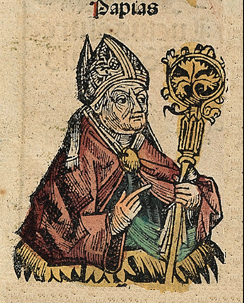
Papias (Greek: Παπίας) or Papias of Hierapolis was a Greek Apostolic Father, Bishop of Hierapolis (modern Pamukkale, Turkey), and author who lived c. AD 60 – c. 130. He is mainly known for gathering oral stories about Jesus and his disciples from John the Elder and the daughters of Philip. Papias compiled these in the Exposition of the Sayings of the Lord (Greek: Λογίων Κυριακῶν Ἐξήγησις), of which brief excerpts appear in the works of Irenaeus of Lyons (c. 180) and Eusebius of Caesarea (c. 320). A scholarly consensus dates his work to around 110 AD They are considered an important early source on Christian oral tradition and especially on the origins of the canonical Gospels.
Although Papias's precise dates are unknown, he is traditionally born around 60–70 AD. He lived in Hierapolis, Phrygia, in Asia Minor, and flourished in the early 2nd century. The name Papias was common in the region, suggesting that he may have been a native of the area.
Much of what is known about Papias comes from later testimony and from inferences drawn from his own writings. Irenaeus, a disciple of Polycarp of Smyrna, describes him as "an ancient man", "a hearer of John [of Ephesus]", and "a companion of Polycarp". Eusebius places Papias in the same period as Ignatius of Antioch and Polycarp, and portrays him as a learned collector of early Christian tradition but a poor interpreter, especially in his millennialism.
The claim that Papias died around 164 AD is based on a late and probably erroneous tradition, commonly explained as a confusion with the martyr Papylus/Papylas. Dale B. Martin places his death around 130.
A scholarly consensus dates Papias's five-volume work titled Expositions of the Oracles of the Lord to around 110 AD. Many scholars giving a range of 100–120, though a date of 125 or 130 remains commonly cited. William Davies and Dale Allison allows for the possibility that it was written in 100 AD or prior, and Anna M. Sitz favours an earlier date between 90–120.
Eusebius refers to Papias only in his third book, and seems to date him before the opening of his fourth book in 109. Papias himself knows several New Testament books, whose dates are themselves controversial, and was stated to be informed by John the Elder, Aristion, the daughters of Philip and others who had themselves heard the Twelve Apostles. He is also called a companion of the long-lived Polycarp (69–155), Agapius of Hierapolis dates one of his histories to the 12th year of Trajan's rule (110 AD). For all these reasons, Papias is thought to have written around the turn of the 2nd century.
There are indications that the work of Papias was still extant in the late Middle Ages, but the full text is now lost. Extracts, however, appear in a number of other writings, some of which cite a book number. MacDonald proposes the following tentative reconstruction of the five books, following a presumed Matthaean order.
In the preface of his book, he describes his way of gathering information:
Hub AI
Papias of Hierapolis AI simulator
(@Papias of Hierapolis_simulator)
Papias of Hierapolis
Papias (Greek: Παπίας) or Papias of Hierapolis was a Greek Apostolic Father, Bishop of Hierapolis (modern Pamukkale, Turkey), and author who lived c. AD 60 – c. 130. He is mainly known for gathering oral stories about Jesus and his disciples from John the Elder and the daughters of Philip. Papias compiled these in the Exposition of the Sayings of the Lord (Greek: Λογίων Κυριακῶν Ἐξήγησις), of which brief excerpts appear in the works of Irenaeus of Lyons (c. 180) and Eusebius of Caesarea (c. 320). A scholarly consensus dates his work to around 110 AD They are considered an important early source on Christian oral tradition and especially on the origins of the canonical Gospels.
Although Papias's precise dates are unknown, he is traditionally born around 60–70 AD. He lived in Hierapolis, Phrygia, in Asia Minor, and flourished in the early 2nd century. The name Papias was common in the region, suggesting that he may have been a native of the area.
Much of what is known about Papias comes from later testimony and from inferences drawn from his own writings. Irenaeus, a disciple of Polycarp of Smyrna, describes him as "an ancient man", "a hearer of John [of Ephesus]", and "a companion of Polycarp". Eusebius places Papias in the same period as Ignatius of Antioch and Polycarp, and portrays him as a learned collector of early Christian tradition but a poor interpreter, especially in his millennialism.
The claim that Papias died around 164 AD is based on a late and probably erroneous tradition, commonly explained as a confusion with the martyr Papylus/Papylas. Dale B. Martin places his death around 130.
A scholarly consensus dates Papias's five-volume work titled Expositions of the Oracles of the Lord to around 110 AD. Many scholars giving a range of 100–120, though a date of 125 or 130 remains commonly cited. William Davies and Dale Allison allows for the possibility that it was written in 100 AD or prior, and Anna M. Sitz favours an earlier date between 90–120.
Eusebius refers to Papias only in his third book, and seems to date him before the opening of his fourth book in 109. Papias himself knows several New Testament books, whose dates are themselves controversial, and was stated to be informed by John the Elder, Aristion, the daughters of Philip and others who had themselves heard the Twelve Apostles. He is also called a companion of the long-lived Polycarp (69–155), Agapius of Hierapolis dates one of his histories to the 12th year of Trajan's rule (110 AD). For all these reasons, Papias is thought to have written around the turn of the 2nd century.
There are indications that the work of Papias was still extant in the late Middle Ages, but the full text is now lost. Extracts, however, appear in a number of other writings, some of which cite a book number. MacDonald proposes the following tentative reconstruction of the five books, following a presumed Matthaean order.
In the preface of his book, he describes his way of gathering information:
Recent media