Hubbry Logo
Oral gospel traditionsOral gospel traditionsMain
Open search
Oral gospel traditions
Community hub
Oral gospel traditions
logo
8 pages, 0 posts
0 subscribers
Be the first to start a discussion here.
Contribute something
Oral gospel traditions
from Wikipedia
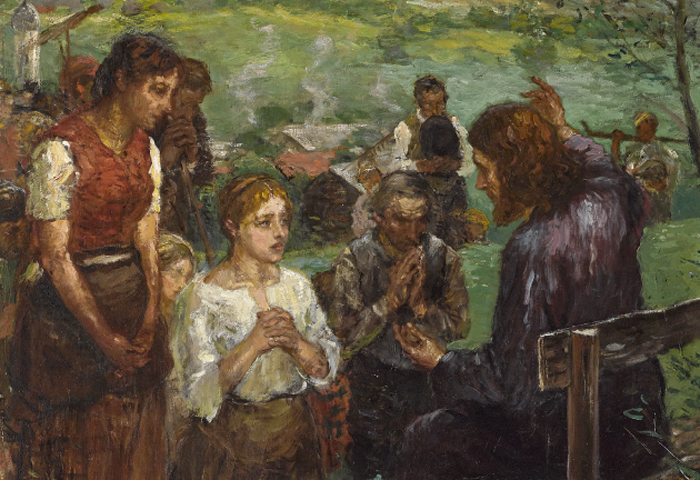
Sermon on the Mount by Fritz von Uhde (see Sermon on the Mount)

Oral gospel traditions is the hypothetical first stage in the formation of the written gospels as information was passed by word of mouth. These oral traditions included different types of stories about Jesus. For example, people told anecdotes about Jesus healing the sick and debating with his opponents. The traditions also included sayings attributed to Jesus, such as parables and teachings on various subjects which, along with other sayings, formed the oral gospel tradition.[1][2] The supposition of such traditions have been the focus of scholars such as Bart Ehrman, James Dunn, and Richard Bauckham, although each scholar varies widely in his conclusions, with Ehrman and Bauckham publicly debating on the subject.

History of research

[edit]

It is widely agreed amongst Biblical scholars that accounts of Jesus's teachings and life were initially conserved by oral transmission, which was the source of the written gospels.[3] For much of the 20th century, form criticism, formulated by Martin Dibelius and Rudolf Bultmann, dominated Biblical scholarship.[4]

Modern media criticism began with Birger Gerhardsson, a Swedish scholar who was the first to challenge form criticism. Gerhardsson, basing his research off of Rabbinic methods of transmission, argued that the early Christians transmitted the story and teachings of Jesus through strict memorization, claiming that a collegium formed by the twelve disciples could carefully control tradition. While rebuffed for decades, he is now viewed as a pioneer of research in oral Gospel traditions.[5]

Two decades later, Werner Kelber drew on various fields such as communications media and cultural studies and applied them to the Bible, opposing form-critical views of a steady evolution of the Jesus traditions. He argued instead that the transition from oral tradition to the written gospels, namely the Gospel of Mark, represented a disruption of transmission. Kelber compared oral tradition to a "biosphere" rather than a medium; oral tradition provides a context, not just a medium, of tradition.[6][7]

Kenneth Bailey published in 1991 an essay titled "Informal Controlled Oral Tradition and the Synoptic Gospels". In it, Bailey presented a model of oral tradition based on contemporary traditions in the Middle East. Bailey argued that communities, especially by leading members, informally controlled oral traditions to a degree, preventing core parts of stories from major change. Bailey showed how oral tradition could maintain stability over time while exhibiting variance in detail.[8]

Richard Horsley focused on literary criticism and how societal power interacts with media criticism.[9]

Critical methods: source and form criticism

[edit]
James Tissot, The Beatitudes Sermon, c. 1890, Brooklyn Museum

Biblical scholars use a variety of critical methodologies known as biblical criticism. They apply source criticism to identify the written sources beneath the canonical gospels. Scholars generally understood that these written sources must have had a prehistory as oral tellings, but the very nature of oral transmission seemed to rule out the possibility of recovering them. In the early 20th century, the German scholar Hermann Gunkel demonstrated a new critical method, form criticism, which he believed could discover traces of oral tradition in written texts. Gunkel specialized in Old Testament studies, but other scholars soon adopted and adapted his methods to the study of the New Testament.[10]

The essence of form criticism is the identification of the Sitz im Leben, "situation in life", which gave rise to a particular written passage. When form critics discuss oral traditions about Jesus, they theorize about the particular social situation in which different accounts of Jesus were told.[11][12] For New Testament scholars, this focus remains the Second Temple period. First-century Palestine was predominantly an oral society.[3]

A modern consensus exists that Jesus must be understood as a Jew in a Jewish environment.[13] According to scholar Bart D. Ehrman, Jesus was so very firmly rooted in his own time and place as a first-century Palestinian Jew – with his ancient Jewish comprehension of the world and God – that he does not translate easily into a modern idiom. Ehrman stresses that Jesus was raised in a Jewish household in the Jewish hamlet of Nazareth. He was brought up in a Jewish culture, accepted Jewish ways, and eventually became a Jewish teacher who, like other Jewish teachers of his time, debated the Law of Moses orally.[14] Early Christians sustained these teachings of Jesus orally. Rabbis or teachers in every generation were raised and trained to deliver this oral tradition accurately. It consisted of two parts: the Jesus tradition (i.e., logia or sayings of Jesus) and inspired opinion. The distinction is one of authority: where the earthly Jesus has spoken on a subject, that word is to be regarded as an instruction or command.[15]

According to Bruce Chilton and Craig A. Evans, "the Judaism of the period treated such traditions very carefully, and the New Testament writers in numerous passages applied to apostolic traditions the same technical terminology found elsewhere in Judaism for 'delivering', 'receiving', 'learning', 'holding', 'keeping', and 'guarding', the traditioned 'teaching'. In this way they both identified their traditions as 'holy word' and showed their concern for a careful and ordered transmission of it. The word and work of Jesus were an important albeit distinct part of these apostolic traditions."[16]

NT Wright also argued for a stable oral tradition, stating "Communities that live in an oral culture tend to be story-telling communities [...] Such stories [...] acquire a fairly fixed form, down to precise phraseology [...] they retain that form, and phraseology, as long as they are told [...] The storyteller in such a culture has no license to invent or adapt at will. The less important the story, the more the entire community, in a process that is informal but very effective, will keep a close watch on the precise form and wording with which the story is told.[17]

According to Anthony Le Donne, "Oral cultures have been capable of tremendous competence...The oral culture in which Jesus was reared trained their brightest children to remember entire libraries of story, law, poetry, song, etcetera...When a rabbi imparted something important to his disciples, the memory was expected to maintain a high degree of stability." Le Donne disputes the view that the oral traditions are comparable to a 'Telephone Game'. [18]

According to Dunn, the accuracy of the oral gospel tradition was insured by the community designating certain learned individuals to bear the main responsibility for retaining the gospel message of Jesus. The prominence of teachers in the earliest communities such as the Jerusalem Church is best explained by the communities' reliance on them as repositories of oral tradition.[19] According to Dunn, one of the most striking features to emerge from his study is the "amazing consistency" of the history of the tradition "which gave birth to the NT".[20][21] Dunn argues that Kelber exaggerates the divide between orality and written transmission, critiquing the latter's view that Mark tried to override prior oral tradition. [22] Rafael Rodriguez also sees Kelber's media contrast as much too distinct, arguing that tradition was sustained in memory alongside text. [23] Terence Mournet argued that oral traditions provide reliable historical data as well. [24]

John Kloppenborg wrote that the variants between the Synoptic Gospels are completely explainable by literary interdependence.[25] Travis Derico, following Dunn's ideas, argues that memorization and oral transmission can potentially account for the Synoptics instead and deserves increased study.[26]

Jens Schroter argued that a mass of material from various sources, such as Christian prophets issuing sayings in the name of Jesus, the Hebrew Bible, miscellaneous sayings, alongside the actual words of Jesus, were all attributed by the Gospels to the singular historical Jesus.[27] However, James DG Dunn and Tucker Ferda point out that the early Christian tradition sought to distinguish between their own sayings and those of the historical Jesus and that there is little evidence that the claims of new "prophets" often became mistaken as those of Jesus himself; Ferda notes that the phenomena of prophetic sayings merging with those of Jesus is more relevant to the dialogue gospels of the second and third centuries.[28][29]

A review of Richard Bauckham's book Jesus and the Eyewitnesses: The Gospels as Eyewitness Testimony states "The common wisdom in the academy is that stories and sayings of Jesus circulated for decades, undergoing countless retellings and embellishments before being finally set down in writing."[30] Alan Kirk praised Bauckham for realizing the deep link between true memory and tradition, potentially contributing widely to Jesus research and the demise of form criticism, and his pioneering and underappreciated application of cognition and memory to the Jesus tradition. However, Kirk argues that Bauckham's failure to bridge the divide between eyewitness testimony and the Jesus tradition is detrimental to the overall case the two editions of Jesus and the Eyewitnesses provides against the prevailing skepticism form critics brought in. [31]

According to Bart Ehrman, the oral traditions are comparable to a "Telephone game. He says "Invariably, the story has changed so much in the process of retelling that everyone gets a good laugh...Imagine this same activity...over the expanse of the Roman empire...with thousands of participants...some of whom have to translate the stories into different languages."[32] These traditions precede the surviving gospels by decades, going back to the time of Jesus and the time of Paul's persecution of the early Christian Jews, prior to his conversion.[33]

Alan Kirk finds Ehrman's writing in Jesus Before the Gospels to cite memory research selectively, neglecting the fact that John Bartlett's experiment discovered that stories quickly took on a stable, 'schematic' form rather quickly. Ehrman also overemphasizes individual transmission instead of community, makes a 'lethal oversight' where Jan Vansina, whom he quoted as evidence for corruption in the Jesus tradition, changed his mind, arguing that information was conveyed through a community that placed controls, rather than through chains of transmission easily subject to change. Kirk does sympathize with Ehrman that appealing to memory cannot automatically guarantee historicity.[34] Both Ehrman and Bauckham overemphasize individuality, whether transmission chains or eyewitness testimony, in their studies.

According to Maurice Casey, Aramaic sources have been detected in Mark's Gospel, which could indicate use of early or even eyewitness testimony when it was being written.[35]

Oral traditions and the formation of the gospels

[edit]

Burkett writes that modern scholars posit the formation of the gospels to an oral stage including stories and teachings of Jesus, a stage where the oral traditions were written down in collections, written proto-gospels, and the canonical gospels composed with such sources.[1] Helen Bond observes a scholarly turn against source-criticism of the gospels.[36] According to Chris Keith, there is no incontrovertible evidence the gospel traditions circulated as written narratives, testimonia, or notes prior to Mark.[37]

Mark, Matthew and Luke are known as the Synoptic Gospels because they are so highly interdependent. Since the twentieth century, scholars have generally agreed that Mark was the first of the gospels to be written (see Marcan priority). The author does not seem to have used extensive written sources, but rather to have woven together small collections and individual traditions into a coherent presentation.[38] The most popular scholarly theory is the Two-source hypothesis, where the authors of Matthew and Luke used as sources the gospel of Mark and a collection of sayings called the Q source, though alternative theories that posit direct use of Matthew by Luke or vice versa without Q are increasing in popularity within scholarship.[39][40] These two together account for the bulk of each of Matthew and Luke, with the remainder made up of smaller amounts of source material unique to each, called the M source for Matthew and the L source for Luke, which may have been a mix of written and oral material. Recent scholarship has tended to turn against positing hypothetical sources or editions for John and argue that John was aware of the Synoptic gospels.[41]

Oral transmission may also be seen as a different approach to understanding the Synoptic Gospels in New Testament scholarship. Current theories attempt to link the three synoptic gospels together through a common textual tradition. However, many problems arise when linking these three texts together (see the Synoptic problem). This has led many scholars to hypothesize the existence of a fourth document from which Matthew and Luke drew upon independently of each other (for example, the Q source).[42] The Oral Transmission hypothesis based on the oral tradition steps away from this model, proposing instead that this common, shared tradition was transmitted orally rather than through a lost document.[43]

Elite agency

[edit]

While there is a broad consensus on this view of the process of development from oral tradition to written gospels, an alternative thesis proposed by historian Robyn Faith Walsh in her book The Origins of Early Christian Literature, builds on scholarship from historian of religion Jonathan Z. Smith. She proposes viewing gospel authors as individual elite cultural producers in the classical vein, writing for an elite audience instead of early Christian communities, with agency in the composition of their text rather than primarily transmitters of tradition.[44][45]

Notes

[edit]

Bibliography

[edit]

Further reading

[edit]
Revisions and contributorsEdit on WikipediaRead on Wikipedia
from Grokipedia
Oral gospel traditions refer to the verbal narratives, sayings, and teachings about Jesus of Nazareth that were transmitted orally among his followers and early Christian communities, forming the foundational source material for the later written canonical Gospels. These traditions emerged in the oral culture of first-century Palestine and the broader Greco-Roman world, where literacy rates were low and public storytelling served as the primary means of preserving communal memory and religious instruction. Following Jesus' crucifixion around 30 CE, his disciples and converts recounted his life, miracles, parables, and resurrection appearances through repeated performances in communal settings, such as synagogues and house gatherings, rather than fixed written texts. This process allowed for a dynamic interplay of stability in core elements—like key sayings and events—and flexibility in phrasing and emphasis, reflecting the adaptive nature of oral transmission in living communities. Scholarly consensus holds that the (Matthew, Mark, and Luke) and the Gospel of John, composed between approximately 65 and 110 CE, drew substantially from these oral sources, which circulated for decades before being committed to writing amid growing Christian communities and potential . Key studies, such as Werner Kelber's The Oral and the Written Gospel (1983, revised 1997), highlight how the shift from orality to marked a transformative hermeneutic, with written Gospels attempting to stabilize and supersede the fluid oral forms while retaining their performative essence. James D. G. Dunn's The Oral Gospel Tradition (2013) further argues that these traditions reliably conveyed ' character and impact, challenging earlier assumptions of rampant distortion and emphasizing their role in explaining variations among the Gospels, such as differences in the accounts of the or healing miracles. Debates persist on the reliability of oral transmission, with some scholars like in Jesus and the Eyewitnesses (2006, revised 2017) positing that anchored the traditions through controlled communal recall, while others caution against overestimating verbatim accuracy in an era without recording technology. Nonetheless, the oral phase underscores the Gospels' roots in lived faith practices, influencing ongoing scholarship on memory, performance, and the .

Background and Context

Definition and scope

Oral gospel traditions constitute the pre-literary phase of early Christian transmission, encompassing the verbal sharing of ' teachings, sayings, parables, miracle stories, and passion narratives among his followers in the decades following his . These traditions formed the foundational material for the later written Gospels, originating in the oral practices of first-century Jewish and Christian communities where was limited and served as the primary means of preserving and disseminating religious . The scope of these traditions includes a variety of narrative and didactic forms suited to oral delivery, such as apothegms (short incidents culminating in a teaching by ), pronouncement stories (episodes building to a climactic saying), and controversy dialogues (verbal exchanges between and opponents highlighting theological points). Other elements comprised prophetic sayings, legal pronouncements, and extended parables like the Sower or the Lost Sheep, often circulated independently before compilation. This diversity reflects the performative and adaptive quality of oral cultures, where narratives were recited in communal settings like or , allowing for contextual variations in wording and emphasis to engage audiences effectively. Hypothetically, these traditions began shortly after ' death around 30 CE, as eyewitnesses and early disciples recounted events to sustain communal faith, and persisted for approximately 40 to 70 years until the were composed between 70 and 100 CE. Even after writing emerged, oral forms continued in parallel, underscoring their enduring role in shaping . serves as a primary analytical tool for reconstructing these oral units from the written texts.

Historical setting in early Christianity

In the first-century Mediterranean world, Jewish and Greco-Roman societies were characterized by a predominance of oral communication, as rates remained exceptionally low, particularly in where they hovered around 3-5% among the Jewish population. This scarcity of reading and writing skills necessitated reliance on memory-based transmission for preserving and disseminating cultural, religious, and legal knowledge, with spoken discourse serving as the primary medium in everyday interactions, , and communal gatherings. Scholars emphasize that such conditions fostered robust oral performance traditions, where accuracy depended on mnemonic techniques and social reinforcement rather than textual fixation. Within , this oral-dominant framework shaped the dissemination of gospel traditions amid the movement's expansion from outward. House churches, the typical venues for in the decades following ' death (circa 30 CE), facilitated intimate settings for communal retelling of his teachings and actions, often integrated into Eucharistic meals and instructional sessions that reinforced . figures like Paul exemplified this practice through their preaching in the 50s CE, delivering oral proclamations of in synagogues, marketplaces, and homes across the , where letters served as proxies for his physical voice to be performed aloud by readers. These gatherings prioritized auditory engagement, with participants reciting and adapting narratives to address local contexts while maintaining core elements through repetition and . Oral gospel traditions drew significantly from Jewish memorization practices, such as those surrounding the emerging , where rabbinic teachings were committed to memory and transmitted verbatim across generations to embody piety in a post-Temple era. Hellenistic influences further enriched this process, introducing performative elements akin to epic recitations and rhetorical delivery, which early Christians adapted to convey ' parables and miracles in dynamic, audience-responsive forms. These intertwined cultural streams ensured the vitality of oral dissemination before the shift toward written gospels later in the century.

Evolution of Scholarly Research

Pioneering studies and form criticism

The study of oral gospel traditions emerged prominently in early 20th-century German scholarship, particularly following the end of in 1919, as biblical critics sought to reconstruct the pre-literary stages of the texts. This approach built on the foundational work of , who in 1901 applied to the in his commentary on Genesis, identifying short, independent oral units such as sagas and myths that had been shaped and transmitted within ancient Israelite communities before compilation into written sources. Gunkel's method emphasized recovering the oral origins of traditions, viewing them as products of communal life rather than authorial invention, and his ideas directly influenced scholars by providing a model for analyzing materials as derived from popular oral transmission. A pivotal advancement came with Martin Dibelius's 1919 publication From Tradition to Gospel: The History of the Development of the Gospels, which adapted Gunkel's principles to the and classified oral traditions into distinct forms such as paradigms (short anecdotal units highlighting Jesus's teachings) and novellen (elaborated narrative tales). Dibelius argued that these forms arose from the evangelists' roles as collectors rather than creators, preserving pre-existing oral materials that had been stylized through repeated communal use in preaching and teaching. His work underscored the dynamic process by which simple oral kernels evolved into more structured accounts, reflecting the needs of early Christian audiences for edification and . Building on Dibelius, Rudolf Bultmann's 1921 book History of the Synoptic Tradition further refined by systematically categorizing gospel units—such as apophthegms (sayings framed by dialogue) and miracle stories—and linking each to its Sitz im Leben, or specific social setting within Palestinian Jewish-Christian communities. Bultmann posited that these traditions originated in oral forms suited to the life of the early church, where they were adapted and expanded to address contemporary communal concerns like ethical instruction and , rather than historical reporting. He distinguished between Palestinian and later Hellenistic influences on the traditions, emphasizing their growth from brief, authentic oral elements into the written Gospels through layers of community-driven modification. At its core, form criticism viewed oral gospel traditions as composed of "small units" that were initially transmitted orally in response to the practical demands of early Christian life, gradually coalescing into larger written compilations as the church stabilized. This perspective shifted scholarly focus from the final Gospel texts to their pre-literary history, highlighting how control shaped the material for liturgical, catechetical, and purposes. While later developments critiqued aspects of this method, its pioneering emphasis on oral dynamics remains foundational to understanding gospel formation.

Post-form criticism developments

Following the establishment of in the early 20th century, which posited a period of fluid oral transmission shaping the gospel materials, subsequent scholarship from the 1960s onward began to challenge its assumptions of uncontrolled variability by proposing models of more structured oral processes. A pivotal contribution came from Birger Gerhardsson in his 1961 monograph Memory and Manuscript: Oral Tradition and Written Transmission in and , where he argued that early Christian communities employed a controlled system of akin to Pharisaic rabbinic practices. Gerhardsson drew direct parallels between the meticulous preservation of sacred texts in Jewish oral traditions—such as the use of fixed recitations, repetition, and communal oversight to ensure fidelity—and the transmission of ' teachings and narratives in the nascent church. He contended that this rabbinic-style approach minimized distortion, positing that apostles like Peter and Paul functioned as authoritative "rabbis" who trained disciples in verbatim recall, thereby bridging oral and written phases with relative stability. Werner H. Kelber advanced a contrasting perspective in The Oral and the Written Gospel: The Hermeneutics of Speaking and Writing in the Synoptic Tradition, Mark, Paul, and Q (1983, revised 1997), introducing a media disruption theory that highlighted the transformative impact of writing on oral traditions. Kelber asserted that the shift from performative, fluid orality—characterized by variability, communal adaptation, and voice-based authority—to the fixity of written texts "de-oralized" the gospel materials, imposing permanence that altered their interpretive dynamics and centralized control among scribes rather than performers. Influenced by media theorists like Walter Ong, he emphasized how this transition disrupted the participatory nature of oral storytelling, leading to new hermeneutical frameworks where written gospels gained authoritative status over evolving spoken versions. Kenneth E. Bailey offered a middle-ground model in his 1991 article "Informal Controlled Oral Tradition and the Synoptic Gospels," based on ethnographic observations of Middle Eastern oral cultures where he served as a and . Bailey described an "informal controlled" system in which traditions were safeguarded not through rigid but via community-designated "trusted tellers"—respected figures who balanced interpretive flexibility with core through social accountability and contextual relevance. Drawing from examples like storytelling and Levantine folk narratives, he illustrated how such mechanisms allowed for minor adaptations (e.g., cultural idioms) while preserving essential content, challenging both the unchecked fluidity of and the strict verbatim models by underscoring communal stability in pre-literate settings. Subsequent scholarship in the integrated insights from , , and , further refining understandings of oral transmission. Richard Bauckham's Jesus and the Eyewitnesses (, revised ) argued that named eyewitnesses provided stability to the traditions through communal validation, countering notions of anonymous fluidity. James D. G. Dunn's The Oral Tradition (2013) emphasized the traditions' capacity to convey ' impact reliably, accounting for variations as natural outcomes of performative orality. More recently, Alan Kirk's and the Tradition (2019) explored how social shaped narratives, balancing distortion risks with collective preservation mechanisms. These developments, as of 2025, underscore a consensus on controlled yet adaptive oral processes.

Analytical Methods

Form criticism techniques

Form criticism techniques provide a systematic approach to dissecting the Gospel texts in order to reconstruct the oral traditions that informed their composition. Pioneered by scholars such as Martin Dibelius and in the early twentieth century, these methods emphasize the pre-literary phase of transmission, where stories and sayings circulated independently within early Christian communities before being compiled by the evangelists. A core technique involves the identification of literary forms, which are concise, self-contained units presumed to originate in oral contexts. These include paradigms (short narratives culminating in a pronouncement, such as Mark 3:31-35), miracle tales (e.g., Mark 5:1-20), and sayings or logia (e.g., Matthew 8:20), each tied to a specific Sitz im Leben—the social or functional setting in the community. Miracle stories, for instance, often reflect a Sitz im Leben in or apologetic preaching, while sayings typically served or discipleship purposes, helping to categorize how traditions functioned before literary fixation. To establish the oral origins of these units, form critics apply criteria for orality, examining textual features that indicate transmission through spoken performance rather than written composition. Key indicators include repetition of key phrases for emphasis and memorability, in structural elements to aid recall, and variation in wording across parallel accounts, which suggest flexible retelling in live settings. Multiple attestation—where a tradition appears in independent sources like Mark, , or special material in Matthew and Luke—further supports orality, as does the standalone nature of pericopes with minimal chronological links, pointing to their circulation as detached pieces in the oral period from approximately A.D. 30 to 70. The analytical process unfolds in stages: first, isolating pericopes by delineating natural breaks in the narrative, such as shifts in topic or setting (e.g., Mark 2:1-12 as a healing controversy unit). Next, assessing the Sitz im Leben involves inferring the community's use of the form, like catechetical instruction for parables or evangelistic proclamation for passion narratives. Finally, tracing redactional layers distinguishes the original oral core from evangelists' additions, such as interpretive expansions or thematic groupings, to reveal how traditions evolved from communal storytelling to authored texts. This methodical peeling back of layers enables scholars to approximate the dynamic, performative quality of early gospel oral traditions. Source criticism, a key method in New Testament scholarship, aims to reconstruct the literary and oral sources underlying the Synoptic Gospels by analyzing patterns of verbal agreement, sequence, and variation among them. Central to this approach is the two-source theory, which proposes that the Gospel of Mark served as the primary written source for both Matthew and Luke, supplemented by a hypothetical known as —a collection of ' sayings and teachings dated to approximately 50-60 CE. Scholars infer Q's existence from the "double tradition" material shared uniquely between Matthew and Luke, which exhibits a high degree of similarity in wording and order but lacks narrative elements found in Mark, suggesting Q originated as a of earlier oral traditions circulating in early Christian communities. Building on form criticism's identification of discrete tradition units, emphasizes the transition from oral to written forms, positing that documents like represent stabilized oral materials adapted for communal use. This method highlights how oral traditions, characterized by flexible yet controlled transmission, provided the raw material for 's composition, with variations in Matthew and Luke reflecting independent redactions of a rather than direct copying. for 's oral includes its focus on aphoristic sayings amenable to and repetition in preaching contexts, distinguishing it from Mark's more narrative style. Post-2000 developments have integrated social memory theory into , particularly through the work of , who applies social, cultural, and cognitive dimensions of memory to trace the tradition's evolution. Kirk argues that oral gospel traditions functioned as collectively remembered narratives, dynamically shaped by communal experiences, including the trauma of , which anchored memories of violence and persecution in sources like . This approach views early Christian communities as active agents in preserving and contouring traditions, countering earlier models that emphasized uncontrolled oral variation. Recent advances, extending into the 2020s, incorporate to examine mnemonic patterns observed in oral epics—such as formulaic phrasing and thematic stability—applied to the relative consistency of gospel sayings despite oral transmission. Kirk's 2023 analysis, for instance, leverages cognitive memory research to explain how trauma and reinforced the fidelity of traditions from oral origins to written gospels, providing a framework for assessing source reliability without assuming verbatim preservation. These interdisciplinary methods address gaps in traditional by modeling transmission as a socially embedded cognitive process, with implications for reconstructing pre-gospel oral layers.

Role in Gospel Formation

Integration into Synoptic Gospels

The Gospel of Mark, dated to around 70 CE and considered the earliest of the under the widely accepted theory of , incorporated oral traditions through the compilation of pre-existing narrative units such as the passion narrative and cycles of miracle stories. Form critics, including , traditionally hypothesized a pre-Markan passion narrative as an early connected oral account spanning ' arrest, trial, crucifixion, and burial, which may have provided a framework emphasizing themes of suffering and kingship; however, recent scholarship, such as Brandon Massey's analysis (2023), has challenged the viability of this hypothesis, arguing it is no longer supported by advances in orality and . Similarly, miracle cycles—collections of episodic healing and tales circulated orally in early Christian communities—were woven into Mark's structure, providing vivid demonstrations of Jesus' authority while serving communal memory and proclamation needs. Mark's evangelist introduced distinctive redactional elements, such as the "" motif, where Jesus commands silence about his identity following miracles and revelations, likely as a theological to address post-resurrection understandings of messiahship rather than a direct oral . Matthew and Luke, composed later in the first century, built upon Mark while integrating additional oral-derived materials, including the hypothetical —a collection of ' sayings—and their respective special traditions (M for Matthew, L for Luke). The material, comprising predominantly sayings and parables shared between Matthew and Luke but absent from Mark, is viewed by scholars as stemming from oral traditions of ' teachings that were eventually committed to writing, reflecting a sayings-focused gospel genre. Matthew, for instance, expanded these into structured discourses, as seen in the (Matthew 5–7), which arranges oral teaching units on ethics, prayer, and discipleship into a cohesive manifesto, adapting them to emphasize fulfillment of Jewish law for a community audience. Luke similarly incorporated sayings and L traditions, such as birth narratives and parables, to create an "orderly account" (Luke 1:3), redacting oral elements for a readership while preserving their didactic core. Evidence of orality's influence persists in the Synoptics through patterns of verbal agreements and variations across parallel passages, suggesting transmission via memorized units rather than verbatim copying. High degrees of agreement in triple tradition material (shared by all three Gospels) indicate stable oral formulas, while divergences—such as differing wordings in accounts—reflect flexible recall and contextual adaptation typical of oral performance. The evangelists' further attests this transition: Luke, for example, explicitly aimed to organize oral "events...in their order" (Luke 1:3), smoothing variations into a theological that highlights salvation , thereby transforming fluid traditions into fixed literary forms. Under the , these dynamics underscore how oral materials like bridged pre-literary phases to written composition.

Impact on the Gospel of John

The , composed around 90–110 CE, draws upon independent oral streams distinct from the Synoptic traditions, reflecting a later stage in early Christian oral transmission where theological reflection had deepened. Unlike the Synoptics' reliance on shared sources like , John's narrative incorporates extended discourses that appear to stem from developed oral interpretations within a specific context, allowing for interpretive expansion over time. A prime example is the in John 13–17, which scholars interpret as an elaboration of oral prophetic performance traditions rather than a direct transcription of historical sayings. This lengthy address, encompassing themes of abiding in and the coming of the , likely originated in creative oral retellings by early Christian prophets, regulated in texts like the , and adapted to address the Johannine community's experiences of separation and . Such discourses emphasize eschatological comfort and mutual indwelling, shaped by oral dynamics that prioritized performative delivery over verbatim recall. The Signs Gospel hypothesis posits a pre-Johannine written narrative source based on earlier oral traditions, emphasizing ' acts as symbolic revelations rather than mere historical events—a theory proposed by and refined by Robert T. Fortna, though it lacks scholarly consensus in contemporary research. This source likely included stories like the wedding at Cana (John 2:1–11), where the transformation of water into wine serves as a sign of messianic abundance and new creation theology, with the underlying traditions transmitted orally with flexibility to highlight theological meaning over chronological detail. Fortna's reconstruction identifies these signs as a coherent strand integrated into John to underscore belief in as the divine revealer. Within the , oral practices shaped reflective retellings of ' teachings, particularly through liturgical uses of signs and "I am" sayings. These absolute and predicate "I am" declarations (e.g., "I am the bread of life" in John 6:35), echoing Exodus 3:14, emerged from communal worship and prophetic speech, where charismatic figures invoked ' authority in oral logoi to foster spiritual intimacy and . Scholars like Werner Kelber argue that such elements reflect a transition from oral to written stabilization, with the community's expulsion from synagogues (John 9:22) intensifying oral-theological adaptations for endurance and revelation. For contrast, John's account of (John 6:16–21) varies from Synoptic parallels by focusing on disciples' acclamation of , highlighting oral theological emphasis over resolution.

Key Theories and Debates

Community control of traditions

In theories of oral gospel traditions, community control emphasizes the role of grassroots groups in preserving and transmitting narratives through collective oversight, ensuring fidelity to core elements while allowing contextual adaptations. Kenneth Bailey's model of "informal controlled" transmission, developed from his observations in Middle Eastern oral cultures, posits that communities actively monitored performances of stories, correcting deviations from established communal memory to maintain narrative integrity. This approach contrasts with purely uncontrolled oral processes by highlighting how group settings, such as gatherings for teaching or worship, functioned as mechanisms for validation and refinement. James D. G. Dunn further elaborates on this communal stability in his work Jesus Remembered, arguing that oral traditions about endured due to multiple attestations across community retellings and mnemonic devices like rhythmic structures or key phrases that anchored memories. Dunn describes these traditions as "living" within communities, where collective recitation resisted major alterations, fostering a shared reservoir of remembrance rather than individual improvisation. This communal dynamism aligns with form criticism's notion of Sitz im Leben, the social settings in early Christian groups that shaped tradition formation. Supporting evidence for such controlled flexibility appears in variations among gospel parallels, such as the , where differing formulations across Matthew and Luke reflect adaptive phrasing within stable thematic cores, indicative of communal rather than random evolution. Ethnographic parallels from contemporary oral societies, including Bailey's documentation of Levantine storytelling circles, demonstrate how audiences intervene to realign tellers with accepted versions, mirroring the presumed dynamics in early Christian communities. These patterns underscore the traditions' resilience through decentralized group authority.

Elite agency and transmission dynamics

In the transition from oral to written gospel traditions, literate elites, particularly the evangelists, played a pivotal role in selecting and stabilizing narratives, disrupting the inherent fluidity of oral transmission. Werner Kelber, in his 1983 work The Oral and the Written Gospel, posits that these evangelists acted as disruptive agents by imposing written structures that favored linear, hierarchical compositions over the associative and performative nature of oral storytelling. This elite intervention countered the charismatic authority of oral performers, such as disciples who embodied a "glory theology" through living speech, by privileging fixed texts that marginalized variant retellings. Kelber illustrates this through the Gospel of Mark, where the evangelist reconfigures oral passion traditions into a literary narrative (e.g., Mark 14–16), excluding elements like the disciples' role in the resurrection (Mark 16:8) to discredit their ongoing oral authority. Claims of apostolic authorship further reinforced this hierarchy, legitimizing the written gospel as superior to fluid oral variants and shifting interpretive power from communal performers to individual scribal editors. Such dynamics marked a broader hermeneutic rupture, where writing transformed dynamic speech into static artifacts, altering how Jesus' teachings were preserved and disseminated. Complementing Kelber's emphasis on disruption, Richard Bauckham's 2006 eyewitness model highlights elites as guarantors of reliability during the oral-to-written bridge. In Jesus and the Eyewitnesses, Bauckham argues that named tradents, such as Peter in Mark, served as authoritative eyewitnesses whose testimony stabilized traditions before their inscription. Mark's narrative employs a Petrine inclusio (:16; 16:7) and frequent naming of Peter to signal his role as , drawing on early attestations like Papias (via , Hist. Eccl. 3.39.3–4). Other named figures, including (:18) and Simon of Cyrene's sons, functioned similarly as elite anchors, ensuring the gospels reflected verifiable testimony within living memory rather than anonymous communal flux. This elite agency facilitated a power shift from oral performers to scribal editors, with profound implications for canon formation. By the late 2nd century, church leaders like Irenaeus prioritized four canonical gospels, excluding variant oral-derived stories and non-conforming texts to enforce textual uniformity. Scribal control stabilized traditions but sidelined diverse oral narratives, contrasting with models of community-driven stability.

References

Add your contribution
Related Hubs
Contribute something
User Avatar
No comments yet.